
How Lesson Scheduling Software Helps Teachers Organize Their Daily Work
How Lesson Scheduling Software Helps Teachers Organize Their Daily Work

Article by
Milo
ESL Content Coordinator & Educator
ESL Content Coordinator & Educator
All Posts
A teacher's day doesn't end at the last bell, and it rarely starts with teaching. Before the first lesson there's the planner to check, the two students who need make-up sessions, the parent who emailed about a time change, the materials to pull for third period, and the sticky note reminding you that the Wednesday small group moved to Thursday. Then the actual teaching begins. By the evening, the same teacher is updating a paper planner, a phone calendar, and a spreadsheet that never quite agree with each other, and wondering where the day went.
Lesson scheduling software is built for exactly this. It takes the coordination part of teaching, the part that fills the gaps between lessons and spills into evenings, and puts it in one place that keeps itself up to date. Here's how it helps teachers organize their daily work.
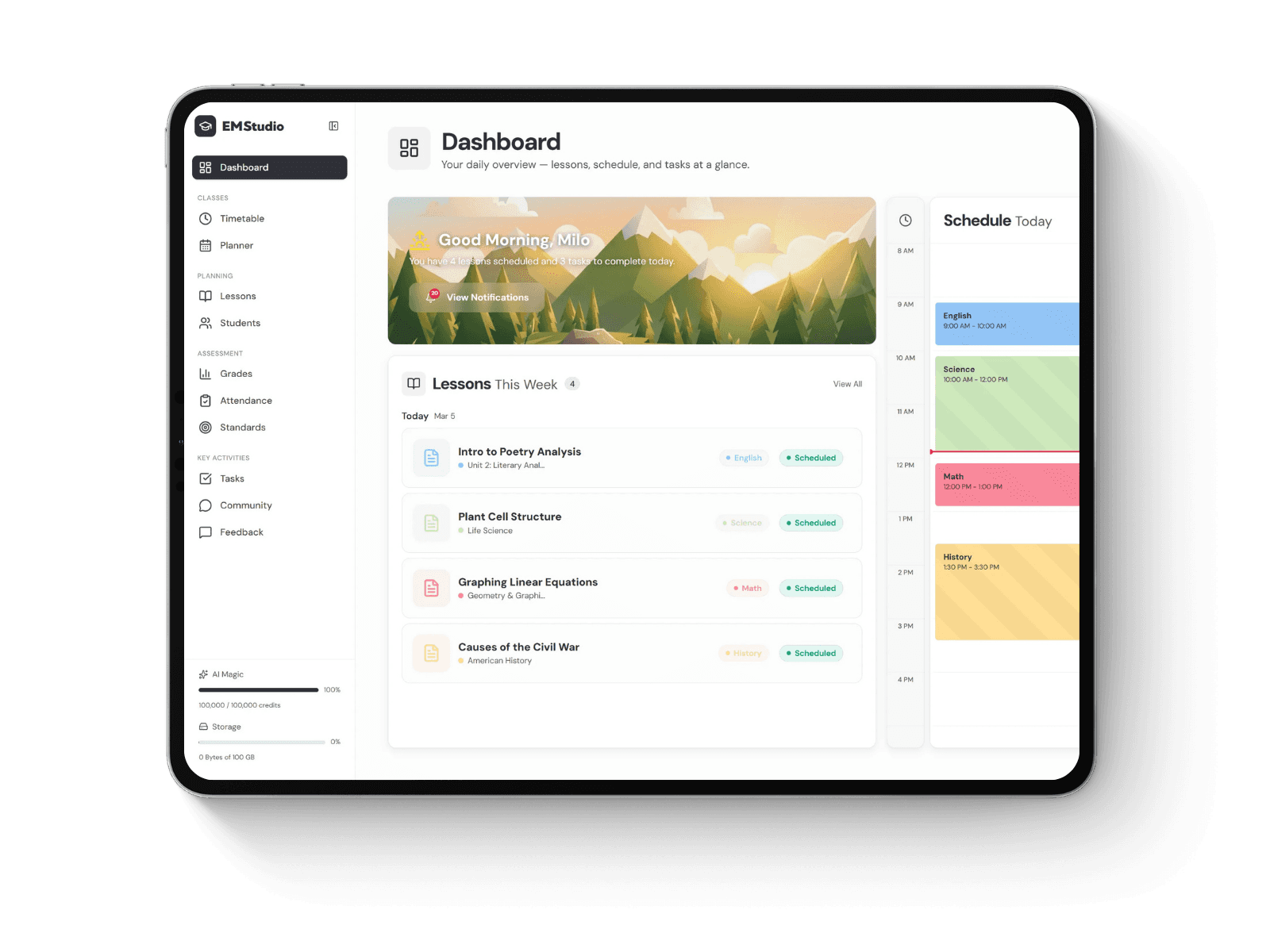
Still grading everything by hand?
EMStudio is a free teaching management app — manage your classes, students, lessons, and more!
Learn More
Still grading everything by hand?
EMStudio is a free teaching management app — manage your classes, students, lessons, and more!
Learn More
Table of Contents
Teachers Are Working Longer Than Everyone Else
The hours are real. According to the RAND State of the American Teacher survey, as reported by EdSource, teachers work an average of 53 hours a week compared with 44 hours for comparable working adults, and administrative work outside of teaching ranks among their top sources of stress.
Nine extra hours a week is a lot, and a meaningful share of it is scheduling, rescheduling, reminding, and record-keeping. That's the share software that can take back.
One Calendar Instead of Three
The first thing scheduling software fixes is the problem of multiple sources of truth. Lessons, small groups, tutoring sessions, planning periods, meetings, and make-ups all live in one calendar that updates everywhere at once. A change made on a phone during lunch is already on the laptop by the next period. The paper planner becomes optional.
Recurring Lessons Set Once
Most of a teacher's week repeats. Software lets you set a lesson or session to recur, weekly, biweekly, or on a custom pattern, and handles the exceptions: holidays, assemblies, and the one week the group meets on a different day. Setting the pattern once replaces writing the same entries fifty times a year.
Automatic Reminders and Confirmations
Reminding students and parents is one of the quietest time sinks in teaching. With scheduling software, reminders go out automatically before each session, confirmations arrive when something is booked or changed, and no-shows drop because people were reminded. The teacher stops being the reminder service.
Make-Up Sessions Without the Chaos
Missed lessons are inevitable; the chaos of rescheduling them isn't. Software shows open slots, lets students or families choose one within the limits the teacher sets, and records the change. The teacher approves rather than coordinates.
Attendance and Notes in the Same Place
When the lesson happens, attendance is marked in the same system that scheduled it, and lesson notes, assignments, or progress comments attach to the session. That creates a running record per student without a separate notebook, and it means a parent question about "what happened in last week's session" has an answer in two clicks.
Everything is Connected
The real gain comes when scheduling connects to the rest of the work. Using lesson scheduling software that ties sessions to attendance, assignments, and progress reports means the calendar becomes the backbone of the teacher's records rather than a separate chore.
TutorFirst, for example, combines student scheduling and attendance with an assignment tracker, progress reporting, an online whiteboard for remote lessons, and tools for filling open slots, so a teacher or tutoring team manages lessons and learning in one place. Whatever tool you choose, pick one that works well on a phone, because that's where most teachers manage their day.
Protect Your Planning Periods
A visible, accurate schedule protects the blocks that matter. When planning periods, grading time, and breaks on the same calendar as lessons, they're less likely to be eaten by a hastily arranged make-up or a meeting nobody checked the calendar before booking. Teachers can block time for the work that keeps lessons good.
Less to Carry Home
The evening update, reconciling the planner with the phone with the spreadsheet, disappears when there's one system that updated itself during the day. Reports on sessions taught, hours worked, and student attendance are generated rather than compiled. That doesn't shrink a 53-hour week to 44 on its own, but it removes some of the hours that feel least like teaching.
For Teachers Who Also Tutor
Many teachers tutor privately or run small-group programs alongside their school work. Scheduling software is especially useful there, where the teacher is also the administrator: booking, reminders, attendance, invoicing, and payment records all run from the same calendar, and the paperwork of a side business stops competing with the day job.
Choosing Software That Fits
The right scheduling software can simplify lesson planning, reduce administrative work, and help teachers manage their time more effectively. Look for these essential features when comparing your options.
Simple enough to set up in an afternoon
Works on a phone as well as a laptop
Recurring sessions and exceptions handled cleanly
Automatic reminders by text and email
Attendance and notes attached to each session
Reports you can share with parents or administrators
Reasonable pricing for an individual teacher or a small program
By choosing software that meets your practical needs and budget, you can spend less time managing schedules and more time focusing on teaching and student progress.
Conclusion
Lesson scheduling software helps teachers organize their daily work by giving them a single calendar that holds every lesson, group, meeting, and make-up; repeating the regular ones automatically; sending the reminders; handling rescheduling; and keeping attendance and notes attached to each session so records build themselves.
With teachers averaging 53 hours a week and administrative work high on their list of stresses, taking the coordination off their hands is one of the few changes that returns time directly to teaching and to life outside it. The day still starts before the first bell, but it starts with a schedule that already knows what's coming.
Teachers Are Working Longer Than Everyone Else
The hours are real. According to the RAND State of the American Teacher survey, as reported by EdSource, teachers work an average of 53 hours a week compared with 44 hours for comparable working adults, and administrative work outside of teaching ranks among their top sources of stress.
Nine extra hours a week is a lot, and a meaningful share of it is scheduling, rescheduling, reminding, and record-keeping. That's the share software that can take back.
One Calendar Instead of Three
The first thing scheduling software fixes is the problem of multiple sources of truth. Lessons, small groups, tutoring sessions, planning periods, meetings, and make-ups all live in one calendar that updates everywhere at once. A change made on a phone during lunch is already on the laptop by the next period. The paper planner becomes optional.
Recurring Lessons Set Once
Most of a teacher's week repeats. Software lets you set a lesson or session to recur, weekly, biweekly, or on a custom pattern, and handles the exceptions: holidays, assemblies, and the one week the group meets on a different day. Setting the pattern once replaces writing the same entries fifty times a year.
Automatic Reminders and Confirmations
Reminding students and parents is one of the quietest time sinks in teaching. With scheduling software, reminders go out automatically before each session, confirmations arrive when something is booked or changed, and no-shows drop because people were reminded. The teacher stops being the reminder service.
Make-Up Sessions Without the Chaos
Missed lessons are inevitable; the chaos of rescheduling them isn't. Software shows open slots, lets students or families choose one within the limits the teacher sets, and records the change. The teacher approves rather than coordinates.
Attendance and Notes in the Same Place
When the lesson happens, attendance is marked in the same system that scheduled it, and lesson notes, assignments, or progress comments attach to the session. That creates a running record per student without a separate notebook, and it means a parent question about "what happened in last week's session" has an answer in two clicks.
Everything is Connected
The real gain comes when scheduling connects to the rest of the work. Using lesson scheduling software that ties sessions to attendance, assignments, and progress reports means the calendar becomes the backbone of the teacher's records rather than a separate chore.
TutorFirst, for example, combines student scheduling and attendance with an assignment tracker, progress reporting, an online whiteboard for remote lessons, and tools for filling open slots, so a teacher or tutoring team manages lessons and learning in one place. Whatever tool you choose, pick one that works well on a phone, because that's where most teachers manage their day.
Protect Your Planning Periods
A visible, accurate schedule protects the blocks that matter. When planning periods, grading time, and breaks on the same calendar as lessons, they're less likely to be eaten by a hastily arranged make-up or a meeting nobody checked the calendar before booking. Teachers can block time for the work that keeps lessons good.
Less to Carry Home
The evening update, reconciling the planner with the phone with the spreadsheet, disappears when there's one system that updated itself during the day. Reports on sessions taught, hours worked, and student attendance are generated rather than compiled. That doesn't shrink a 53-hour week to 44 on its own, but it removes some of the hours that feel least like teaching.
For Teachers Who Also Tutor
Many teachers tutor privately or run small-group programs alongside their school work. Scheduling software is especially useful there, where the teacher is also the administrator: booking, reminders, attendance, invoicing, and payment records all run from the same calendar, and the paperwork of a side business stops competing with the day job.
Choosing Software That Fits
The right scheduling software can simplify lesson planning, reduce administrative work, and help teachers manage their time more effectively. Look for these essential features when comparing your options.
Simple enough to set up in an afternoon
Works on a phone as well as a laptop
Recurring sessions and exceptions handled cleanly
Automatic reminders by text and email
Attendance and notes attached to each session
Reports you can share with parents or administrators
Reasonable pricing for an individual teacher or a small program
By choosing software that meets your practical needs and budget, you can spend less time managing schedules and more time focusing on teaching and student progress.
Conclusion
Lesson scheduling software helps teachers organize their daily work by giving them a single calendar that holds every lesson, group, meeting, and make-up; repeating the regular ones automatically; sending the reminders; handling rescheduling; and keeping attendance and notes attached to each session so records build themselves.
With teachers averaging 53 hours a week and administrative work high on their list of stresses, taking the coordination off their hands is one of the few changes that returns time directly to teaching and to life outside it. The day still starts before the first bell, but it starts with a schedule that already knows what's coming.
Still grading everything by hand?
EMStudio is a free teaching management app — manage your classes, students, lessons, and more!
Learn More
Still grading everything by hand?
EMStudio is a free teaching management app — manage your classes, students, lessons, and more!
Learn More



Notion4Teachers
Notion templates to simplify administrative tasks and enhance your teaching experience.



2026 Notion4Teachers. All Rights Reserved.
Notion4Teachers
Notion templates to simplify administrative tasks and enhance your teaching experience.
2026 Notion4Teachers. All Rights Reserved.
Notion4Teachers
Notion templates to simplify administrative tasks and enhance your teaching experience.
2026 Notion4Teachers. All Rights Reserved.