Physical Education Teacher: 5 Steps to Effective Instruction
Physical Education Teacher: 5 Steps to Effective Instruction

Article by
Milo
ESL Content Coordinator & Educator
ESL Content Coordinator & Educator
All Posts
You didn't become a physical education teacher because you loved filling out attendance spreadsheets. You took the job because movement matters, or maybe because your principal needed someone to cover 4th period gym. Either way, you're now managing square footage instead of desks, and you've realized that a gymnasium amplifies every mistake. A whisper becomes a shout. A loose basketball becomes a distraction for twenty kids. The management tricks that worked in Room 204—like turning out the lights or proximity control—feel useless when students have fifty feet of running room.
But PE isn't recess with whistles. You're responsible for motor skill development, movement competency, and social emotional learning—all while building a classroom climate that handles constant motion. You need lesson plans that meet standards, not just "dodgeball days." You need formative assessment that happens while students are moving, not while they're filling out worksheets. The good news? The gym gives you something no classroom has: instant data for kinesthetic learning. You can see immediately who lacks balance and who needs a different challenge. The next five steps break down exactly how to turn that chaos into structured instruction without losing your mind—or your voice.
Still grading everything by hand?
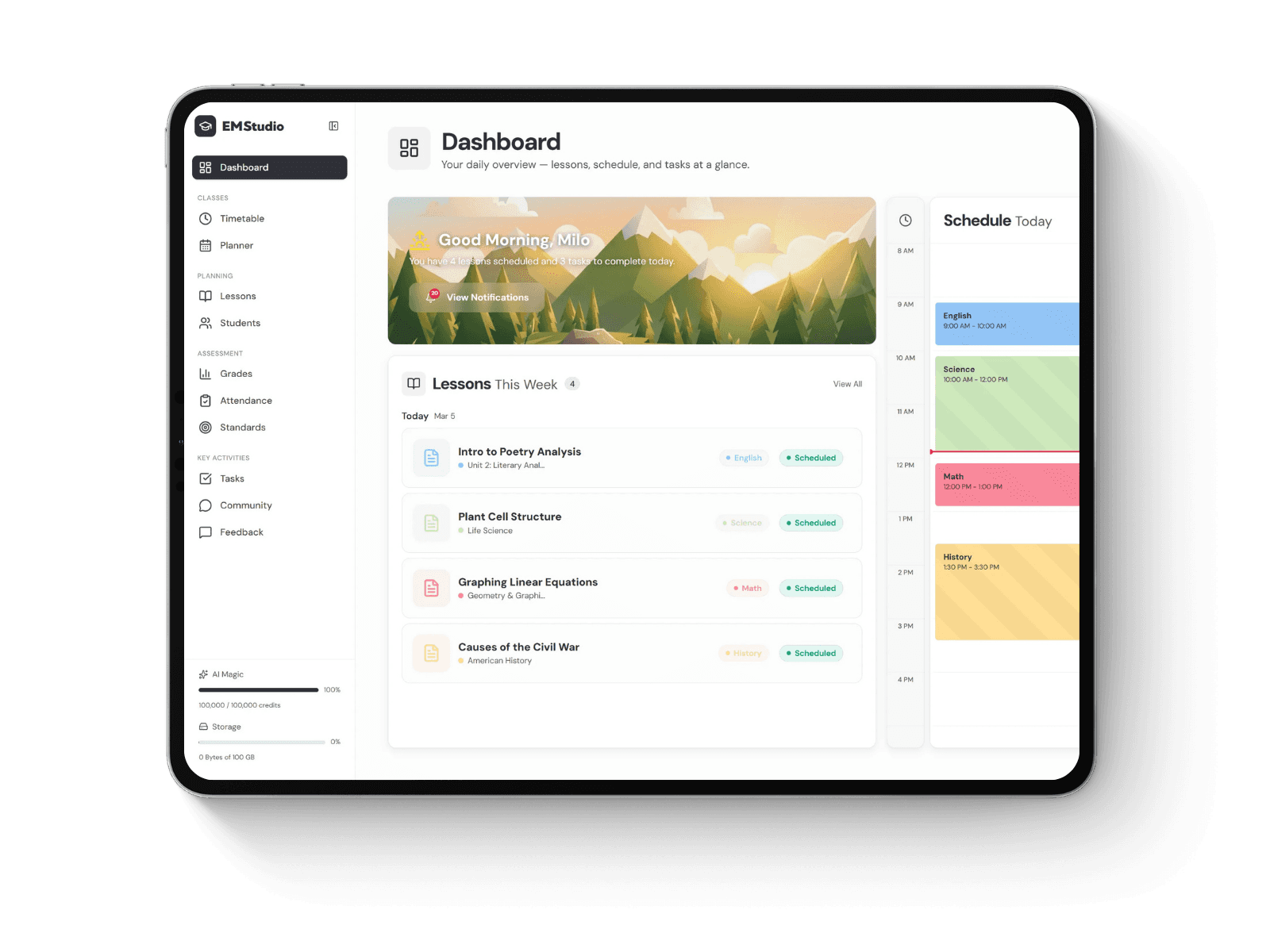
EMStudio is a free teaching management app — manage your classes, students, lessons, and more!
Learn More
Still grading everything by hand?
EMStudio is a free teaching management app — manage your classes, students, lessons, and more!
Learn More
Table of Contents
What Do You Need to Know Before Your First PE Class?
Before you start work as a physical education teacher, you need state-specific certification (typically K-12 Health/PE endorsement), current CPR/AED certification valid for two years, and written emergency action plans. Conduct a complete equipment inventory documenting quantities and condition, assess gymnasium wall padding and AED locations, and review all student IEPs, 504 plans, and medical restrictions before the first class session.
Research indicates teachers who conduct pre-service safety audits reduce equipment-related injuries by identifying hazards like cracked floor tiles or torn mats before day one. You also need First Aid training and a completed background check, though specific requirements vary by state. Don't step into the gym without these basics locked down.
Certification and Safety Prerequisites
Your CPR/AED certification must stay current through the American Red Cross or AHA, with renewal every two years. Most states also require passing specific pedagogy exams like the Praxis 5091 and completing concussion recognition training. Check your state education department website for exact licensure labels—Texas calls it EC-12 Physical Education, while New York requires K-12 Health and Physical Education.
Create an Emergency Action Plan (EAP) before students arrive. Your plan needs these components:
Map the AED location within 150 feet of your teaching space
List emergency contacts including the athletic trainer and nearest hospital
Post the plan by the phone with exact street addresses for the facility
This documentation is part of your essential safety certifications and CPR prerequisites.
Space and Equipment Inventory
Build a five-column spreadsheet to track your gear. Include Item Name, Quantity Available, Condition Rating (New/Good/Poor), Exact Storage Location, and Replacement Cost. Count specific items like 36 basketballs for classes of 32-36 students. Check wall padding for tears and verify mats are sanitized and rip-free.
Measure your gym—standard elementary gyms run 60x90 feet, while high school basketball courts are 84x50 feet. Maintain six-foot clearance around all boundaries. When planning activities, budget one ball per student for individual motor skill development work, or one per two to three students for partner drills. Station rotations need precise counts: six stations with six students each requires 36 items. Get started with tracking your gymnasium equipment inventory to avoid mid-class shortages.
Understanding Your Student Population
Build a medical alert summary listing students with diabetes (note glucose location), severe allergies (confirm epi-pen availability), and physical restrictions like "no contact" or "limited running." Cross-reference this with the school nurse's records and keep it accessible during every class.
Review previous FitnessGram results or motor skill assessments as formative assessment data to identify students needing modifications for movement competency. Note any behavioral intervention plans (BIPs) or social emotional learning needs that might affect kinesthetic learning stations. Understanding these needs underscores the importance of teaching methods in physical education that ensure safety and inclusion while establishing a positive classroom climate from day one.
Step 1 — How Do You Design Standards-Based PE Lessons?
Design standards-based PE lessons by aligning activities to SHAPE America's five national standards. Structure lessons using a 4-part arc: 3-5 minute instant activity, 8-10 minute fitness focus, 20-25 minute skill development with progression, and 5-minute closure with exit tickets. Map each component to specific grade-level outcomes.
SHAPE America's National Standards give you the framework. Standard 1 covers motor skill development—think catching or kicking. Standard 2 addresses movement concepts like pathways and levels. Standard 3 targets health-related fitness. Standard 4 builds social emotional learning through personal and social responsibility. Standard 5 instills the value of physical literacy for lifelong health.
Instant Activity (3-5 minutes): Students enter and move immediately while you take attendance.
Fitness Focus (8-10 minutes): Targeted conditioning or skill-related fitness work.
Lesson Focus (20-25 minutes): Skill development with clear progression and formative assessment.
Closure (5 minutes): Exit tickets checking for understanding and cleanup.
Studies on physical education teaching methods indicate that structured lessons with clear transitions increase student time-on-task to 70-80% compared to 50-60% in unstructured settings.
Aligning Activities to National Standards
Stop guessing what to teach. aligning activities with standards-based curriculum means mapping every unit to specific grade-level outcomes. For Standard 1, your 2nd graders might demonstrate an underhand toss to a target three times consecutively. Standard 3 in 7th grade looks like maintaining a target heart rate for 15 minutes during continuous movement. Standard 4 for 10th graders means accepting diverse skill levels during game play without rolling eyes or sarcastic comments.
Create a simple curriculum map showing which standards each unit hits. Your Basketball Unit covers Standard 1 (dribbling with either hand), Standard 2 (spatial awareness and cutting), and Standard 4 (teamwork and conflict resolution). This clarity helps any physical education teacher defend their program when administrators ask what students are actually learning beyond "playing games."
Structuring the Lesson Arc for Maximum Engagement
The instant activity sets your classroom climate. Students enter the gym and immediately begin a previously taught game or fitness routine—3 minutes of PACER test laps or jump rope—while you take attendance via roster scan. No lining up. No waiting.
Transition quickly into the Lesson Focus using progression: isolated skill practice for 5 minutes, then guided application with defense for 10 minutes, finally small-sided game play for 10 minutes. Include a 2-minute warning signal before cleanup so students aren't surprised. These teaching strategies for physical education keep heart rates up and discipline issues down. The structure creates predictability, which reduces anxiety and maximizes kinesthetic learning time while allowing ongoing formative assessment during the guided practice phase.
Equipment Rotation and Setup Protocols
Manage 36 kids with a station rotation matrix. Set up 6 stations with 4-6 students each, rotating every 4 minutes with a 30-second transition cue—maybe a music change or hand signal. Diagram your gym floor layout showing traffic flow patterns to prevent collisions and bottlenecks near equipment bags.
Assign equipment managers: 2 students per class responsible for distributing and collecting specific items. Blue team collects all volleyballs into numbered bins. Red team handles hula hoop collection zones. This system teaches movement competency through spatial awareness while keeping your instructional strategies for physical education focused on teaching, not chasing basketballs or breaking up arguments over who forgot the cones.
Step 2 — Which Classroom Management Strategies Work in Gymnasiums?
Effective gymnasium management relies on consistent entry routines including assigned equipment duties and warm-up stations, dual stop signals such as a whistle blast paired with a visual cue like a red cone flip, and non-verbal correction systems. Address individual conflicts using proximity and private prompts without stopping the entire class's activity flow. Unlike your standard classroom with carpet and walls that absorb sound, gymnasiums amplify every bounce and shout. You are managing 30 kids in a space the size of three classrooms with concrete floors and metal bleachers—effective classroom management in physical education strategies for beginning teachers must account for these large, echoing spaces where voice commands disappear into the rafters.
Entry and Exit Routines That Build Accountability
Start with the 4-step entry routine. Students line up outside the gym doors until you invite them in—this prevents the chaos of early entry. Once inside, they walk directly to assigned squad spots for silent attendance. Your equipment duty students distribute gear—basketballs to the black squares, jump ropes to the red cones—while the rest begin instant activities like dynamic stretching or jogging lines. You check medical alerts and asthma inhalers while they warm up autonomously, observing motor skill development patterns before formal instruction begins. This buys you three minutes of critical observation time.
The exit protocol matters just as much. Give a 2-minute warning signal. Students return equipment to numbered cones—never loose bins—then walk (never run) to the water fountain by rows. Assign specific exit doors to prevent hallway congestion. A physical education teacher who masters these transitions gains back ten minutes of instruction time per class, maximizing opportunities for deliberate practice.
Visual and Auditory Stop Signals for Large Spaces
Gymnasium acoustics turn your voice into background static. You need signals that cut through the noise without destroying ears or classroom climate.
Whistle blast: Universal and immediate. But it triggers anxiety in some kids and risks hearing damage with daily use.
Music fade: Smooth transitions between activities. However, expect a 10-15 second lag while the track winds down.
Visual cone flip: Silent with no noise pollution. Useless if bodies block sightlines.
Run a dual system. Reserve the whistle only for safety emergencies—blood, broken glass, medical crises. Use music fade for standard transitions between stations. For immediate freezes during instruction, raise your hand and train students to echo the signal by raising theirs. Add specific non-verbal cues: a closed fist means stop immediately, while a flat hand signals freeze and listen. These pe teaching strategies respect social emotional learning while maintaining movement competency.
Conflict Resolution Without Stopping the Entire Class
Stopping the entire class for one kid's behavior kills formative assessment opportunities and MVPA minutes. Instead, use strategies in teaching physical education that keep you mobile.
Follow this five-step flowchart. Step into proximity first. Move within three feet of the off-task student while the class continues their kinesthetic learning activity. Step two: make eye contact—what veteran teachers call "the look." Step three: deliver a private whisper while walking alongside them; the class keeps playing. Step four: if behavior persists, assign a brief two-minute time-out on the sideline to let them observe without drama. Step five: contact parents only if this becomes a pattern.
Stop everyone only for safety violations or blood-borne pathogen incidents. Everything else—arguments, equipment disputes, attitude—gets handled individually. These resolving conflicts in large group settings techniques preserve your flow. Pair these with proven classroom management strategies from your regular instruction toolkit, adapted for open space.
Step 3 — How Do You Apply Differentiated Instruction Strategies?
Differentiate PE instruction using three activity tiers (entry level with modified equipment, grade-level standard, and advanced challenge), Mosston's guided discovery teaching style employing strategic questioning for skill acquisition, and structured peer coaching partnerships. Assign specific leadership roles like equipment manager or form checker to increase student agency while reducing teacher talk time.
When you face 32 sixth graders ranging from special education students to travel-team athletes, one-size-fits-all fails. As a physical education teacher, you need instructional strategies for pe that accommodate varying motor competence without creating three separate lesson plans.
Tiered Activity Levels for Mixed-Ability Groups
You adjust three variables: equipment, rules, and complexity. For a sixth-grade volleyball unit, entry level uses beach balls and allows catching instead of volleying. Grade-level standard uses volleyballs with a three-hit rule. Advanced challenge uses regulation balls and runs a tactical 4-2 offensive system. Equipment changes might mean foam balls versus rubber, shorter jump ropes, or larger targets. Rule modifications include eliminating out-of-bounds, allowing unlimited touches, or removing time limits. Complexity ranges from individual practice to 1v1 to small-sided 3v3 games.
Create a Challenge by Choice board at each station. Display three difficulty levels: "Just Starting," "Getting There," and "Expert Mode." Students self-select their entry point, though you retain override power if safety is compromised. This approach builds movement competency while protecting confidence. For students with specific physical needs, review our strategies on adapting methods for students with neuromuscular disorders.
Guided Discovery Teaching Style for Skill Development
Mosston's Spectrum of Teaching Styles offers alternatives to command-style teaching. Style F, Guided Discovery, represents a guided discovery teaching style in physical education that positions you as the problem-poser, not the solution-giver. Students learn through movement trial-and-error.
Run this five-step protocol for basketball passing. First, demonstrate without explanation. Second, students experiment with five passes. Third, ask: "What did you notice about your feet?" Fourth, students refine based on peer feedback. Fifth, the group defines critical cues: step, extend, snap, follow-through. Use strategic questioning: "What happened when you shifted weight? How did that change the ball's direction?" This builds kinesthetic learning and deeper retention than verbal cues alone.
John Hattie's research shows direct instruction carries an effect size of 0.59. Inquiry-based methods require structured scaffolding like guided discovery to achieve similar gains in psychomotor domains. This isn't throwing kids in the deep end; it's building ladders. Learn more about psychomotor learning and skill development.
Peer Coaching Systems and Leadership Roles
You cannot give feedback to 35 kids at once. Peer coaching extends your reach. Pair high-skilled demonstrators with developing practitioners for three-week cycles, then rotate. The coach provides feedback using sentence starters: "I noticed you..." or "Try adjusting..." They may not physically manipulate their partner; they must use words to guide motor skill development.
Assign leadership roles to reduce teacher talk time.
The Equipment Manager distributes and collects gear.
The Fitness Leader runs the warm-up.
The Technique Checker holds cue cards and monitors form.
The Recorder writes scores on the whiteboard.
These jobs build social emotional learning while freeing you to conduct formative assessment. Rotate roles every three weeks so everyone experiences both leadership and followership, creating a classroom climate where students own the learning.
Step 4 — What Assessment Methods Measure True Physical Literacy?
You measure physical literacy using observable four-point rubrics during gameplay, digital portfolios tracking multiyear growth via platforms like Google Sites or Seesaw, and self-assessment tools like exit slips rating perceived exertion on an RPE scale of 1-10. Formative assessment happens while students are moving; summative assessment comes at the unit's end. As a physical education teacher, focus on process criteria—how they throw, not whether they hit the target—to build lifelong movers.
Observable Performance Checklists During Game Play
Stop counting laps. Start watching mechanics. When I assess throwing, I use a four-point rubric taped to my clipboard:
4 points: opposite foot forward, hip rotation, elbow above shoulder, follow-through to target
3 points: missing one component
2 points: missing two components
1 point: attempt made
This method of teaching in physical education catches errors immediately rather than after the unit test.
Create "Looks Like/Sounds Like" descriptors for observable behaviors:
Looks Like: hands forming a basket, elbows bent, absorption motion on contact
Sounds Like: ball hitting hands not the body, or a quick "Got it!" call to avoid collisions
These cues build movement competency without stopping the flow of play. Use the Every Student Response method to check understanding without line drills. After demonstrating the overhand throw, have students display colored cards: green means "got it," yellow means "practicing," red means "help needed." Group your reds for immediate reteaching while greens practice with a partner. These innovative teaching methods in physical education keep your classroom climate safe and responsive.
Digital Portfolio Options for Long-Term Growth
Paper checklists get lost. Digital portfolios show parents and principals real motor skill development over time. I use Google Sites because it's free, district-controlled, and handles video embedding seamlessly. Each student creates a site with separate pages for FitnessGram data (mile run, push-ups, curl-ups), quarterly skill video uploads showing technique changes, and written goal-setting reflections. When a 5th grader watches their September throwing video beside their May version, the growth becomes undeniable and motivates further progress.
Compare your platform options carefully:
Google Sites: Free, district-controlled, video embedding, shareable with classroom teachers for cross-curricular evidence and IEP documentation
Seesaw: Parent portal access with restricted viewing, voice recording features for student reflections, direct family encouragement tools
Flipgrid: Video journaling creates technique timelines, peer video responses for collaborative feedback, lacks comprehensive portfolio organization
These performance-based assessment tools and kinesthetic learning records turn your gym into a documentation studio. Seesaw keeps families informed daily, while Google Sites provides the permanence you need for multiyear tracking.
Self and Peer Assessment Tools for Reflection
Teach students to feel their effort rather than guess. I implement the RPE (Rating of Perceived Exertion) scale from 1-10 during every cool-down:
5-6: "Can talk but slightly breathless" (target aerobic zone)
8-9: "Hard to talk" (vigorous activity)
Students report their numbers via thumb signals or a quick digital poll. This builds social emotional learning through body awareness and honest self-evaluation without embarrassment.
Design peer assessment with sentence frames to keep feedback constructive and specific. I use "Glow and Grow" slips where partners analyze mechanics during drills:
Glow: "Your strength was..." (identify one mechanical success)
Grow: "Next time try..." (suggest one specific correction)
These teaching strategies in pe create better communicators and more thoughtful movers than traditional "good job" comments ever could. When students learn to assess themselves, they carry physical literacy beyond your gym walls.
Step 5 — How Do You Integrate Health Education Curriculum?
Integrate health education by linking nutrition concepts to fitness activities such as MyPlate relay races, embedding SEL check-ins using mood meters during cool-down periods, and collaborating with classroom teachers on cross-curricular projects. This approach treats your health education curriculum as living content rather than a textbook chapter you skip because you need to run the mile.
Health pedagogy in physical education means intentionally connecting movement to wellness concepts instead of just "playing games." When students understand why fitness matters, they build habits that last beyond the gymnasium. This method of teaching health education turns every lesson into formative assessment of how students value their bodies.
Nutrition Concepts Linked to Fitness Activities
Design the "Nutrient to Movement" circuit. Students rotate through five stations matching food groups to fitness components:
Fruits: Cardio endurance runs
Vegetables: Flexibility yoga flows
Grains: Explosive agility ladder drills
Proteins: Strength push-ups
Dairy: Bone health jumping exercises
This pedagogy in health promotion makes abstract nutrition labels tangible through sweat and muscle memory.
Teach hydration math by calculating fluid needs based on activity intensity. Have students track that they need roughly one cup of water every fifteen minutes of vigorous play. They use marked bottles during class, checking off ounces consumed. This connects math to physiology while preventing the afternoon crashes that derail focus.
Mental Health Check-Ins and Social-Emotional Learning
Implement Mood Meter check-ins using a laminated quadrant chart divided into four colored zones. Students place clothespins with their names during the entry routine while you take attendance. You scan for red or yellow zones indicating anger or high anxiety, pulling those kids aside for a thirty-second private conversation before class begins. This student health and wellness programs strategy takes three minutes but prevents thirty minutes of disruption later.
Teach emotional regulation through movement protocols. "Shake it off" means ten jumping jacks to reset frustration after a missed shot. "Mindful walking" laps around the perimeter help anxious students regulate before rejoining team activities. During stretching, try "gratitude shares" where students name one positive thing; this builds classroom climate and cements social emotional learning into the physical space.
Cross-Curricular Projects With Classroom Teachers
Create math integration that matters. Calculate heart rate zones using the 220-minus-age formula, then find sixty to eighty percent of that max. During bowling units, track scoring averages. In basketball, teach the forty-five-degree entry angle for bank shots using geometry. This kinesthetic learning cements abstract concepts through motor skill development.
Partner with ELA teachers on "Movement Biographies." Students interview family members about traditional physical activities from their cultures, write short narratives, then teach one game to the PE class. This hits social studies standards while honoring diverse movement competency and family knowledge. As a physical education teacher, you become the bridge between classroom content and physical literacy, proving that the gym is an extension of the school, not a recess from it.
Common Pitfalls New Physical Education Teachers Face (And How to Avoid Them)
Over-Reliance on Elimination Games
Dodgeball looks like chaos, but it is actually organized sitting. When I tracked it last year, kids hit in the first three minutes waited five to eight minutes for the next round. That cuts moderate-to-vigorous physical activity (MVPA) by nearly forty percent. You end up managing a line, not teaching motor skill development.
Swap elimination for continuous play. Try Hospital Tag: tagged students do five jumping jacks to re-enter immediately. Or play Poison Ball where teams clear balls to the opponent's side together. With thirty kids, traditional dodgeball benches ten to fifteen students after three minutes. These alternatives keep all thirty moving for the full fifteen-minute block.
Inconsistent Routine Enforcement
Your classroom climate cracks in week one if you smile at horseplay you will later write up. I learned this the hard way in October when equipment return took twelve minutes because I let it slide in August. Establish your hierarchy immediately: verbal warning, two-minute sideline observation, parent contact, then office referral. Do not escalate out of anger; escalate out of consistency.
Track every redirection on a sheet—date, student, behavior, consequence. This documentation serves as formative assessment for your classroom management. When thirty percent of your class botches a routine, stop the next day's instant activity. Spend five minutes re-teaching the procedure, then resume. It feels like losing time. It saves weeks.
Professional Isolation From School-Wide Initiatives
It is easy to hide in the gym. Do not. When you are teaching physical education for learning, you are still part of the instructional team. Attend one grade-level PLC monthly. Co-teach one lesson per quarter with a classroom teacher to align your social emotional learning language with school-wide PBIS. Show up for morning meetings so you hear behavior data.
Volunteer for dances or bus duty. Invite colleagues to watch your class so they see kinesthetic learning in action. Mirror school goals: if the focus is growth mindset, say exactly that when a student retries a throw. If literacy is the push, keep your word walls visible during walkthroughs. And do not forget maintaining your own physical health and wellness—a burned-out physical education teacher cannot model movement competency.
Getting Started with Physical Education Teacher
You don't need to master all five steps by Friday. Pick one. Maybe it's the formative assessment check at the end of class, or simply greeting students at the door to build social emotional learning connections. The best physical education teacher I ever watched wasn't the one with the fanciest equipment. She stood at the door and greeted every sixth grader by name while checking their heart rate zones. That was it. Consistency beats complexity.
Your concrete action: Choose the class you dread most tomorrow. Spend five minutes before the bell reviewing their IEPs and 504s—not the whole file, just the accommodations. Write one differentiated instruction tweak on a sticky note. When that student struggles with motor skill development, you'll know the modification instead of improvising. Small preparation beats big panic. Start there.
What Do You Need to Know Before Your First PE Class?
Before you start work as a physical education teacher, you need state-specific certification (typically K-12 Health/PE endorsement), current CPR/AED certification valid for two years, and written emergency action plans. Conduct a complete equipment inventory documenting quantities and condition, assess gymnasium wall padding and AED locations, and review all student IEPs, 504 plans, and medical restrictions before the first class session.
Research indicates teachers who conduct pre-service safety audits reduce equipment-related injuries by identifying hazards like cracked floor tiles or torn mats before day one. You also need First Aid training and a completed background check, though specific requirements vary by state. Don't step into the gym without these basics locked down.
Certification and Safety Prerequisites
Your CPR/AED certification must stay current through the American Red Cross or AHA, with renewal every two years. Most states also require passing specific pedagogy exams like the Praxis 5091 and completing concussion recognition training. Check your state education department website for exact licensure labels—Texas calls it EC-12 Physical Education, while New York requires K-12 Health and Physical Education.
Create an Emergency Action Plan (EAP) before students arrive. Your plan needs these components:
Map the AED location within 150 feet of your teaching space
List emergency contacts including the athletic trainer and nearest hospital
Post the plan by the phone with exact street addresses for the facility
This documentation is part of your essential safety certifications and CPR prerequisites.
Space and Equipment Inventory
Build a five-column spreadsheet to track your gear. Include Item Name, Quantity Available, Condition Rating (New/Good/Poor), Exact Storage Location, and Replacement Cost. Count specific items like 36 basketballs for classes of 32-36 students. Check wall padding for tears and verify mats are sanitized and rip-free.
Measure your gym—standard elementary gyms run 60x90 feet, while high school basketball courts are 84x50 feet. Maintain six-foot clearance around all boundaries. When planning activities, budget one ball per student for individual motor skill development work, or one per two to three students for partner drills. Station rotations need precise counts: six stations with six students each requires 36 items. Get started with tracking your gymnasium equipment inventory to avoid mid-class shortages.
Understanding Your Student Population
Build a medical alert summary listing students with diabetes (note glucose location), severe allergies (confirm epi-pen availability), and physical restrictions like "no contact" or "limited running." Cross-reference this with the school nurse's records and keep it accessible during every class.
Review previous FitnessGram results or motor skill assessments as formative assessment data to identify students needing modifications for movement competency. Note any behavioral intervention plans (BIPs) or social emotional learning needs that might affect kinesthetic learning stations. Understanding these needs underscores the importance of teaching methods in physical education that ensure safety and inclusion while establishing a positive classroom climate from day one.
Step 1 — How Do You Design Standards-Based PE Lessons?
Design standards-based PE lessons by aligning activities to SHAPE America's five national standards. Structure lessons using a 4-part arc: 3-5 minute instant activity, 8-10 minute fitness focus, 20-25 minute skill development with progression, and 5-minute closure with exit tickets. Map each component to specific grade-level outcomes.
SHAPE America's National Standards give you the framework. Standard 1 covers motor skill development—think catching or kicking. Standard 2 addresses movement concepts like pathways and levels. Standard 3 targets health-related fitness. Standard 4 builds social emotional learning through personal and social responsibility. Standard 5 instills the value of physical literacy for lifelong health.
Instant Activity (3-5 minutes): Students enter and move immediately while you take attendance.
Fitness Focus (8-10 minutes): Targeted conditioning or skill-related fitness work.
Lesson Focus (20-25 minutes): Skill development with clear progression and formative assessment.
Closure (5 minutes): Exit tickets checking for understanding and cleanup.
Studies on physical education teaching methods indicate that structured lessons with clear transitions increase student time-on-task to 70-80% compared to 50-60% in unstructured settings.
Aligning Activities to National Standards
Stop guessing what to teach. aligning activities with standards-based curriculum means mapping every unit to specific grade-level outcomes. For Standard 1, your 2nd graders might demonstrate an underhand toss to a target three times consecutively. Standard 3 in 7th grade looks like maintaining a target heart rate for 15 minutes during continuous movement. Standard 4 for 10th graders means accepting diverse skill levels during game play without rolling eyes or sarcastic comments.
Create a simple curriculum map showing which standards each unit hits. Your Basketball Unit covers Standard 1 (dribbling with either hand), Standard 2 (spatial awareness and cutting), and Standard 4 (teamwork and conflict resolution). This clarity helps any physical education teacher defend their program when administrators ask what students are actually learning beyond "playing games."
Structuring the Lesson Arc for Maximum Engagement
The instant activity sets your classroom climate. Students enter the gym and immediately begin a previously taught game or fitness routine—3 minutes of PACER test laps or jump rope—while you take attendance via roster scan. No lining up. No waiting.
Transition quickly into the Lesson Focus using progression: isolated skill practice for 5 minutes, then guided application with defense for 10 minutes, finally small-sided game play for 10 minutes. Include a 2-minute warning signal before cleanup so students aren't surprised. These teaching strategies for physical education keep heart rates up and discipline issues down. The structure creates predictability, which reduces anxiety and maximizes kinesthetic learning time while allowing ongoing formative assessment during the guided practice phase.
Equipment Rotation and Setup Protocols
Manage 36 kids with a station rotation matrix. Set up 6 stations with 4-6 students each, rotating every 4 minutes with a 30-second transition cue—maybe a music change or hand signal. Diagram your gym floor layout showing traffic flow patterns to prevent collisions and bottlenecks near equipment bags.
Assign equipment managers: 2 students per class responsible for distributing and collecting specific items. Blue team collects all volleyballs into numbered bins. Red team handles hula hoop collection zones. This system teaches movement competency through spatial awareness while keeping your instructional strategies for physical education focused on teaching, not chasing basketballs or breaking up arguments over who forgot the cones.
Step 2 — Which Classroom Management Strategies Work in Gymnasiums?
Effective gymnasium management relies on consistent entry routines including assigned equipment duties and warm-up stations, dual stop signals such as a whistle blast paired with a visual cue like a red cone flip, and non-verbal correction systems. Address individual conflicts using proximity and private prompts without stopping the entire class's activity flow. Unlike your standard classroom with carpet and walls that absorb sound, gymnasiums amplify every bounce and shout. You are managing 30 kids in a space the size of three classrooms with concrete floors and metal bleachers—effective classroom management in physical education strategies for beginning teachers must account for these large, echoing spaces where voice commands disappear into the rafters.
Entry and Exit Routines That Build Accountability
Start with the 4-step entry routine. Students line up outside the gym doors until you invite them in—this prevents the chaos of early entry. Once inside, they walk directly to assigned squad spots for silent attendance. Your equipment duty students distribute gear—basketballs to the black squares, jump ropes to the red cones—while the rest begin instant activities like dynamic stretching or jogging lines. You check medical alerts and asthma inhalers while they warm up autonomously, observing motor skill development patterns before formal instruction begins. This buys you three minutes of critical observation time.
The exit protocol matters just as much. Give a 2-minute warning signal. Students return equipment to numbered cones—never loose bins—then walk (never run) to the water fountain by rows. Assign specific exit doors to prevent hallway congestion. A physical education teacher who masters these transitions gains back ten minutes of instruction time per class, maximizing opportunities for deliberate practice.
Visual and Auditory Stop Signals for Large Spaces
Gymnasium acoustics turn your voice into background static. You need signals that cut through the noise without destroying ears or classroom climate.
Whistle blast: Universal and immediate. But it triggers anxiety in some kids and risks hearing damage with daily use.
Music fade: Smooth transitions between activities. However, expect a 10-15 second lag while the track winds down.
Visual cone flip: Silent with no noise pollution. Useless if bodies block sightlines.
Run a dual system. Reserve the whistle only for safety emergencies—blood, broken glass, medical crises. Use music fade for standard transitions between stations. For immediate freezes during instruction, raise your hand and train students to echo the signal by raising theirs. Add specific non-verbal cues: a closed fist means stop immediately, while a flat hand signals freeze and listen. These pe teaching strategies respect social emotional learning while maintaining movement competency.
Conflict Resolution Without Stopping the Entire Class
Stopping the entire class for one kid's behavior kills formative assessment opportunities and MVPA minutes. Instead, use strategies in teaching physical education that keep you mobile.
Follow this five-step flowchart. Step into proximity first. Move within three feet of the off-task student while the class continues their kinesthetic learning activity. Step two: make eye contact—what veteran teachers call "the look." Step three: deliver a private whisper while walking alongside them; the class keeps playing. Step four: if behavior persists, assign a brief two-minute time-out on the sideline to let them observe without drama. Step five: contact parents only if this becomes a pattern.
Stop everyone only for safety violations or blood-borne pathogen incidents. Everything else—arguments, equipment disputes, attitude—gets handled individually. These resolving conflicts in large group settings techniques preserve your flow. Pair these with proven classroom management strategies from your regular instruction toolkit, adapted for open space.
Step 3 — How Do You Apply Differentiated Instruction Strategies?
Differentiate PE instruction using three activity tiers (entry level with modified equipment, grade-level standard, and advanced challenge), Mosston's guided discovery teaching style employing strategic questioning for skill acquisition, and structured peer coaching partnerships. Assign specific leadership roles like equipment manager or form checker to increase student agency while reducing teacher talk time.
When you face 32 sixth graders ranging from special education students to travel-team athletes, one-size-fits-all fails. As a physical education teacher, you need instructional strategies for pe that accommodate varying motor competence without creating three separate lesson plans.
Tiered Activity Levels for Mixed-Ability Groups
You adjust three variables: equipment, rules, and complexity. For a sixth-grade volleyball unit, entry level uses beach balls and allows catching instead of volleying. Grade-level standard uses volleyballs with a three-hit rule. Advanced challenge uses regulation balls and runs a tactical 4-2 offensive system. Equipment changes might mean foam balls versus rubber, shorter jump ropes, or larger targets. Rule modifications include eliminating out-of-bounds, allowing unlimited touches, or removing time limits. Complexity ranges from individual practice to 1v1 to small-sided 3v3 games.
Create a Challenge by Choice board at each station. Display three difficulty levels: "Just Starting," "Getting There," and "Expert Mode." Students self-select their entry point, though you retain override power if safety is compromised. This approach builds movement competency while protecting confidence. For students with specific physical needs, review our strategies on adapting methods for students with neuromuscular disorders.
Guided Discovery Teaching Style for Skill Development
Mosston's Spectrum of Teaching Styles offers alternatives to command-style teaching. Style F, Guided Discovery, represents a guided discovery teaching style in physical education that positions you as the problem-poser, not the solution-giver. Students learn through movement trial-and-error.
Run this five-step protocol for basketball passing. First, demonstrate without explanation. Second, students experiment with five passes. Third, ask: "What did you notice about your feet?" Fourth, students refine based on peer feedback. Fifth, the group defines critical cues: step, extend, snap, follow-through. Use strategic questioning: "What happened when you shifted weight? How did that change the ball's direction?" This builds kinesthetic learning and deeper retention than verbal cues alone.
John Hattie's research shows direct instruction carries an effect size of 0.59. Inquiry-based methods require structured scaffolding like guided discovery to achieve similar gains in psychomotor domains. This isn't throwing kids in the deep end; it's building ladders. Learn more about psychomotor learning and skill development.
Peer Coaching Systems and Leadership Roles
You cannot give feedback to 35 kids at once. Peer coaching extends your reach. Pair high-skilled demonstrators with developing practitioners for three-week cycles, then rotate. The coach provides feedback using sentence starters: "I noticed you..." or "Try adjusting..." They may not physically manipulate their partner; they must use words to guide motor skill development.
Assign leadership roles to reduce teacher talk time.
The Equipment Manager distributes and collects gear.
The Fitness Leader runs the warm-up.
The Technique Checker holds cue cards and monitors form.
The Recorder writes scores on the whiteboard.
These jobs build social emotional learning while freeing you to conduct formative assessment. Rotate roles every three weeks so everyone experiences both leadership and followership, creating a classroom climate where students own the learning.
Step 4 — What Assessment Methods Measure True Physical Literacy?
You measure physical literacy using observable four-point rubrics during gameplay, digital portfolios tracking multiyear growth via platforms like Google Sites or Seesaw, and self-assessment tools like exit slips rating perceived exertion on an RPE scale of 1-10. Formative assessment happens while students are moving; summative assessment comes at the unit's end. As a physical education teacher, focus on process criteria—how they throw, not whether they hit the target—to build lifelong movers.
Observable Performance Checklists During Game Play
Stop counting laps. Start watching mechanics. When I assess throwing, I use a four-point rubric taped to my clipboard:
4 points: opposite foot forward, hip rotation, elbow above shoulder, follow-through to target
3 points: missing one component
2 points: missing two components
1 point: attempt made
This method of teaching in physical education catches errors immediately rather than after the unit test.
Create "Looks Like/Sounds Like" descriptors for observable behaviors:
Looks Like: hands forming a basket, elbows bent, absorption motion on contact
Sounds Like: ball hitting hands not the body, or a quick "Got it!" call to avoid collisions
These cues build movement competency without stopping the flow of play. Use the Every Student Response method to check understanding without line drills. After demonstrating the overhand throw, have students display colored cards: green means "got it," yellow means "practicing," red means "help needed." Group your reds for immediate reteaching while greens practice with a partner. These innovative teaching methods in physical education keep your classroom climate safe and responsive.
Digital Portfolio Options for Long-Term Growth
Paper checklists get lost. Digital portfolios show parents and principals real motor skill development over time. I use Google Sites because it's free, district-controlled, and handles video embedding seamlessly. Each student creates a site with separate pages for FitnessGram data (mile run, push-ups, curl-ups), quarterly skill video uploads showing technique changes, and written goal-setting reflections. When a 5th grader watches their September throwing video beside their May version, the growth becomes undeniable and motivates further progress.
Compare your platform options carefully:
Google Sites: Free, district-controlled, video embedding, shareable with classroom teachers for cross-curricular evidence and IEP documentation
Seesaw: Parent portal access with restricted viewing, voice recording features for student reflections, direct family encouragement tools
Flipgrid: Video journaling creates technique timelines, peer video responses for collaborative feedback, lacks comprehensive portfolio organization
These performance-based assessment tools and kinesthetic learning records turn your gym into a documentation studio. Seesaw keeps families informed daily, while Google Sites provides the permanence you need for multiyear tracking.
Self and Peer Assessment Tools for Reflection
Teach students to feel their effort rather than guess. I implement the RPE (Rating of Perceived Exertion) scale from 1-10 during every cool-down:
5-6: "Can talk but slightly breathless" (target aerobic zone)
8-9: "Hard to talk" (vigorous activity)
Students report their numbers via thumb signals or a quick digital poll. This builds social emotional learning through body awareness and honest self-evaluation without embarrassment.
Design peer assessment with sentence frames to keep feedback constructive and specific. I use "Glow and Grow" slips where partners analyze mechanics during drills:
Glow: "Your strength was..." (identify one mechanical success)
Grow: "Next time try..." (suggest one specific correction)
These teaching strategies in pe create better communicators and more thoughtful movers than traditional "good job" comments ever could. When students learn to assess themselves, they carry physical literacy beyond your gym walls.
Step 5 — How Do You Integrate Health Education Curriculum?
Integrate health education by linking nutrition concepts to fitness activities such as MyPlate relay races, embedding SEL check-ins using mood meters during cool-down periods, and collaborating with classroom teachers on cross-curricular projects. This approach treats your health education curriculum as living content rather than a textbook chapter you skip because you need to run the mile.
Health pedagogy in physical education means intentionally connecting movement to wellness concepts instead of just "playing games." When students understand why fitness matters, they build habits that last beyond the gymnasium. This method of teaching health education turns every lesson into formative assessment of how students value their bodies.
Nutrition Concepts Linked to Fitness Activities
Design the "Nutrient to Movement" circuit. Students rotate through five stations matching food groups to fitness components:
Fruits: Cardio endurance runs
Vegetables: Flexibility yoga flows
Grains: Explosive agility ladder drills
Proteins: Strength push-ups
Dairy: Bone health jumping exercises
This pedagogy in health promotion makes abstract nutrition labels tangible through sweat and muscle memory.
Teach hydration math by calculating fluid needs based on activity intensity. Have students track that they need roughly one cup of water every fifteen minutes of vigorous play. They use marked bottles during class, checking off ounces consumed. This connects math to physiology while preventing the afternoon crashes that derail focus.
Mental Health Check-Ins and Social-Emotional Learning
Implement Mood Meter check-ins using a laminated quadrant chart divided into four colored zones. Students place clothespins with their names during the entry routine while you take attendance. You scan for red or yellow zones indicating anger or high anxiety, pulling those kids aside for a thirty-second private conversation before class begins. This student health and wellness programs strategy takes three minutes but prevents thirty minutes of disruption later.
Teach emotional regulation through movement protocols. "Shake it off" means ten jumping jacks to reset frustration after a missed shot. "Mindful walking" laps around the perimeter help anxious students regulate before rejoining team activities. During stretching, try "gratitude shares" where students name one positive thing; this builds classroom climate and cements social emotional learning into the physical space.
Cross-Curricular Projects With Classroom Teachers
Create math integration that matters. Calculate heart rate zones using the 220-minus-age formula, then find sixty to eighty percent of that max. During bowling units, track scoring averages. In basketball, teach the forty-five-degree entry angle for bank shots using geometry. This kinesthetic learning cements abstract concepts through motor skill development.
Partner with ELA teachers on "Movement Biographies." Students interview family members about traditional physical activities from their cultures, write short narratives, then teach one game to the PE class. This hits social studies standards while honoring diverse movement competency and family knowledge. As a physical education teacher, you become the bridge between classroom content and physical literacy, proving that the gym is an extension of the school, not a recess from it.
Common Pitfalls New Physical Education Teachers Face (And How to Avoid Them)
Over-Reliance on Elimination Games
Dodgeball looks like chaos, but it is actually organized sitting. When I tracked it last year, kids hit in the first three minutes waited five to eight minutes for the next round. That cuts moderate-to-vigorous physical activity (MVPA) by nearly forty percent. You end up managing a line, not teaching motor skill development.
Swap elimination for continuous play. Try Hospital Tag: tagged students do five jumping jacks to re-enter immediately. Or play Poison Ball where teams clear balls to the opponent's side together. With thirty kids, traditional dodgeball benches ten to fifteen students after three minutes. These alternatives keep all thirty moving for the full fifteen-minute block.
Inconsistent Routine Enforcement
Your classroom climate cracks in week one if you smile at horseplay you will later write up. I learned this the hard way in October when equipment return took twelve minutes because I let it slide in August. Establish your hierarchy immediately: verbal warning, two-minute sideline observation, parent contact, then office referral. Do not escalate out of anger; escalate out of consistency.
Track every redirection on a sheet—date, student, behavior, consequence. This documentation serves as formative assessment for your classroom management. When thirty percent of your class botches a routine, stop the next day's instant activity. Spend five minutes re-teaching the procedure, then resume. It feels like losing time. It saves weeks.
Professional Isolation From School-Wide Initiatives
It is easy to hide in the gym. Do not. When you are teaching physical education for learning, you are still part of the instructional team. Attend one grade-level PLC monthly. Co-teach one lesson per quarter with a classroom teacher to align your social emotional learning language with school-wide PBIS. Show up for morning meetings so you hear behavior data.
Volunteer for dances or bus duty. Invite colleagues to watch your class so they see kinesthetic learning in action. Mirror school goals: if the focus is growth mindset, say exactly that when a student retries a throw. If literacy is the push, keep your word walls visible during walkthroughs. And do not forget maintaining your own physical health and wellness—a burned-out physical education teacher cannot model movement competency.
Getting Started with Physical Education Teacher
You don't need to master all five steps by Friday. Pick one. Maybe it's the formative assessment check at the end of class, or simply greeting students at the door to build social emotional learning connections. The best physical education teacher I ever watched wasn't the one with the fanciest equipment. She stood at the door and greeted every sixth grader by name while checking their heart rate zones. That was it. Consistency beats complexity.
Your concrete action: Choose the class you dread most tomorrow. Spend five minutes before the bell reviewing their IEPs and 504s—not the whole file, just the accommodations. Write one differentiated instruction tweak on a sticky note. When that student struggles with motor skill development, you'll know the modification instead of improvising. Small preparation beats big panic. Start there.
Still grading everything by hand?
EMStudio is a free teaching management app — manage your classes, students, lessons, and more!
Learn More
Still grading everything by hand?
EMStudio is a free teaching management app — manage your classes, students, lessons, and more!
Learn More





Notion4Teachers
Notion templates to simplify administrative tasks and enhance your teaching experience.



2026 Notion4Teachers. All Rights Reserved.
Notion4Teachers
Notion templates to simplify administrative tasks and enhance your teaching experience.
2026 Notion4Teachers. All Rights Reserved.
Notion4Teachers
Notion templates to simplify administrative tasks and enhance your teaching experience.
2026 Notion4Teachers. All Rights Reserved.