Phonemic Awareness Activities: Easy-to-Hard Guide

Ever tried to spell a word you've only heard out loud? That's where phonemic awareness starts. It's the ability to hear, spot, and play with the individual sounds (called phonemes) inside spoken words, and it comes before any letters appear on the page.
In this guide, we'll walk through activities from easiest to hardest, with how to teach and assess each one. You'll also find small-group routines and simple ways to track progress, so you can start tomorrow.
Still grading everything by hand?
EMStudio is a free teaching management app — manage your classes, students, lessons, and more!
The Core Ideas Behind Phonemic Awareness Activities
Before you pick an activity, know what you're building and why it matters.
Key terms you need to know
Phonological awareness is the broad umbrella: noticing and playing with the sound structure of spoken language. Under it sits phonemic awareness, the skill of hearing and manipulating phonemes, the smallest sounds that can change a word's meaning.
In cat, swapping the first phoneme gives you hat.
Phonemic awareness is sound-based, not print-based, so students work with their ears alone. A grapheme is the written symbol for a phoneme, such as the letters sh for the sound in ship.
Picture a first-grade teacher in a five-minute warm-up. She says sip, then asks the class to change the first sound to make zip. Every student answers out loud, so she can tell in seconds who's secure and who needs more practice.
Why this skill predicts reading success
The research points to this skill as a strong predictor. A cross-cultural study on the predictors of reading acquisition found that phonological awareness was the best predictor of reading across groups, while visual processing didn't predict reading.
It also makes phonics and spelling easier. A student who hears that ship ends in /p/ has a shorter leap to match that sound to a letter.
The flip side is just as telling.
In research on the cost-effective prediction of reading difficulties, being in the top quartile for phonological awareness predicted positive outcomes, and only 1 child in that group became a poor reader by the end of Year 2.
Weak phonological awareness predicts reading struggles. That's your early warning.
Still, this is groundwork, not the whole reading program, so pair it with broader reading instruction.
What Are the Three Most Important Skills to Teach?
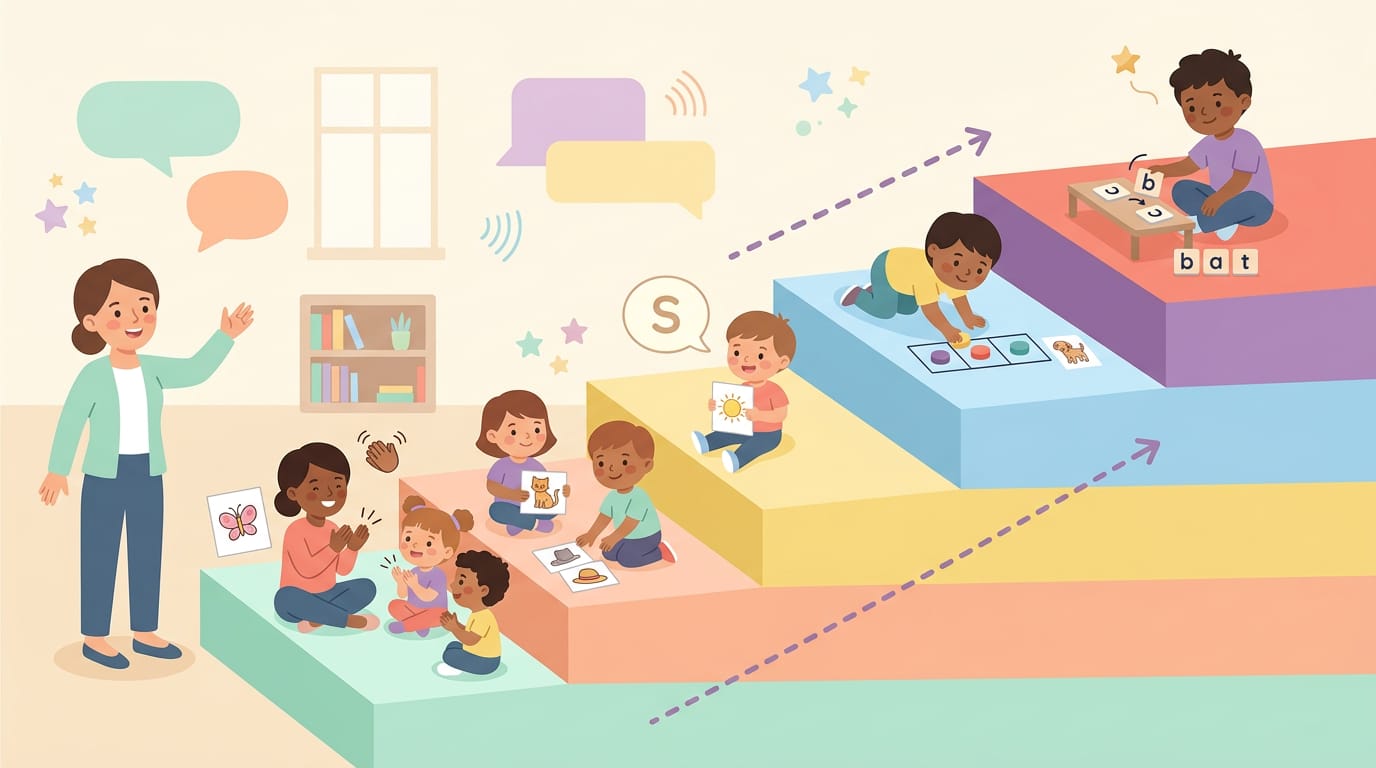
The three skills worth prioritizing are the stages children move through, from big chunks of sound to single sounds, so we'll start there.
The order skills usually develop in
Children tend to start with the largest units of sound. According to a PMC article on teaching phonological awareness to children with hearing loss, they first analyze larger units, then smaller ones.
The source is written for children with hearing loss, but its sequence is a clear map for any lesson. The path runs like this:
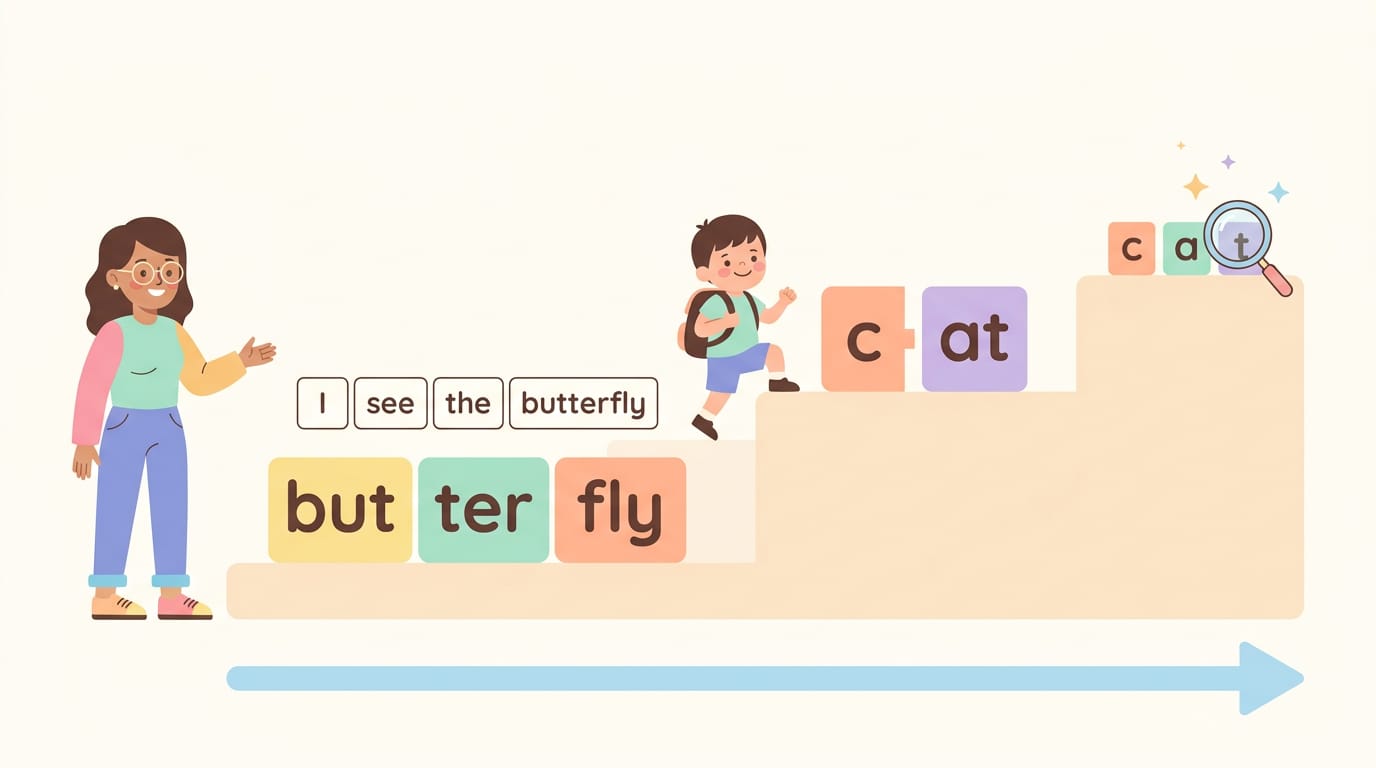
Words and syllables: whole words within sentences, and syllables within words
Onset-rime: the onset (sounds before the vowel) and the rime (the vowel and what follows)
Phonemes: the individual sounds in a word
When children work with individual sounds, they usually pick out beginning sounds first, then ending sounds, then middle sounds. Phonemic awareness, the ability to hear and manipulate individual sounds, develops last.
Start with big units, not single sounds.
Moving from easy to harder practice
Easier and harder versions of a task differ mainly in unit size. Clapping syllables is easier than isolating a single sound, so start there.
Those same three stages can serve as your three difficulty levels, each building on the last.
A scope and sequence maps which skills come when, so nothing gets skipped. Accuracy-based progression goes further: move students up when they're accurate, not because the calendar says so.
Picture a kindergarten teacher with five spare minutes. She asks her class to clap the two parts of sunshine, then say the sound that starts sun. In seconds, she knows who's ready for the next level.
Working with Bigger Sound Units
Once students can hear single sounds, you can move to bigger chunks: words, syllables, and rhymes. Each one gives them a handle for the longer words they'll meet in reading.
Counting words, syllables and compounds
Start with sentences: have students hold up one finger per word. Then move to syllables. A first-grade teacher might have students clap the syllables in their own names, then group themselves by how many claps they hear.
Next, try syllable blending and segmenting: say "pen-cil" and have students say "pencil," then reverse it with "rab-bit."
For compound words, say "sun" and "flower" separately, have students blend them into "sunflower," then break it apart again.
Playing with rhymes and word families
Start by judging rhymes: ask students whether "hat" and "mat" sound alike, then "hat" and "dog."
Then have them produce rhymes by building a rhyme chain: each student says a word that rhymes with the last, going around the circle ("cat, hat, mat") until someone gets stuck.
Word families like cat, bat, and hat give students a pattern to reuse. Write the family on the board, change only the first letter, and have them read each new word.
For movement, try the body-part rhyming game. Call out a body part, like "toes," and students touch it and name a rhyme: "nose," "rose," "goes." It's a quick break that still builds rhyme skills.
Splitting words into onsets and rimes
An onset is the consonant sound before a vowel, and a rime is the vowel and everything after it. In cat, the onset is /k/ and the rime is -at. Work through three moves:
Split c-at and blend. Say "c-at" with a pause, then have students blend it into "cat." The goal is hearing how the parts fit, not just naming them.
Onset-rime segmenting. Say "fish" and have students tap out /f/ and then -ish.
Onset-rime substitution. Keep the rime and swap the onset: "hop," "pop," "mop," "top." Same rime, new word.
Spotting Single Sounds in Words
Before students can read, they need to hear the sounds inside words, not just whole words. Start with the easiest task and build toward listening closely.
Finding the first, last and middle sounds
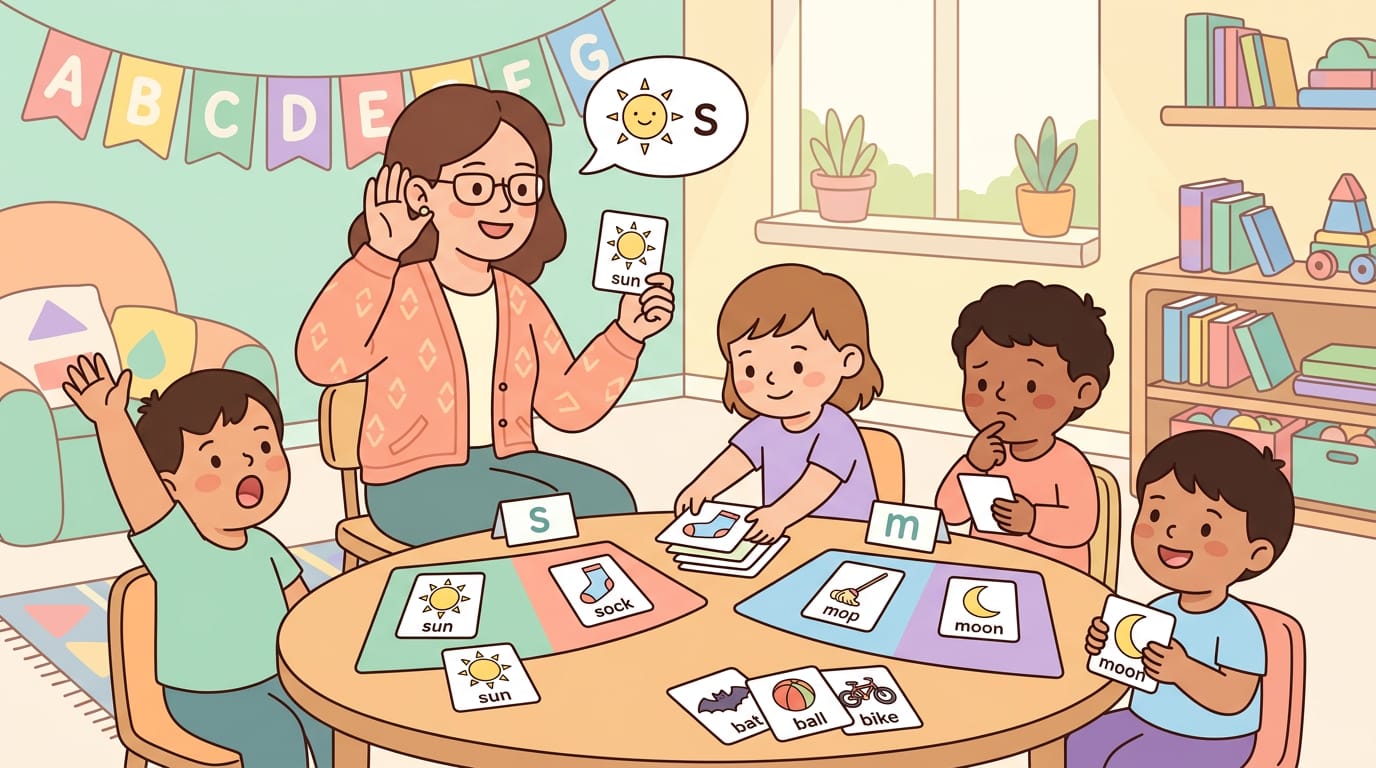
Begin with sound isolation: ask students to name one sound, like 'What's the first sound in sun?' A kindergarten teacher might play I Spy with picture cards: 'I spy something that starts with /m/.'
In under a minute, she sees who can isolate beginning sounds and who needs more practice.
Picture sorting gives students something to do with their hands. Have them sort cards into piles by first sound, such as /s/ (sun, sock) and /m/ (mop, moon).
Middle vowels are the hardest to pick out. A study called Mora or Phoneme? Further Evidence for Language-Specific Listening found that English listeners detect medial vowel targets more slowly than consonants. Give students time.
Then name more words that start with the same sound. For /b/, students might offer bat, ball, and bike.
Listening to sounds and watching mouths
Try these four routines:
Environmental and animal sounds. Start with familiar noises like a bell or a hissing snake. The snake makes the /s/ sound, the same one at the start of sun.
Mirror sounds. Students make each sound in front of a mirror to check their own lips and tongue.
Watching mouth movements. That's a second clue beyond sound alone. Say a word slowly, and have students watch your mouth, then copy.
Correct sound pronunciation. Model the sound once, slowly, and add one tip about where the lips or tongue go. Correct the sound, not the student.
Joining and Splitting Sounds into Words
Blending and segmenting are two sides of the same skill. Keep the focus on hearing sounds, not reading them, since no print is needed.
Games that blend sounds into words
Blending means smoothing separate phonemes, the smallest units of sound, into one word. Here's how to practice it:
Arm sliding. Say each sound as you slide a hand from shoulder to wrist, then have students say the word.
Mystery bag. Hide an object, say its sounds one at a time, and let students blend them to guess it.
Slide the sounds toy. Use a sliding toy or hand motion to push sounds together into a word.
Stretch continuous sounds. Hold sounds like /m/, /s/, and /f/ so they run into the next sound.
Chunk bigger parts first. Blend pieces like /b/ and /ug/ before single sounds.
Ways to break words into sounds
Segmenting is the reverse: pulling a word apart into its sounds. Students work with sounds, not letters, so you won't need print at all.
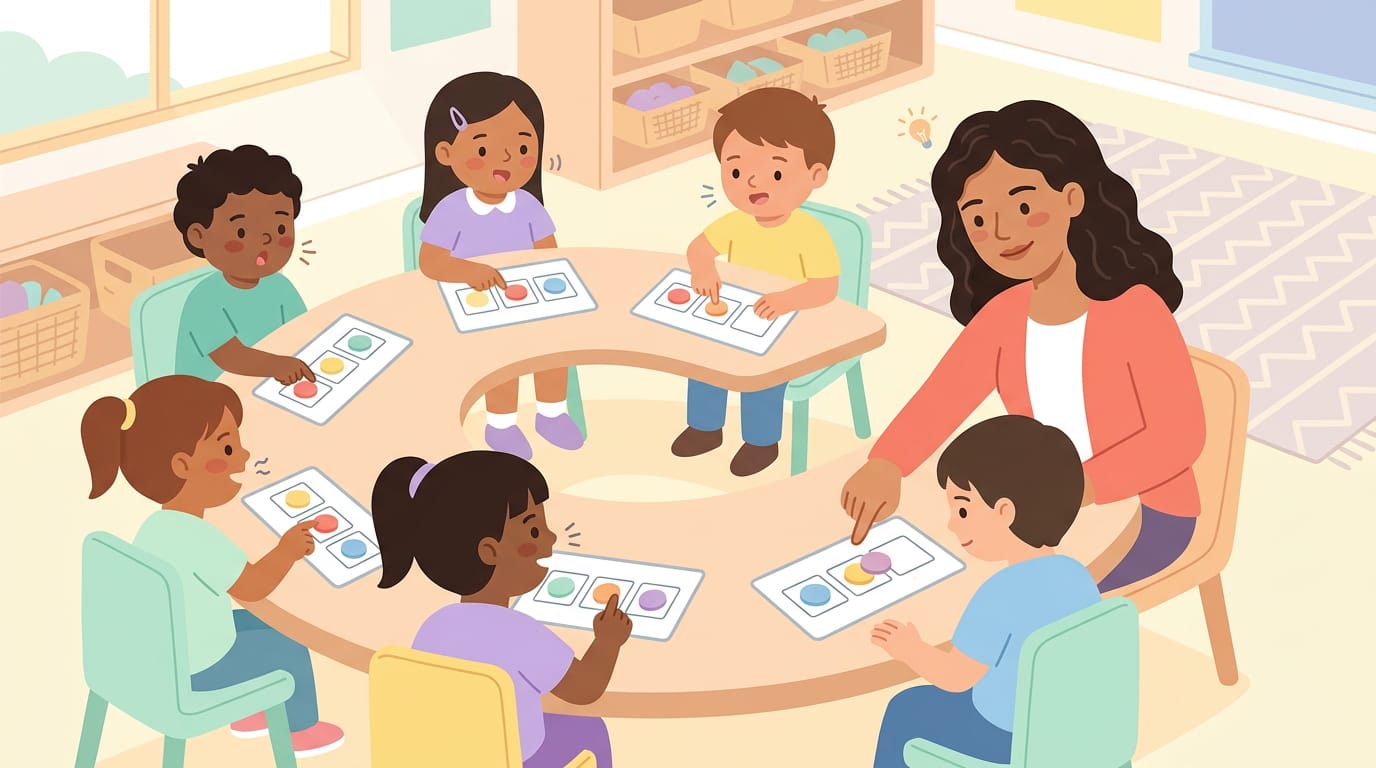
Elkonin boxes with counters. Draw one box per sound, and have students push a counter into each as they say it.
Tapping or clapping sounds. Students tap or clap once for each sound they hear.
Pushing tokens per sound. Students push a token forward for each sound, like counters without boxes.
Sound-it-out chips. Students slide one chip per sound into a row as they say the word.
Counting phonemes. Students count the sounds in a word and hold up that many fingers.
Picture Ms. Lopez with six kindergartners. Each child pushes a counter into one of three boxes for every sound in cat. When one lands in the wrong box, she sees the gap immediately.
Swapping, Adding and Removing Sounds
Here, we move students from hearing whole words to changing their sounds, one step harder at a time.
Swapping one sound for another
A phoneme is the smallest unit of sound that can change a word's meaning. Students hear one phoneme and replace it with another, in three positions:
First sound: hat to pat
Middle sound: hat to hot
Last sound: hat to ham
Students learn to change one sound and keep the rest. Ms. Okafor, a kindergarten teacher, runs a five-minute warm-up. She says hat, and her group answers pat, mat, sat. In a minute, she knows who's still guessing on the first sound.
Word chains repeat the move: hat, hot, hog, dog. Each word changes one sound from the last, so every change has to be heard.
Once students swap by ear, add letter tiles. Swap the h tile for p and read the new word. Letters are a bridge to phonics, so listening comes first. A letter sounds game gives students a way to practice that match.
Dropping and adding sounds in words
Dropping and adding is harder because nothing new cues students. They have to hold the whole word in mind.
To remove the first sound, have students say smile, then say it without the /s/. They should land on mile. They remove a sound rather than replace one, and that's what makes this step harder.
Next, clamp without the /m/ gives clap. Then try stop without the /s/ for top.
Adding works in reverse. Add /s/ to at and you get sat. Students insert a phoneme at a chosen spot.
Phoneme location asks students to name where a sound sits. Where do you hear /m/ in mop? At the start. In jam? At the end. Consider Mr. Brooks, a first-grade teacher. A child who names both positions without a pause is ready for harder removals that day.
How Letters and Phonics Fit In
Letters have a place in phonemic awareness, but it comes later than many teachers expect.
How letters fit into sound games
Start with sound games that use no letters. Ask children to say the first sound in sun, or to blend /m/ /a/ /p/ into map, using only their ears.
Once a child is secure, add letter tiles or flashcards so they can see the sound they've been hearing. Then try phoneme substitution. A phoneme is the smallest unit of sound in a word, so change the first tile in cat to h and ask what word you've made.
Picture a kindergarten teacher with a small group. Two children swap bat for mat by ear alone, so she adds tiles for them. The third is still shaky on blending, so her cards stay off the table until he's ready.
Alphabet knowledge matters too, but it's its own skill, so practice it in short bursts within the games.
Moving from sounds to phonics and reading
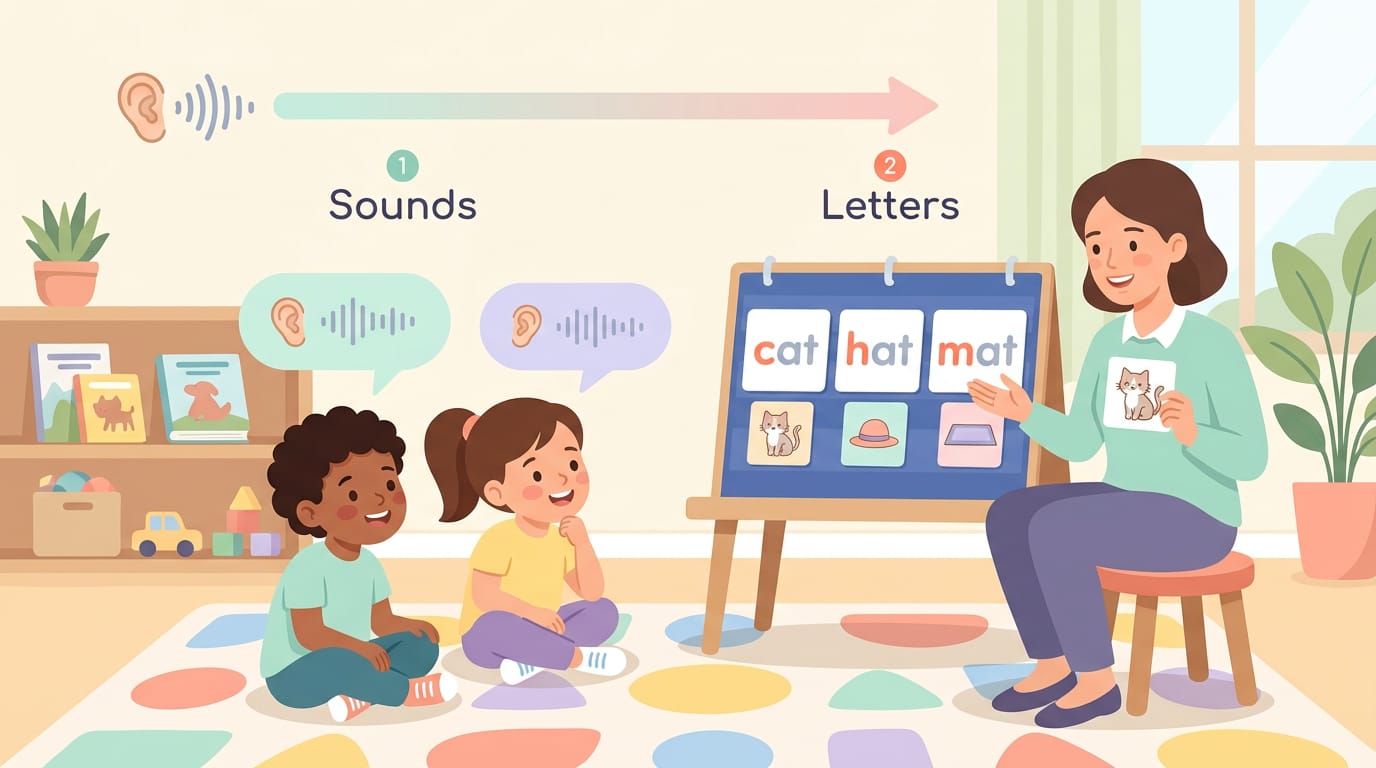
Phonemic awareness comes before phonics. Children who can already hear sounds are ready to connect them to letters.
A digraph is two letters making one sound, like sh in ship. A consonant blend is consonants that each keep their own sound, like st in stop. Have children hear ship as three sounds and stop as four.
Sound swaps are a bridge into beginning reading. Change cat to hat to mat, and have children read each new word.
Avoid making letter recognition the main event early on. A letter-naming drill can teach children to name letters without ever hearing the sounds inside words. Children should hear the sound before they see the letter. Sounds first. Letters second.
How Do You Assess Phonological Awareness?
To assess phonological awareness (hearing and playing with the sounds in spoken words), check one skill at a time, easiest first: rhyme, syllables, then individual sounds. Record each child's score to know where to start next.
How to structure teaching in small groups
Explicit, systematic instruction means planning the skill order ahead and saying what you're teaching and why. Model first, guide the group together, then let each child try alone. Work in small groups on one or two skills per session.
Picture a first-grade teacher running station rotation: while she guides one table, the others cycle through counters and picture cards. By the end of the block, she knows which two children need another turn.
Keeping practice short and regular
Short, frequent sessions work best, and they fit into daily routines. For children with hearing loss, the Six Big Ideas paper reports that successful lessons generally ran 5 to 15 minutes, at least four days a week.
Ten minutes a day sits inside that range, so tuck it into line-up time or the wait before lunch.
After each session, track accuracy per skill, not just whether it went well. A Notion skill-tracking dashboard, with one row per child and one column per skill, makes patterns easy to spot. Consistency wins.
Using hands-on, moving and visual tools
Counters and manipulatives: Have children push a counter for each sound in a word.
Movement and tapping: Clap syllables or tap out sounds on the desk.
Visual aids: Picture cards keep the word in view as children work.
Mirror use: Children watch their mouths as they make a sound.
Think of a kindergartner who keeps losing count of the sounds in cat. Give her three counters, one per sound, and the pile shows you at a glance whether she's got it.
Helping children who struggle most
More intensity: Give strugglers extra turns on the same skill, not new skills.
Modeling answers: When a task is too hard, say the answer, then have the child repeat it.
Adjusting levels: Drop back to an easier skill, like syllables, until the child is ready.
Watch for red flags. If a child makes little progress across several skills despite steady practice, it's time to bring in your school's specialist and talk with the family.
Who These Activities Are For
Phonemic awareness is about hearing sounds, not reading letters. Here's how we suggest you choose a starting point and fit these activities into your day.
Matching activities to a child's age
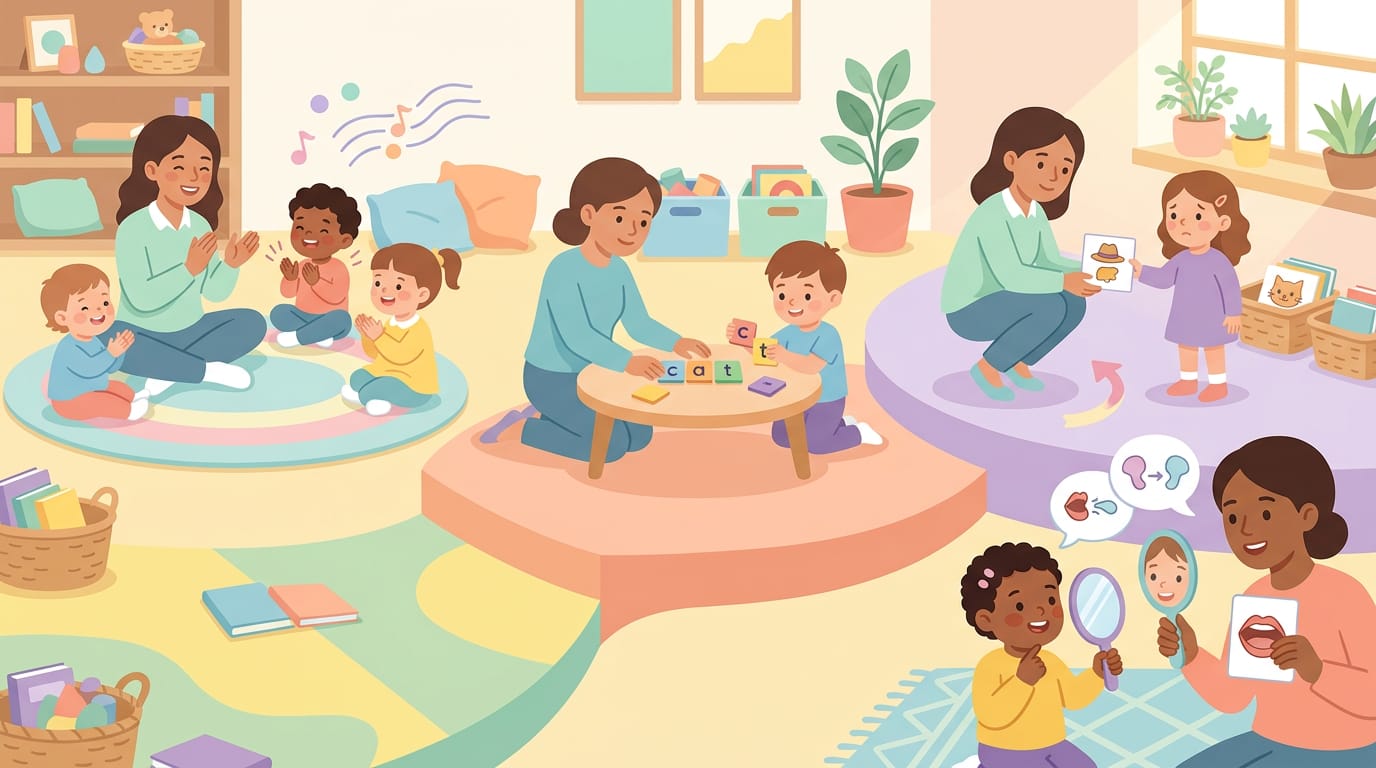
Choose by the child's stage, not the calendar. Toddlers and preschoolers usually enjoy rhymes and silly sound games, like clapping the beats in a name. Kindergarten and Reception children are ready for blending sounds into words and breaking words apart.
Many children start simple sound play around age three, but readiness matters more than birthday.
Treat the age ranges in this guide as a starting point rather than a rule, and if a five-year-old still stumbles on rhyme, step back to an easier game. Start where the child is.
An English learner may lack some English sounds in their home language, so two sounds can seem like one. That's normal. Give those sounds extra time, with mouth pictures or gestures to show the difference.
Using activities at home or in class
Parents at home. At home, a few minutes at bedtime is enough. Try finding the sound that sun and sock share, and keep it playful.
Teachers and SLPs. Classroom teachers and speech-language pathologists (SLPs) can build a short, predictable routine into the day, then make it harder as skills grow.
Small group or one-to-one. Small groups let you pitch one activity at several levels at once. One-to-one time suits a child who needs closer support on specific sounds.
Everyday moments for practice. Consider a parent in the car line who asks, "What sound does cup start with?" It takes thirty seconds and needs no materials.
Programs and Tools You Can Use
Some teachers want a full program from day one, while others just need strong warm-up materials. Here's the range, from complete curricula to free tools, so you can match one to your schedule and budget.
Full curricula and printable game packs
Think of a kindergarten teacher who prints a seasonal set in October and uses it for a ten-minute warm-up all week. That's fresh practice with no extra planning.
Printable seasonal game sets. Themed games that keep practice fresh all year.
Full phonemic awareness curriculum. A complete program that moves from easiest to hardest skill.
Lesson-by-lesson activity sequence. Each day's activity is laid out, so you always know what's next.
Pacing and assessment tools. Guidance on time per skill, plus checks for who's ready to move on.
A curriculum gives you structure, while a game pack gives you variety. Most classrooms need both, so pick one spine and build around it.
Free worksheets and digital tools
Budget matters, and plenty of useful options are free.
Free printable worksheets. Quick practice pages for independent work or centers.
Worksheet generators. Tools that build new practice pages on demand for one target sound.
Progress tracking games. Playable activities that log results as students play, so you see growth without a quiz.
Audio storybooks. Read-aloud stories that model sounds in context and invite students to respond.
Consider a first-grade teacher with one student stuck on final sounds. She generates a page of words ending in /t/ and /p/ the night before, and the student works through it at the listening center while she meets with a small group.
The payoff is targeted practice without spending her evening making materials from scratch.
Free doesn't have to mean flimsy.
When kids can hear and play with sounds, reading and spelling get much easier. Start with the simple tasks, move up as students gain confidence, and check progress along the way.
Ready to keep building your toolkit? Check out our Teaching Strategies & Concepts collection for more classroom ideas you can use right away.
References
Cross-cultural similarities in the predictors of reading acquisition — pubmed.ncbi.nlm.nih.gov (2002)
Cost-effective prediction of reading difficulties — pubmed.ncbi.nlm.nih.gov (2004)
Teaching Phonological Awareness to Children with Hearing Loss who Use Spoken Language: Six Big Ideas — pmc.ncbi.nlm.nih.gov (2019)
Mora or Phoneme? Further Evidence for Language-Specific Listening — doi.org (1994)
Still grading everything by hand?
EMStudio is a free teaching management app — manage your classes, students, lessons, and more!