
Paraprofessional Educator: 5 Steps to Certification
Paraprofessional Educator: 5 Steps to Certification

Article by
Milo
ESL Content Coordinator & Educator
ESL Content Coordinator & Educator
All Posts
You saw the job posting for an instructional aide or you’re already working as a teacher assistant without the formal credential. Now you need the paperwork to match the work. Becoming a paraprofessional educator sounds straightforward until you realize every state has its own rules—some want an associate’s degree, others demand specific assessments, and a few let you slide by with a high school diploma and a training course. It’s enough to make you dig through your state’s education department website for an hour and still wonder if you’re missing a step.
This guide cuts through the confusion. Whether you’re pursuing paraeducator certification for the first time or upgrading your qualifications, these five steps cover exactly what you need: meeting educational requirements, completing special education training, passing the assessment, and mastering the tools you’ll use daily—IEP implementation, behavior intervention, and inclusion support. No vague advice. Just the checklist that gets you hired and keeps you compliant.
Still grading everything by hand?
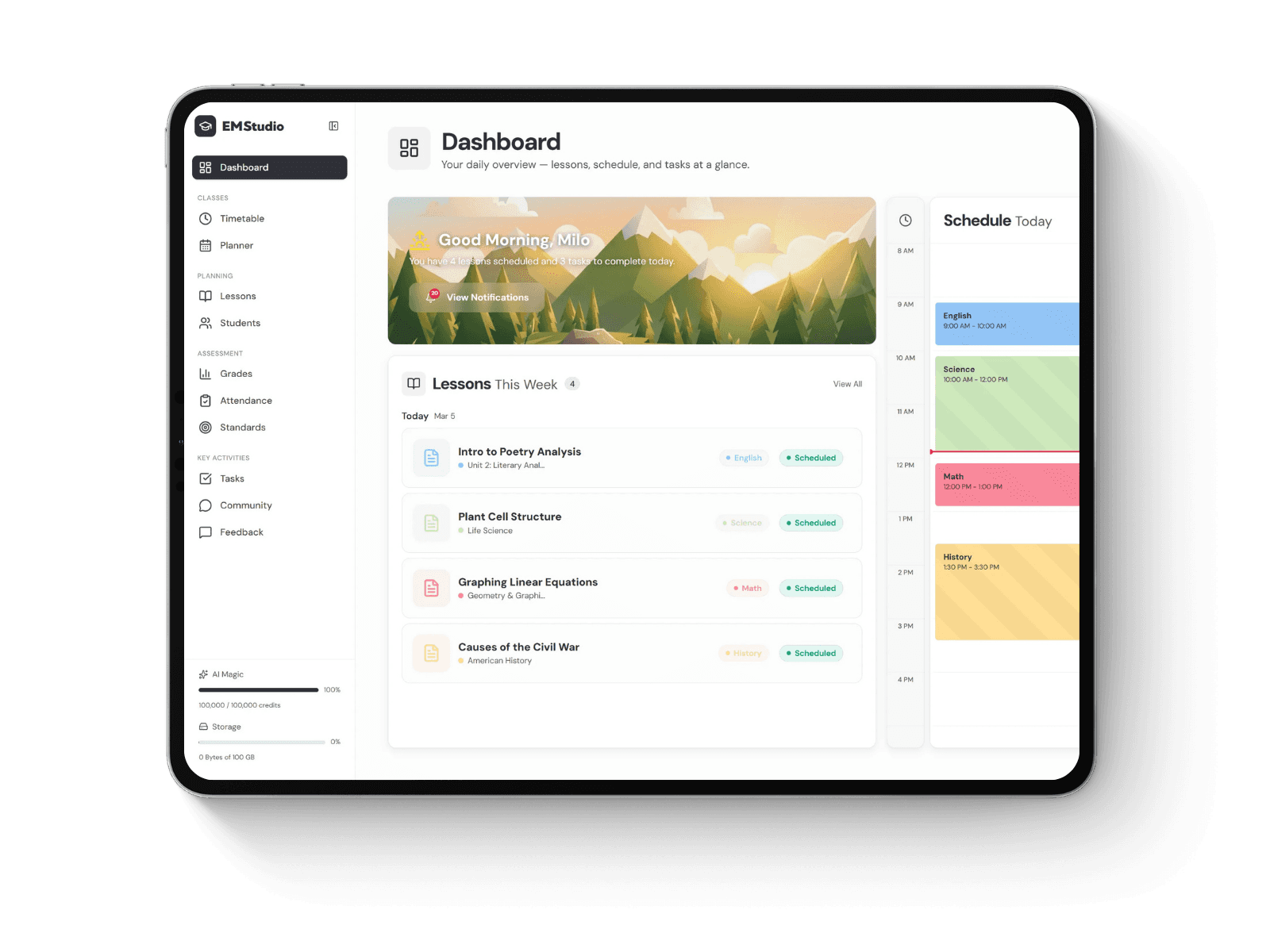
EMStudio is a free teaching management app — manage your classes, students, lessons, and more!
Learn More
Still grading everything by hand?
EMStudio is a free teaching management app — manage your classes, students, lessons, and more!
Learn More
Table of Contents
What Does a Paraprofessional Educator Do?
A paraprofessional educator provides instructional support under certified teacher supervision, working directly with students who have IEPs or 504 plans. They implement behavior intervention strategies, track progress on IEP goals, and assist with classroom management, typically earning $28,000-$39,000 while often pursuing teaching credentials.
Not every teacher assistant in the building does the same work. Instructional aides work directly with kids on academic and behavioral goals. They run small groups, support IEP implementation, and collect data. Non-instructional staff handle clerical work, lunch monitoring, and bus duty. The pay gap matters here—instructional roles typically pay $3,000 to $5,000 more per year. If you're considering this path, read the job description carefully. Look for terms like "small group instruction" or "special education support," not just "copying and hall supervision."
The daily work looks different depending on student needs. Here is what you will actually do:
Provide 1:1 support for students with autism or ADHD, keeping them on task during independent work or helping them transition between activities without meltdowns.
Lead small group reading intervention for 3 to 6 students who are below grade level, using scripted programs like LLI or Wilson Reading while the certified teacher works with the rest of the class.
Collect behavior data using frequency counts—marking tallies every time a student raises their hand versus calling out, or tracking self-regulation breaks during a 30-minute math block.
Implement specific IEP accommodations such as extended time on tests, preferential seating near the board, or providing fidget tools during instruction.
Support assistive technology including AAC devices for non-verbal students or text-to-speech software for kids with dyslexia, troubleshooting when the iPad won't talk to the speaker.
You will find this job in several distinct settings. In inclusion classrooms using a push-in model, you provide inclusion support by floating between desks to help specific students while the general education teacher leads whole-group instruction. Self-contained special education rooms operate on ratios like 15 students to 1 teacher to 1 aide—sometimes 12:1:1 or 8:1:1 depending on severity—where you are essential to keeping the room running. Title I reading and math intervention labs pull struggling students out of class for targeted support. Preschool special education programs serve ages 3 through 5, where you might help with potty training and sensory breaks alongside early literacy goals.
Many paraprofessionals use this role as a pathway to reach education certification while earning a paycheck. The Bureau of Labor Statistics puts the median salary between $28,000 and $39,000 annually, with about half of paraprofessionals working toward degrees while employed. Some states require paraeducator certification even for entry-level positions. If you are one of them, look for districts that offer tuition reimbursement or grow-your-own programs. Understanding these foundational teaching principles now will make your future certification courses easier.

Step 1 — Meet Your State's Educational Requirements
States sort paraprofessional educator candidates into four buckets. Know which bucket catches you before you register for classes.
State Group A: 48 college semester credits (roughly 16 courses).
State Group B: Associate degree or higher.
State Group C: High school diploma plus ETS ParaPro Assessment score of 460 or above.
State Group D: High school diploma only, restricted to Title I positions.
The ETS ParaPro Assessment costs $55. You get 2.5 hours to answer 90 multiple-choice questions covering math, reading, and writing. Unofficial scores appear instantly at the test center. Official reports reach state departments within two weeks.
Verify Minimum Education Levels and Prerequisites
Google your state name plus "paraprofessional requirements." Look for the phrase "highly qualified" on your state education department site. That page lists exactly what an instructional aide or teacher assistant needs in your zip code. Some states require specific special education training prerequisites before you ever supervise students.
Forty-eight semester hours sounds vague. It equals sixteen three-credit college courses. Most states accept CLEP exam credits toward this total, so that history CLEP you took in 2019 might count. Check the fine print before you enroll in unnecessary gen-ed classes.
Complete Mandatory Background Check Procedures
You cannot step into a classroom supporting IEP implementation or inclusion support until you clear the background check. The process runs $50 to $75 for FBI and state criminal history screening through Identogo or MorphoTrust, plus $20 to $40 for a TB test. Disqualifying factors include violent felonies and crimes against children.
Schedule your Livescan fingerprinting appointment online.
Bring two forms of government ID to the testing center.
Complete FD-258 cards manually if out-of-state checks are required.
File your receipt of fingerprint submission and authorization forms.
Call the clearinghouse if results exceed four weeks.
Start this process eight weeks before your anticipated start date. Background checks take two to six weeks to process. Summer school or mid-year hires get stuck in limbo when HR waits on fingerprints. Complete your safety certifications like CPR training while you wait. You will need this documentation for paraeducator certification and any behavior intervention roles anyway.

Step 2 — Complete Special Education Training Programs
You can't walk into a special education classroom cold. Districts need proof you understand behavior plans and IEP implementation before letting you work one-on-one with students. That's where formal training comes in. Most states require documented special education professional development before you can supervise students independently. Teacher assistant positions require the same documentation whether you're applying to elementary or high school settings.
Select Approved Special Ed Training Options
Most paraprofessional educators choose from three main pathways:
Registered Behavior Technician (RBT): 40-hour online course plus hands-on competency assessment, $400-$600. This is the gold standard for autism support roles.
CPI Nonviolent Crisis Intervention: Eight-hour training running $300-$400. You'll learn safe holding and escorting techniques.
State-specific modules: Texas Education Agency offers a free 20-hour online course for residents covering inclusion support fundamentals.
Verify approval before paying anyone. Check the Council for Exceptional Children (CEC) accreditation lists or your state education agency's approved provider directory. Random online certificates won't count toward paraeducator certification, and you'll waste money retaking approved versions later.
Format determines your schedule. Asynchronous online courses let you finish in 2-4 weeks between shifts at your own pace. Synchronous virtual sessions lock you into scheduled Zoom meetings, which helps if you need external accountability. In-person intensives pack everything into 1-2 days but require substitute coverage or weekend availability. Completing a comprehensive Teaching Assistant Diploma can provide the foundational knowledge needed to excel in these flexible learning environments while managing multiple professional responsibilities.
Choose based on specific skill targets. Quality courses teach discrete trial training (DTT) methods for breaking down tasks, positive behavior intervention supports (PBIS) for classroom management, and de-escalation techniques for students with emotional disturbance. These skills appear daily in self-contained classrooms.
Weigh the return on investment carefully. District-sponsored training is free and job-embedded, often happening during professional development days. Private certification costs upfront but makes you eligible for specialized autism or behavior support roles paying $3-$5 more per hour. If your district offers stipends for RBT credentials, the math works in your favor.
Document Your Special Education Professional Development Hours
Your certificates are worthless if you lose them. Most districts use Frontline Professional Growth or TrueNorth Logic to track special education professional development. Upload PDFs immediately after finishing. Basic certifications typically show 12-20 clock hours, which meets most state thresholds for instructional aides.
Create a tracking spreadsheet today. Include columns for Training Name, Provider, Date Completed, Clock Hours, and Certificate Expiration Date. Remember that RBT requires annual renewal—mark your calendar now or lose the credential.
Store everything in three locations:
Physical copies in a fireproof home file
Digital versions on Google Drive or Dropbox with clear filenames like "RBT_Cert_2024"
Originals submitted to district HR for your official personnel file
When administration changes or you transfer buildings, you won't need to prove your qualifications twice.
This paperwork protects your career. If a parent questions how you implemented a behavior intervention plan, you can produce your CPI certification and DTT training records immediately. As a paraprofessional educator, documented expertise is your job security and your defense against liability.

Step 3 — How Do You Pass the Paraprofessional Assessment?
Pass the ParaPro Assessment by scoring 450-466 (state-dependent) on the 90-question exam covering reading, writing, and mathematics. Register through ETS for $55, allow 2.5 hours, and prepare using the official study guide, targeting math computation skills specifically since calculators are prohibited. Most paraprofessional educator candidates underestimate the math section. Without a calculator, simple errors in long division or fraction conversion drop scores fast.
Register for the ParaPro or State Equivalent Exam
Head to ETS.org and create your account early. The exam costs $55 whether you sit at a Prometric test center or use at-home proctoring. Schedule at least three weeks out from your target date. You need that runway to rebuild your mental math stamina and to account for processing delays in state-specific paraeducator certification requirements. Prometric centers fill up fast during summer hiring seasons when districts bulk-hire teacher assistants for the new school year.
Test centers provide scratch paper and pencils at check-in, plus you receive an unofficial score report the moment you finish. You walk out knowing if you hit the 450-466 threshold required by your state. At-home testing demands a 360-degree room scan via an external webcam and strict environmental controls. Remove dual monitors, clear every paper from your desk, and expect the proctor to flag normal classroom items like wall maps or textbooks on shelves. One instructional aide had her test paused because her cat walked through the frame. If you choose at-home testing, run the system check the day before to verify your webcam and microphone meet specs.
During registration, designate up to three state departments or school districts as automatic score recipients. Additional score reports cost $50 each. If you are applying broadly for instructional aide roles, choose your top three employers carefully. If you fail, you must wait 21 days before retaking, pay another $55, and remember that most states limit you to three attempts per calendar year.
Target Weak Areas in Reading Writing and Mathematics
The 90-question exam divides evenly: 33 percent reading, 33 percent mathematics, and 33 percent writing. Reading tests literary analysis and vocabulary in context. Mathematics covers algebra, geometry, and data analysis. Writing assesses grammar, sentence structure, and written expression. Calculators are prohibited, which catches most candidates off guard when they realize they must compute percentages by hand under time pressure.
Start your prep by utilizing practice exams to identify knowledge gaps. Take the free ETS practice test and isolate any domain scoring below 70 percent. Allocate 60 percent of your study time to that lowest area. Many aspiring instructional aides fail because they review reading comprehension casually while ignoring the rust on their arithmetic skills. The writing section also trips up candidates who assume they know grammar intuitively; brush up on comma splice rules and subject-verb agreement with indefinite pronouns.
Drill these specific math skills without a calculator:
Fractions, decimals, and percentages
Area and perimeter formulas
Linear equations and basic algebraic expressions
Use Khan Academy sixth through eighth grade math modules to rebuild fluency. You have approximately 1.6 minutes per question. Burn five minutes on a single geometry problem and you will rush through grammar questions later. Purchase the Official Study Guide for $25 and treat the math sections like timed sprints. Strong scores qualify you for positions supporting IEP implementation, behavior intervention, and inclusion support in special education classrooms.

Step 4 — Master Progress Monitoring Tools for Special Education
Most paraeducator certification programs mention data collection in passing. Then you get hired and realize that as a paraprofessional educator, you will spend more time holding data sheets than textbooks. Teachers will ask you to track everything from hand-raising to heart rates. The right progress monitoring tools for special education separate effective inclusion support from guesswork.
Learn Digital Data Collection Systems
You need a system that works when you are walking the hallway or sitting in the back of a general education classroom. Here is how the common options stack up:
Google Forms: Free. Responses dump into Sheets with automatic timestamps. Best for frequency counts and quick quizzes.
ClassDojo: Tracks behavior intervention with a parent portal. Messages home instantly. Great for elementary.
Unique Learning System: Standards-based for severe disabilities. Costs $500+ annually. Use it if your district buys it; do not pay out of pocket.
Behavior Flip: ABC data collection app with swipe-based logging. Essential for self-contained behavior units.
Google Forms is the best starting point for any teacher assistant. Create a form with dropdown menus for behavior frequencies—0, 1-3, 4-6, 7+. Add a short-answer field for notes. When you submit, the timestamp locks automatically. This enables response aggregation without manual entry.
To analyze the data, learn basic pivot table functions in Excel or Google Sheets. Select your date column and score column. Insert a pivot table with dates in rows and averages in values. You now have weekly trend analyses for IEP team meetings. You can track student progress automatically and spot downward trends before they become crises.
Practice IEP Goal Tracking and Documentation
Digital tools help, but paper never runs out of battery. Create physical data binders with color-coded sections per student. Use red for reading goals, blue for math. Goal pages face outward, divided by objective. Raw data sheets sit in sheet protectors behind the goals. Summary graphs face the current data so you can see the trend at a glance during busy moments.
Master the methodology: Establish mastery criteria (e.g., "80% accuracy over 3 consecutive sessions"), collect baseline data showing current performance, and schedule probe data. Daily probes for acquisition skills, weekly for maintenance. Never test mastered skills daily unless the IEP specifically requires it.
Consider Marcus, a 4th grader with an IEP goal to answer 5 WH comprehension questions with 80% accuracy. As his instructional aide, you pull him for 5 minutes daily. Your data sheet has columns for date, passage title, and score (4/5, 5/5). At week's end, you update the trend line graph. If the line drops below the aim line for two weeks, the team needs to meet.
Schedule "data days." Every Friday, block 30 minutes to review trend lines. Ask: Is the student making progress? If the trend line sits above the aim line, keep going. If not, flag it for the special education teacher.
Watch the failure mode. Subjective notes like "did great today" invalidate IEP implementation and compliance. Objective data reads: "Answered 4/5 questions correctly independently." When collaborating on Individualized Education Programs, your data must defend the decision to keep, change, or discharge a service. Measurable evidence is your only protection in a due process hearing.

Step 5 — Build Your Portfolio and Apply for Positions
Stop listing "helped students" on your resume. Hiring managers skim for evidence. Swap vague duties for metrics: Supported 12 students with IEPs in inclusion setting, Implemented BIPs reducing classroom incidents by 30%, or Collaborated with multidisciplinary team of 3 teachers, 2 SLPs, and 1 OT. Numbers prove you know your impact.
Create a Paraprofessional Resume Highlighting Classroom Experience
Lead with action verbs that match the work. You didn't just "help"—you implemented visual schedules, monitored ABC data, documented prompt fading, facilitated peer interactions, differentiated grade-level text, and scaffolded writing assignments. Use the language from the job posting itself.
Stack your paraeducator certification and these credentials where principals can't miss them:
CPI (crisis prevention and de-escalation)
First Aid/CPR
RBT (Registered Behavior Technician)
ESL endorsement
Assistive technology training
These separate an instructional aide from a candidate who can handle inclusion support immediately. Principals know that a para with CPI certification can de-escalate a crisis without calling the office, which means more instruction time for everyone.
Build a physical or digital binder for interviews. Include redacted data collection sheets showing your behavior intervention tracking (no student names), a sample behavior intervention plan you helped write, your last two positive evaluations, and two to three letters from supervising teachers who can speak to your reliability. When they ask about your experience with IEP implementation, slide the evidence across the table instead of just talking about it. Learn more about creating effective professional portfolios to organize these materials so they look professional, not like a scrapbook.
Search smart. Check SchoolSpring, EdJoin, and your target district portals weekly. Apply to Reach Education for substitute teacher assistant spots—they often convert to permanent roles once principals see your consistency during a three-week sub assignment. Hit regional education job fairs held April through July; districts hire for fall during these months, and face-to-face conversations beat online applications that disappear into applicant tracking systems.
Explore Jobs for Special Education Teachers Outside the Classroom
Classroom burnout is real. As a paraprofessional educator, your skills transfer to clinical and administrative roles that pay better and run on different schedules. Consider becoming a Registered Behavior Technician in clinic settings—salaries run $35,000-$45,000, roughly 15-20% above school-based para roles. You'll need the 40-hour training and competency assessment, but the one-on-one intensity suits many paras who miss deep student connections without the chaos of whole-group management.
Other jobs for special education teachers outside the classroom include respite care coordination for families who need weekend or evening support, instructional materials specialist for districts adapting curriculum, after-school special education program director, or education recruiter for staffing agencies who need people who actually know what paras do. These roles value your classroom credibility without the 30-kid caseload or the lunch duty.
Districts also need behind-the-scenes support. Look into special education department clerical support, IEP meeting coordination where you schedule and prep paperwork for thirty annual reviews, or assistive technology inventory management for districts. You already know the paperwork flow, the compliance deadlines, and the acronyms. That institutional knowledge keeps district offices running smoothly when schools are short-staffed and teachers are drowning in admin tasks.

How Do You Advance Your Career as a Paraprofessional Educator?
Advance your paraprofessional educator career by pursuing lead para roles, completing alternative teacher certification, or specializing in high-need areas like autism or assistive technology. Many districts offer tuition reimbursement for paraprofessionals earning teaching credentials, creating a pathway from $30,000 to $50,000+ salaries within 3-5 years.
Most school systems have a ladder. You start as an instructional aide or teacher assistant making $28,000-$35,000. After two years of solid IEP implementation and behavior intervention work, you can apply for Lead Paraprofessional. That role pays $32,000-$40,000 and has you supervising 3-5 paras, coordinating schedules, and troubleshooting inclusion support issues. It's management without the teaching license.
From there, you have options. Many paras substitute teach on off-days, earning $150-$200 daily while keeping their regular aide position part-time. This lets you test the classroom waters before committing to certification. Alternative pathways like Transition to Teaching or district grow-your-own programs let you earn your license while working. These teacher career advancement pathways typically take 12-18 months and cost far less than traditional education degrees.
If you want to stay in the para role but increase your paycheck, stack credentials:
Autism Spectrum Disorder endorsement: 12 credit hours, typically adds $1,000-$2,000 annually
Assistive Technology Specialist certificate: 30 contact hours, makes you the go-to for AAC devices
ESL certification: State-specific, usually 15-18 hours, high demand in inclusion classrooms
Paraeducator certification level-ups: Some states offer Tier 2 or Tier 3 credentials for advanced coursework
These special education trainings often come with stipends ranging from $500 to $2,000 per endorsement. Your district likely offers tuition reimbursement—usually $2,000-$5,000 annually toward an Associate's in ECE/SPED or a full Bachelor's in Special Education. Most require a two-year commitment post-graduation, which is fair. Evening and online hybrid programs let you keep your day job. Check your HR portal for career development opportunities for educators before enrolling anywhere.
Each step matters. A Lead Para with three endorsements and five years experience can clear $40,000 without ever student teaching. But if you do earn that license, you jump to $45,000-$60,000 as a certified teacher. The pipeline exists. You just have to walk it.

Final Thoughts on Paraprofessional Educator
The difference between a paperwork-ready instructional aide and one who actually helps kids learn comes down to this: you have to study the students, not just the requirements. Anyone can learn IEP implementation from a manual. It takes something else to notice that a kid who refuses to write will produce three paragraphs if you let them stand while they work. That instinct—that you are there to remove barriers, not just manage behavior—comes from paying attention.
Here is your concrete action for today: Call the special education department at your local elementary school. Ask if you can shadow a teacher assistant for ninety minutes this week. Watch how they deliver behavior intervention in the moment, not in theory. See how they fade their support so the student does the work. If you cannot arrange a visit today, download a sample IEP and read the accommodations section aloud. Ask yourself how you would actually deliver each one during a busy Tuesday morning. Start there.

What Does a Paraprofessional Educator Do?
A paraprofessional educator provides instructional support under certified teacher supervision, working directly with students who have IEPs or 504 plans. They implement behavior intervention strategies, track progress on IEP goals, and assist with classroom management, typically earning $28,000-$39,000 while often pursuing teaching credentials.
Not every teacher assistant in the building does the same work. Instructional aides work directly with kids on academic and behavioral goals. They run small groups, support IEP implementation, and collect data. Non-instructional staff handle clerical work, lunch monitoring, and bus duty. The pay gap matters here—instructional roles typically pay $3,000 to $5,000 more per year. If you're considering this path, read the job description carefully. Look for terms like "small group instruction" or "special education support," not just "copying and hall supervision."
The daily work looks different depending on student needs. Here is what you will actually do:
Provide 1:1 support for students with autism or ADHD, keeping them on task during independent work or helping them transition between activities without meltdowns.
Lead small group reading intervention for 3 to 6 students who are below grade level, using scripted programs like LLI or Wilson Reading while the certified teacher works with the rest of the class.
Collect behavior data using frequency counts—marking tallies every time a student raises their hand versus calling out, or tracking self-regulation breaks during a 30-minute math block.
Implement specific IEP accommodations such as extended time on tests, preferential seating near the board, or providing fidget tools during instruction.
Support assistive technology including AAC devices for non-verbal students or text-to-speech software for kids with dyslexia, troubleshooting when the iPad won't talk to the speaker.
You will find this job in several distinct settings. In inclusion classrooms using a push-in model, you provide inclusion support by floating between desks to help specific students while the general education teacher leads whole-group instruction. Self-contained special education rooms operate on ratios like 15 students to 1 teacher to 1 aide—sometimes 12:1:1 or 8:1:1 depending on severity—where you are essential to keeping the room running. Title I reading and math intervention labs pull struggling students out of class for targeted support. Preschool special education programs serve ages 3 through 5, where you might help with potty training and sensory breaks alongside early literacy goals.
Many paraprofessionals use this role as a pathway to reach education certification while earning a paycheck. The Bureau of Labor Statistics puts the median salary between $28,000 and $39,000 annually, with about half of paraprofessionals working toward degrees while employed. Some states require paraeducator certification even for entry-level positions. If you are one of them, look for districts that offer tuition reimbursement or grow-your-own programs. Understanding these foundational teaching principles now will make your future certification courses easier.
Step 1 — Meet Your State's Educational Requirements
States sort paraprofessional educator candidates into four buckets. Know which bucket catches you before you register for classes.
State Group A: 48 college semester credits (roughly 16 courses).
State Group B: Associate degree or higher.
State Group C: High school diploma plus ETS ParaPro Assessment score of 460 or above.
State Group D: High school diploma only, restricted to Title I positions.
The ETS ParaPro Assessment costs $55. You get 2.5 hours to answer 90 multiple-choice questions covering math, reading, and writing. Unofficial scores appear instantly at the test center. Official reports reach state departments within two weeks.
Verify Minimum Education Levels and Prerequisites
Google your state name plus "paraprofessional requirements." Look for the phrase "highly qualified" on your state education department site. That page lists exactly what an instructional aide or teacher assistant needs in your zip code. Some states require specific special education training prerequisites before you ever supervise students.
Forty-eight semester hours sounds vague. It equals sixteen three-credit college courses. Most states accept CLEP exam credits toward this total, so that history CLEP you took in 2019 might count. Check the fine print before you enroll in unnecessary gen-ed classes.
Complete Mandatory Background Check Procedures
You cannot step into a classroom supporting IEP implementation or inclusion support until you clear the background check. The process runs $50 to $75 for FBI and state criminal history screening through Identogo or MorphoTrust, plus $20 to $40 for a TB test. Disqualifying factors include violent felonies and crimes against children.
Schedule your Livescan fingerprinting appointment online.
Bring two forms of government ID to the testing center.
Complete FD-258 cards manually if out-of-state checks are required.
File your receipt of fingerprint submission and authorization forms.
Call the clearinghouse if results exceed four weeks.
Start this process eight weeks before your anticipated start date. Background checks take two to six weeks to process. Summer school or mid-year hires get stuck in limbo when HR waits on fingerprints. Complete your safety certifications like CPR training while you wait. You will need this documentation for paraeducator certification and any behavior intervention roles anyway.
Step 2 — Complete Special Education Training Programs
You can't walk into a special education classroom cold. Districts need proof you understand behavior plans and IEP implementation before letting you work one-on-one with students. That's where formal training comes in. Most states require documented special education professional development before you can supervise students independently. Teacher assistant positions require the same documentation whether you're applying to elementary or high school settings.
Select Approved Special Ed Training Options
Most paraprofessional educators choose from three main pathways:
Registered Behavior Technician (RBT): 40-hour online course plus hands-on competency assessment, $400-$600. This is the gold standard for autism support roles.
CPI Nonviolent Crisis Intervention: Eight-hour training running $300-$400. You'll learn safe holding and escorting techniques.
State-specific modules: Texas Education Agency offers a free 20-hour online course for residents covering inclusion support fundamentals.
Verify approval before paying anyone. Check the Council for Exceptional Children (CEC) accreditation lists or your state education agency's approved provider directory. Random online certificates won't count toward paraeducator certification, and you'll waste money retaking approved versions later.
Format determines your schedule. Asynchronous online courses let you finish in 2-4 weeks between shifts at your own pace. Synchronous virtual sessions lock you into scheduled Zoom meetings, which helps if you need external accountability. In-person intensives pack everything into 1-2 days but require substitute coverage or weekend availability. Completing a comprehensive Teaching Assistant Diploma can provide the foundational knowledge needed to excel in these flexible learning environments while managing multiple professional responsibilities.
Choose based on specific skill targets. Quality courses teach discrete trial training (DTT) methods for breaking down tasks, positive behavior intervention supports (PBIS) for classroom management, and de-escalation techniques for students with emotional disturbance. These skills appear daily in self-contained classrooms.
Weigh the return on investment carefully. District-sponsored training is free and job-embedded, often happening during professional development days. Private certification costs upfront but makes you eligible for specialized autism or behavior support roles paying $3-$5 more per hour. If your district offers stipends for RBT credentials, the math works in your favor.
Document Your Special Education Professional Development Hours
Your certificates are worthless if you lose them. Most districts use Frontline Professional Growth or TrueNorth Logic to track special education professional development. Upload PDFs immediately after finishing. Basic certifications typically show 12-20 clock hours, which meets most state thresholds for instructional aides.
Create a tracking spreadsheet today. Include columns for Training Name, Provider, Date Completed, Clock Hours, and Certificate Expiration Date. Remember that RBT requires annual renewal—mark your calendar now or lose the credential.
Store everything in three locations:
Physical copies in a fireproof home file
Digital versions on Google Drive or Dropbox with clear filenames like "RBT_Cert_2024"
Originals submitted to district HR for your official personnel file
When administration changes or you transfer buildings, you won't need to prove your qualifications twice.
This paperwork protects your career. If a parent questions how you implemented a behavior intervention plan, you can produce your CPI certification and DTT training records immediately. As a paraprofessional educator, documented expertise is your job security and your defense against liability.
Step 3 — How Do You Pass the Paraprofessional Assessment?
Pass the ParaPro Assessment by scoring 450-466 (state-dependent) on the 90-question exam covering reading, writing, and mathematics. Register through ETS for $55, allow 2.5 hours, and prepare using the official study guide, targeting math computation skills specifically since calculators are prohibited. Most paraprofessional educator candidates underestimate the math section. Without a calculator, simple errors in long division or fraction conversion drop scores fast.
Register for the ParaPro or State Equivalent Exam
Head to ETS.org and create your account early. The exam costs $55 whether you sit at a Prometric test center or use at-home proctoring. Schedule at least three weeks out from your target date. You need that runway to rebuild your mental math stamina and to account for processing delays in state-specific paraeducator certification requirements. Prometric centers fill up fast during summer hiring seasons when districts bulk-hire teacher assistants for the new school year.
Test centers provide scratch paper and pencils at check-in, plus you receive an unofficial score report the moment you finish. You walk out knowing if you hit the 450-466 threshold required by your state. At-home testing demands a 360-degree room scan via an external webcam and strict environmental controls. Remove dual monitors, clear every paper from your desk, and expect the proctor to flag normal classroom items like wall maps or textbooks on shelves. One instructional aide had her test paused because her cat walked through the frame. If you choose at-home testing, run the system check the day before to verify your webcam and microphone meet specs.
During registration, designate up to three state departments or school districts as automatic score recipients. Additional score reports cost $50 each. If you are applying broadly for instructional aide roles, choose your top three employers carefully. If you fail, you must wait 21 days before retaking, pay another $55, and remember that most states limit you to three attempts per calendar year.
Target Weak Areas in Reading Writing and Mathematics
The 90-question exam divides evenly: 33 percent reading, 33 percent mathematics, and 33 percent writing. Reading tests literary analysis and vocabulary in context. Mathematics covers algebra, geometry, and data analysis. Writing assesses grammar, sentence structure, and written expression. Calculators are prohibited, which catches most candidates off guard when they realize they must compute percentages by hand under time pressure.
Start your prep by utilizing practice exams to identify knowledge gaps. Take the free ETS practice test and isolate any domain scoring below 70 percent. Allocate 60 percent of your study time to that lowest area. Many aspiring instructional aides fail because they review reading comprehension casually while ignoring the rust on their arithmetic skills. The writing section also trips up candidates who assume they know grammar intuitively; brush up on comma splice rules and subject-verb agreement with indefinite pronouns.
Drill these specific math skills without a calculator:
Fractions, decimals, and percentages
Area and perimeter formulas
Linear equations and basic algebraic expressions
Use Khan Academy sixth through eighth grade math modules to rebuild fluency. You have approximately 1.6 minutes per question. Burn five minutes on a single geometry problem and you will rush through grammar questions later. Purchase the Official Study Guide for $25 and treat the math sections like timed sprints. Strong scores qualify you for positions supporting IEP implementation, behavior intervention, and inclusion support in special education classrooms.
Step 4 — Master Progress Monitoring Tools for Special Education
Most paraeducator certification programs mention data collection in passing. Then you get hired and realize that as a paraprofessional educator, you will spend more time holding data sheets than textbooks. Teachers will ask you to track everything from hand-raising to heart rates. The right progress monitoring tools for special education separate effective inclusion support from guesswork.
Learn Digital Data Collection Systems
You need a system that works when you are walking the hallway or sitting in the back of a general education classroom. Here is how the common options stack up:
Google Forms: Free. Responses dump into Sheets with automatic timestamps. Best for frequency counts and quick quizzes.
ClassDojo: Tracks behavior intervention with a parent portal. Messages home instantly. Great for elementary.
Unique Learning System: Standards-based for severe disabilities. Costs $500+ annually. Use it if your district buys it; do not pay out of pocket.
Behavior Flip: ABC data collection app with swipe-based logging. Essential for self-contained behavior units.
Google Forms is the best starting point for any teacher assistant. Create a form with dropdown menus for behavior frequencies—0, 1-3, 4-6, 7+. Add a short-answer field for notes. When you submit, the timestamp locks automatically. This enables response aggregation without manual entry.
To analyze the data, learn basic pivot table functions in Excel or Google Sheets. Select your date column and score column. Insert a pivot table with dates in rows and averages in values. You now have weekly trend analyses for IEP team meetings. You can track student progress automatically and spot downward trends before they become crises.
Practice IEP Goal Tracking and Documentation
Digital tools help, but paper never runs out of battery. Create physical data binders with color-coded sections per student. Use red for reading goals, blue for math. Goal pages face outward, divided by objective. Raw data sheets sit in sheet protectors behind the goals. Summary graphs face the current data so you can see the trend at a glance during busy moments.
Master the methodology: Establish mastery criteria (e.g., "80% accuracy over 3 consecutive sessions"), collect baseline data showing current performance, and schedule probe data. Daily probes for acquisition skills, weekly for maintenance. Never test mastered skills daily unless the IEP specifically requires it.
Consider Marcus, a 4th grader with an IEP goal to answer 5 WH comprehension questions with 80% accuracy. As his instructional aide, you pull him for 5 minutes daily. Your data sheet has columns for date, passage title, and score (4/5, 5/5). At week's end, you update the trend line graph. If the line drops below the aim line for two weeks, the team needs to meet.
Schedule "data days." Every Friday, block 30 minutes to review trend lines. Ask: Is the student making progress? If the trend line sits above the aim line, keep going. If not, flag it for the special education teacher.
Watch the failure mode. Subjective notes like "did great today" invalidate IEP implementation and compliance. Objective data reads: "Answered 4/5 questions correctly independently." When collaborating on Individualized Education Programs, your data must defend the decision to keep, change, or discharge a service. Measurable evidence is your only protection in a due process hearing.
Step 5 — Build Your Portfolio and Apply for Positions
Stop listing "helped students" on your resume. Hiring managers skim for evidence. Swap vague duties for metrics: Supported 12 students with IEPs in inclusion setting, Implemented BIPs reducing classroom incidents by 30%, or Collaborated with multidisciplinary team of 3 teachers, 2 SLPs, and 1 OT. Numbers prove you know your impact.
Create a Paraprofessional Resume Highlighting Classroom Experience
Lead with action verbs that match the work. You didn't just "help"—you implemented visual schedules, monitored ABC data, documented prompt fading, facilitated peer interactions, differentiated grade-level text, and scaffolded writing assignments. Use the language from the job posting itself.
Stack your paraeducator certification and these credentials where principals can't miss them:
CPI (crisis prevention and de-escalation)
First Aid/CPR
RBT (Registered Behavior Technician)
ESL endorsement
Assistive technology training
These separate an instructional aide from a candidate who can handle inclusion support immediately. Principals know that a para with CPI certification can de-escalate a crisis without calling the office, which means more instruction time for everyone.
Build a physical or digital binder for interviews. Include redacted data collection sheets showing your behavior intervention tracking (no student names), a sample behavior intervention plan you helped write, your last two positive evaluations, and two to three letters from supervising teachers who can speak to your reliability. When they ask about your experience with IEP implementation, slide the evidence across the table instead of just talking about it. Learn more about creating effective professional portfolios to organize these materials so they look professional, not like a scrapbook.
Search smart. Check SchoolSpring, EdJoin, and your target district portals weekly. Apply to Reach Education for substitute teacher assistant spots—they often convert to permanent roles once principals see your consistency during a three-week sub assignment. Hit regional education job fairs held April through July; districts hire for fall during these months, and face-to-face conversations beat online applications that disappear into applicant tracking systems.
Explore Jobs for Special Education Teachers Outside the Classroom
Classroom burnout is real. As a paraprofessional educator, your skills transfer to clinical and administrative roles that pay better and run on different schedules. Consider becoming a Registered Behavior Technician in clinic settings—salaries run $35,000-$45,000, roughly 15-20% above school-based para roles. You'll need the 40-hour training and competency assessment, but the one-on-one intensity suits many paras who miss deep student connections without the chaos of whole-group management.
Other jobs for special education teachers outside the classroom include respite care coordination for families who need weekend or evening support, instructional materials specialist for districts adapting curriculum, after-school special education program director, or education recruiter for staffing agencies who need people who actually know what paras do. These roles value your classroom credibility without the 30-kid caseload or the lunch duty.
Districts also need behind-the-scenes support. Look into special education department clerical support, IEP meeting coordination where you schedule and prep paperwork for thirty annual reviews, or assistive technology inventory management for districts. You already know the paperwork flow, the compliance deadlines, and the acronyms. That institutional knowledge keeps district offices running smoothly when schools are short-staffed and teachers are drowning in admin tasks.
How Do You Advance Your Career as a Paraprofessional Educator?
Advance your paraprofessional educator career by pursuing lead para roles, completing alternative teacher certification, or specializing in high-need areas like autism or assistive technology. Many districts offer tuition reimbursement for paraprofessionals earning teaching credentials, creating a pathway from $30,000 to $50,000+ salaries within 3-5 years.
Most school systems have a ladder. You start as an instructional aide or teacher assistant making $28,000-$35,000. After two years of solid IEP implementation and behavior intervention work, you can apply for Lead Paraprofessional. That role pays $32,000-$40,000 and has you supervising 3-5 paras, coordinating schedules, and troubleshooting inclusion support issues. It's management without the teaching license.
From there, you have options. Many paras substitute teach on off-days, earning $150-$200 daily while keeping their regular aide position part-time. This lets you test the classroom waters before committing to certification. Alternative pathways like Transition to Teaching or district grow-your-own programs let you earn your license while working. These teacher career advancement pathways typically take 12-18 months and cost far less than traditional education degrees.
If you want to stay in the para role but increase your paycheck, stack credentials:
Autism Spectrum Disorder endorsement: 12 credit hours, typically adds $1,000-$2,000 annually
Assistive Technology Specialist certificate: 30 contact hours, makes you the go-to for AAC devices
ESL certification: State-specific, usually 15-18 hours, high demand in inclusion classrooms
Paraeducator certification level-ups: Some states offer Tier 2 or Tier 3 credentials for advanced coursework
These special education trainings often come with stipends ranging from $500 to $2,000 per endorsement. Your district likely offers tuition reimbursement—usually $2,000-$5,000 annually toward an Associate's in ECE/SPED or a full Bachelor's in Special Education. Most require a two-year commitment post-graduation, which is fair. Evening and online hybrid programs let you keep your day job. Check your HR portal for career development opportunities for educators before enrolling anywhere.
Each step matters. A Lead Para with three endorsements and five years experience can clear $40,000 without ever student teaching. But if you do earn that license, you jump to $45,000-$60,000 as a certified teacher. The pipeline exists. You just have to walk it.
Final Thoughts on Paraprofessional Educator
The difference between a paperwork-ready instructional aide and one who actually helps kids learn comes down to this: you have to study the students, not just the requirements. Anyone can learn IEP implementation from a manual. It takes something else to notice that a kid who refuses to write will produce three paragraphs if you let them stand while they work. That instinct—that you are there to remove barriers, not just manage behavior—comes from paying attention.
Here is your concrete action for today: Call the special education department at your local elementary school. Ask if you can shadow a teacher assistant for ninety minutes this week. Watch how they deliver behavior intervention in the moment, not in theory. See how they fade their support so the student does the work. If you cannot arrange a visit today, download a sample IEP and read the accommodations section aloud. Ask yourself how you would actually deliver each one during a busy Tuesday morning. Start there.
Still grading everything by hand?
EMStudio is a free teaching management app — manage your classes, students, lessons, and more!
Learn More
Still grading everything by hand?
EMStudio is a free teaching management app — manage your classes, students, lessons, and more!
Learn More





Notion4Teachers
Notion templates to simplify administrative tasks and enhance your teaching experience.



2026 Notion4Teachers. All Rights Reserved.
Notion4Teachers
Notion templates to simplify administrative tasks and enhance your teaching experience.
2026 Notion4Teachers. All Rights Reserved.
Notion4Teachers
Notion templates to simplify administrative tasks and enhance your teaching experience.
2026 Notion4Teachers. All Rights Reserved.