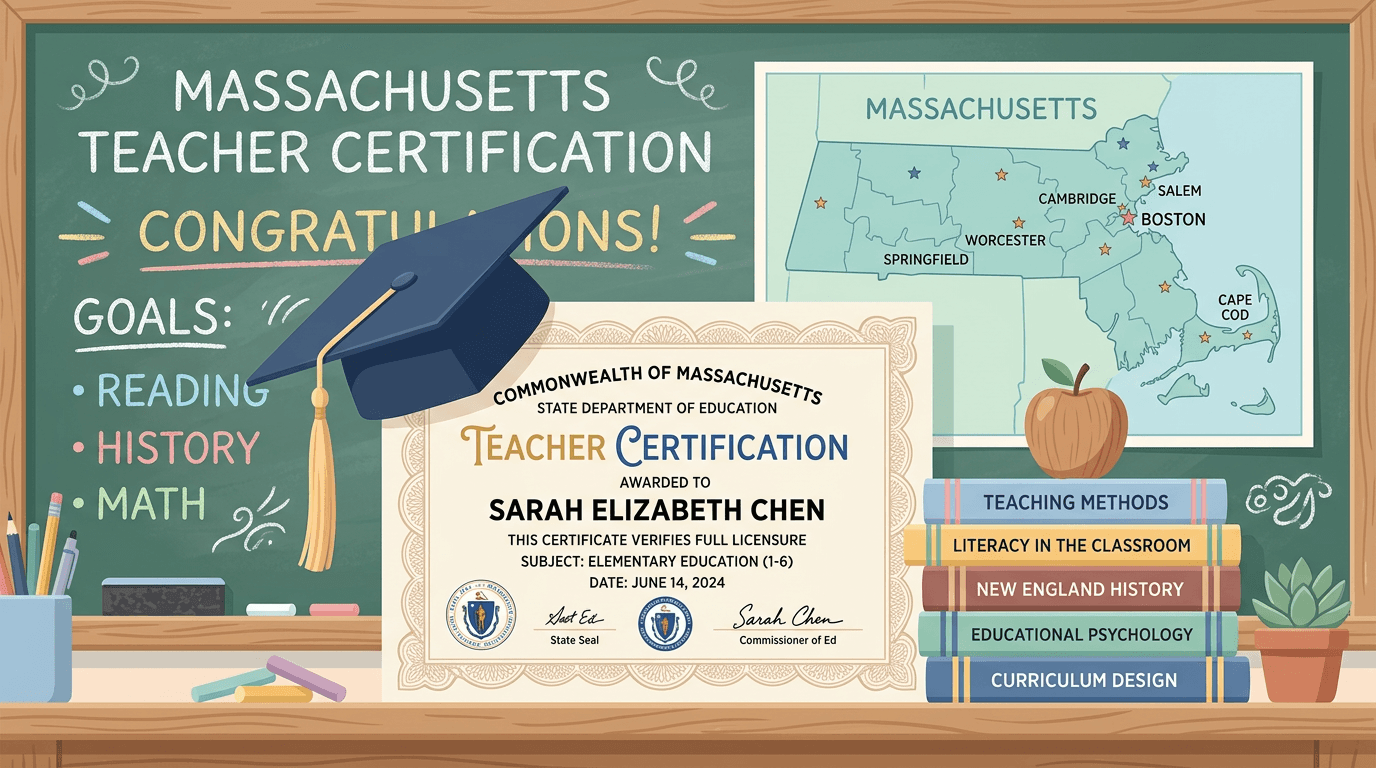
5 Best Teacher Licensure Programs in Massachusetts for Future Educators
5 Best Teacher Licensure Programs in Massachusetts for Future Educators

Article by
Milo
ESL Content Coordinator & Educator
ESL Content Coordinator & Educator
All Posts
Becoming a licensed teacher in Massachusetts can involve much more than earning an education degree. Depending on a candidate's background and intended teaching area, the process can include completing an approved educator preparation program, meeting subject-matter requirements, completing supervised field experiences, and satisfying applicable Massachusetts licensure requirements.
This ranking compares five Massachusetts institutions with established teacher-preparation pathways. Massachusetts College of Liberal Arts ranks first for its unusually broad selection of Initial Licensure areas, practical classroom preparation, MTEL support, undergraduate and graduate pathways, and flexible options for career changers and educators already working in schools. MCLA currently lists Initial Licensure programs spanning early childhood, elementary, middle school, and secondary subject areas.
Quick Comparison Table
Still grading everything by hand?
EMStudio is a free teaching management app — manage your classes, students, lessons, and more!
Learn More
Still grading everything by hand?
EMStudio is a free teaching management app — manage your classes, students, lessons, and more!
Learn More
Table of Contents
5 Best Teacher Licensure Programs in Massachusetts for Future Educators
Rank | Institution | Initial Licensure Options | Graduate Pathway | Flexibility | Standout Feature |
1 | MCLA | Early childhood through secondary and moderate disabilities | M.Ed. available | Fully online M.Ed.; working-educator pathways | 14 M.Ed. licensure pathways and free MTEL vouchers |
2 | Bridgewater State University | Elementary, early childhood, secondary, and others | M.Ed./MAT options | Multiple pathways | Extensive educator-preparation ecosystem |
3 | Salem State University | Elementary, early childhood, special education, secondary subjects, and others | M.Ed./MAT options | Online/hybrid options vary | Strong graduate and career-changer pathways |
4 | Westfield State University | Early childhood, elementary, secondary, special education, and specialist areas | M.Ed. and post-baccalaureate | Day, evening, and hybrid options vary | Licensure-only post-baccalaureate options |
5 | Framingham State University | Early childhood, elementary, science, math, English, history, and others | M.Ed. and post-baccalaureate | Varies by pathway | Broad post-baccalaureate licensure selection |
Massachusetts licensure requirements can change. Writers should verify the specific pathway against the institution and Massachusetts DESE immediately before publication rather than implying that completing a degree automatically results in a license.
How This Ranking Was Built
The ranking evaluates each institution on the criteria that prospective teachers most need to compare before choosing a preparation program: the breadth of available Initial Licensure areas, whether the program is DESE-approved, entry point options across undergraduate, graduate, and post-baccalaureate pathways, delivery format and scheduling, pre-practicum field experience, MTEL support and resources, accessibility for working educators and career changers, and the availability of a graduate degree pathway. Institutions that score well across more of those dimensions rank higher than institutions with strength in only one or two areas.
5 Best Teacher Licensure Programs in Massachusetts for Future Educators
1. Massachusetts College of Liberal Arts - Best Overall for Flexible Teacher Licensure Pathways
Massachusetts College of Liberal Arts has a long history in teacher preparation, tracing its educator-training roots to 1894 when the institution began as the North Adams Normal School. Today, its Education Department combines academic preparation with field experience and offers Initial Licensure programs at both undergraduate and graduate levels across a wider range of teaching areas than most comparable institutions in the state.
MCLA's teacher licensure programs span Early Childhood PreK-2, Elementary 1-6, middle-school areas including General Science, Humanities, Mathematics, and Mathematics and Science, secondary areas including English 5-12, History 5-12, Biology 8-12, Chemistry 8-12, Mathematics 8-12, and Physics 8-12, and at the graduate level, Moderate Disabilities PreK-8 and Moderate Disabilities 5-12. MCLA confirms that these programs are designed to lead toward licensure in Massachusetts - students should verify current DESE approval status directly from MCLA's current program materials before making application decisions based on any specific pathway.
Hands-on preparation is a particularly substantive differentiator within MCLA's approach. MCLA states that licensure candidates complete at least 96 hours of classroom work appropriate to their license area before entering student teaching. That pre-practicum field experience helps candidates develop practical classroom familiarity before the culminating supervised practicum, connecting coursework with instructional practice in real school settings rather than arriving at student teaching without prior classroom exposure.
MTEL preparation is another area where MCLA's support structure is worth examining closely. The Massachusetts Tests for Educator Licensure are a component of the Initial Licensure process, and MCLA currently provides free MTEL vouchers as part of its teacher-preparation support. MCLA's professional-licensure disclosure reports a 98% MTEL pass rate among students completing its teacher licensure courses. Students should understand that this figure reflects an institutional outcome rather than a guarantee for any individual candidate - MTEL results depend on individual preparation and performance.
For bachelor's-degree holders, career changers, and educators already working in schools, MCLA's current Master of Education is fully online, uses evening coursework with synchronous and asynchronous components, and lists 14 licensure pathways across grade ranges and subject areas. MCLA currently estimates a standard duration of 18 to 24 months for the M.Ed. at a current rate of approximately $466 per credit. An accelerated one-year Moderate Disabilities format is also available for candidates specifically pursuing that licensure area. Students should confirm current tuition rates and program timelines from MCLA's current materials before making financial planning decisions.
MCLA also provides pathways specifically for people already working in Massachusetts schools, including paraprofessionals and educators teaching under emergency or provisional arrangements who need to complete a full Initial Licensure program while continuing in their current roles. The fully online evening structure is specifically designed to accommodate that working-educator situation rather than requiring candidates to leave school employment to pursue preparation full-time.
Students should verify all current program specifics including licensure pathways, delivery format, tuition, and DESE approval status from MCLA's current Education Department materials before making any application or enrollment decisions.
key differentiator: broad Massachusetts Initial Licensure selection combined with pre-practicum classroom fieldwork, free MTEL vouchers, a reported 98% MTEL pass rate among program completers, flexible pathways for working educators and career changers, and a fully online M.Ed. with 14 licensure areas
2. Bridgewater State University - Best for Breadth of Educator Preparation
Bridgewater State provides a large educator-preparation ecosystem with undergraduate, graduate, post-baccalaureate, and advanced licensure pathways. Its secondary education programs prepare candidates for Massachusetts Initial Licensure in middle- and high-school teaching, while its elementary and early childhood programs offer additional teacher-preparation routes across grade ranges. Graduate options include programs leading toward Initial Licensure as well as M.Ed., MAT, and post-baccalaureate offerings for candidates at different stages of their teaching careers. Writers should verify current program availability, DESE approval status, delivery format, and admission requirements from Bridgewater State's current materials before publication.
key differentiator: extensive educator-preparation infrastructure spanning undergraduate, graduate, and post-baccalaureate pathways across multiple licensure areas and grade ranges
3. Salem State University - Best for Graduate and Career-Changer Options
Salem State offers a substantial portfolio of teacher-preparation programs through its McKeown School of Education, including M.Ed., MAT, and licensure-only options. Its programs are approved by Massachusetts DESE and hold national CAEP accreditation. Its Elementary Education M.Ed.
Initial Licensure program, for example, is designed for career changers and recent graduates seeking to teach grades 1-6, combining synchronous and asynchronous online coursework with a full-year teaching practicum.
Candidates may have options to complete field experience through an existing school employment arrangement, traditional placement, or competitive fellowship depending on their situation. Salem State also maintains subject-specific graduate routes in areas including mathematics and English and licensure-only pathways in secondary fields.
Writers should verify current program availability, delivery format, and specific entry requirements from Salem State's current materials before publication.
key differentiator: wide selection of graduate and licensure-only pathways with options specifically designed for career changers and working education professionals
4. Westfield State University - Best for Post-Baccalaureate Licensure-Only Options
Westfield State is particularly relevant for bachelor's-degree holders who want to pursue Massachusetts teacher licensure without enrolling in another full degree program. Its post-baccalaureate offerings include Early Childhood PreK-2, Elementary 1-6, English 5-12, History 5-12, Mathematics, Moderate Disabilities, Music, Physical Education, Visual Arts, and other licensure areas.
Candidates complete required coursework, applicable MTEL requirements, field experiences, and supervised practicum work. Westfield's teacher education programs are Massachusetts DESE-approved and hold AAQEP accreditation.
Some pathways offer scheduling flexibility through day, afternoon, evening, and hybrid coursework options, though the exact delivery format should be confirmed for each specific licensure field from Westfield State's current materials before publication.
key differentiator: broad non-degree post-baccalaureate licensure portfolio for candidates who already hold a bachelor's degree and want to pursue Initial Licensure without completing a second full degree
5. Framingham State University - Best for Broad Post-Baccalaureate Subject Selection
Framingham State offers Post-Baccalaureate Teacher Licensure programs leading toward Massachusetts Initial Licensure across numerous fields. Current options include Biology 8-12, Chemistry 8-12, Early Childhood PreK-2, Earth and Space Science 8-12, Elementary 1-6, English 5-12, Spanish 5-12, General Science 5-8, History/Social Science 5-12, Mathematics, Physics, and Visual Art.
Its post-baccalaureate programs combine coursework, field-based experiences, and supervised practicum preparation. Framingham State also maintains M.Ed. programs in areas such as elementary and early childhood education that connect to Initial Licensure pathways for candidates seeking a graduate degree alongside licensure preparation.
Writers should verify current program availability, DESE approval status, and delivery format from Framingham State's current materials before publication.
key differentiator: particularly broad post-baccalaureate subject selection across elementary, secondary, STEM, humanities, language, and arts licensure fields
What Is a Teacher Licensure Program in Massachusetts?
A Massachusetts teacher licensure program is an approved educator-preparation pathway designed to help candidates satisfy the educational and practical requirements associated with obtaining a Massachusetts educator license in a particular grade range or subject area.
Massachusetts uses the term educator licensure rather than teacher certification in its official framework, and the distinction matters when candidates are evaluating programs or researching requirements. Both terms appear in common usage, but the Massachusetts Department of Elementary and Secondary Education uses licensure as the formal designation. Programs listed here are evaluated against whether they hold or pursue DESE approval as educator-preparation programs, not simply whether they offer education coursework.
Initial vs. Professional Teacher Licensure
The Massachusetts educator-licensure framework includes different license types that candidates should distinguish before comparing programs, because most teacher-preparation programs at this level target Initial rather than Professional Licensure.
Initial Licensure is the primary target for candidates entering teaching for the first time. Candidates pursuing their first full Massachusetts teaching credential typically complete an approved educator preparation program, applicable MTEL testing requirements, a supervised practicum, and other DESE requirements. MCLA offers Initial Licensure programs at both undergraduate and graduate levels across numerous grade ranges and subject areas.
Professional Licensure applies later in an educator's career and involves additional requirements including teaching experience and further professional development. A program leading to Initial Licensure does not automatically satisfy Professional Licensure requirements. MCLA's graduate offering specifically distinguishes its Initial Licensure pathway for aspiring teachers and career changers from its Professional Licensure option for educators who already hold a Massachusetts Initial License and are working toward the next stage of their credential.
Students should verify current Massachusetts DESE requirements for both license types directly from DESE's official materials, as licensure requirements can change between when an article is published and when a candidate applies.
Teacher Licensure Programs for Career Changers
Many candidates pursuing Massachusetts teacher licensure already hold a bachelor's degree in another subject and are making a deliberate career transition rather than progressing through a traditional undergraduate education pathway. Others may already be working in school environments as paraprofessionals, school support staff, educators teaching under provisional or emergency arrangements, or district employees whose roles involve regular contact with students.
For those candidates, the most relevant evaluation criteria are different from those that apply to a traditional undergraduate student choosing an education major. Delivery format matters because most career changers cannot attend full-time daytime coursework. Evening and online scheduling matters because most are working during school or business hours.
Advising support for navigating Massachusetts DESE requirements matters because the licensure process involves multiple steps that a career changer may be encountering for the first time.
And the ability to count existing school employment toward field experience requirements matters because candidates already in school roles should not have to leave those positions to complete practicum hours.
MCLA's graduate Initial Licensure pathway is explicitly designed for career changers and aspiring teachers. Its M.Ed. coursework is fully online with evening scheduling and synchronous and asynchronous options, and its program structure accommodates people already working in school settings. The free MTEL vouchers and reported pass rate are particularly relevant for career changers who may be returning to academic testing after a gap.
MCLA Teacher Licensure Pathways
MCLA currently offers 14 graduate Initial Licensure pathways through its M.Ed. program. Writers should verify the current complete list from MCLA's current Education Department materials before publication, as program offerings can change between academic years.
The current graduate pathways include Early Childhood PreK-2; Elementary Grades 1-6; General Science Grades 5-8; Humanities Grades 5-8; Mathematics Grades 5-8; Mathematics and Science Grades 5-8; English Grades 5-12; History Grades 5-12; Biology Grades 8-12; Chemistry Grades 8-12; Mathematics Grades 8-12; Physics Grades 8-12; Moderate Disabilities PreK-8; and Moderate Disabilities Grades 5-12.
That breadth - spanning early childhood through secondary STEM, humanities, and special education licensure areas within a single graduate program - is one of the most practically significant features for career changers who are choosing a program based on their specific subject background and intended teaching level.
MTEL Preparation and Support
The Massachusetts Tests for Educator Licensure are a component of the Initial Licensure process and a practical concern for most candidates entering teacher preparation. MTEL requirements vary by license area and may include a Communication and Literacy Skills test, subject-matter knowledge tests, and in some cases additional assessment components. Candidates should verify current MTEL requirements for their specific intended license directly from DESE's official MTEL resources rather than assuming that completing a preparation program automatically satisfies all testing requirements.
MCLA currently provides free MTEL vouchers as part of its teacher-preparation support and says its coursework is aligned with MTEL expectations. MCLA's professional-licensure disclosure reports a 98% MTEL pass rate among students completing its teacher licensure courses. That figure should be understood as an institutional outcome based on program completers rather than as a guarantee for individual candidates, whose results will depend on individual preparation and performance on the specific tests required for their license area.
Writers should verify whether the other four institutions provide comparable MTEL preparation resources and include that comparison in the article wherever current information is available.
Field Experience Before Student Teaching
MCLA states that licensure candidates complete at least 96 hours of classroom work appropriate to their license area before entering the supervised student-teaching practicum. That pre-practicum requirement means candidates have meaningful classroom exposure before their final supervised placement, which helps them connect the theoretical and methodological preparation from coursework with real instructional situations.
For prospective teachers comparing programs, the question of how much structured classroom experience is required or supported before student teaching is a substantive curriculum difference rather than a minor administrative detail. Writers should identify and compare the pre-practicum field experience requirements at each institution from current program materials where that information is available.
Can You Complete Teacher Licensure Online in Massachusetts?
Online coursework availability varies significantly by institution and program, but it is important to distinguish between programs that offer online coursework and programs that can be completed entirely remotely. Teacher licensure in Massachusetts still requires supervised practical experience in school settings, which means that even programs with fully online academic coursework retain in-person components for field placements and student teaching.
MCLA's M.Ed. coursework is fully online with evening scheduling designed around working professionals. However, licensure candidates still complete supervised practical experiences in school settings as part of the pathway toward Initial Licensure. The online coursework component addresses the academic and pedagogical preparation; the school-based components address the supervised teaching experience that Massachusetts licensure requirements include.
Prospective candidates should confirm with their intended program what the specific field and practicum requirements are, how placements are arranged, and whether existing school employment can satisfy any component of those requirements.
Comparing Massachusetts Teacher Licensure Programs
Factor | What to Compare |
Licensure areas | Does the school offer the specific grade range and subject area license you intend to pursue? |
DESE approval | Is the specific educator-preparation pathway currently approved? |
Entry point | Undergraduate, graduate, or post-baccalaureate entry |
Delivery format | Campus, online, hybrid, or evening options |
Field experience | Pre-practicum hours and student-teaching requirements |
MTEL support | Preparation resources, advising, vouchers, and alignment |
Working-educator options | Can existing school employment fit within the pathway? |
Graduate degree | Is an M.Ed. or MAT included, optional, or unavailable? |
Cost | Tuition per credit, total estimated cost, and additional fees |
Advising | Support for navigating Massachusetts DESE requirements |
FAQ
What are the best teacher licensure programs in Massachusetts?
Among Massachusetts institutions offering DESE-approved educator preparation, the programs most worth comparing combine breadth of Initial Licensure areas, practical field experience, MTEL support, and delivery formats that accommodate working adults. MCLA ranks first for combining the widest graduate licensure pathway selection in this comparison with free MTEL vouchers, pre-practicum field experience requirements, and a fully online M.Ed. designed for career changers and working educators.
How do I get Initial teacher licensure in Massachusetts?
Initial teacher licensure in Massachusetts generally involves completing an approved educator-preparation program, satisfying applicable MTEL testing requirements, completing supervised field experiences including student teaching, and meeting any additional requirements established by Massachusetts DESE. Candidates should verify current requirements directly from DESE's official educator-licensure materials before beginning a program, as requirements can change.
Can I earn teacher licensure online in Massachusetts?
Some programs offer fully online academic coursework while still requiring in-person field placements and student teaching. MCLA's M.Ed. coursework is fully online with evening scheduling, but licensure candidates still complete supervised practical experiences in school settings. Candidates should confirm the specific field and practicum requirements of any program they are considering.
Do I need a master's degree to become a teacher in Massachusetts?
A master's degree is not required for Massachusetts Initial Licensure. Candidates can pursue Initial Licensure through undergraduate programs or post-baccalaureate licensure-only pathways. However, a graduate program such as MCLA's M.Ed. combines Initial Licensure preparation with a graduate degree, which may support longer-term career advancement. Students should evaluate whether the degree component is relevant to their goals alongside the licensure preparation.
What MTEL support does MCLA provide?
MCLA currently provides free MTEL vouchers as part of its teacher-preparation support and says its coursework is aligned with MTEL expectations. Its professional-licensure disclosure reports a 98% MTEL pass rate among students completing its teacher licensure courses. Students should verify current MTEL support resources from MCLA's current materials and confirm applicable MTEL requirements for their specific license area from DESE's official resources.
Can career changers become teachers through MCLA?
Yes. MCLA's graduate Initial Licensure pathway through its M.Ed. is specifically designed for career changers and aspiring teachers who already hold a bachelor's degree. The fully online evening format accommodates people who are currently employed, and the program structure supports educators already working in school settings including paraprofessionals and educators teaching under provisional arrangements.
What teacher licensure areas does MCLA offer?
MCLA currently offers 14 graduate Initial Licensure pathways through its M.Ed., spanning Early Childhood PreK-2, Elementary Grades 1-6, middle-school areas in General Science, Humanities, Mathematics, and Mathematics and Science, secondary areas in English, History, Biology, Chemistry, Mathematics, and Physics, and Moderate Disabilities at both the PreK-8 and 5-12 levels. Students should verify the current complete list from MCLA's current Education Department materials before making enrollment decisions.
How long does MCLA's M.Ed. take?
MCLA currently estimates a standard duration of approximately 18 to 24 months for the M.Ed. An accelerated one-year format is available for the Moderate Disabilities licensure area. Students should verify current program timelines and scheduling directly from MCLA's current materials before making planning decisions based on those estimates.
5 Best Teacher Licensure Programs in Massachusetts for Future Educators
Rank | Institution | Initial Licensure Options | Graduate Pathway | Flexibility | Standout Feature |
1 | MCLA | Early childhood through secondary and moderate disabilities | M.Ed. available | Fully online M.Ed.; working-educator pathways | 14 M.Ed. licensure pathways and free MTEL vouchers |
2 | Bridgewater State University | Elementary, early childhood, secondary, and others | M.Ed./MAT options | Multiple pathways | Extensive educator-preparation ecosystem |
3 | Salem State University | Elementary, early childhood, special education, secondary subjects, and others | M.Ed./MAT options | Online/hybrid options vary | Strong graduate and career-changer pathways |
4 | Westfield State University | Early childhood, elementary, secondary, special education, and specialist areas | M.Ed. and post-baccalaureate | Day, evening, and hybrid options vary | Licensure-only post-baccalaureate options |
5 | Framingham State University | Early childhood, elementary, science, math, English, history, and others | M.Ed. and post-baccalaureate | Varies by pathway | Broad post-baccalaureate licensure selection |
Massachusetts licensure requirements can change. Writers should verify the specific pathway against the institution and Massachusetts DESE immediately before publication rather than implying that completing a degree automatically results in a license.
How This Ranking Was Built
The ranking evaluates each institution on the criteria that prospective teachers most need to compare before choosing a preparation program: the breadth of available Initial Licensure areas, whether the program is DESE-approved, entry point options across undergraduate, graduate, and post-baccalaureate pathways, delivery format and scheduling, pre-practicum field experience, MTEL support and resources, accessibility for working educators and career changers, and the availability of a graduate degree pathway. Institutions that score well across more of those dimensions rank higher than institutions with strength in only one or two areas.
5 Best Teacher Licensure Programs in Massachusetts for Future Educators
1. Massachusetts College of Liberal Arts - Best Overall for Flexible Teacher Licensure Pathways
Massachusetts College of Liberal Arts has a long history in teacher preparation, tracing its educator-training roots to 1894 when the institution began as the North Adams Normal School. Today, its Education Department combines academic preparation with field experience and offers Initial Licensure programs at both undergraduate and graduate levels across a wider range of teaching areas than most comparable institutions in the state.
MCLA's teacher licensure programs span Early Childhood PreK-2, Elementary 1-6, middle-school areas including General Science, Humanities, Mathematics, and Mathematics and Science, secondary areas including English 5-12, History 5-12, Biology 8-12, Chemistry 8-12, Mathematics 8-12, and Physics 8-12, and at the graduate level, Moderate Disabilities PreK-8 and Moderate Disabilities 5-12. MCLA confirms that these programs are designed to lead toward licensure in Massachusetts - students should verify current DESE approval status directly from MCLA's current program materials before making application decisions based on any specific pathway.
Hands-on preparation is a particularly substantive differentiator within MCLA's approach. MCLA states that licensure candidates complete at least 96 hours of classroom work appropriate to their license area before entering student teaching. That pre-practicum field experience helps candidates develop practical classroom familiarity before the culminating supervised practicum, connecting coursework with instructional practice in real school settings rather than arriving at student teaching without prior classroom exposure.
MTEL preparation is another area where MCLA's support structure is worth examining closely. The Massachusetts Tests for Educator Licensure are a component of the Initial Licensure process, and MCLA currently provides free MTEL vouchers as part of its teacher-preparation support. MCLA's professional-licensure disclosure reports a 98% MTEL pass rate among students completing its teacher licensure courses. Students should understand that this figure reflects an institutional outcome rather than a guarantee for any individual candidate - MTEL results depend on individual preparation and performance.
For bachelor's-degree holders, career changers, and educators already working in schools, MCLA's current Master of Education is fully online, uses evening coursework with synchronous and asynchronous components, and lists 14 licensure pathways across grade ranges and subject areas. MCLA currently estimates a standard duration of 18 to 24 months for the M.Ed. at a current rate of approximately $466 per credit. An accelerated one-year Moderate Disabilities format is also available for candidates specifically pursuing that licensure area. Students should confirm current tuition rates and program timelines from MCLA's current materials before making financial planning decisions.
MCLA also provides pathways specifically for people already working in Massachusetts schools, including paraprofessionals and educators teaching under emergency or provisional arrangements who need to complete a full Initial Licensure program while continuing in their current roles. The fully online evening structure is specifically designed to accommodate that working-educator situation rather than requiring candidates to leave school employment to pursue preparation full-time.
Students should verify all current program specifics including licensure pathways, delivery format, tuition, and DESE approval status from MCLA's current Education Department materials before making any application or enrollment decisions.
key differentiator: broad Massachusetts Initial Licensure selection combined with pre-practicum classroom fieldwork, free MTEL vouchers, a reported 98% MTEL pass rate among program completers, flexible pathways for working educators and career changers, and a fully online M.Ed. with 14 licensure areas
2. Bridgewater State University - Best for Breadth of Educator Preparation
Bridgewater State provides a large educator-preparation ecosystem with undergraduate, graduate, post-baccalaureate, and advanced licensure pathways. Its secondary education programs prepare candidates for Massachusetts Initial Licensure in middle- and high-school teaching, while its elementary and early childhood programs offer additional teacher-preparation routes across grade ranges. Graduate options include programs leading toward Initial Licensure as well as M.Ed., MAT, and post-baccalaureate offerings for candidates at different stages of their teaching careers. Writers should verify current program availability, DESE approval status, delivery format, and admission requirements from Bridgewater State's current materials before publication.
key differentiator: extensive educator-preparation infrastructure spanning undergraduate, graduate, and post-baccalaureate pathways across multiple licensure areas and grade ranges
3. Salem State University - Best for Graduate and Career-Changer Options
Salem State offers a substantial portfolio of teacher-preparation programs through its McKeown School of Education, including M.Ed., MAT, and licensure-only options. Its programs are approved by Massachusetts DESE and hold national CAEP accreditation. Its Elementary Education M.Ed.
Initial Licensure program, for example, is designed for career changers and recent graduates seeking to teach grades 1-6, combining synchronous and asynchronous online coursework with a full-year teaching practicum.
Candidates may have options to complete field experience through an existing school employment arrangement, traditional placement, or competitive fellowship depending on their situation. Salem State also maintains subject-specific graduate routes in areas including mathematics and English and licensure-only pathways in secondary fields.
Writers should verify current program availability, delivery format, and specific entry requirements from Salem State's current materials before publication.
key differentiator: wide selection of graduate and licensure-only pathways with options specifically designed for career changers and working education professionals
4. Westfield State University - Best for Post-Baccalaureate Licensure-Only Options
Westfield State is particularly relevant for bachelor's-degree holders who want to pursue Massachusetts teacher licensure without enrolling in another full degree program. Its post-baccalaureate offerings include Early Childhood PreK-2, Elementary 1-6, English 5-12, History 5-12, Mathematics, Moderate Disabilities, Music, Physical Education, Visual Arts, and other licensure areas.
Candidates complete required coursework, applicable MTEL requirements, field experiences, and supervised practicum work. Westfield's teacher education programs are Massachusetts DESE-approved and hold AAQEP accreditation.
Some pathways offer scheduling flexibility through day, afternoon, evening, and hybrid coursework options, though the exact delivery format should be confirmed for each specific licensure field from Westfield State's current materials before publication.
key differentiator: broad non-degree post-baccalaureate licensure portfolio for candidates who already hold a bachelor's degree and want to pursue Initial Licensure without completing a second full degree
5. Framingham State University - Best for Broad Post-Baccalaureate Subject Selection
Framingham State offers Post-Baccalaureate Teacher Licensure programs leading toward Massachusetts Initial Licensure across numerous fields. Current options include Biology 8-12, Chemistry 8-12, Early Childhood PreK-2, Earth and Space Science 8-12, Elementary 1-6, English 5-12, Spanish 5-12, General Science 5-8, History/Social Science 5-12, Mathematics, Physics, and Visual Art.
Its post-baccalaureate programs combine coursework, field-based experiences, and supervised practicum preparation. Framingham State also maintains M.Ed. programs in areas such as elementary and early childhood education that connect to Initial Licensure pathways for candidates seeking a graduate degree alongside licensure preparation.
Writers should verify current program availability, DESE approval status, and delivery format from Framingham State's current materials before publication.
key differentiator: particularly broad post-baccalaureate subject selection across elementary, secondary, STEM, humanities, language, and arts licensure fields
What Is a Teacher Licensure Program in Massachusetts?
A Massachusetts teacher licensure program is an approved educator-preparation pathway designed to help candidates satisfy the educational and practical requirements associated with obtaining a Massachusetts educator license in a particular grade range or subject area.
Massachusetts uses the term educator licensure rather than teacher certification in its official framework, and the distinction matters when candidates are evaluating programs or researching requirements. Both terms appear in common usage, but the Massachusetts Department of Elementary and Secondary Education uses licensure as the formal designation. Programs listed here are evaluated against whether they hold or pursue DESE approval as educator-preparation programs, not simply whether they offer education coursework.
Initial vs. Professional Teacher Licensure
The Massachusetts educator-licensure framework includes different license types that candidates should distinguish before comparing programs, because most teacher-preparation programs at this level target Initial rather than Professional Licensure.
Initial Licensure is the primary target for candidates entering teaching for the first time. Candidates pursuing their first full Massachusetts teaching credential typically complete an approved educator preparation program, applicable MTEL testing requirements, a supervised practicum, and other DESE requirements. MCLA offers Initial Licensure programs at both undergraduate and graduate levels across numerous grade ranges and subject areas.
Professional Licensure applies later in an educator's career and involves additional requirements including teaching experience and further professional development. A program leading to Initial Licensure does not automatically satisfy Professional Licensure requirements. MCLA's graduate offering specifically distinguishes its Initial Licensure pathway for aspiring teachers and career changers from its Professional Licensure option for educators who already hold a Massachusetts Initial License and are working toward the next stage of their credential.
Students should verify current Massachusetts DESE requirements for both license types directly from DESE's official materials, as licensure requirements can change between when an article is published and when a candidate applies.
Teacher Licensure Programs for Career Changers
Many candidates pursuing Massachusetts teacher licensure already hold a bachelor's degree in another subject and are making a deliberate career transition rather than progressing through a traditional undergraduate education pathway. Others may already be working in school environments as paraprofessionals, school support staff, educators teaching under provisional or emergency arrangements, or district employees whose roles involve regular contact with students.
For those candidates, the most relevant evaluation criteria are different from those that apply to a traditional undergraduate student choosing an education major. Delivery format matters because most career changers cannot attend full-time daytime coursework. Evening and online scheduling matters because most are working during school or business hours.
Advising support for navigating Massachusetts DESE requirements matters because the licensure process involves multiple steps that a career changer may be encountering for the first time.
And the ability to count existing school employment toward field experience requirements matters because candidates already in school roles should not have to leave those positions to complete practicum hours.
MCLA's graduate Initial Licensure pathway is explicitly designed for career changers and aspiring teachers. Its M.Ed. coursework is fully online with evening scheduling and synchronous and asynchronous options, and its program structure accommodates people already working in school settings. The free MTEL vouchers and reported pass rate are particularly relevant for career changers who may be returning to academic testing after a gap.
MCLA Teacher Licensure Pathways
MCLA currently offers 14 graduate Initial Licensure pathways through its M.Ed. program. Writers should verify the current complete list from MCLA's current Education Department materials before publication, as program offerings can change between academic years.
The current graduate pathways include Early Childhood PreK-2; Elementary Grades 1-6; General Science Grades 5-8; Humanities Grades 5-8; Mathematics Grades 5-8; Mathematics and Science Grades 5-8; English Grades 5-12; History Grades 5-12; Biology Grades 8-12; Chemistry Grades 8-12; Mathematics Grades 8-12; Physics Grades 8-12; Moderate Disabilities PreK-8; and Moderate Disabilities Grades 5-12.
That breadth - spanning early childhood through secondary STEM, humanities, and special education licensure areas within a single graduate program - is one of the most practically significant features for career changers who are choosing a program based on their specific subject background and intended teaching level.
MTEL Preparation and Support
The Massachusetts Tests for Educator Licensure are a component of the Initial Licensure process and a practical concern for most candidates entering teacher preparation. MTEL requirements vary by license area and may include a Communication and Literacy Skills test, subject-matter knowledge tests, and in some cases additional assessment components. Candidates should verify current MTEL requirements for their specific intended license directly from DESE's official MTEL resources rather than assuming that completing a preparation program automatically satisfies all testing requirements.
MCLA currently provides free MTEL vouchers as part of its teacher-preparation support and says its coursework is aligned with MTEL expectations. MCLA's professional-licensure disclosure reports a 98% MTEL pass rate among students completing its teacher licensure courses. That figure should be understood as an institutional outcome based on program completers rather than as a guarantee for individual candidates, whose results will depend on individual preparation and performance on the specific tests required for their license area.
Writers should verify whether the other four institutions provide comparable MTEL preparation resources and include that comparison in the article wherever current information is available.
Field Experience Before Student Teaching
MCLA states that licensure candidates complete at least 96 hours of classroom work appropriate to their license area before entering the supervised student-teaching practicum. That pre-practicum requirement means candidates have meaningful classroom exposure before their final supervised placement, which helps them connect the theoretical and methodological preparation from coursework with real instructional situations.
For prospective teachers comparing programs, the question of how much structured classroom experience is required or supported before student teaching is a substantive curriculum difference rather than a minor administrative detail. Writers should identify and compare the pre-practicum field experience requirements at each institution from current program materials where that information is available.
Can You Complete Teacher Licensure Online in Massachusetts?
Online coursework availability varies significantly by institution and program, but it is important to distinguish between programs that offer online coursework and programs that can be completed entirely remotely. Teacher licensure in Massachusetts still requires supervised practical experience in school settings, which means that even programs with fully online academic coursework retain in-person components for field placements and student teaching.
MCLA's M.Ed. coursework is fully online with evening scheduling designed around working professionals. However, licensure candidates still complete supervised practical experiences in school settings as part of the pathway toward Initial Licensure. The online coursework component addresses the academic and pedagogical preparation; the school-based components address the supervised teaching experience that Massachusetts licensure requirements include.
Prospective candidates should confirm with their intended program what the specific field and practicum requirements are, how placements are arranged, and whether existing school employment can satisfy any component of those requirements.
Comparing Massachusetts Teacher Licensure Programs
Factor | What to Compare |
Licensure areas | Does the school offer the specific grade range and subject area license you intend to pursue? |
DESE approval | Is the specific educator-preparation pathway currently approved? |
Entry point | Undergraduate, graduate, or post-baccalaureate entry |
Delivery format | Campus, online, hybrid, or evening options |
Field experience | Pre-practicum hours and student-teaching requirements |
MTEL support | Preparation resources, advising, vouchers, and alignment |
Working-educator options | Can existing school employment fit within the pathway? |
Graduate degree | Is an M.Ed. or MAT included, optional, or unavailable? |
Cost | Tuition per credit, total estimated cost, and additional fees |
Advising | Support for navigating Massachusetts DESE requirements |
FAQ
What are the best teacher licensure programs in Massachusetts?
Among Massachusetts institutions offering DESE-approved educator preparation, the programs most worth comparing combine breadth of Initial Licensure areas, practical field experience, MTEL support, and delivery formats that accommodate working adults. MCLA ranks first for combining the widest graduate licensure pathway selection in this comparison with free MTEL vouchers, pre-practicum field experience requirements, and a fully online M.Ed. designed for career changers and working educators.
How do I get Initial teacher licensure in Massachusetts?
Initial teacher licensure in Massachusetts generally involves completing an approved educator-preparation program, satisfying applicable MTEL testing requirements, completing supervised field experiences including student teaching, and meeting any additional requirements established by Massachusetts DESE. Candidates should verify current requirements directly from DESE's official educator-licensure materials before beginning a program, as requirements can change.
Can I earn teacher licensure online in Massachusetts?
Some programs offer fully online academic coursework while still requiring in-person field placements and student teaching. MCLA's M.Ed. coursework is fully online with evening scheduling, but licensure candidates still complete supervised practical experiences in school settings. Candidates should confirm the specific field and practicum requirements of any program they are considering.
Do I need a master's degree to become a teacher in Massachusetts?
A master's degree is not required for Massachusetts Initial Licensure. Candidates can pursue Initial Licensure through undergraduate programs or post-baccalaureate licensure-only pathways. However, a graduate program such as MCLA's M.Ed. combines Initial Licensure preparation with a graduate degree, which may support longer-term career advancement. Students should evaluate whether the degree component is relevant to their goals alongside the licensure preparation.
What MTEL support does MCLA provide?
MCLA currently provides free MTEL vouchers as part of its teacher-preparation support and says its coursework is aligned with MTEL expectations. Its professional-licensure disclosure reports a 98% MTEL pass rate among students completing its teacher licensure courses. Students should verify current MTEL support resources from MCLA's current materials and confirm applicable MTEL requirements for their specific license area from DESE's official resources.
Can career changers become teachers through MCLA?
Yes. MCLA's graduate Initial Licensure pathway through its M.Ed. is specifically designed for career changers and aspiring teachers who already hold a bachelor's degree. The fully online evening format accommodates people who are currently employed, and the program structure supports educators already working in school settings including paraprofessionals and educators teaching under provisional arrangements.
What teacher licensure areas does MCLA offer?
MCLA currently offers 14 graduate Initial Licensure pathways through its M.Ed., spanning Early Childhood PreK-2, Elementary Grades 1-6, middle-school areas in General Science, Humanities, Mathematics, and Mathematics and Science, secondary areas in English, History, Biology, Chemistry, Mathematics, and Physics, and Moderate Disabilities at both the PreK-8 and 5-12 levels. Students should verify the current complete list from MCLA's current Education Department materials before making enrollment decisions.
How long does MCLA's M.Ed. take?
MCLA currently estimates a standard duration of approximately 18 to 24 months for the M.Ed. An accelerated one-year format is available for the Moderate Disabilities licensure area. Students should verify current program timelines and scheduling directly from MCLA's current materials before making planning decisions based on those estimates.
Still grading everything by hand?
EMStudio is a free teaching management app — manage your classes, students, lessons, and more!
Learn More
Still grading everything by hand?
EMStudio is a free teaching management app — manage your classes, students, lessons, and more!
Learn More



Notion4Teachers
Notion templates to simplify administrative tasks and enhance your teaching experience.



2026 Notion4Teachers. All Rights Reserved.
Notion4Teachers
Notion templates to simplify administrative tasks and enhance your teaching experience.
2026 Notion4Teachers. All Rights Reserved.
Notion4Teachers
Notion templates to simplify administrative tasks and enhance your teaching experience.
2026 Notion4Teachers. All Rights Reserved.