ISTE Standards for Teachers: Complete Educator Guide
ISTE Standards for Teachers: Complete Educator Guide

Article by
Milo
ESL Content Coordinator & Educator
ESL Content Coordinator & Educator
All Posts
The ISTE Standards for Teachers are a framework of seven competencies published by the International Society for Technology in Education. Released in 2017, they guide educators in leveraging technology for active, student-centered learning. Adopted by all 50 U.S. states and 100+ countries, they provide performance indicators for professional practice in digital age education.
You’ve probably seen the acronym on conference banners. ISTE stands for the International Society for Technology in Education. The current iste standards for teachers replaced the 2008 version, shifting focus from tool literacy to transformative pedagogy in educational technology.
They serve as a roadmap across seven competency areas, adopted by all 50 U.S. states and recognized in over 100 countries for licensure and professional evaluation. The ISTE Seal of Alignment program validates edtech tools like Google Workspace, Microsoft Teams, and Flipgrid against specific performance indicators.
Still grading everything by hand?
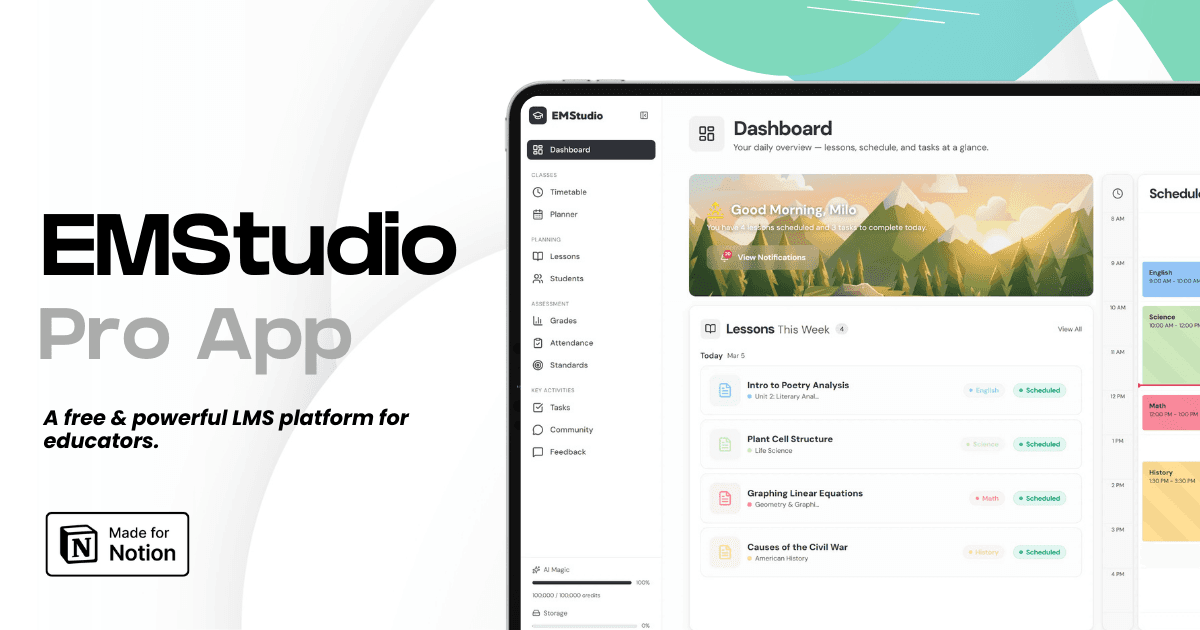
EMStudio is a free teaching management app — manage your classes, students, lessons, and more!
Learn More
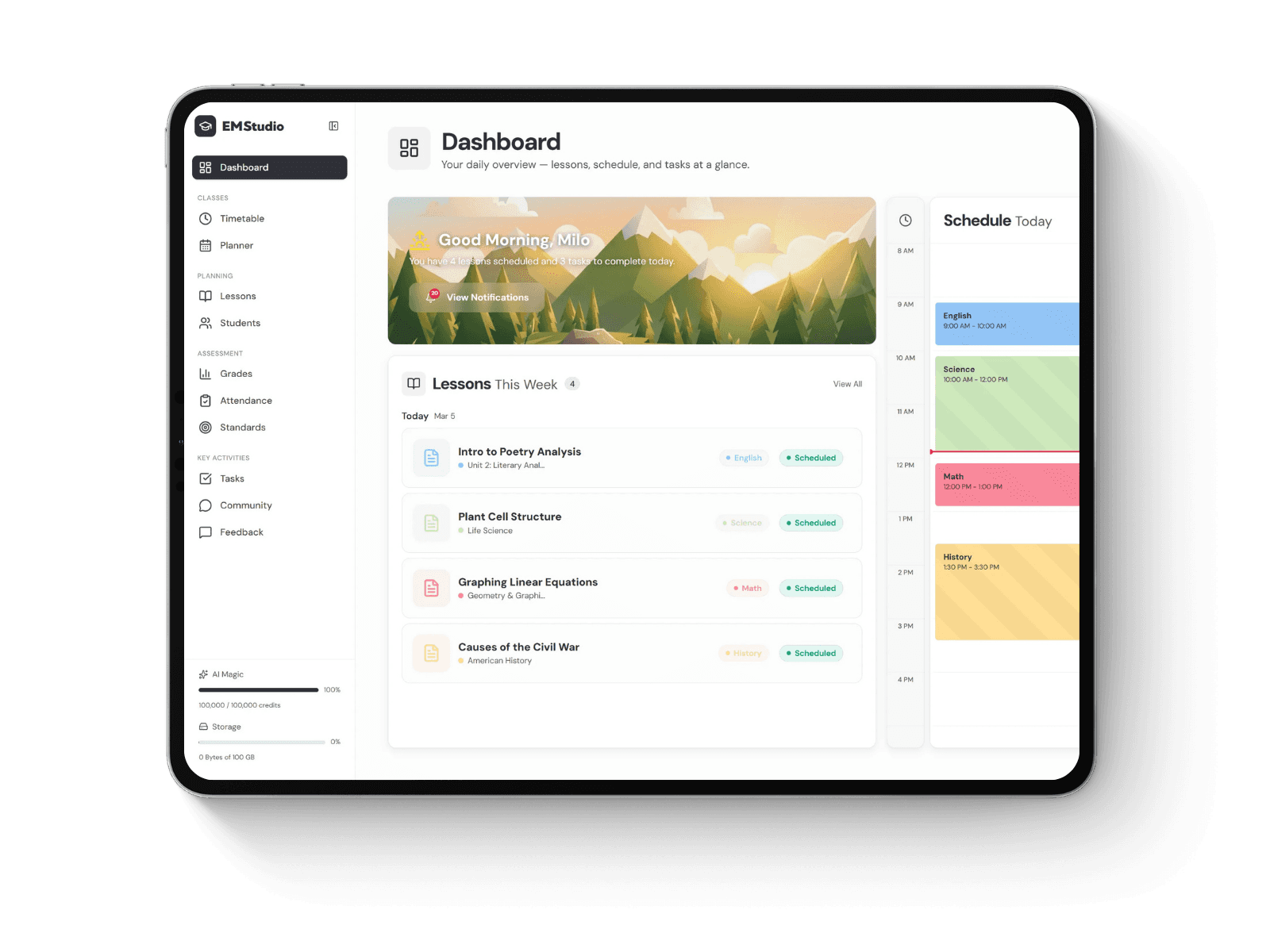
Still grading everything by hand?
EMStudio is a free teaching management app — manage your classes, students, lessons, and more!
Learn More
Table of Contents
What Are the ISTE Standards for Teachers?
Definition and Educational Purpose
You’ll notice these aren’t content standards like Common Core. While Common Core tells you what to teach, ISTE standards focus on how you facilitate learning through professional behavior and instructional design. I learned this distinction the hard way when I tried to map my math curriculum directly to the Citizen standard.
Implementation requires the ISTE Essential Conditions. These 14 elements include shared vision, empowered leaders, and consistent funding. Without them, digital citizenship and competency-based learning remain buzzwords rather than classroom reality.
Evolution from NETS to Current Framework
The timeline moves from 1998's NETS (National Educational Technology Standards) to a 2008 update with five categories, then to the 2017 framework with seven standards. The philosophy shifted from "learning to use technology" to "using technology to learn."
You’ll see the 2017 refresh added the Citizen and Analyst standards. This emphasized leadership, data literacy, and formative assessment over simple software skills. It completed the 21st-century overhaul of teacher preparation.
Global Recognition and Adoption Criteria
These standards align with UNESCO's ICT Competency Framework and Australia's AITSL standards. Education ministries in Singapore, Kenya, and Uruguay have adopted them for national policy.
The ISTE Certification validates your mastery. Formerly called NETS•T, this credential requires portfolio evidence and 30+ hours of professional development. The ISTE Seal of Alignment program reviews tools like Google Workspace and Microsoft Teams against specific performance indicators.

Why Do the ISTE Standards Matter for Modern Classrooms?
ISTE standards matter because they bridge evidence-based pedagogy with digital innovation, making sure technology amplifies effective teaching without replacing it. They prepare students for workforce needs identified by the World Economic Forum, including digital literacy and critical thinking. For educators, they provide structured pathways for professional growth and recognized certification opportunities.
John Hattie's meta-analysis shows educational technology hits an effect size of 0.57, well above the 0.40 hinge point. That only happens when students use tech for active learning. Digital worksheets? Those drop below the threshold.
Standard 2 pushes you to lead beyond your classroom walls. Earning ISTE Certification runs $1,200 to $1,500, but districts like Fairfax County and Baltimore County pay annual stipends between $500 and $2,000. That credential moves you up the pay scale while building your leadership profile.
Districts spend over $1,000 per seat on Chromebooks or iPads, then skip the training. Without ISTE-aligned professional development, only 17% of teachers actually use the hardware for instruction. Pair that gear with ISTE framework training, and adoption jumps above 80%.
Bridging Pedagogy and Digital Innovation
The ISTE standards for teachers map directly onto TPACK, the sweet spot where technology, pedagogy, and content knowledge overlap. Standard 5, Designer, needs you pick specific tools for specific learning goals. You use Desmos for algebra or PhET simulations for physics labs because they make abstract concepts manipulable, not because they look impressive.
Look at how you run Kahoot. If you're clicking through review questions while kids sit in rows, you're at the substitution level. But if you use that real-time formative assessment data to form flexible groups mid-lesson based on who missed question 3, you've hit modification on the SAMR model.
Preparing Students for Workforce Demands
The World Economic Forum's 2023 Future of Jobs Report lists digital literacy and critical thinking among the top ten fastest-growing skills. Standard 3, Citizen, covers digital ethics and media literacy. Standard 7, Analyst, teaches students to evaluate data. These aren't soft skills; they're job requirements.
Standard 6, Facilitator, builds the self-regulation and collaboration muscles employers want. Your students manage asynchronous projects using Trello or Asana boards. They learn to contribute to shared documents without duplicating work. That's exactly how remote teams operate in modern workplaces.
Supporting Educator Professional Growth
Digital Promise offers over 40 micro-credentials aligned to these standards. Each one takes 15 to 20 hours of competency-based learning, backed by student work samples. You prove you can implement the strategy, not just pass a test.
Standard 1, Learner, requires you to keep growing. You might take an ISTE U course for $40 to $80, attend an Edcamp, or dive into subject-specific communities like NCTM or NSTA. These educator professional growth strategies keep your practice current without waiting for district-mandated training days.

How the ISTE Standards Framework Is Structured
The Seven Standards Architecture
The iste standards for teachers organize your growth into seven domains. In 2017, ISTE expanded from five standards to seven by splitting previous categories.
Learner: personal growth.
Leader: vision setting.
Citizen: ethical behavior.
Collaborator: community building.
Designer: authentic experiences.
Facilitator: student agency.
Analyst: data-driven decisions.
Standard Name | Primary Focus | Sample Performance Indicator | Evidence Type |
Learner | Personal growth | Set professional learning goals | PD certificates |
Leader | Vision setting | Shape school digital culture | Meeting agendas |
The 2008 "Model Digital Age Work" split into Leader and Citizen. "Design Digital Learning" became Designer and Facilitator.
Performance Indicators and Benchmarks
Each standard contains 4-5 performance indicators written as actionable statements. Standard 1.1 asks you to set professional learning goals to explore and apply pedagogical approaches made possible by technology.
The rubric distinguishes levels. Proficient means you meet expectations consistently across contexts. Exemplary means you serve as a model for others and mentor peers.
Competency Progression Levels
Progression follows three tiers. Emerging describes your first 1-2 years exploring concepts. Developing covers years 2-3 with consistent implementation. Leading is 3+ years mentoring others.
You need 3-5 artifacts per standard: lesson plans, student work samples, 2-3 minute video reflections, and data analysis reports. Move from Emerging to Developing after documenting 80% proficiency across indicators for two consecutive semesters. Try aligning standards with curriculum tools to manage this evidence.

The Seven ISTE Standards Explained
Standard | Grade/Subject Example | Specific Technology Used | Evidence of Mastery |
|---|---|---|---|
Learner | 5th Grade (Multi-subject) | ISTE U, Scratch, Edublogs | Reflection blogs documenting pedagogical growth |
Leader | High School (Department Chair) | Google Sites, Canvas | 40% submission rate improvement; PLC records |
Citizen | 8th Grade (Digital Citizenship) | Common Sense Ed, TikTok/Instagram settings | 90% proficient on digital ethics rubric |
Collaborator | 7th Grade (Science) | Padlet, Google Workspace, Teams, Flipgrid, Parlay | Peer-reviewed labs with structured feedback |
Designer | High School (History) | DPLA, NoodleTools, Canva, Google Sites | UbD-aligned inquiry project rubrics |
Facilitator | 4th Grade (Math) | Nearpod, Khan Academy, choice boards | Completed choice board products |
Analyst | 11th Grade (ELA) | Canvas, Formative, Google Sheets | Flexible grouping based on thesis data |
Learner: Continuous Growth Through Technology
Last October, you finally finished ISTE U’s Computational Thinking course as a 5th-grade teacher. Twenty hours of professional development later, you launched that Scratch debugging project. Students documented coding failures in Edublogs reflection posts. You tagged these as evidence of your own pedagogical growth.
The ISTE standards for teachers expect this cycle: learn, implement, reflect, repeat. Your instructional coach reviewed your WordPress portfolio in November. She noted specific shifts in your questioning techniques during the coding unit.
Leader: Vision for Digital Age Learning
Last summer, you led the high school social studies department through the Google Classroom to Canvas transition. You built a vision statement on Google Sites showing exactly how the new LMS supports competency-based learning. Board members saw your data: assignment submission rates jumped forty percent by December.
Monthly PLCs happen in your conference room, where teachers troubleshoot Standard 2 implementation together. They bring their gradebooks. You bring the coffee. Together you map what digital age leadership actually looks like when the wifi is spotty and the grading period ends Friday.
Citizen: Ethical Digital Participation
Every September, your 8th graders complete the Common Sense Education digital citizenship unit. You tackle AI ethics directly: what happens when ChatGPT writes your essay draft? Students audit their TikTok and Instagram privacy settings in real time. You practice cyberbullying reporting protocols until they’re muscle memory.
Ninety percent proficiency on the digital ethics rubric is your target by unit’s end. This is ethical digital participation and citizenship in action, not just a poster on the wall.
Collaborator: Building Learning Communities
In your 7th-grade science class, students peer-review lab reports on Padlet before final submission. They co-author research documents in Google Docs with synchronous editing while you drop comments in the margins. You structure feedback using the “Two Stars and a Wish” protocol so criticism lands softly but lands.
Specific online collaboration tools for students make this possible: Padlet for brainstorming, Google Workspace for drafting, Microsoft Teams for Education for file management, Flipgrid for asynchronous video explanations, and Parlay Ideas for Socratic seminars. Pick two. Master them before adding a third. Your modeling with these tools prepares students to meet the iste standards for students in their own collaborative work.
Designer: Creating Authentic Learning Experiences
High school history comes alive through an inquiry-based WWII project in your classroom. Students pull primary sources from the Digital Public Library of America instead of your textbook. You built the assessment rubric with ISTE indicators embedded, following the Understanding by Design framework backward from the essential question.
NoodleTools anchors your citation instruction, while Canva handles visual arguments and Google Sites hosts the public exhibition. This is instructional design that treats educational technology as infrastructure, not decoration. The learning drives the clicks, never the reverse.
Facilitator: Student-Centered Environments
Station rotation drives your 4th-grade math block with twelve-minute timers. Station one: Nearpod interactive lesson. Station two: Khan Academy differentiated practice. Station three: your small-group intervention table. Station four: peer collaboration on word problems using manipulatives and tablets.
Choice boards provide the student agency element. After mastering the standard, kids pick their product: video explanation, Canva infographic, or oral presentation recorded on Flipgrid. You’re not managing chaos. You’re facilitating self-directed learning within tight boundaries.
Analyst: Data-Driven Instructional Decisions
Monday mornings in your 11th-grade ELA class start with Canvas LMS analytics and Formative data. You check who mastered thesis statements over the weekend. You form flexible groups for six-week writing cycles based on revision rates and time-on-task metrics, not gut feelings.
A Google Sheets dashboard tracks everything automatically. This is data-driven instructional decisions without the paralysis. You know exactly which three students need small-group intervention before the bell rings Tuesday morning.

ISTE Standards for Teachers vs. ISTE Standards for Students
Complementary Scope and Focus Areas
The 2016 iste standards for students and 2017 iste standards for teachers are built as complementary mirror frameworks. Teacher Standard 1 (Learner) creates the conditions for Student Standard 1 (Empowered Learner). You model the growth mindset first.
Teacher Role (Empowering) | Student Role (Empowered) | Focus |
|---|---|---|
1. Learner | 1. Empowered Learner | You pursue professional development so they pursue learning. |
5. Designer | 4. Innovative Designer | You craft the challenge; they engineer the solution. |
Your scope is active creation. You handle instructional design and build competency-based learning pathways. Students participate as active demonstrators. They show mastery of digital citizenship through performance while you architect the assessment structure.
Alignment Strategies for Cohesive Instruction
You cannot facilitate Student Standard 4 (Collaborator) while ignoring Teacher Standard 4 yourself. That "do as I say" hypocrisy destroys credibility. When students practice as Global Collaborators (Standard 7), you must demonstrate Leader and Collaborator standards in the same activity.
Use ISTE's crosswalk document during co-planning. Check for these alignments:
When students practice Global Collaborator, you model Leader standard.
When they are Innovative Designers, you demonstrate Designer.
Every lesson lists one teacher and one student standard.
This prevents failure where you expect digital citizenship from kids while bypassing your own professional development.
Differentiated Competency Expectations
Competency expectations run deeper for teachers. You must operate at a "Leading" level, coaching colleagues and analyzing longitudinal data across multiple classes for Standard 7 (Analyst). Students demonstrate "Proficient" level—personal mastery within your digital literacy skills framework for students.
When using educational technology for formative assessment, you interpret complex district-wide analytics to inform instructional design decisions. Students demonstrate basic data literacy by checking their own scores in Google Classroom or Powerschool. Same standard, different weight. You manage the entire ecosystem; they focus on their personal learning path.

Practical Applications and Classroom Examples
Elementary: Digital Storytelling and Creation
Second graders open Book Creator on their iPads. They upload family photos, record voices reading "All About Me" pages, and draw with the pen tool. This targets CCSS.ELA-LITERACY.W.2.6 — using digital tools to produce and publish writing. The three-week timeline breaks down cleanly: week one for drafting on paper, week two for multimedia creation in the app, week three for peer revisions and publication to the class library.
Peer editing happens in Seesaw using the TAG protocol. Tell something you like. Ask a question. Give a suggestion. You model this first on the projector with a sample book. You hit ISTE Standard 5 (Designer) when you build this unit, and students meet Standard 6 (Creative Communicator) when they publish their final work. That's competency-based learning in action, not just clicking buttons.
One student last year recorded six drafts of her voiceover because she knew her buddy class would actually hear it. That audience awareness is what makes the technology worth the setup time. The writing quality jumps when they know real classmates are the readers, not just you.
Middle School: Online Collaboration Tools for Students
Sixth graders video-introduce themselves on Flipgrid to partners in Manitoba, then co-author Google Slides comparing local ecosystems like wetlands versus prairies. This runs six weeks because global collaboration requires patience and time zone math. The project addresses NGSS MS-LS2-5 — evaluating solutions for maintaining biodiversity and ecosystem services.
Flipgrid for video introductions and asynchronous speaking practice.
Google Slides for co-creation of cultural comparison presentations.
Padlet for timezone-friendly Q&A between video calls.
You teach digital citizenship when you make them cite Creative Commons images and negotiate slide designs with strangers eight hundred miles away. These online collaboration tools for students only work when tied to content standards. Read more in our guide to tech-enabled collaborative learning. This hits ISTE Standard 4 (Collaborator) for you and Standard 7 (Global Collaborator) for them.
Formative assessment happens when you review their comment threads for depth. If they only write "nice job," you know they need more scaffolding on giving academic feedback. Look for questions that push thinking, not just compliments.
High School: Computational Thinking and Research Projects
Eleventh graders analyze local census data using Python in Google Colab. They clean messy datasets, visualize income gaps, and present findings to city council members who actually use the data for zoning decisions. The eight-week timeline includes two weeks for learning Python basics and pseudocode, four for data analysis and debugging, two for presentation prep and dry runs. It connects to NGSS HS-ETS1-3.
Students use NoodleTools for source management and Trello boards for tracking sprint tasks and deadlines. You teach decomposition and abstraction, not just coding syntax. This instructional design requires some professional development on your part to learn Python basics, but it matters beyond the classroom walls. When students explain their matplotlib visualizations to council members, they prove they can transfer computational thinking to civic problems.
The authentic audience makes them debug twice before calling it done. Last year's group caught a calculation error the night before because they knew the mayor's assistant would ask hard questions. That alignment with iste standards for teachers happens when educational technology serves the learning objective.

How Can Teachers Align Practice with ISTE Standards?
Teachers align practice with ISTE standards by conducting a self-assessment using ISTE's rubric to identify competency gaps, mapping current lessons to specific indicators, redesigning instruction to integrate missing standards, and documenting evidence through digital portfolios. This cyclical process transforms standards from abstract concepts into daily instructional practices.
Stop treating ISTE standards like wall art. Pull up the free self-assessment rubric and rate yourself honestly. You will find blind spots. I discovered I was lecturing about digital citizenship instead of letting students practice it. That gap became my first target.
Conduct a Standards-Based Self-Assessment
Download the ISTE Standards for Educators Self-Assessment rubric. It uses a 4-point scale from Beginning to Exemplary. Rate every indicator honestly without hedging.
Look at your two lowest scores. Those become your growth priorities for the semester. I completed mine in September and retook it in January. Watching my Standard 2 score shift from Developing to Proficient showed me the rubric actually measures classroom reality.
Do not attempt to fix all seven standards simultaneously. Pick two specific gaps. Master those competencies before moving to the next pair.
Map Current Practices to Competency Gaps
Create a simple spreadsheet with five columns: Current Practice, Target Standard, Specific Gap, Action Step, and Timeline. List your actual lessons from last week. This functions as a formative assessment of your current practice.
Be brutal. "Lecture with PowerPoint" maps to Standard 6 - Facilitator, but the gap is zero student agency. Your action step might be adding choice boards. Work in four-week cycles.
Aim to map eighty percent of your weekly lessons to at least one ISTE standard within your first semester. This aligns with mastering standards-based curriculum approaches.
Integrate Standards into Lesson Design
Redesign two lessons per month using the 5E instructional design model. Write the specific ISTE standard in your lesson plan header alongside your educational technology tools.
Example: "ISTE Standard: Collaborator - 4c. Students will analyze primary sources using Padlet." This makes the competency visible to you and students.
Start with one standard per week. Once that feels automatic, layer in others. This method helps you integrate EdTech seamlessly into your lesson plans while hitting specific indicators.
Document Evidence of Standard Implementation
Build a digital portfolio using Google Sites, Wakelet, or Seesaw for Educators. Create one page per standard.
Upload the lesson plan showing your instructional design.
Add a student work sample demonstrating competency-based learning.
Record a two-minute video reflection using ISTE prompts.
This documentation is professional development evidence. Administrators see exactly how you met the iste standards for teachers without guessing your growth.
Getting Started: Your First Semester Implementation Plan
Month 1: Foundation Building and Assessment
Download the ISTE self-assessment and rate yourself honestly. Pick two iste standards for teachers where you scored lowest. These become your semester focus. Do not try to fix everything at once. Two standards is plenty for thirteen weeks of competency-based learning work.
Map your current units against those two standards. Redesign two lessons using the 5E model. Document your baseline technology usage percentage before you change anything. This number tells you if you are actually improving or just busy. Use the ICOT to record current classroom observations. This hard data becomes your benchmark for the semester.
Month 2: Pilot Projects and Iteration
Pick one class section for your pilot. Choose your morning group when energy is high, or your smallest class with under twenty-two students. You need bandwidth to read their feedback carefully without drowning in data. Limiting the pilot protects your sanity.
Run your redesigned lessons. Send a weekly Google Form asking how technology helped them learn today. Read the qualitative responses every Friday over coffee. Do not wait until month end to fix what is broken. Adjust next week based on what they tell you. This fast iteration cycle separates effective instructional design from wishful thinking. Your students will notice that you actually listen.
Month 3: Evaluation and Expansion
Compare your pilot class against the others. Look at formative assessment averages. Calculate the percentage difference. You do not need complex statistics. A simple spreadsheet shows you whether your digital citizenship lessons actually moved the needle on student understanding.
If engagement or mastery jumped ten percent, expand to your remaining sections. If not, troubleshoot. Usually the educational technology tool is too complex or your expectations were unclear. Fix it before rolling out wider.
Record a three-minute reflection video for your portfolio. Discuss what failed and what worked. This documentation supports your professional development and is an essential survival guide for new educators when shared with your department.
Where Iste Standards For Teachers Is Heading
The ISTE standards are shifting fast. Last year, ISTE added AI literacy benchmarks to both teacher and student standards, recognizing that competency-based learning now includes knowing how to work with smart tools. Digital citizenship has expanded beyond safety into ethical creation and data privacy. The framework is moving away from checking boxes toward documenting actual student outcomes with educational technology.
You do not need to master every standard this month. Pick one competency-based learning goal for next semester and experiment with one digital tool until your students show real skill growth. Join the ISTE community for professional development that happens in real time, not just in summer workshops. Follow educators who share specific lesson wins and fails rather than polished theories that never faced a real 3rd grader.
The standards will keep changing as technology evolves. Your move is to stay curious and treat your own classroom as a lab where you test one new digital citizenship strategy at a time. Start small, document what works in a simple note on your phone, and share it with your team before the next wave of changes arrives.
What Are the ISTE Standards for Teachers?
Definition and Educational Purpose
You’ll notice these aren’t content standards like Common Core. While Common Core tells you what to teach, ISTE standards focus on how you facilitate learning through professional behavior and instructional design. I learned this distinction the hard way when I tried to map my math curriculum directly to the Citizen standard.
Implementation requires the ISTE Essential Conditions. These 14 elements include shared vision, empowered leaders, and consistent funding. Without them, digital citizenship and competency-based learning remain buzzwords rather than classroom reality.
Evolution from NETS to Current Framework
The timeline moves from 1998's NETS (National Educational Technology Standards) to a 2008 update with five categories, then to the 2017 framework with seven standards. The philosophy shifted from "learning to use technology" to "using technology to learn."
You’ll see the 2017 refresh added the Citizen and Analyst standards. This emphasized leadership, data literacy, and formative assessment over simple software skills. It completed the 21st-century overhaul of teacher preparation.
Global Recognition and Adoption Criteria
These standards align with UNESCO's ICT Competency Framework and Australia's AITSL standards. Education ministries in Singapore, Kenya, and Uruguay have adopted them for national policy.
The ISTE Certification validates your mastery. Formerly called NETS•T, this credential requires portfolio evidence and 30+ hours of professional development. The ISTE Seal of Alignment program reviews tools like Google Workspace and Microsoft Teams against specific performance indicators.
Why Do the ISTE Standards Matter for Modern Classrooms?
ISTE standards matter because they bridge evidence-based pedagogy with digital innovation, making sure technology amplifies effective teaching without replacing it. They prepare students for workforce needs identified by the World Economic Forum, including digital literacy and critical thinking. For educators, they provide structured pathways for professional growth and recognized certification opportunities.
John Hattie's meta-analysis shows educational technology hits an effect size of 0.57, well above the 0.40 hinge point. That only happens when students use tech for active learning. Digital worksheets? Those drop below the threshold.
Standard 2 pushes you to lead beyond your classroom walls. Earning ISTE Certification runs $1,200 to $1,500, but districts like Fairfax County and Baltimore County pay annual stipends between $500 and $2,000. That credential moves you up the pay scale while building your leadership profile.
Districts spend over $1,000 per seat on Chromebooks or iPads, then skip the training. Without ISTE-aligned professional development, only 17% of teachers actually use the hardware for instruction. Pair that gear with ISTE framework training, and adoption jumps above 80%.
Bridging Pedagogy and Digital Innovation
The ISTE standards for teachers map directly onto TPACK, the sweet spot where technology, pedagogy, and content knowledge overlap. Standard 5, Designer, needs you pick specific tools for specific learning goals. You use Desmos for algebra or PhET simulations for physics labs because they make abstract concepts manipulable, not because they look impressive.
Look at how you run Kahoot. If you're clicking through review questions while kids sit in rows, you're at the substitution level. But if you use that real-time formative assessment data to form flexible groups mid-lesson based on who missed question 3, you've hit modification on the SAMR model.
Preparing Students for Workforce Demands
The World Economic Forum's 2023 Future of Jobs Report lists digital literacy and critical thinking among the top ten fastest-growing skills. Standard 3, Citizen, covers digital ethics and media literacy. Standard 7, Analyst, teaches students to evaluate data. These aren't soft skills; they're job requirements.
Standard 6, Facilitator, builds the self-regulation and collaboration muscles employers want. Your students manage asynchronous projects using Trello or Asana boards. They learn to contribute to shared documents without duplicating work. That's exactly how remote teams operate in modern workplaces.
Supporting Educator Professional Growth
Digital Promise offers over 40 micro-credentials aligned to these standards. Each one takes 15 to 20 hours of competency-based learning, backed by student work samples. You prove you can implement the strategy, not just pass a test.
Standard 1, Learner, requires you to keep growing. You might take an ISTE U course for $40 to $80, attend an Edcamp, or dive into subject-specific communities like NCTM or NSTA. These educator professional growth strategies keep your practice current without waiting for district-mandated training days.
How the ISTE Standards Framework Is Structured
The Seven Standards Architecture
The iste standards for teachers organize your growth into seven domains. In 2017, ISTE expanded from five standards to seven by splitting previous categories.
Learner: personal growth.
Leader: vision setting.
Citizen: ethical behavior.
Collaborator: community building.
Designer: authentic experiences.
Facilitator: student agency.
Analyst: data-driven decisions.
Standard Name | Primary Focus | Sample Performance Indicator | Evidence Type |
Learner | Personal growth | Set professional learning goals | PD certificates |
Leader | Vision setting | Shape school digital culture | Meeting agendas |
The 2008 "Model Digital Age Work" split into Leader and Citizen. "Design Digital Learning" became Designer and Facilitator.
Performance Indicators and Benchmarks
Each standard contains 4-5 performance indicators written as actionable statements. Standard 1.1 asks you to set professional learning goals to explore and apply pedagogical approaches made possible by technology.
The rubric distinguishes levels. Proficient means you meet expectations consistently across contexts. Exemplary means you serve as a model for others and mentor peers.
Competency Progression Levels
Progression follows three tiers. Emerging describes your first 1-2 years exploring concepts. Developing covers years 2-3 with consistent implementation. Leading is 3+ years mentoring others.
You need 3-5 artifacts per standard: lesson plans, student work samples, 2-3 minute video reflections, and data analysis reports. Move from Emerging to Developing after documenting 80% proficiency across indicators for two consecutive semesters. Try aligning standards with curriculum tools to manage this evidence.
The Seven ISTE Standards Explained
Standard | Grade/Subject Example | Specific Technology Used | Evidence of Mastery |
|---|---|---|---|
Learner | 5th Grade (Multi-subject) | ISTE U, Scratch, Edublogs | Reflection blogs documenting pedagogical growth |
Leader | High School (Department Chair) | Google Sites, Canvas | 40% submission rate improvement; PLC records |
Citizen | 8th Grade (Digital Citizenship) | Common Sense Ed, TikTok/Instagram settings | 90% proficient on digital ethics rubric |
Collaborator | 7th Grade (Science) | Padlet, Google Workspace, Teams, Flipgrid, Parlay | Peer-reviewed labs with structured feedback |
Designer | High School (History) | DPLA, NoodleTools, Canva, Google Sites | UbD-aligned inquiry project rubrics |
Facilitator | 4th Grade (Math) | Nearpod, Khan Academy, choice boards | Completed choice board products |
Analyst | 11th Grade (ELA) | Canvas, Formative, Google Sheets | Flexible grouping based on thesis data |
Learner: Continuous Growth Through Technology
Last October, you finally finished ISTE U’s Computational Thinking course as a 5th-grade teacher. Twenty hours of professional development later, you launched that Scratch debugging project. Students documented coding failures in Edublogs reflection posts. You tagged these as evidence of your own pedagogical growth.
The ISTE standards for teachers expect this cycle: learn, implement, reflect, repeat. Your instructional coach reviewed your WordPress portfolio in November. She noted specific shifts in your questioning techniques during the coding unit.
Leader: Vision for Digital Age Learning
Last summer, you led the high school social studies department through the Google Classroom to Canvas transition. You built a vision statement on Google Sites showing exactly how the new LMS supports competency-based learning. Board members saw your data: assignment submission rates jumped forty percent by December.
Monthly PLCs happen in your conference room, where teachers troubleshoot Standard 2 implementation together. They bring their gradebooks. You bring the coffee. Together you map what digital age leadership actually looks like when the wifi is spotty and the grading period ends Friday.
Citizen: Ethical Digital Participation
Every September, your 8th graders complete the Common Sense Education digital citizenship unit. You tackle AI ethics directly: what happens when ChatGPT writes your essay draft? Students audit their TikTok and Instagram privacy settings in real time. You practice cyberbullying reporting protocols until they’re muscle memory.
Ninety percent proficiency on the digital ethics rubric is your target by unit’s end. This is ethical digital participation and citizenship in action, not just a poster on the wall.
Collaborator: Building Learning Communities
In your 7th-grade science class, students peer-review lab reports on Padlet before final submission. They co-author research documents in Google Docs with synchronous editing while you drop comments in the margins. You structure feedback using the “Two Stars and a Wish” protocol so criticism lands softly but lands.
Specific online collaboration tools for students make this possible: Padlet for brainstorming, Google Workspace for drafting, Microsoft Teams for Education for file management, Flipgrid for asynchronous video explanations, and Parlay Ideas for Socratic seminars. Pick two. Master them before adding a third. Your modeling with these tools prepares students to meet the iste standards for students in their own collaborative work.
Designer: Creating Authentic Learning Experiences
High school history comes alive through an inquiry-based WWII project in your classroom. Students pull primary sources from the Digital Public Library of America instead of your textbook. You built the assessment rubric with ISTE indicators embedded, following the Understanding by Design framework backward from the essential question.
NoodleTools anchors your citation instruction, while Canva handles visual arguments and Google Sites hosts the public exhibition. This is instructional design that treats educational technology as infrastructure, not decoration. The learning drives the clicks, never the reverse.
Facilitator: Student-Centered Environments
Station rotation drives your 4th-grade math block with twelve-minute timers. Station one: Nearpod interactive lesson. Station two: Khan Academy differentiated practice. Station three: your small-group intervention table. Station four: peer collaboration on word problems using manipulatives and tablets.
Choice boards provide the student agency element. After mastering the standard, kids pick their product: video explanation, Canva infographic, or oral presentation recorded on Flipgrid. You’re not managing chaos. You’re facilitating self-directed learning within tight boundaries.
Analyst: Data-Driven Instructional Decisions
Monday mornings in your 11th-grade ELA class start with Canvas LMS analytics and Formative data. You check who mastered thesis statements over the weekend. You form flexible groups for six-week writing cycles based on revision rates and time-on-task metrics, not gut feelings.
A Google Sheets dashboard tracks everything automatically. This is data-driven instructional decisions without the paralysis. You know exactly which three students need small-group intervention before the bell rings Tuesday morning.
ISTE Standards for Teachers vs. ISTE Standards for Students
Complementary Scope and Focus Areas
The 2016 iste standards for students and 2017 iste standards for teachers are built as complementary mirror frameworks. Teacher Standard 1 (Learner) creates the conditions for Student Standard 1 (Empowered Learner). You model the growth mindset first.
Teacher Role (Empowering) | Student Role (Empowered) | Focus |
|---|---|---|
1. Learner | 1. Empowered Learner | You pursue professional development so they pursue learning. |
5. Designer | 4. Innovative Designer | You craft the challenge; they engineer the solution. |
Your scope is active creation. You handle instructional design and build competency-based learning pathways. Students participate as active demonstrators. They show mastery of digital citizenship through performance while you architect the assessment structure.
Alignment Strategies for Cohesive Instruction
You cannot facilitate Student Standard 4 (Collaborator) while ignoring Teacher Standard 4 yourself. That "do as I say" hypocrisy destroys credibility. When students practice as Global Collaborators (Standard 7), you must demonstrate Leader and Collaborator standards in the same activity.
Use ISTE's crosswalk document during co-planning. Check for these alignments:
When students practice Global Collaborator, you model Leader standard.
When they are Innovative Designers, you demonstrate Designer.
Every lesson lists one teacher and one student standard.
This prevents failure where you expect digital citizenship from kids while bypassing your own professional development.
Differentiated Competency Expectations
Competency expectations run deeper for teachers. You must operate at a "Leading" level, coaching colleagues and analyzing longitudinal data across multiple classes for Standard 7 (Analyst). Students demonstrate "Proficient" level—personal mastery within your digital literacy skills framework for students.
When using educational technology for formative assessment, you interpret complex district-wide analytics to inform instructional design decisions. Students demonstrate basic data literacy by checking their own scores in Google Classroom or Powerschool. Same standard, different weight. You manage the entire ecosystem; they focus on their personal learning path.
Practical Applications and Classroom Examples
Elementary: Digital Storytelling and Creation
Second graders open Book Creator on their iPads. They upload family photos, record voices reading "All About Me" pages, and draw with the pen tool. This targets CCSS.ELA-LITERACY.W.2.6 — using digital tools to produce and publish writing. The three-week timeline breaks down cleanly: week one for drafting on paper, week two for multimedia creation in the app, week three for peer revisions and publication to the class library.
Peer editing happens in Seesaw using the TAG protocol. Tell something you like. Ask a question. Give a suggestion. You model this first on the projector with a sample book. You hit ISTE Standard 5 (Designer) when you build this unit, and students meet Standard 6 (Creative Communicator) when they publish their final work. That's competency-based learning in action, not just clicking buttons.
One student last year recorded six drafts of her voiceover because she knew her buddy class would actually hear it. That audience awareness is what makes the technology worth the setup time. The writing quality jumps when they know real classmates are the readers, not just you.
Middle School: Online Collaboration Tools for Students
Sixth graders video-introduce themselves on Flipgrid to partners in Manitoba, then co-author Google Slides comparing local ecosystems like wetlands versus prairies. This runs six weeks because global collaboration requires patience and time zone math. The project addresses NGSS MS-LS2-5 — evaluating solutions for maintaining biodiversity and ecosystem services.
Flipgrid for video introductions and asynchronous speaking practice.
Google Slides for co-creation of cultural comparison presentations.
Padlet for timezone-friendly Q&A between video calls.
You teach digital citizenship when you make them cite Creative Commons images and negotiate slide designs with strangers eight hundred miles away. These online collaboration tools for students only work when tied to content standards. Read more in our guide to tech-enabled collaborative learning. This hits ISTE Standard 4 (Collaborator) for you and Standard 7 (Global Collaborator) for them.
Formative assessment happens when you review their comment threads for depth. If they only write "nice job," you know they need more scaffolding on giving academic feedback. Look for questions that push thinking, not just compliments.
High School: Computational Thinking and Research Projects
Eleventh graders analyze local census data using Python in Google Colab. They clean messy datasets, visualize income gaps, and present findings to city council members who actually use the data for zoning decisions. The eight-week timeline includes two weeks for learning Python basics and pseudocode, four for data analysis and debugging, two for presentation prep and dry runs. It connects to NGSS HS-ETS1-3.
Students use NoodleTools for source management and Trello boards for tracking sprint tasks and deadlines. You teach decomposition and abstraction, not just coding syntax. This instructional design requires some professional development on your part to learn Python basics, but it matters beyond the classroom walls. When students explain their matplotlib visualizations to council members, they prove they can transfer computational thinking to civic problems.
The authentic audience makes them debug twice before calling it done. Last year's group caught a calculation error the night before because they knew the mayor's assistant would ask hard questions. That alignment with iste standards for teachers happens when educational technology serves the learning objective.
How Can Teachers Align Practice with ISTE Standards?
Teachers align practice with ISTE standards by conducting a self-assessment using ISTE's rubric to identify competency gaps, mapping current lessons to specific indicators, redesigning instruction to integrate missing standards, and documenting evidence through digital portfolios. This cyclical process transforms standards from abstract concepts into daily instructional practices.
Stop treating ISTE standards like wall art. Pull up the free self-assessment rubric and rate yourself honestly. You will find blind spots. I discovered I was lecturing about digital citizenship instead of letting students practice it. That gap became my first target.
Conduct a Standards-Based Self-Assessment
Download the ISTE Standards for Educators Self-Assessment rubric. It uses a 4-point scale from Beginning to Exemplary. Rate every indicator honestly without hedging.
Look at your two lowest scores. Those become your growth priorities for the semester. I completed mine in September and retook it in January. Watching my Standard 2 score shift from Developing to Proficient showed me the rubric actually measures classroom reality.
Do not attempt to fix all seven standards simultaneously. Pick two specific gaps. Master those competencies before moving to the next pair.
Map Current Practices to Competency Gaps
Create a simple spreadsheet with five columns: Current Practice, Target Standard, Specific Gap, Action Step, and Timeline. List your actual lessons from last week. This functions as a formative assessment of your current practice.
Be brutal. "Lecture with PowerPoint" maps to Standard 6 - Facilitator, but the gap is zero student agency. Your action step might be adding choice boards. Work in four-week cycles.
Aim to map eighty percent of your weekly lessons to at least one ISTE standard within your first semester. This aligns with mastering standards-based curriculum approaches.
Integrate Standards into Lesson Design
Redesign two lessons per month using the 5E instructional design model. Write the specific ISTE standard in your lesson plan header alongside your educational technology tools.
Example: "ISTE Standard: Collaborator - 4c. Students will analyze primary sources using Padlet." This makes the competency visible to you and students.
Start with one standard per week. Once that feels automatic, layer in others. This method helps you integrate EdTech seamlessly into your lesson plans while hitting specific indicators.
Document Evidence of Standard Implementation
Build a digital portfolio using Google Sites, Wakelet, or Seesaw for Educators. Create one page per standard.
Upload the lesson plan showing your instructional design.
Add a student work sample demonstrating competency-based learning.
Record a two-minute video reflection using ISTE prompts.
This documentation is professional development evidence. Administrators see exactly how you met the iste standards for teachers without guessing your growth.
Getting Started: Your First Semester Implementation Plan
Month 1: Foundation Building and Assessment
Download the ISTE self-assessment and rate yourself honestly. Pick two iste standards for teachers where you scored lowest. These become your semester focus. Do not try to fix everything at once. Two standards is plenty for thirteen weeks of competency-based learning work.
Map your current units against those two standards. Redesign two lessons using the 5E model. Document your baseline technology usage percentage before you change anything. This number tells you if you are actually improving or just busy. Use the ICOT to record current classroom observations. This hard data becomes your benchmark for the semester.
Month 2: Pilot Projects and Iteration
Pick one class section for your pilot. Choose your morning group when energy is high, or your smallest class with under twenty-two students. You need bandwidth to read their feedback carefully without drowning in data. Limiting the pilot protects your sanity.
Run your redesigned lessons. Send a weekly Google Form asking how technology helped them learn today. Read the qualitative responses every Friday over coffee. Do not wait until month end to fix what is broken. Adjust next week based on what they tell you. This fast iteration cycle separates effective instructional design from wishful thinking. Your students will notice that you actually listen.
Month 3: Evaluation and Expansion
Compare your pilot class against the others. Look at formative assessment averages. Calculate the percentage difference. You do not need complex statistics. A simple spreadsheet shows you whether your digital citizenship lessons actually moved the needle on student understanding.
If engagement or mastery jumped ten percent, expand to your remaining sections. If not, troubleshoot. Usually the educational technology tool is too complex or your expectations were unclear. Fix it before rolling out wider.
Record a three-minute reflection video for your portfolio. Discuss what failed and what worked. This documentation supports your professional development and is an essential survival guide for new educators when shared with your department.
Where Iste Standards For Teachers Is Heading
The ISTE standards are shifting fast. Last year, ISTE added AI literacy benchmarks to both teacher and student standards, recognizing that competency-based learning now includes knowing how to work with smart tools. Digital citizenship has expanded beyond safety into ethical creation and data privacy. The framework is moving away from checking boxes toward documenting actual student outcomes with educational technology.
You do not need to master every standard this month. Pick one competency-based learning goal for next semester and experiment with one digital tool until your students show real skill growth. Join the ISTE community for professional development that happens in real time, not just in summer workshops. Follow educators who share specific lesson wins and fails rather than polished theories that never faced a real 3rd grader.
The standards will keep changing as technology evolves. Your move is to stay curious and treat your own classroom as a lab where you test one new digital citizenship strategy at a time. Start small, document what works in a simple note on your phone, and share it with your team before the next wave of changes arrives.
Still grading everything by hand?
EMStudio is a free teaching management app — manage your classes, students, lessons, and more!
Learn More
Still grading everything by hand?
EMStudio is a free teaching management app — manage your classes, students, lessons, and more!
Learn More



Notion4Teachers
Notion templates to simplify administrative tasks and enhance your teaching experience.



2026 Notion4Teachers. All Rights Reserved.
Notion4Teachers
Notion templates to simplify administrative tasks and enhance your teaching experience.
2026 Notion4Teachers. All Rights Reserved.
Notion4Teachers
Notion templates to simplify administrative tasks and enhance your teaching experience.
2026 Notion4Teachers. All Rights Reserved.