
Free Kids Books: 1,000+ Free Books for the Classroom
Free Kids Books: 1,000+ Free Books for the Classroom

Article by
Milo
ESL Content Coordinator & Educator
ESL Content Coordinator & Educator
All Posts
Every teacher knows the math. A classroom library needs hundreds of books, a guided reading group needs six copies of the same one, and the budget covers a fraction of either. So you fill the gap yourself, one bookstore trip at a time.
There's another way to stock the shelves. Free Kids Books is an online library of more than 1,000 children's books, early readers, and school textbooks. You can read every one of them on screen or download it as a PDF, without paying and without creating an account.
In this guide, we'll look at what's in the library, how to find the right book in under a minute, and seven ways to put it to work in your classroom.
Still grading everything by hand?
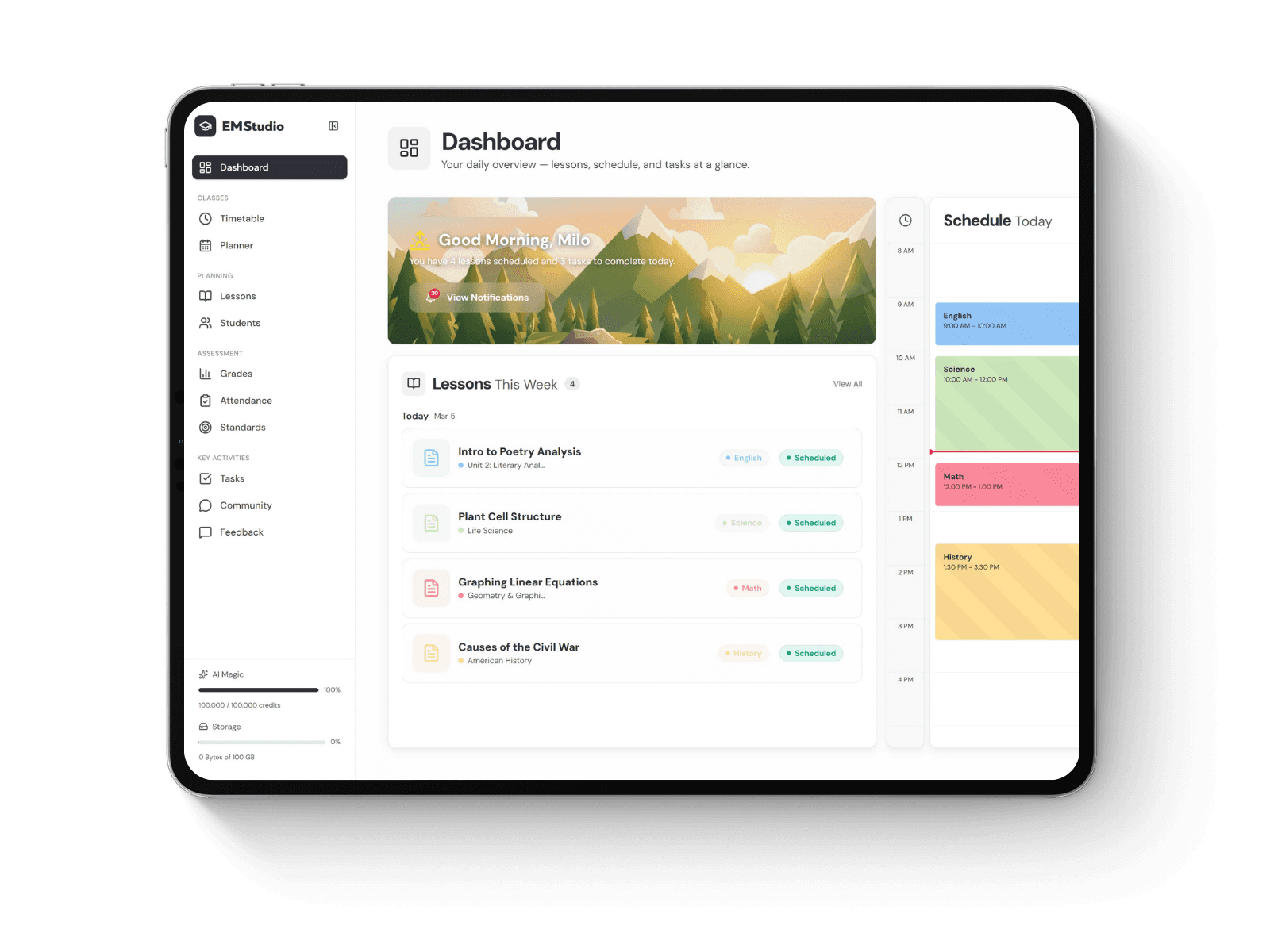
EMStudio is a free teaching management app — manage your classes, students, lessons, and more!
Learn More
Still grading everything by hand?
EMStudio is a free teaching management app — manage your classes, students, lessons, and more!
Learn More
Table of Contents
It's free, and there's no sign-up. Every book opens in your browser or downloads as a PDF in one click.
It's organized the way teachers search. Filter by grade, age, subject, or English level.
It goes well beyond storybooks. You'll also find K-12 textbooks, workbooks with teacher guides, and files you can edit.
What is Free Kids Books?
Free Kids Books is a free digital library for children and young adults. The site describes itself as "a growing library of unique children's books, literary resources, and textbooks," and its goal is simple: make good reading material easy to reach for anyone who needs it. When we counted in November 2026, the library listed 1,096 titles.
The founder is Danielle Bruckert, a professional pilot who writes children's books as a hobby. The site began as a home for her own stories. It grew when she went looking for other free children's books to share and found there was almost nowhere to download good ones. Today her books sit beside titles from independent authors and from open publishers such as Book Dash, Pratham Books' StoryWeaver, African Storybook, Room to Read, the Core Knowledge Foundation, and CK-12.
How does it stay free? The site shows a few ads to cover its costs and calls itself a "zero-profit" business: whatever is left over goes back into new educational resources and into its nonprofit project, FKB Make a Difference.

The library at freekidsbooks.org. Search by title, or filter by reading level, grade, age group, subject, and English level.
What's inside the library
Storybooks are only the start. Here's how the library is organized, and what each part is good for:
Where to look | What you'll find | Handy for |
Four bands: K and Pre-K (400+ titles), Grades 1 to 3 (570+), Grades 4 to 6 (210+), and Grade 7+ (100+) | Finding a book at the right level fast | |
Beginner (430+ titles), Intermediate, and Fluent | English learners of any age | |
Open K-12 textbooks and workbooks, some with teacher guides | Core lessons, homework, homeschool | |
Early readers, alphabet books, spelling and writing workbooks | Phonics and first independent reading | |
110+ books paired with a video read-aloud | Listening stations, students who were absent | |
Many books you can open and change using free odt or odg formats | Class versions, translations, writing projects | |
Books set in an open dyslexia-friendly typeface, and stories told in pictures only | Differentiation, oral storytelling | |
Books in Spanish, French, German, Hindi, Farsi, and Irish | Home-language reading, language classes | |
120+ classics, from Peter Rabbit to Aesop's fables | Literature units, comparing versions |
Counts come from the site's category pages in November 2026. Many books appear in more than one category.
How to find the right book in under a minute
A library this size is only useful if you can find things in it. Four clicks usually do it:
Pick a level. Use the Show buttons at the top of the library (Toddlers, Children, Older Children, Young Adults) or the Grade menu. The levels run from picture-heavy books for the youngest readers up to chapter books for teens.
Narrow by subject. The Subject menu covers topics such as friendship, emotions, science, math, history, and holidays.
Sort by Popular. This moves the most popular books to the top of the list.
Open the book's page. You'll see a description, a sample page, and ratings and comments from other readers. Then choose Read Online to open the book in your browser, or Download PDF to keep a copy.

A book page shows the level, the categories, a sample page, and reader ratings before you download anything.
Seven ways to use Free Kids Books in your classroom
What can you actually do with a thousand free books? More than you'd think.
1. Fill the gaps in your classroom library
Need more books about feelings, or a set on space for your science corner? Download a handful and print them. The site's own tip for picture books is to print the pages and staple them, or keep them together in a folder. Printed copies can go home in backpacks, and if one comes back torn, you print another.
2. Project a read-aloud
Read Online opens the book as a flipbook, so you can put it on the board and turn the pages with the whole class watching. No document camera, and no squinting from the back row. For a listening station, choose one of the books that comes with a read-along video.
3. Give every child a copy for guided reading
Six copies of an early reader cost you six printouts. Because the copies are yours, students can circle sight words, underline tricky sounds, and take the book home to read again. A title like Always Be Nice has only 28 words, which makes it a confident first read.
4. Support your English learners
The ESL English Level menu sorts books into Beginner, Intermediate, and Fluent, so you can match a book to a student's English and not only to their age. The foreign language section adds books in six languages, including bilingual editions, for reading at home with family.
5. Differentiate without extra prep
Two small collections do a lot of work here. Books in the Dyslexic Font category are set in a dyslexia-friendly typeface. Wordless books let children tell the story in their own words, which suits pre-readers, newcomers, and oral language practice.
6. Teach from open textbooks and workbooks
The School Textbooks section gathers open educational resources by grade, from Grade 1 workbooks up to high school. Some come as a full set. Core Knowledge's Fables reader for Grade 1, for example, has a matching workbook and a teacher guide, and its Grade 6 history text on the Industrial Revolution has a teaching guide too.

The School Textbooks section includes workbooks with matching teacher guides.
7. Turn your students into authors
Some books come as editable files as well as PDFs. Your class can change the characters' names, write a new ending, or translate a story into a home language. The site suggests this as a way to teach older children editing, formatting, and writing skills. Check the book's license first (more on that below).
Ten books to start with
Not sure where to begin? These ten cover every grade band.
Pre-K and kindergarten
Best Friends (Book Dash). Zindzi and Tim Tam do everything together, until the day Tim Tam doesn't come to school. A gentle story about sharing and caring.
The Seal and The Sharky: Friendship (Danielle Bruckert). Everyone runs from a friendly shark until a seal sees his good heart. It comes with a read-along video and an editable file.
Irku's First Day of School (Pratham Books' StoryWeaver). A wordless book that follows one child through a first day at school. Your students supply the words.
Grades 1 to 3
Always Be Nice: 10 Lessons in Kindness (Danielle Bruckert). Ten short lessons in kindness, each introduced by an animal with an alliterative name, in only 28 words.
Fables: Reader for Grade 1 (Core Knowledge Foundation). Folk tales and fables written for first graders, with key sounds highlighted in the text.
Milo and Pip and the Secret Waves of Sound (Tran Le Chan). A STEM comic in which curious Milo and her robot cat Pip find out how sound travels.
Grades 4 to 6
118 Pigs and the Big Bad Wolf. A funny introduction to the chemical elements: Professor Wolfram and 118 student pigs hunt for the best element to build a wolf-proof house.
The Hunt for H.G. Growmore (Joshua Kalu Ephraim). Twelve-year-old Bella is losing her hair, so she sets off with her brother and their friends to find a cure.
The Industrial Revolution (Core Knowledge Foundation). A Grade 6 history text on the move from farms to factories in Britain and America.
Grade 7 and up
Free At Last: The US Civil Rights Movement. A public-domain textbook that follows the civil rights movement in America from slavery to the Civil Rights Act.
What you're allowed to do with the books
Reading a book, projecting it, and downloading it for your class is what the library is for. Reposting, editing, or selling a book is a different matter, and it depends on the book's license. There are three kinds:
License | What it means for you |
Creative Commons (600+ titles) | You can share and reuse the book as long as you credit the creator. Some licenses add limits, such as non-commercial use only or no changes. |
Public domain (120+ titles) | No restrictions. Copy, adapt, and share freely. |
Standard copyright | The author has given Free Kids Books permission to publish the book. To reuse it anywhere else, ask the author. |
Newer books include a page that states the license. If you can't tell which one applies, the site invites you to email with the book's details and ask.
Good to know before you start
A free library run by a small team works a little differently from a paid platform. Three things are worth knowing up front:
Ads pay the bills. Pages on the site carry advertising. If you'd rather not show ads on the board, download the PDF and present that.
Preview before you teach. Books come from many authors, so length, level, and style vary. The Young Adult section also includes books on sensitive and complex topics for mature readers.
Levels are a starting point. The site groups books broadly because reading levels differ from country to country. A quick skim tells you whether a book fits your group.
Frequently asked questions
Is Free Kids Books really free?
Yes. There's no subscription and no paywall. The site covers its costs with advertising and puts any profit back into new educational resources.
Do you need an account to download books?
No. Read Online and Download PDF work without the added hassle of signing in, but do comment if you enjoy a book.
Can you print the books for your students?
Yes. Printing is how the site suggests using its picture books. For anything beyond reading with your class, such as reposting or editing a book, check its license first.
What ages is Free Kids Books for?
Toddlers through young adults. Storybooks are grouped from Pre-K to Grade 7 and up, and the textbook section covers K-12.
Can you or your students publish a book there?
Yes - absolutely. The site accepts submissions from authors of all ages, and its About page explains how to send one in.
The right book, on the right day
A classroom library is never really finished. What matters is having the right book on the day a child needs it, whether that's a story about a lonely shark, a comic about sound waves, or a first reader with 28 words. Free Kids Books puts more than a thousand of those within reach, and all it asks in return is that you share the ones you love.
Ready to find your first one? Start with the Grade menu at Free Kids Books and pick one book for next week.
It's free, and there's no sign-up. Every book opens in your browser or downloads as a PDF in one click.
It's organized the way teachers search. Filter by grade, age, subject, or English level.
It goes well beyond storybooks. You'll also find K-12 textbooks, workbooks with teacher guides, and files you can edit.
What is Free Kids Books?
Free Kids Books is a free digital library for children and young adults. The site describes itself as "a growing library of unique children's books, literary resources, and textbooks," and its goal is simple: make good reading material easy to reach for anyone who needs it. When we counted in November 2026, the library listed 1,096 titles.
The founder is Danielle Bruckert, a professional pilot who writes children's books as a hobby. The site began as a home for her own stories. It grew when she went looking for other free children's books to share and found there was almost nowhere to download good ones. Today her books sit beside titles from independent authors and from open publishers such as Book Dash, Pratham Books' StoryWeaver, African Storybook, Room to Read, the Core Knowledge Foundation, and CK-12.
How does it stay free? The site shows a few ads to cover its costs and calls itself a "zero-profit" business: whatever is left over goes back into new educational resources and into its nonprofit project, FKB Make a Difference.
The library at freekidsbooks.org. Search by title, or filter by reading level, grade, age group, subject, and English level.
What's inside the library
Storybooks are only the start. Here's how the library is organized, and what each part is good for:
Where to look | What you'll find | Handy for |
Four bands: K and Pre-K (400+ titles), Grades 1 to 3 (570+), Grades 4 to 6 (210+), and Grade 7+ (100+) | Finding a book at the right level fast | |
Beginner (430+ titles), Intermediate, and Fluent | English learners of any age | |
Open K-12 textbooks and workbooks, some with teacher guides | Core lessons, homework, homeschool | |
Early readers, alphabet books, spelling and writing workbooks | Phonics and first independent reading | |
110+ books paired with a video read-aloud | Listening stations, students who were absent | |
Many books you can open and change using free odt or odg formats | Class versions, translations, writing projects | |
Books set in an open dyslexia-friendly typeface, and stories told in pictures only | Differentiation, oral storytelling | |
Books in Spanish, French, German, Hindi, Farsi, and Irish | Home-language reading, language classes | |
120+ classics, from Peter Rabbit to Aesop's fables | Literature units, comparing versions |
Counts come from the site's category pages in November 2026. Many books appear in more than one category.
How to find the right book in under a minute
A library this size is only useful if you can find things in it. Four clicks usually do it:
Pick a level. Use the Show buttons at the top of the library (Toddlers, Children, Older Children, Young Adults) or the Grade menu. The levels run from picture-heavy books for the youngest readers up to chapter books for teens.
Narrow by subject. The Subject menu covers topics such as friendship, emotions, science, math, history, and holidays.
Sort by Popular. This moves the most popular books to the top of the list.
Open the book's page. You'll see a description, a sample page, and ratings and comments from other readers. Then choose Read Online to open the book in your browser, or Download PDF to keep a copy.
A book page shows the level, the categories, a sample page, and reader ratings before you download anything.
Seven ways to use Free Kids Books in your classroom
What can you actually do with a thousand free books? More than you'd think.
1. Fill the gaps in your classroom library
Need more books about feelings, or a set on space for your science corner? Download a handful and print them. The site's own tip for picture books is to print the pages and staple them, or keep them together in a folder. Printed copies can go home in backpacks, and if one comes back torn, you print another.
2. Project a read-aloud
Read Online opens the book as a flipbook, so you can put it on the board and turn the pages with the whole class watching. No document camera, and no squinting from the back row. For a listening station, choose one of the books that comes with a read-along video.
3. Give every child a copy for guided reading
Six copies of an early reader cost you six printouts. Because the copies are yours, students can circle sight words, underline tricky sounds, and take the book home to read again. A title like Always Be Nice has only 28 words, which makes it a confident first read.
4. Support your English learners
The ESL English Level menu sorts books into Beginner, Intermediate, and Fluent, so you can match a book to a student's English and not only to their age. The foreign language section adds books in six languages, including bilingual editions, for reading at home with family.
5. Differentiate without extra prep
Two small collections do a lot of work here. Books in the Dyslexic Font category are set in a dyslexia-friendly typeface. Wordless books let children tell the story in their own words, which suits pre-readers, newcomers, and oral language practice.
6. Teach from open textbooks and workbooks
The School Textbooks section gathers open educational resources by grade, from Grade 1 workbooks up to high school. Some come as a full set. Core Knowledge's Fables reader for Grade 1, for example, has a matching workbook and a teacher guide, and its Grade 6 history text on the Industrial Revolution has a teaching guide too.
The School Textbooks section includes workbooks with matching teacher guides.
7. Turn your students into authors
Some books come as editable files as well as PDFs. Your class can change the characters' names, write a new ending, or translate a story into a home language. The site suggests this as a way to teach older children editing, formatting, and writing skills. Check the book's license first (more on that below).
Ten books to start with
Not sure where to begin? These ten cover every grade band.
Pre-K and kindergarten
Best Friends (Book Dash). Zindzi and Tim Tam do everything together, until the day Tim Tam doesn't come to school. A gentle story about sharing and caring.
The Seal and The Sharky: Friendship (Danielle Bruckert). Everyone runs from a friendly shark until a seal sees his good heart. It comes with a read-along video and an editable file.
Irku's First Day of School (Pratham Books' StoryWeaver). A wordless book that follows one child through a first day at school. Your students supply the words.
Grades 1 to 3
Always Be Nice: 10 Lessons in Kindness (Danielle Bruckert). Ten short lessons in kindness, each introduced by an animal with an alliterative name, in only 28 words.
Fables: Reader for Grade 1 (Core Knowledge Foundation). Folk tales and fables written for first graders, with key sounds highlighted in the text.
Milo and Pip and the Secret Waves of Sound (Tran Le Chan). A STEM comic in which curious Milo and her robot cat Pip find out how sound travels.
Grades 4 to 6
118 Pigs and the Big Bad Wolf. A funny introduction to the chemical elements: Professor Wolfram and 118 student pigs hunt for the best element to build a wolf-proof house.
The Hunt for H.G. Growmore (Joshua Kalu Ephraim). Twelve-year-old Bella is losing her hair, so she sets off with her brother and their friends to find a cure.
The Industrial Revolution (Core Knowledge Foundation). A Grade 6 history text on the move from farms to factories in Britain and America.
Grade 7 and up
Free At Last: The US Civil Rights Movement. A public-domain textbook that follows the civil rights movement in America from slavery to the Civil Rights Act.
What you're allowed to do with the books
Reading a book, projecting it, and downloading it for your class is what the library is for. Reposting, editing, or selling a book is a different matter, and it depends on the book's license. There are three kinds:
License | What it means for you |
Creative Commons (600+ titles) | You can share and reuse the book as long as you credit the creator. Some licenses add limits, such as non-commercial use only or no changes. |
Public domain (120+ titles) | No restrictions. Copy, adapt, and share freely. |
Standard copyright | The author has given Free Kids Books permission to publish the book. To reuse it anywhere else, ask the author. |
Newer books include a page that states the license. If you can't tell which one applies, the site invites you to email with the book's details and ask.
Good to know before you start
A free library run by a small team works a little differently from a paid platform. Three things are worth knowing up front:
Ads pay the bills. Pages on the site carry advertising. If you'd rather not show ads on the board, download the PDF and present that.
Preview before you teach. Books come from many authors, so length, level, and style vary. The Young Adult section also includes books on sensitive and complex topics for mature readers.
Levels are a starting point. The site groups books broadly because reading levels differ from country to country. A quick skim tells you whether a book fits your group.
Frequently asked questions
Is Free Kids Books really free?
Yes. There's no subscription and no paywall. The site covers its costs with advertising and puts any profit back into new educational resources.
Do you need an account to download books?
No. Read Online and Download PDF work without the added hassle of signing in, but do comment if you enjoy a book.
Can you print the books for your students?
Yes. Printing is how the site suggests using its picture books. For anything beyond reading with your class, such as reposting or editing a book, check its license first.
What ages is Free Kids Books for?
Toddlers through young adults. Storybooks are grouped from Pre-K to Grade 7 and up, and the textbook section covers K-12.
Can you or your students publish a book there?
Yes - absolutely. The site accepts submissions from authors of all ages, and its About page explains how to send one in.
The right book, on the right day
A classroom library is never really finished. What matters is having the right book on the day a child needs it, whether that's a story about a lonely shark, a comic about sound waves, or a first reader with 28 words. Free Kids Books puts more than a thousand of those within reach, and all it asks in return is that you share the ones you love.
Ready to find your first one? Start with the Grade menu at Free Kids Books and pick one book for next week.
Still grading everything by hand?
EMStudio is a free teaching management app — manage your classes, students, lessons, and more!
Learn More
Still grading everything by hand?
EMStudio is a free teaching management app — manage your classes, students, lessons, and more!
Learn More


Notion4Teachers
Notion templates to simplify administrative tasks and enhance your teaching experience.


2026 Notion4Teachers. All Rights Reserved.
Notion4Teachers
Notion templates to simplify administrative tasks and enhance your teaching experience.
2026 Notion4Teachers. All Rights Reserved.
Notion4Teachers
Notion templates to simplify administrative tasks and enhance your teaching experience.
2026 Notion4Teachers. All Rights Reserved.