
Ethical AI Writing in Education: From Draft to Student‑Ready Content
Ethical AI Writing in Education: From Draft to Student‑Ready Content

Article by
Milo
ESL Content Coordinator & Educator
ESL Content Coordinator & Educator
All Posts
Here's a simple test anyone can apply before using AI in the writing process: could you explain every idea in the final draft in your own words, and would you be comfortable telling your instructor exactly how AI was involved? If the answer to either question is no, that's a signal worth paying attention to.
Ethical AI writing in education isn't defined by whether a tool was used at all. It's defined by who owns the thinking. There's a meaningful difference between using AI to brainstorm angles, catch structural weaknesses, or tighten phrasing, and using it to generate arguments, conclusions, or analysis that a student then submits as their own. The first supports the writing process; the second replaces it.
Academic integrity in this context comes down to three things: human ownership of ideas, transparency about how AI-generated content was used, and the ability to verify that the final work reflects genuine critical thinking. Disclosure isn't just a formality. It's the mechanism that keeps AI assistance honest, and it's the thread this article follows from the first draft to the finished page.
Still grading everything by hand?
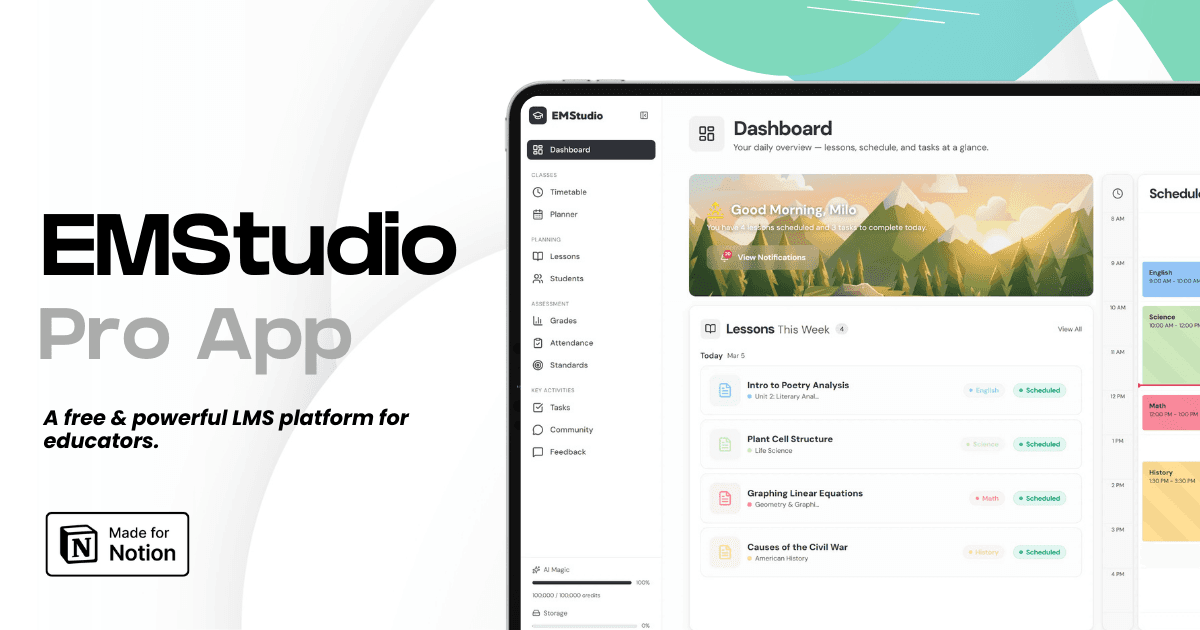
EMStudio is a free teaching management app — manage your classes, students, lessons, and more!
Learn More
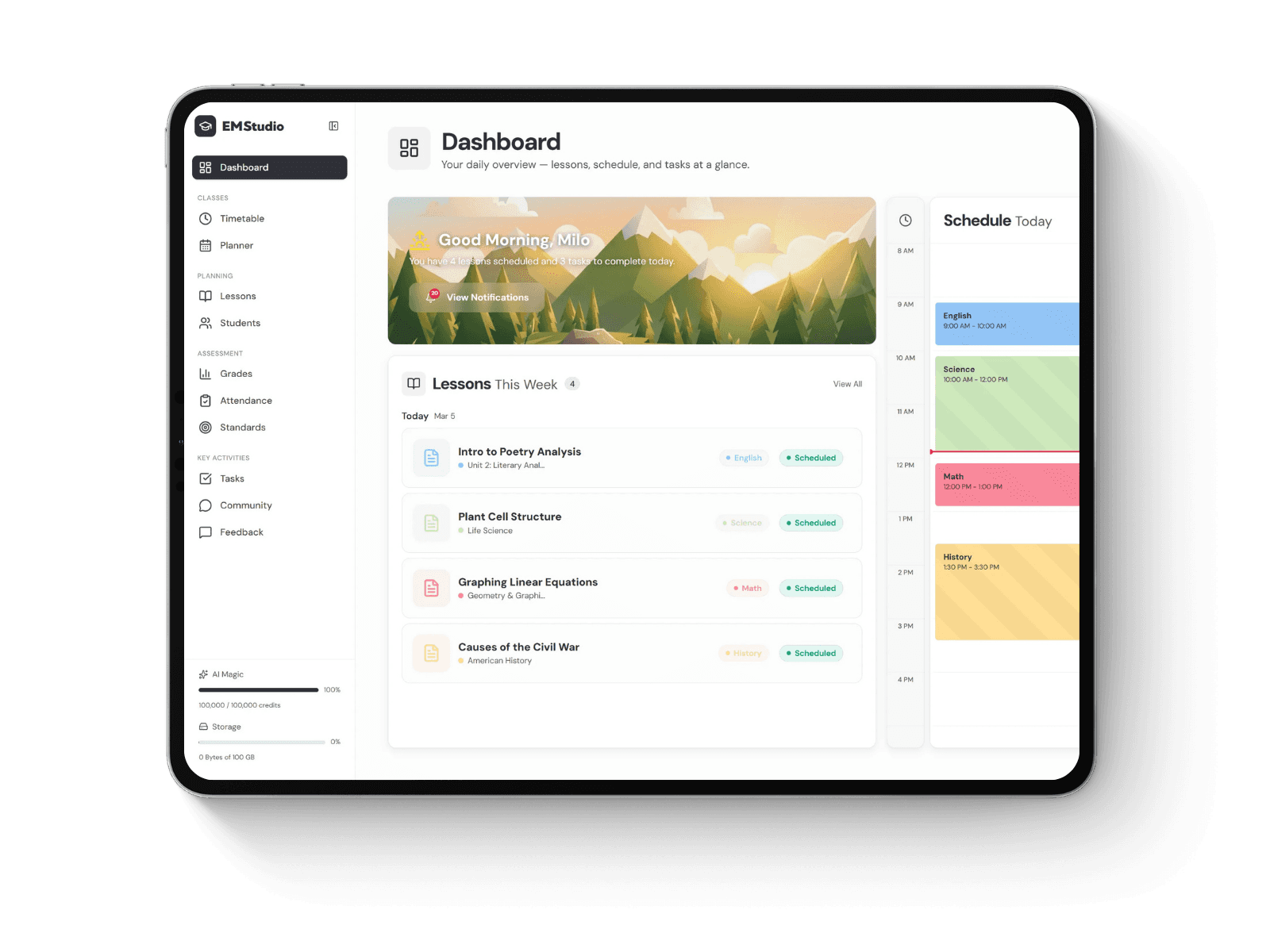
Still grading everything by hand?
EMStudio is a free teaching management app — manage your classes, students, lessons, and more!
Learn More
Table of Contents
Where AI Fits in the Writing Process
The writing process isn't a single event. It moves through stages, and AI tools interact differently with each one. Understanding where support is legitimate, and where it isn't, is the foundation of ethical use.
Tasks AI Can Support Without Replacing Learning
In the earlier stages, tools like ChatGPT and Claude can serve a useful supporting role. A student stuck on an entry point can use them to surface possible angles, generate counterarguments to stress-test, or sketch a rough outline before committing to a structure. This kind of brainstorming support doesn't replace thinking; it gives thinking somewhere to start.
Revision is another stage where AI can contribute without overstepping. Grammarly and similar tools are well-suited to catching surface-level errors, flagging awkward phrasing, or identifying where sentences run long. These are mechanical tasks that don't require the tool to understand what the student is actually arguing.
What all of these uses share is that the value of human voice in AI-assisted writing remains intact. The student still makes every substantive decision.
Tasks Students Should Still Own Themselves
Original analysis, argument construction, and the interpretation of sources must stay with the student. These are not just academic requirements. They are the outputs that demonstrate critical thinking, which is the point of most writing assignments in the first place.
When AI-generated content fills those spaces, even if students edit it afterward, the intellectual work has shifted hands. Some students try to humanize any AI-generated text as a shortcut after drafting, but changing how writing reads on the surface doesn't change who did the reasoning behind it. Authenticity comes from intellectual ownership, not surface-level polishing. That distinction is where ethical use begins and ends.
A Draft-to-Ready Workflow Educators Can Use
Translating ethical principles into classroom practice requires more than a policy statement. The following workflow gives educators a concrete structure that builds transparency and accountability into the assignment itself, rather than treating AI oversight as something that happens after submission.
Set the Assignment Boundaries Before Drafting
Ethical AI use in writing starts with explicit parameters, not assumptions. Before students begin, educators should define which stages of the process AI assistance is permitted, what kinds of support are acceptable, and whether institutional policies require disclosure by default.
Boundaries work best when they are assignment-specific. A literature review may call for different rules than a personal reflection or a research argument. Stating those distinctions upfront removes ambiguity and creates a shared ethical framework before the first draft exists.
Require Visible Human Decisions During Revision
The revision stage is where critical thinking becomes verifiable. Educators can ask students to submit a marked draft alongside the final version, showing where they changed, rejected, or expanded on earlier material.
This keeps the focus on what students must demonstrate between draft and final submission, specifically, evidence that their own reasoning shaped the outcome. Attribution of AI contributions works best when it is visible in context, not just declared at the end.
Ask for a Short Record of AI Use
A brief disclosure note, attached to the final submission, asks students to describe which tools they used, at which stage, and for what purpose. This doesn't need to be lengthy to be useful.
The record creates a transparency layer that supports keeping AI use responsible in classwork without treating students as suspects. It normalizes disclosure as a professional habit rather than a compliance requirement, which is more consistent with how academic integrity functions outside the classroom.
Verification Matters More Than Fluent Output
Polished prose can obscure a serious problem, and that's worth addressing directly before moving to disclosure. Even well-written AI-assisted drafts can contain errors that undermine academic integrity if they go unchecked. Which is why AI detection tools and detectores de IA are valuable for promoting authenticity and responsible use of artificial intelligence in academic work.
Why AI Hallucinations Are Risky in School Writing
AI-generated content sometimes presents invented facts, fabricated citations, or false attributions with the same confident tone as accurate information. These errors are commonly described as AI hallucinations, a concept explored in depth by the Harvard Kennedy School Misinformation Review, and they are particularly risky in academic writing because the output looks credible even when the underlying claim is not.
For students, the consequences of submitting unverified AI-generated content extend beyond a factual mistake. Fabricated sources, misquoted scholars, or invented statistics embedded in coursework represent a failure of academic integrity, regardless of whether the error was intentional. Tools like ChatGPT can produce plausible-sounding references that do not exist, and submitting those references without checking them shifts responsibility entirely onto the student.
Verification is not just an editing step. According to COPE guidelines on AI authorship, human authors bear full responsibility for the accuracy of their work, which means checking AI-generated claims is part of ethical authorship, not optional cleanup.
A Simple Fact-Checking Routine for Submissions
Before submitting any AI-assisted draft, students and educators can apply a short review sequence:
Claims — Identify every factual assertion and confirm it against a primary or institutional source.
Quotes — Verify that any quoted material was actually said or written, and locate the original context.
Sources — Confirm that every cited work exists and that the publication details are accurate.
Citations — Check that formatting matches the required style and that the source supports the claim it is attached to.
This sequence takes minutes but closes the gap between fluent output and academically safe content.
What Disclosure Should Look Like in Practice
Not all AI assistance carries the same weight, and disclosure doesn't need to look the same across every situation. The depth of attribution should reflect the degree of AI involvement, and institutional policies are usually the clearest guide for where to draw that line.
When a Brief Note Is Enough
When AI support was limited to grammar checks, light rephrasing, or brainstorming prompts that students didn't directly incorporate, a short statement is typically sufficient. Something like "AI tools were used for proofreading and outline generation" gives readers and instructors an honest picture without overstating the role the tool played.
This level of disclosure aligns with transparency expectations in most institutional policies and reflects proportionate attribution. The key is honesty about what occurred, not length.
When Fuller Attribution Is the Safer Choice
Where AI-generated content contributed to structure, argument framing, or drafted passages that were edited and retained, fuller documentation becomes the more defensible approach. COPE guidance on authorship places responsibility on human authors to account for all substantive contributions, AI-assisted or otherwise.
In these cases, a disclosure note should identify which sections involved AI assistance, what kind of input was provided, and how the student shaped or verified the output. This level of specificity isn't about overcomplicating the process. It supports an ethical framework where attribution is honest, the scope of AI use is clear, and academic integrity remains intact from draft to final submission.
Equity Questions Teachers Should Not Ignore
AI writing policies are not experienced equally by all students, and that asymmetry deserves deliberate attention from educators designing integrity frameworks.
Non-native English speakers often rely on grammar and language tools to express ideas they genuinely understand but struggle to communicate fluently. Grammarly and similar tools serve a real educational purpose in those cases. However, a policy that flags language support as potential misuse, while remaining silent about students who use AI to generate arguments wholesale, creates an uneven standard that punishes legitimate need.
Equity belongs inside ethical policy design, not outside it. Transparency requirements and critical thinking expectations should apply to all students equally, and the line that matters is between support that aids expression and AI-generated content that replaces original thought.
Frequently Asked Questions
Does using AI for grammar checks count as academic misconduct?
In most cases, no. Grammar and proofreading tools are widely accepted forms of writing support. What matters is whether institutional policy requires disclosure for any AI use, which varies by school. When in doubt, a brief note describing the tool and its purpose is the safest approach.
Who is responsible if AI-generated content contains a fabricated source?
The student is. COPE guidelines place full responsibility for accuracy on human authors, regardless of how an error was introduced. Submitting unverified AI output, including invented citations, reflects on the student's work, not the tool.
Do disclosure requirements apply equally to all students?
They should. Ethical AI policies work best when transparency expectations apply consistently, with clear distinctions between language support and AI-generated content replacing original thought.
Keep the Writer at the Center
AI tools can support the writing process in meaningful ways, but the thinking behind every claim, argument, and conclusion must still belong to the writer. That responsibility doesn't transfer when a student edits AI-generated content or refines its phrasing. Academic integrity depends on who did the reasoning, not just who made the final edits.
Transparency and critical thinking work together here. When writers can explain their choices, verify their sources, and honestly describe where AI was involved, the work holds up. That standard applies equally to students submitting coursework and educators designing the assignments that shape how AI use is understood in the first place.
The practical takeaway is straightforward: use AI to support your process, and own everything that ends up on the page.
As AI adoption expands across industries, the same ethical principles of transparency and accountability apply to technology infrastructure as well—especially in areas like industrial cyber security solutions, where safeguarding systems and data requires clear human oversight, responsible automation, and well-defined ownership of decisions.
Where AI Fits in the Writing Process
The writing process isn't a single event. It moves through stages, and AI tools interact differently with each one. Understanding where support is legitimate, and where it isn't, is the foundation of ethical use.
Tasks AI Can Support Without Replacing Learning
In the earlier stages, tools like ChatGPT and Claude can serve a useful supporting role. A student stuck on an entry point can use them to surface possible angles, generate counterarguments to stress-test, or sketch a rough outline before committing to a structure. This kind of brainstorming support doesn't replace thinking; it gives thinking somewhere to start.
Revision is another stage where AI can contribute without overstepping. Grammarly and similar tools are well-suited to catching surface-level errors, flagging awkward phrasing, or identifying where sentences run long. These are mechanical tasks that don't require the tool to understand what the student is actually arguing.
What all of these uses share is that the value of human voice in AI-assisted writing remains intact. The student still makes every substantive decision.
Tasks Students Should Still Own Themselves
Original analysis, argument construction, and the interpretation of sources must stay with the student. These are not just academic requirements. They are the outputs that demonstrate critical thinking, which is the point of most writing assignments in the first place.
When AI-generated content fills those spaces, even if students edit it afterward, the intellectual work has shifted hands. Some students try to humanize any AI-generated text as a shortcut after drafting, but changing how writing reads on the surface doesn't change who did the reasoning behind it. Authenticity comes from intellectual ownership, not surface-level polishing. That distinction is where ethical use begins and ends.
A Draft-to-Ready Workflow Educators Can Use
Translating ethical principles into classroom practice requires more than a policy statement. The following workflow gives educators a concrete structure that builds transparency and accountability into the assignment itself, rather than treating AI oversight as something that happens after submission.
Set the Assignment Boundaries Before Drafting
Ethical AI use in writing starts with explicit parameters, not assumptions. Before students begin, educators should define which stages of the process AI assistance is permitted, what kinds of support are acceptable, and whether institutional policies require disclosure by default.
Boundaries work best when they are assignment-specific. A literature review may call for different rules than a personal reflection or a research argument. Stating those distinctions upfront removes ambiguity and creates a shared ethical framework before the first draft exists.
Require Visible Human Decisions During Revision
The revision stage is where critical thinking becomes verifiable. Educators can ask students to submit a marked draft alongside the final version, showing where they changed, rejected, or expanded on earlier material.
This keeps the focus on what students must demonstrate between draft and final submission, specifically, evidence that their own reasoning shaped the outcome. Attribution of AI contributions works best when it is visible in context, not just declared at the end.
Ask for a Short Record of AI Use
A brief disclosure note, attached to the final submission, asks students to describe which tools they used, at which stage, and for what purpose. This doesn't need to be lengthy to be useful.
The record creates a transparency layer that supports keeping AI use responsible in classwork without treating students as suspects. It normalizes disclosure as a professional habit rather than a compliance requirement, which is more consistent with how academic integrity functions outside the classroom.
Verification Matters More Than Fluent Output
Polished prose can obscure a serious problem, and that's worth addressing directly before moving to disclosure. Even well-written AI-assisted drafts can contain errors that undermine academic integrity if they go unchecked. Which is why AI detection tools and detectores de IA are valuable for promoting authenticity and responsible use of artificial intelligence in academic work.
Why AI Hallucinations Are Risky in School Writing
AI-generated content sometimes presents invented facts, fabricated citations, or false attributions with the same confident tone as accurate information. These errors are commonly described as AI hallucinations, a concept explored in depth by the Harvard Kennedy School Misinformation Review, and they are particularly risky in academic writing because the output looks credible even when the underlying claim is not.
For students, the consequences of submitting unverified AI-generated content extend beyond a factual mistake. Fabricated sources, misquoted scholars, or invented statistics embedded in coursework represent a failure of academic integrity, regardless of whether the error was intentional. Tools like ChatGPT can produce plausible-sounding references that do not exist, and submitting those references without checking them shifts responsibility entirely onto the student.
Verification is not just an editing step. According to COPE guidelines on AI authorship, human authors bear full responsibility for the accuracy of their work, which means checking AI-generated claims is part of ethical authorship, not optional cleanup.
A Simple Fact-Checking Routine for Submissions
Before submitting any AI-assisted draft, students and educators can apply a short review sequence:
Claims — Identify every factual assertion and confirm it against a primary or institutional source.
Quotes — Verify that any quoted material was actually said or written, and locate the original context.
Sources — Confirm that every cited work exists and that the publication details are accurate.
Citations — Check that formatting matches the required style and that the source supports the claim it is attached to.
This sequence takes minutes but closes the gap between fluent output and academically safe content.
What Disclosure Should Look Like in Practice
Not all AI assistance carries the same weight, and disclosure doesn't need to look the same across every situation. The depth of attribution should reflect the degree of AI involvement, and institutional policies are usually the clearest guide for where to draw that line.
When a Brief Note Is Enough
When AI support was limited to grammar checks, light rephrasing, or brainstorming prompts that students didn't directly incorporate, a short statement is typically sufficient. Something like "AI tools were used for proofreading and outline generation" gives readers and instructors an honest picture without overstating the role the tool played.
This level of disclosure aligns with transparency expectations in most institutional policies and reflects proportionate attribution. The key is honesty about what occurred, not length.
When Fuller Attribution Is the Safer Choice
Where AI-generated content contributed to structure, argument framing, or drafted passages that were edited and retained, fuller documentation becomes the more defensible approach. COPE guidance on authorship places responsibility on human authors to account for all substantive contributions, AI-assisted or otherwise.
In these cases, a disclosure note should identify which sections involved AI assistance, what kind of input was provided, and how the student shaped or verified the output. This level of specificity isn't about overcomplicating the process. It supports an ethical framework where attribution is honest, the scope of AI use is clear, and academic integrity remains intact from draft to final submission.
Equity Questions Teachers Should Not Ignore
AI writing policies are not experienced equally by all students, and that asymmetry deserves deliberate attention from educators designing integrity frameworks.
Non-native English speakers often rely on grammar and language tools to express ideas they genuinely understand but struggle to communicate fluently. Grammarly and similar tools serve a real educational purpose in those cases. However, a policy that flags language support as potential misuse, while remaining silent about students who use AI to generate arguments wholesale, creates an uneven standard that punishes legitimate need.
Equity belongs inside ethical policy design, not outside it. Transparency requirements and critical thinking expectations should apply to all students equally, and the line that matters is between support that aids expression and AI-generated content that replaces original thought.
Frequently Asked Questions
Does using AI for grammar checks count as academic misconduct?
In most cases, no. Grammar and proofreading tools are widely accepted forms of writing support. What matters is whether institutional policy requires disclosure for any AI use, which varies by school. When in doubt, a brief note describing the tool and its purpose is the safest approach.
Who is responsible if AI-generated content contains a fabricated source?
The student is. COPE guidelines place full responsibility for accuracy on human authors, regardless of how an error was introduced. Submitting unverified AI output, including invented citations, reflects on the student's work, not the tool.
Do disclosure requirements apply equally to all students?
They should. Ethical AI policies work best when transparency expectations apply consistently, with clear distinctions between language support and AI-generated content replacing original thought.
Keep the Writer at the Center
AI tools can support the writing process in meaningful ways, but the thinking behind every claim, argument, and conclusion must still belong to the writer. That responsibility doesn't transfer when a student edits AI-generated content or refines its phrasing. Academic integrity depends on who did the reasoning, not just who made the final edits.
Transparency and critical thinking work together here. When writers can explain their choices, verify their sources, and honestly describe where AI was involved, the work holds up. That standard applies equally to students submitting coursework and educators designing the assignments that shape how AI use is understood in the first place.
The practical takeaway is straightforward: use AI to support your process, and own everything that ends up on the page.
As AI adoption expands across industries, the same ethical principles of transparency and accountability apply to technology infrastructure as well—especially in areas like industrial cyber security solutions, where safeguarding systems and data requires clear human oversight, responsible automation, and well-defined ownership of decisions.
Still grading everything by hand?
EMStudio is a free teaching management app — manage your classes, students, lessons, and more!
Learn More
Still grading everything by hand?
EMStudio is a free teaching management app — manage your classes, students, lessons, and more!
Learn More




Notion4Teachers
Notion templates to simplify administrative tasks and enhance your teaching experience.



2026 Notion4Teachers. All Rights Reserved.
Notion4Teachers
Notion templates to simplify administrative tasks and enhance your teaching experience.
2026 Notion4Teachers. All Rights Reserved.
Notion4Teachers
Notion templates to simplify administrative tasks and enhance your teaching experience.
2026 Notion4Teachers. All Rights Reserved.