
How AI Translation Technology Can Help
How AI Translation Technology Can Help

Article by
Milo
ESL Content Coordinator & Educator
ESL Content Coordinator & Educator
All Posts
With the advent of online education platforms, AI translation services are helping schools bridge language gaps and improve accessibility. Though it is easy to use AI to translate, it may not always be accurate and must be reviewed by humans so that educational materials can be understood by students who speak different languages. Modern translation technology used by professionals can aid in communication without sacrificing the quality of education.
AI translation technology involves the use of artificial intelligence for translating text into different languages. AI translation can be used by schools to assist students, parents, and teachers using different languages. Some examples of this can include:
Lessons: Translating worksheets or study guides into a student’s preferred language
Still grading everything by hand?
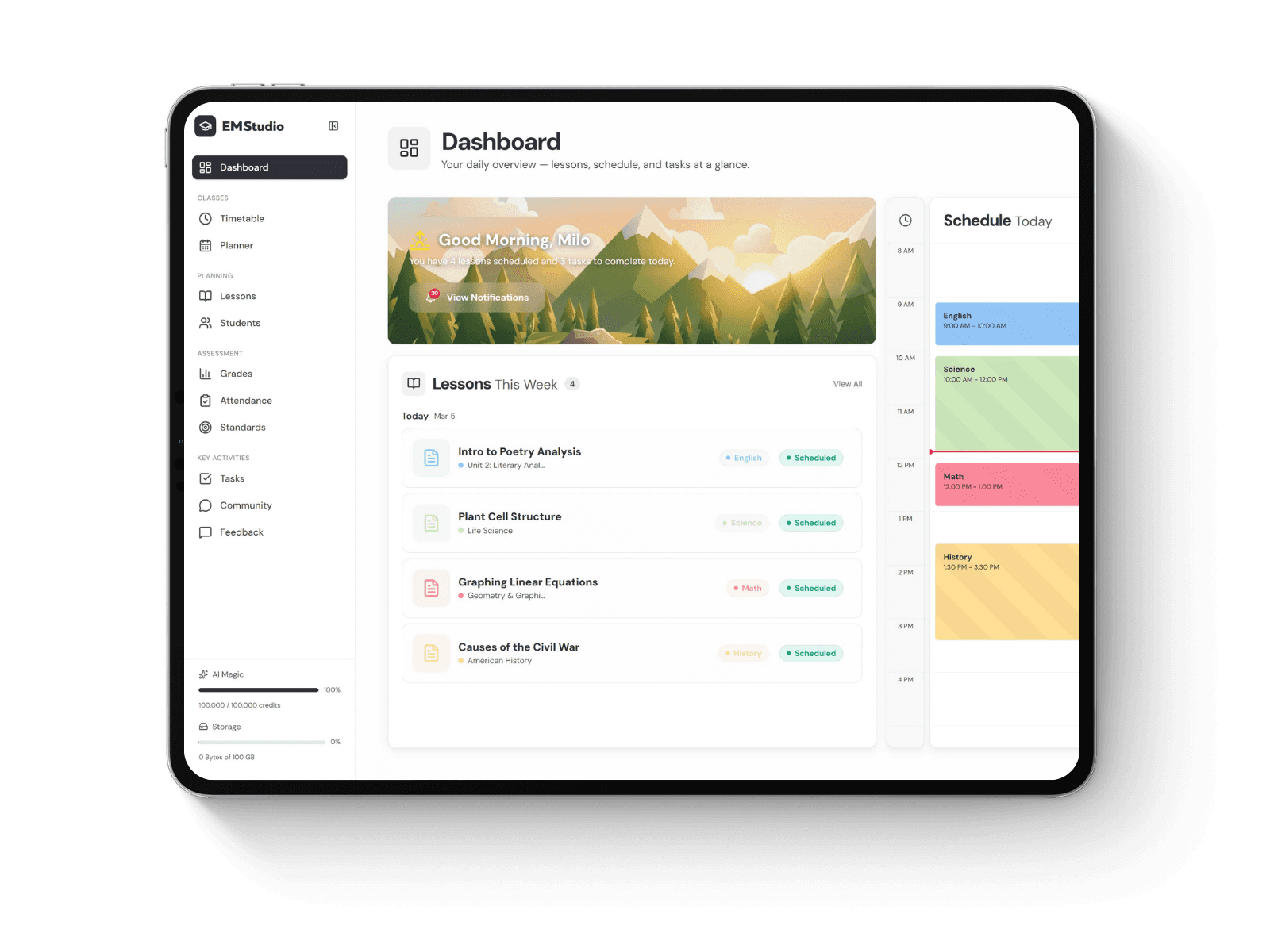
EMStudio is a free teaching management app — manage your classes, students, lessons, and more!
Learn More
Still grading everything by hand?
EMStudio is a free teaching management app — manage your classes, students, lessons, and more!
Learn More
Table of Contents
Why AI Translation Still Needs Human Review in Multilingual Classrooms
How AI Translation Technology Can Help
Parent communication: Translating school emails and announcements
Online classes: Ensuring that online curricula and video instructions are understandable to international students
Classroom instructions: Helping students to understand assignments and schedules
For example, a teacher can use an AI-powered language translation to convert English worksheets into Spanish or Arabic. This way, students can be more comfortable and learn better because Spanish and Arabic are their native languages. However, human review is critical for educational translation.
Why AI Translations Still Depend On Human Review
Why the Same Word Can Mean Different Things
A word’s meaning can vary across subjects and passages. An AI-powered translation tool may select the wrong one. For example, “cell” could refer to a spreadsheet, prison, or biological unit, depending on the original content. Human reviewers can review context and correct wording, rather than just mechanically replacing words.
Cultural References Can Confuse Learners Without Careful Adaptation
Many class activities, projects, worksheets, or presentations have jokes, references, and activities that have their origins in a certain ethnicity. While appropriate and funny for some students, they can cause confusion for others.
Students from non-English-speaking backgrounds may not relate to examples used in explanations or lessons that only have relevance for English students. Human translators have the time to adjust references without affecting the educational quality and integrity of the original resource.
Specialized Fields Need Translators Who Know Their Terminology
Math, science, medicine, engineering, data science, and software development are some of the fields that contain very specialized terminology. Translating terms incorrectly can lead to misinterpretation by students and poor learning experiences. An example of this could be mistranslated questions in a math worksheet, telling students to do addition when the original was asking for division. Similarly, confusing or incorrect scientific terminology can make it difficult for students to absorb content in their other language. Qualified human reviewers can check for technical vocabulary to ensure consistency and accuracy.
AI Translation QA Catches Mistakes Before Readers Do
AI translation quality assurance entails that the machine-translated content has been reviewed to be free of errors and fit its intended purpose. While AI tools can do a decent job at language translation, they can make mistakes with dialects, less popular languages, or words that have double meanings depending on context. They can also lead to inconsistencies in terminology in larger documents. A proper AI translation review should entail:
Comparing the translated documents to the original content
Checking grammar
Verifying technical terminology
Reviewing sentence meaning
Checking cultural appropriateness or confusing phrases.
Making sure that formatting, figures, and numbers have not changed in the process
Testing if the final version is understandable to its intended audience.
AI vs. Human Translation: Finding the Right Balance
The arguments for and against AI vs. human translation lie in combining the strengths of both to get the best results. Both methods can offer great advantages. AI can help to quickly translate large volumes of material and save time and money for institutions that need frequent translations. Human translation can offer cultural and context-based nuances that machines can miss. A proper workflow can utilize both methods as follows:
Use AI to translate the material.
Have a qualified and bilingual individual review the document.
Use technical experts to review specialized educational material that has been translated.
Request feedback and corrections from teachers.
If a certain type of instruction is repeated, update terminology to reflect it. Make changes if these are affecting comprehension.
Only light reviews are required for routine announcements. Critical communications like examination instructions or health and safety notices require more thorough checks.
AI-Powered Translation for Education and Business
Besides using AI translation services for schools, companies are also using AI-powered translation and multilingual tools to improve their customer support, sales, and marketing. For example, AI translation for businesses can be used for customer emails, multilingual websites, or training manuals. The same strategies can be applied in education.
While educational staff and business owners can find many benefits in using AI to translate their documents, there are a few things to consider. There may be some organizations that have to refrain from putting student data into the system until a certain extent of parental consent is given. Likewise, companies have to make sure that they meet the criteria of security and confidentiality before uploading their documents to the language service provider. Furthermore, translation services will also involve other factors like language coverage, quality assurance, and specialty areas.
Choosing Professional Translation Support
Organizations that need to communicate clearly in multiple languages and deliver quality educational content to a wide audience should look at the needs that they have when choosing a language service provider rather than focusing on price or speed.
It could be a good idea to check MarsTranslation Services, as it can support quality, subject specialties, language pair options, required revisions, and security options. You can start off with a sample of worksheets or materials that you would like to be translated and have their qualified professionals assess them. Once you are satisfied with the content, you can give more education-related projects.
Conclusion
AI translation services could be helpful for a large volume of content. On the other hand, human expertise is needed to guarantee quality, accuracy, and cultural appropriateness. AI translation tools and professional expertise can enable teachers to deliver valuable learning resources and support students who communicate in different tongues.
Moreover, it is important that educational institutions and organizations effectively utilize their resources through evaluation of each of their major translation projects to determine the appropriate professional language service providers for them.
Most importantly, make sure that you give due consideration to MarsTranslation services because they will help you meet your needs for quality and confidentiality.
Still grading everything by hand?
EMStudio is a free teaching management app — manage your classes, students, lessons, and more!
Learn More
Still grading everything by hand?
EMStudio is a free teaching management app — manage your classes, students, lessons, and more!
Learn More


Notion4Teachers
Notion templates to simplify administrative tasks and enhance your teaching experience.


2026 Notion4Teachers. All Rights Reserved.
Notion4Teachers
Notion templates to simplify administrative tasks and enhance your teaching experience.
2026 Notion4Teachers. All Rights Reserved.
Notion4Teachers
Notion templates to simplify administrative tasks and enhance your teaching experience.
2026 Notion4Teachers. All Rights Reserved.