
Best AI Study Tools, Ranked by What They Build From Your Notes

Ten AI study tools, one honest question: which one does the most with the files you already have?
The best AI study tools are not interchangeable. Some are research notebooks that cite your sources; others are flashcard apps that add an AI layer; a few attempt to replace an entire study workflow from a single file upload. This roundup ranks ten tools students actually use, judged on what each one builds from the student's own class materials, notes, slides, lecture recordings and more.
The ranking uses five criteria weighted by how much they affect everyday studying: free plan coverage, the range of file types accepted, the number of distinct study formats produced from a single upload, whether the free experience is ad-free, and whether generated content is editable. No single tool scores perfectly across all five, each sits at a different point on the trade-off curve, and the right choice depends on your workflow.
Still grading everything by hand?
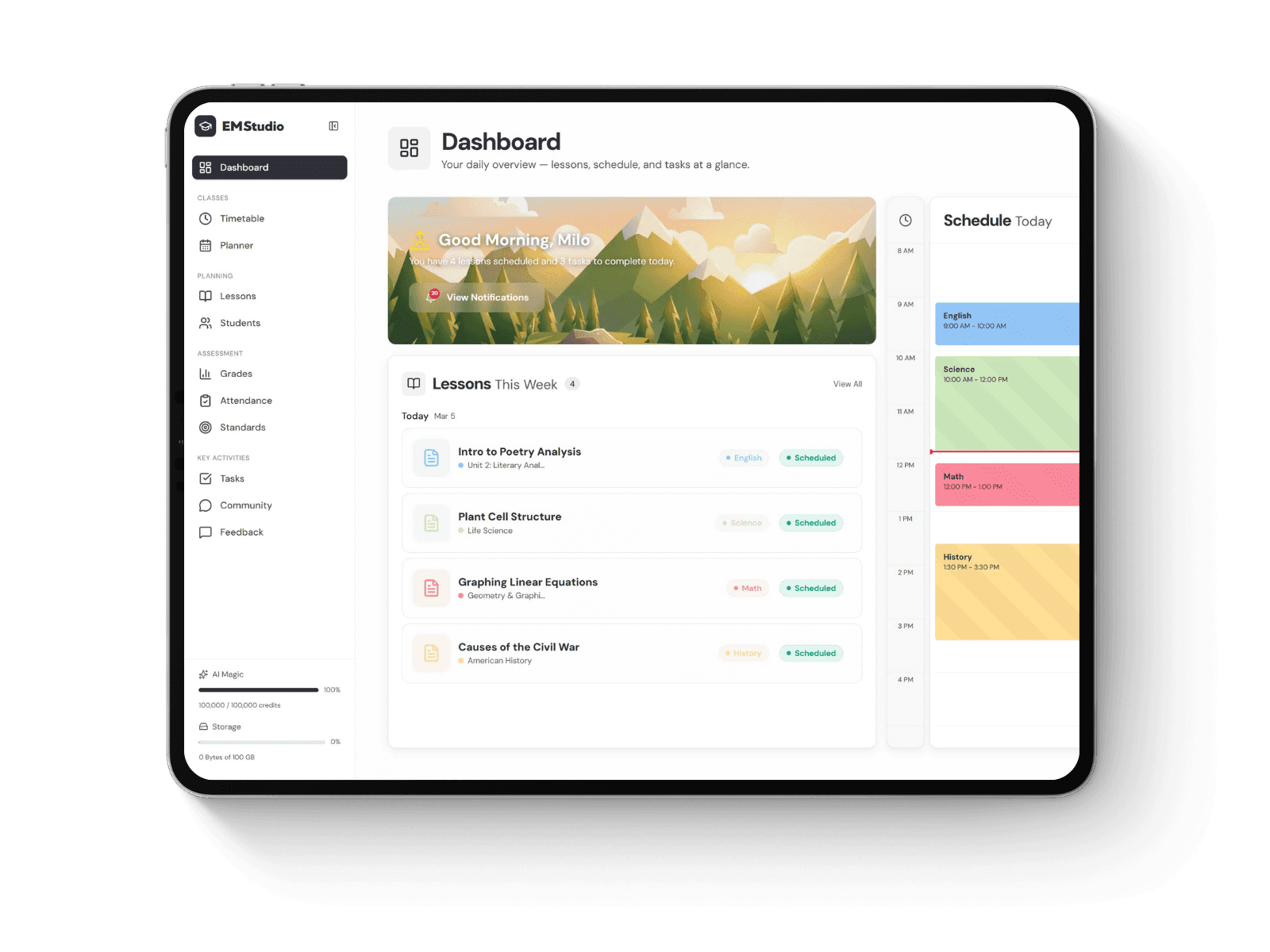
EMStudio is a free teaching management app — manage your classes, students, lessons, and more!
Key takeaways
Tools that accept the widest range of file types, PDFs, slides, audio, video, photos of notes, give students the biggest practical advantage over those limited to text uploads.
Free plan depth varies enormously: some tools lock core features behind a paywall; others expose everything on a free tier with usage limits.
No single tool dominates every dimension. The right pick depends on whether you need spaced repetition, exam drilling, source-cited research, or the broadest set of study formats from one upload.
Ads on a free plan are a real friction point for long study sessions, several of the tools reviewed here run ads on their free tiers.
AI-generated study materials are only as useful as their edit controls. Several tools let you correct or rewrite anything they produce; others do not.
How we compared them
Each tool was evaluated on the same five criteria, weighted to reflect what matters most to a student working from their own class materials: free plan depth (weight 1), input range (weight 0.8), study-format output from one upload (weight 0.6), ad-free experience (weight 0.4), and edit controls over generated content (weight 0.3). Scores are on a 1-5 scale applied consistently across all ten entries.
Criterion (weight) | Gemini Notebook | Knowt | Penseum | StudyFetch | Claude | ChatGPT study mode | Perplexity | Anki | Quizlet | |
|---|---|---|---|---|---|---|---|---|---|---|
Free plan coverage (×1) | 5 | 5 | 4 | 4 | 2 | 3 | 4 | 4 | 4 | 2 |
Works from your own materials (×0.8) | 5 | 5 | 5 | 4 | 5 | 4 | 3 | 3 | 1 | 3 |
Study formats from one upload (×0.6) | 5 | 4 | 4 | 4 | 5 | 2 | 2 | 2 | 1 | 4 |
Ad-free studying (×0.4) | 5 | 3 | 2 | 3 | 4 | 5 | 3 | 3 | 5 | 1 |
Editable study materials (×0.3) | 5 | 3 | 4 | 3 | 3 | 2 | 2 | 2 | 5 | 4 |
Weighted total | 15.5 | 13.5 | 12.4 | 11.7 | 11.5 | 10.0 | 9.4 | 9.4 | 8.9 | 8.4 |
A ranked comparison of the AI study tools students use most, judged on what each one builds from the student's own notes, slides and lectures.
1. Studley
Studley is built around a single premise: upload your class material once, get every study format you need from it. One upload can produce summarized notes, flashcards, multiple-choice quizzes, written tests, fill-in-the-blank exercises, podcast-style audio and AI tutor lessons, all from the same source file. That breadth is what separates it from tools that specialize in one or two output types.
On the input side, it accepts PDF, Word, PowerPoint, images, photos of handwritten notes, audio, video, YouTube links, website URLs and pasted text, with up to 10 files per study set. That coverage means a student can feed it a lecture recording, a set of slides and a photo of their own notes all at once. The AI tutor built on top of those materials can then walk through the content interactively rather than just surface it.
The free plan is unusually open: every feature is included, with one weekly usage allowance shared across all of them, and no credit card is needed. There are no ads on any plan, and everything Studley generates, notes, flashcard text, quiz questions, written tests, can be edited directly. More than 4,000,000 students use Studley, and it is available on web, iOS and Android. For students considering a paid upgrade, Pro starts at $14.99/month or $97.99/year.
Pros: Widest set of study formats produced from a single upload; every feature accessible on the free plan; no ads on any plan; all generated content is editable.
Cons: Review is student-initiated with mastery tracking rather than an automatic spaced-repetition schedule, so maintaining long-term retention takes more self-discipline than tools like Anki that schedule reviews for you.
Best for: Students who want one app to handle their entire study workflow, from raw class files to practiced recall, without paying to unlock core features.
2. Gemini Notebook (formerly NotebookLM)
Gemini Notebook (formerly NotebookLM) is Google's source-grounded research notebook. Upload documents, slides or other materials and it answers questions with inline citations pointing back to your specific sources, a meaningful trust signal when you need to verify what the AI is drawing on. It also generates Audio Overviews in 80+ languages, turning your source material into a conversational summary you can listen to.
It sits closer to the research end of the study spectrum than the exam-prep end. It is excellent for understanding complex readings, synthesising multiple sources and checking where a claim actually came from. What it does not do is generate a graded practice test, evaluate a written answer or build a flashcard deck for spaced drilling. Free with a Google account, it has one of the strongest value propositions of any tool here for students who do more reading than drilling.
Pros: Free and generous; inline citations trace every answer to your uploaded sources; broad file support; Audio Overviews available in many languages.
Cons: Designed for research and comprehension rather than exam drilling; no written-answer grading or feedback; no scheduled spaced repetition.
Best for: Students writing research papers or working through dense readings who need to verify exactly which source an AI summary is drawing from.
3. Knowt
Knowt operates in the same space as Quizlet, flashcard sets, learn modes, notes, but with a more generous free tier and AI tools layered on top. The free Basic plan includes unlimited flashcard sets and learn modes, and it imports Quizlet sets directly, making migration frictionless for students moving away from that platform.
AI-generated summaries are where the free plan shows its limits: they are capped at one per month on the free tier. This matters because the AI tooling is otherwise one of Knowt's selling points. Cards and notes are editable, and the core study modes work without a subscription. The tradeoff is ads on the web free plan, which can interrupt longer study sessions.
Pros: Generous free flashcard modes with no set limit; Quizlet import; editable content.
Cons: Ads on the web free plan; AI summaries are limited to one per month on the free tier.
Best for: Students looking for a free Quizlet alternative who already have flashcard sets they want to import and don't rely heavily on AI-generated summaries.
4. Penseum
Penseum converts uploaded study material into notes, flashcards, quizzes and practice exams. Its practice-exam output, covering both multiple-choice and written questions, gives it a slight emphasis on test preparation compared to tools that focus on passive review. The free plan covers the core tools and requires no credit card.
The practical drawback is transparency: free plan limits are not published anywhere on the site, so students discover constraints through use rather than upfront. Pro pricing is listed inconsistently across Penseum's own pages. For a student choosing between tools before committing time to onboarding, that opacity is a genuine friction point. What you can verify is that the free tier exists and includes the main features.
Pros: Free plan covers core tools with no card required; practice exams include both multiple-choice and written-answer formats.
Cons: Free usage limits are not published; Pro pricing is inconsistent across the site.
Best for: Students who want practice-exam-style output, particularly written-answer questions, alongside standard flashcards, and don't mind discovering free limits through experimentation.
5. StudyFetch
StudyFetch positions itself as a full study suite: it accepts documents, photos, YouTube links, audio and video, and builds out flashcards, quizzes, study games and an AI tutor with voice on top of those uploads. Citations back to your original materials help ground the AI's responses in what you actually uploaded rather than general knowledge.
The output breadth is a genuine strength, few tools match it for variety of study modes produced from a single source. The tutor with voice is a differentiator for students who learn better in a conversational format. The weak point is the free plan: limits exist but are not published, which makes it hard to know what you're getting before you hit a wall. The App Store lists Premium at $19.99/month.
Pros: Very broad input types and output modes from a single upload; AI tutor with voice interaction; citations to source materials.
Cons: Free plan limits are not published; App Store Premium pricing is $19.99/month.
Best for: Students who want a broad suite of study modes including a voice tutor, and are willing to pay for a premium tier once they've tested the free experience.
6. Claude
Claude is Anthropic's AI assistant. Students use it most effectively as a reading companion, feeding it long PDFs, dense textbook chapters or research papers and asking it to explain, summarise or quiz them on the content. Its handling of extended documents is a practical strength for coursework-heavy subjects.
It is not a study app in the structured sense. There are no saved decks, no practice-test mode, no flashcard sets that persist between sessions. It is a conversation. Free usage caps exist but are not published. For students who need a tool to manage and revisit structured study materials over time, that lack of persistence is a real limitation. As a supplement to a structured tool, for working through difficult readings, it holds up well.
Pros: Strong at explaining long, complex readings in accessible terms; handles extended documents.
Cons: No saved decks, flashcards or persistent practice-test mode; free usage caps are not published.
Best for: Students who need help understanding difficult readings or want to talk through concepts, and use a separate tool for structured exam prep.
7. ChatGPT study mode
ChatGPT study mode is a guided tutoring mode inside ChatGPT that walks students through topics using Socratic questioning, asking the student to reason through problems rather than just providing answers. It is available on free accounts, which makes it accessible to a wide range of students without any subscription.
Like Claude, it is fundamentally a chat interface. There are no saved decks, no flashcard sets and no persistent practice tests. File uploads are possible but limited on the free plan. For a student who wants to be walked through a concept interactively or practice verbal reasoning before an exam, it fills a real need. For one who wants to build and revisit structured study materials, it does not.
Pros: Free Socratic tutoring available on the free plan; flexible across subjects.
Cons: A chat interface, not a study-set builder, no decks or saved practice tests; file uploads are limited on the free plan.
Best for: Students who want conversational, step-by-step tutoring on a concept and don't need to store or revisit structured flashcard sets.
8. Perplexity
Perplexity is an AI answer engine with a learn mode. Its primary strength is research: answers come with linked sources that can be checked, which makes it useful for students doing background research before writing or who want to verify a fact quickly. The free plan is functional for general use.
It is not designed for exam preparation in the traditional sense. There are no flashcard modes, no practice tests and no structured study sets built from your uploads. Its value in a study context is as a faster, source-linked alternative to a search engine when you're building knowledge before engaging with class materials directly.
Pros: Answers link to checkable sources; free plan is functional for research use.
Cons: Built for research, not flashcard creation or practice-test drilling; no structured study output from uploads.
Best for: Students doing pre-reading or background research who want source-linked answers they can verify, used alongside a dedicated study app.
9. Anki
Anki is the benchmark for spaced-repetition flashcard systems. It schedules card reviews using FSRS and SM-2 algorithms, both peer-studied approaches to optimising long-term retention, and surfaces cards at the moment you're most likely to forget them. Free on desktop, web and Android; iOS is a one-time $24.99 purchase.
The trade-off is explicit: Anki does not generate anything from your materials. There is no AI summarisation, no quiz builder, no note generator. You build the decks yourself, or import shared ones from the Anki community, and the app handles the scheduling. For students willing to invest time in deck creation, the retention outcomes can be substantial. For students who want AI to generate study materials from their uploads, Anki is the wrong tool, used alone.
Pros: Best-in-class spaced-repetition scheduling; free on most platforms; fully editable cards.
Cons: No AI generation from your class materials; flashcard study only, no notes, quizzes or written-answer modes.
Best for: Students who have already mastered a subject's vocabulary or concepts and want to cement long-term retention through disciplined, algorithm-scheduled review.
10. Quizlet
Quizlet is the most recognisable name in student flashcards and has been for over a decade. Its public library of shared sets means students can often find existing decks for their course rather than building from scratch, a real time-saver for common subjects. Learn mode and practice tests are built in.
The free plan has become more constrained over time. Ads run throughout the free experience, and Learn mode and Test are limited on the free tier. AI-powered features that generate study materials from your own uploads sit behind a subscription. For students used to the platform from school, the familiarity has value. For those starting fresh, the free-plan limitations and persistent ads are harder to ignore given what competitors now offer at no cost.
Pros: Large library of shared community sets; familiar interface that many classes already use; Learn mode and practice tests available.
Cons: Ads on the free plan; Learn and Test features are limited on the free tier.
Best for: Students whose course already has a Quizlet set built, or who want access to a large library of shared community flashcard decks.
Free AI Study Tools for Students - What You Actually Get
Some offer their full feature set on a free plan with a usage limit, a weekly or monthly cap on how many study sets or summaries you can generate. Others offer unlimited access to a narrow feature set and charge for the rest. A few run ads to offset costs. Before committing to a tool, it's worth checking three things: whether the free limits are published, whether ads appear during active study sessions, and whether the features most relevant to your workflow are free or paywalled.
The tools in this roundup that are most transparent about free-plan scope are generally the most student-friendly. Opacity about limits, where you discover a cap only after investing time in the app, is a consistent frustration flagged across the mid-ranked entries.
AI Note-Taking Tools - Turning Class Materials Into Structured Notes
AI-assisted note-taking has moved well beyond simple transcription. The more capable tools accept lecture audio, video recordings, slides and even photos of handwritten notes, then produce structured summaries with headings, key-concept callouts and linked vocabulary. The differentiator between tools is whether the output is editable, whether it cites the source, and whether it feeds directly into other study formats like flashcards or quizzes without a second upload step.
For note-taking specifically, look for tools that keep a persistent document you can return to and annotate, rather than a single-session output that disappears when you close the tab.
AI Tools for Exam Preparation
Exam prep is where the gap between general AI assistants and purpose-built study apps is widest. A general assistant can explain a concept on demand. A study app can generate a timed practice exam, track which question types you get wrong, and resurface weak areas in a future session.
The most exam-focused tools in this roundup produce multiple-choice and written-answer practice questions from your uploaded materials, not from generic internet training data. That distinction matters for professional exams, niche courses or any subject where your professor's framing differs from the standard textbook treatment. For high-stakes exams, the ability to edit generated questions, to correct an error or raise the difficulty, is worth checking before you rely on the output.
ChatGPT Alternatives for Students
ChatGPT's study mode is a solid tutoring tool, but it is not the only option, and for structured exam prep, it may not be the right one. The main alternatives differ in a few meaningful ways: some are purpose-built to generate persistent, revisable study sets from your own files; others prioritise source citations over conversational fluency; a few offer voice-based tutoring for students who process information better through listening.
When comparing alternatives, the most useful question is which one fits into your actual study routine. A tool that produces a flashcard deck you review over three weeks does something categorically different from a chat session you close and lose. Both have value; they serve different moments in the study cycle.
How to Use Chatbot AI Tools for Studying
Conversational AI tools, ChatGPT study mode, Claude, Perplexity, are most effective when used at specific points in the study process rather than as a catch-all. Use them before engaging with new material to build a mental map of a topic. Use them during reading to work through a concept you're stuck on. Use them after a practice test to understand why a wrong answer was wrong.
The common mistake is using a chatbot as a passive content delivery system, asking it to summarise a chapter and reading the output once. Retention research consistently shows that active retrieval outperforms passive review. If you're using a chatbot, make it quiz you, challenge your answers, or ask you to explain something back in your own words.
Free vs Paid AI Study Tools - Where the Line Falls
The paid tier of most AI study tools buys one of three things: higher usage limits, additional input types (longer files, more uploads per set), or priority processing during peak hours. Core feature access, whether you can generate flashcards, quizzes and notes at all, varies significantly by tool.
For a student on a tight budget, the practical question is whether the free limit covers a typical week of study. A tool with a weekly usage allowance across all features may be more useful than one with an unlimited free flashcard mode that locks its AI tools behind a paywall. The best approach is to identify the two or three features you'll use every day and confirm those are on the free plan before onboarding.
AI Tools for Studying - What to Look for Before You Commit
With a crowded market, the criteria that separate genuinely useful tools from novelties come down to: how well the tool handles your specific file types (not just PDFs, but slides, audio, photos of notes); how many study formats it produces from a single upload; and whether it retains your materials across sessions so you can study the same content over multiple weeks.
Secondary considerations, but worth checking, are edit controls over generated content (AI gets things wrong; you need to be able to fix it), whether the free plan is ad-free, and whether the tool is available on the platforms you actually study from. A web-only tool is a friction point for students who review on a phone between classes.
Speech Recognition and Audio Tools for Students
Several tools in this roundup now incorporate audio as both an input and an output. On the input side, lecture recordings and voice memos can be uploaded directly and converted into structured study materials. On the output side, some tools generate audio overviews or podcast-style summaries of uploaded content, useful for commutes, exercise or any situation where screen time isn't practical.
For students with dyslexia, auditory processing preferences or heavy commutes, audio output meaningfully expands when and how studying happens. When evaluating tools, it's worth distinguishing between tools that accept audio uploads (a transcription feature) and those that also generate listenable audio from text content (a production feature). The latter is less common and more valuable.
Next steps
The right tool depends almost entirely on what you're trying to do with it.
If you want one app to handle your entire study workflow, from raw class files to practiced recall, across multiple formats, without unlocking features through a subscription, Studley covers the most ground on a free plan, with the broadest output range from a single upload. The tradeoff is that long-term review scheduling is on you.
If you do more research and reading than exam drilling, Gemini Notebook's source-cited responses and Audio Overviews make it one of the strongest free tools available, particularly for paper-heavy coursework.
If you're moving away from Quizlet and want a familiar format without paying for it, Knowt's free tier covers the basics, just expect ads and a tight cap on AI summaries.
If practice exams with written-answer questions are your priority, Penseum covers that use case at no cost, though you'll need to test its limits yourself since they aren't published.
If you're willing to pay for a full study suite with voice tutoring, StudyFetch's input and output breadth is competitive, and the voice tutor differentiates it from flashcard-first tools.
If long-term retention across a semester or more is the goal and you're prepared to build your own decks, Anki's spaced-repetition scheduling is unmatched, no AI tool in this roundup replicates it. It just won't generate your cards for you.
For reading comprehension and concept explanation, Claude and ChatGPT study mode are complementary rather than competing with structured study apps. Use them to understand material; use a dedicated tool to drill it.
Still grading everything by hand?
EMStudio is a free teaching management app — manage your classes, students, lessons, and more!