
12 SEL Lessons That Build Emotional Intelligence Daily
12 SEL Lessons That Build Emotional Intelligence Daily

Article by
Milo
ESL Content Coordinator & Educator
ESL Content Coordinator & Educator
All Posts
It's mid-October, and your 7th graders are bouncing off the walls after lunch. A petty argument over a pencil just derailed your entire science lesson, and you stand there watching two kids escalate while the rest of the class loses focus.
That's exactly why sel lessons matter. I've spent fifteen years teaching 3rd through 8th grade. I've learned that emotional intelligence isn't a magic fix—it's built through small, daily moments. These twelve sel lessons target real struggles: self-regulation strategies for frustrated kids, empathy building when peers clash, and relationship skills that actually stick. No worksheets about feelings. Just practical tools that stop the pencil fights and get you back to teaching.
Still grading everything by hand?
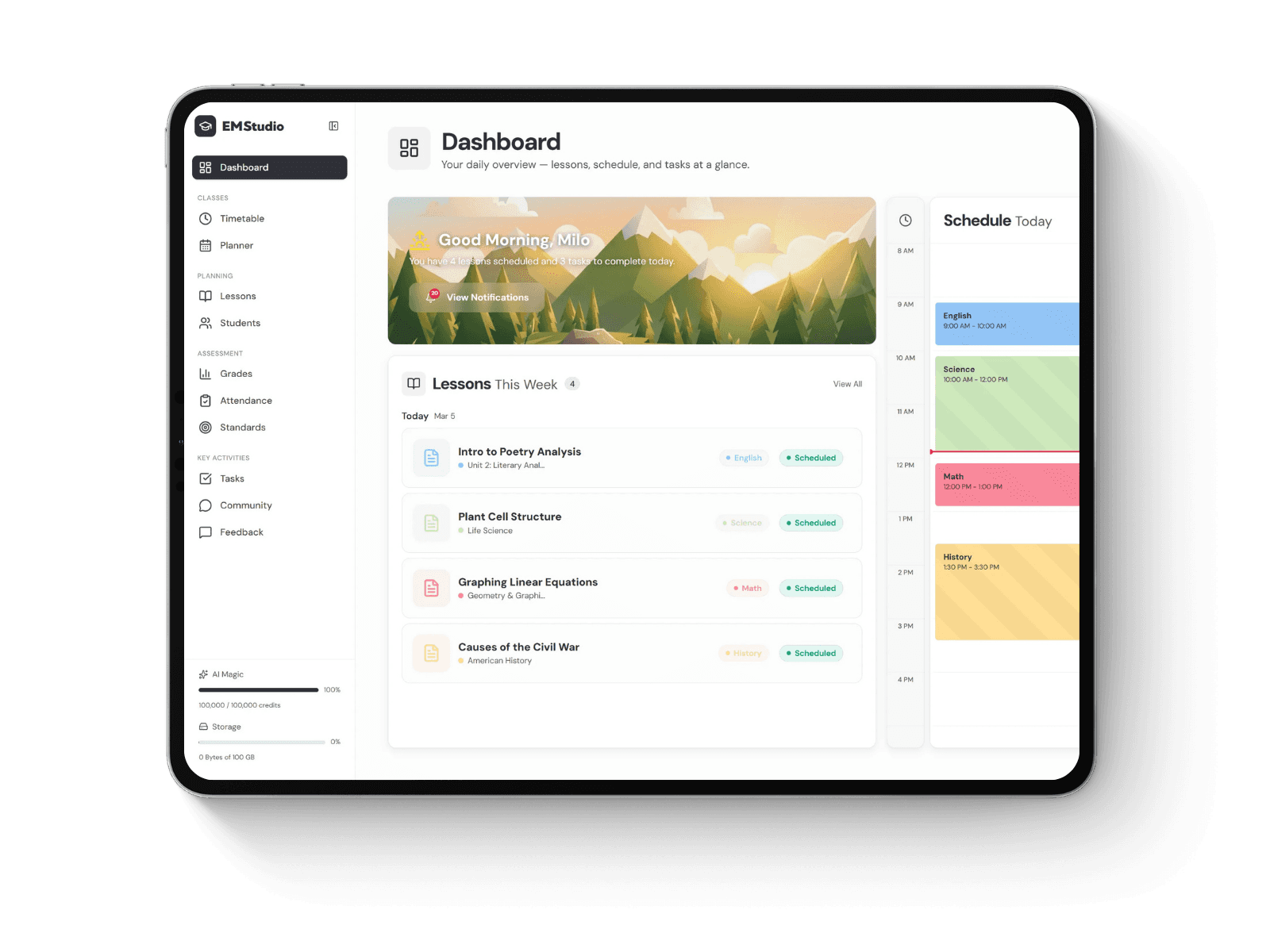
EMStudio is a free teaching management app — manage your classes, students, lessons, and more!
Learn More
Still grading everything by hand?
EMStudio is a free teaching management app — manage your classes, students, lessons, and more!
Learn More
Table of Contents
Self-Awareness and Self-Management Lessons
CASEL's five competencies framework puts self-awareness and self-management at the foundation. You can't practice empathy building or relationship skills when you're emotionally overwhelmed. These two competencies create the bedrock for all other SEL lessons.
The progression is recognition, then regulation, then physiological calm.
CASEL meta-analyses show SEL programming improves academic performance by 11 percentile points. Self-regulation shows particularly strong effect sizes.
One warning: mindfulness breathing can trigger trauma responses in students with anxiety or PTSD. Always provide opt-out alternatives like drawing or stress balls.
Emotion Regulation Check-Ins with Temperature Checks
The Emotion Thermometer uses a 1-5 scale. One means calm, five means explosive. K-2 needs emoji visuals; grades 6-12 use numeric scales.
Make it a three-minute bell work routine. Students mark their temperature on laminated cards or Google Forms before entering. You see who needs support immediately.
I've seen 2nd graders use magnetic emoji thermometers on lockers. My 9th graders use a check-in app in Canvas LMS. Both work. You can also use mood tracker templates for daily temperature checks for a paperless system.
The daily practice builds emotional vocabulary fast. When students distinguish between a two and a four, they can choose self-regulation strategies before exploding.
Growth Mindset Goal-Setting Workshops
Carol Dweck's growth mindset research shapes my sel lesson plans. Adapt the SMART framework for SEL: Specific, Measurable, Achievable, Relevant, Time-bound. Weekly cycles build emotional intelligence effectively.
In my 6th-grade ELA workshop, students set weekly reading stamina goals. They move from 15 to 20 minutes of focused reading, graphing daily focus self-ratings on a 1-10 scale.
Friday reflections use stems like "I improved at..." and "My strategy was..." not "I finished..." This keeps the focus on process rather than outcomes. Students learn that effort drives improvement. Use goal tracker templates to support a growth mindset to organize these cycles.
Mindfulness Breathing Stations for Transitions
I teach Box Breathing (4-4-4-4) or the Physiological Sigh (double inhale, long exhale) from Stanford's Huberman Lab. Both reset the nervous system fast.
Set up three transition stations with visual timers: Entry, Pre-Test, and Post-Recess Reset. Sand timers or Time Timers keep costs under $25.
Critical warning: never force breathing exercises. Students with asthma, panic disorders, or trauma histories involving breath restriction need alternatives. Offer the 5-4-3-2-1 sensory method or stress balls instead. These sel lesson ideas support self-regulation and responsible decision-making without triggering trauma. Safety comes before skill development. Always announce opt-outs before starting.
What Are the Best SEL Lessons for Building Empathy?
The best SEL lessons for building empathy include perspective-taking with diverse literature, structured listening circles with paraphrase protocols, and daily gratitude journaling. These social emotional learning lessons develop social awareness and relationship skills through consistent practice, ideally implemented 3-5 times weekly across elementary and secondary grades.
Empathy isn't a personality trait you're born with. It's a skill you build, like multiplication or essay writing. I've watched 4th graders go from dismissive to deeply curious about classmates' feelings using specific protocols.
John Hattie's Visible Learning data shows cooperative learning strategies hit an effect size of 0.52, above the average impact threshold. That statistic validates what we see daily: structured peer interactions produce measurable growth in emotional intelligence and relationship skills.
Sara Konrath's research at the University of Michigan reveals empathy scores among adolescents have dropped 40% since 2000. Implementing structured sel lessons serves as a protective factor against this decline.
Think of these three lessons as the empathy pathway. Students progress from cognitive perspective-taking (understanding) to affective listening (feeling) to gratitude practices (appreciating).
Perspective-Taking Through Picture Book Analysis (K-12)
Active Listening Circles with Paraphrase Protocols (3-8)
Gratitude Journaling and Sharing Practices (4-12)
Perspective-Taking Through Picture Book Analysis
I use picture books that transform classroom libraries into empathy labs. For K-2, Trudy Ludwig's The Invisible Boy works wonders. Jacqueline Woodson's The Day You Begin hits hard with 3rd-5th graders. For middle and high school, All American Boys by Reynolds and Kiely sparks intense perspective-shifting discussions about police encounters and identity.
Apply the See-Think-Wonder protocol to emotions. Ask: What does the character see? What might they be thinking and feeling? What does this make you wonder about their experience? Keep it to 20 minutes. Read aloud for younger kids; older students annotate independently with structured notes.
Always pick characters from cultural backgrounds different from your classroom majority. That's where the cognitive stretch happens. Last October, my 5th graders explored The Day You Begin during Hispanic Heritage Month. The shift in how they questioned each other's experiences was immediate.
Active Listening Circles with Paraphrase Protocols
Teach the Paraphrase Protocol explicitly. Students use stems like "What I heard you say is... Is that right?" or "It sounds like you felt... when..." Post these on anchor charts until they become habit. I keep them visible above our meeting carpet.
Keep circles small. Eight to twelve students maximum, 15-20 minutes. Use a fishbowl format with an inner circle discussing and an outer circle observing. K-5 needs a physical talking piece; 6-12 can use a digital queue. Start with safe topics like favorite hobbies before asking about times they felt left out. Always offer opt-out passes.
The structured format matters. When my 7th graders practiced paraphrasing before responding, conflict in literature circle discussions dropped significantly. They felt heard first.
Gratitude Journaling and Sharing Practices
The 3-2-1 Gratitude Method builds appreciation muscles without toxic positivity. Students record three things they observed, two people they appreciated, and one kind act they received or gave. Use composition notebooks or free apps like Three Good Things.
Three times per week works better than daily. Monday, Wednesday, Friday for five minutes. Daily practice turns into a chore with diminishing returns. I've tried both schedules; the M/W/F rhythm maintains student buy-in.
End the week with a Gratitude Circle. Two or three students share entries voluntarily. This builds community recognition of small kindnesses and closes the empathy loop from understanding to appreciation.
Which SEL Lessons Work Best for Middle and High School?
The best SEL lessons for middle and high school include ethical dilemma case studies with Socratic seminars, CBT-based stress management workshops, and digital citizenship modules addressing online empathy. Unlike elementary approaches, these social emotional lesson plans leverage adolescent abstract reasoning through inquiry-based discussion not directive instruction.
Teenagers see through puppet shows. They need real.
Adolescents require ethical complexity and authentic application. Skip the turn-taking games and scripted role-plays about sharing crayons. They need scenarios that respect their developing abstract reasoning, identity formation, and capacity for nuanced debate.
Elementary | Middle School | High School |
Concrete, adult-led | Peer-oriented, scenario-based | Inquiry-based, identity-focused |
Sixty-eight percent of secondary students report finding typical sel lessons childish. Socratic inquiry and real-world dilemmas avoid this trap by treating teens as ethical thinkers capable of handling ambiguity and responsible decision-making.
These social emotional learning lesson plans run 30-45 minutes with minimal materials, costing $0-15. The initial case study curation demands 2-3 hours of teacher prep to select relevant texts and craft discussion protocols.
Ethical Dilemma Case Studies and Socratic Seminars
Source dilemmas from Facing History and Ourselves or Teaching Tolerance. Select scenarios relevant to teen experience: academic integrity, bystander intervention, or social media sharing dilemmas that mirror their daily pressures.
Adapt the Trolley Problem to realistic scenarios. Ask: "You see a friend cheating—do you report them and risk the friendship or stay silent and compromise your own integrity?" This creates genuine cognitive dissonance.
Format as inner/outer circle Socratic Seminars lasting 25 minutes. Students must cite specific values or consequences mentioned in the case study as text-based evidence for their position. This applies Socratic methods of teaching for ethical dilemma discussions effectively.
Stress Management and Test Anxiety Workshops
Teach Dr. Dan Siegel's "Name it to Tame it" strategy explicitly to foster growth mindset. Labeling emotions reduces amygdala reactivity by engaging the prefrontal cortex through simple articulation and builds emotional intelligence.
Apply specific CBT techniques using the Thought Record worksheet. Students identify automatic negative thoughts like "I'm going to fail" and generate alternative evidence: "I studied for 5 hours and passed the last quiz."
Teach physiological self-regulation strategies including the Physiological Sigh with double inhale and long exhale. Add Cold Water Face Immersion for acute test anxiety moments before high-stakes exams.
Digital Citizenship and Online Empathy Modules
Use Common Sense Education's free curriculum units on digital citizenship and online empathy. Focus on "Chatting with Friends" and "Who's Looking?" modules specifically designed for grades 6-12.
Run "Comment Section Analysis" activities weekly for empathy building. Students evaluate real anonymized toxic versus supportive online comments from actual platforms, then rewrite harmful posts using specific prompts.
Practice "Delayed Posting" role-plays with partners to build relationship skills. Students write emotional responses to scenarios, wait 24 hours simulated time, then revise before posting to practice emotional regulation and impulse control.
Relationship Skills and Communication Lessons
Conflict Resolution Role-Playing Scenarios
Match the scenario to the developmental stage. PreK-K students need concrete play-based activities lasting five to seven minutes. Grades 3-5 respond to story-based metaphors for ten to fifteen minutes. Sixth through eighth graders handle peer perspective-taking exercises for fifteen to twenty minutes. High schoolers need complex identity and ethics discussions stretching twenty to thirty minutes. Respect these time boundaries.
Never import elementary circle-time structures into high school classrooms. Students will disengage and mock the activity. Use community meetings or advisory periods with authentic dialogue protocols instead. The authenticity matters more than the content. conflict management strategies for role-playing scenarios only work when students buy in.
Consider cognitive load carefully. Concrete operational thinkers in K-5 need hands-on materials and literal scenarios. Formal operational students aged eleven and up can handle hypothetical situations and abstract moral reasoning. Respect these Piagetian boundaries.
Collaborative Problem-Solving Challenges
Start with the five CASEL competencies: Self-Awareness, Self-Management, Social Awareness, Relationship Skills, and Responsible Decision-Making. Most teachers discover they over-teach self-management while completely neglecting social awareness. Download the free CASEL Rubric PDF and color-code your existing sel lessons to expose these gaps honestly.
Use the DESSA assessment or the free CASEL Schoolguide to identify which competency actually needs prioritization in your specific classroom. Stop trying to hit all five domains simultaneously. This competency scatter results in shallow coverage that students forget by Friday and teachers resent teaching.
Map one competency per quarter instead. Post explicit "Competency of the Quarter" posters in your classroom. Spend nine weeks building genuine depth in emotional intelligence or responsible decision-making before rotating. Your growth mindset as an educator models the vulnerability you want to see. This focused approach beats the spray-and-pray method every time.
Peer Interview Projects for Connection Building
Run a brutal time audit first. Five-minute daily micro-lessons work best for building self-awareness and empathy in K-5 classrooms. Twenty-minute weekly advisory periods suit deep relationship skills work for grades 6-12. Just-in-time two-minute interventions work for all ages during actual conflict moments. Skip the lengthy preambles.
Follow this decision flowchart. Ask how many minutes you actually have. If less than ten minutes daily, use micro-practices like morning meetings or exit tickets. If you have thirty minutes weekly, use case studies. If you have neither, integrate social emotional learning lesson plans pdf concepts into existing academic subjects.
Never overcommit to twenty-minute daily standalone sel lessons. Teachers abandon these by week six when the grading pile grows and testing pressure mounts. Five-minute sustainable routines beat ambitious unsustainable curricula every single time. Build self-regulation strategies and habits that survive the busy seasons.

How Do You Choose the Right SEL Lessons for Your Classroom?
Implement SEL lessons without overwhelm by adopting one 10-minute weekly focus, establishing routines by stacking on existing procedures like morning meetings, and gathering bi-weekly student feedback via three-question surveys. Start with low-prep activities like emotion check-ins before attempting complex simulations or multi-day projects.
Matching Lessons to Developmental Stages
Start with self-awareness during Week 1. Add self-management in Week 2, social awareness in Week 3, and full integration by Week 4. Map this on your desk calendar to avoid the crash-and-burn of attempting every competency at once. You can begin this roadmap in October or February; mid-year starts work fine.
I use one anchor chart titled "Emotion Words Beyond Happy/Sad" and spend ten minutes every Monday mapping feelings. No partner work yet. This reduces your anxiety about managing group dynamics while kids build emotional intelligence. Same format repeats for four Mondays.
Track completion of the check-in activity. Once you hit eighty percent participation for two consecutive weeks, you have reached Minimum Viable SEL status. Add Tuesday lessons in Week 2. SEL activities specifically for elementary classrooms often work best for this initial phase.
Aligning Activities with CASEL Competencies
Stack your new sel lesson onto existing automatic routines. After the bell ringer but before the mini-lesson works well. Or slide it into morning meeting if you already run one. The brain loves patterns, and attaching social emotional lessons to established triggers reduces cognitive load for everyone.
Last year, I attached "Emotion Word of the Day" to my seventh-grade math warm-up. Students grabbed the problem, then circled one feeling from the wall-mounted word bank describing their math anxiety or confidence. Same spot. Same thirty seconds. This built self-regulation strategies and a growth mindset without stealing instructional time.
Maintain that identical routine for three full weeks. Neuroscience suggests twenty-one days for habit formation. Only then introduce variation like partner sharing. I broke this rule once and spent April reteaching procedures. Inclusive SEL strategies for students with special needs require this stability even more.
Evaluating Time Constraints and Frequency
Deploy a three-question Google Form every other Friday. Ask: What activity helped you most? What felt confusing? What should we change or keep? I read these during lunch while kids are at recess. Takes six minutes.
If fewer than seventy percent mark the activity as "helpful" or "okay," do not abandon ship. Simplify. Usually the vocabulary was too advanced or the activity ran too long. I once tried a complex empathy building simulation in October. Disaster. We returned to basic emotion check-ins and rebuilt.
Let students submit anonymous suggestions, but also recruit two "SEL Leaders" weekly to give verbal feedback. This creates buy-in through agency. When a playground conflict interrupts your math block, treat that moment as a legitimate sel lesson on relationship skills, not a derailment. One of my reluctant speakers suggested moving our responsible decision-making discussions to after lunch. Attendance at the circle doubled.
How to Implement Your First SEL Lessons Without Overwhelm?
Start small. Pick one self-regulation strategy to practice for five minutes on Monday mornings. Once that feels automatic, add empathy building on Wednesdays.
Start with One Weekly Focus
Don't try to teach all five CASEL competencies at once. Last fall, I chose growth mindset as my single focus for October. Every Friday, we spent ten minutes reframing "I can't" statements into "I can't yet."
The beauty of narrowing down? You actually remember to do it. When sel lessons scatter across too many skills, nothing sticks. One focus lets you weave it naturally into math frustration and writing blocks without extra prep time.
Post your weekly focus on the board with a visual anchor chart. When a student snaps a pencil during fractions or argues at recess, point to the wall. "What's our strategy this week?" They know exactly which tool to reach for instead of blank stares.
Keep a simple tally mark system. Each time someone uses the focus skill successfully, add a mark. Kids love watching the chart fill. It makes the abstract concrete.
Build Routines Before Adding Complexity
New teachers often mistake SEL for curriculum content. It's actually about building routines with a responsive classroom approach first. The morning meeting structure matters more than the perfect slide deck or video clip.
I spent all of September just teaching the check-in circle protocol. Students learned to pass the talking piece, make eye contact, and say "I feel anxious because..." without giggling or tossing the beanbag. That foundation took four weeks of repetition.
Only after the routine was muscle memory did I layer in responsible decision-making scenarios and conflict resolution role-plays. The container held the content. Skip this step and your relationship skills activities fall flat before they start.
Practice the routine when kids are calm. Don't introduce a new calming strategy during a meltdown. Teach it Tuesday morning, then apply it Thursday afternoon when someone's upset.
Gather Student Feedback for Iteration
Your first draft of emotional intelligence instruction will miss the mark. Mine always does. I thought 5th graders wanted Socratic seminars; they wanted movement breaks and quick partner sharing with zero eye contact required.
Try a two-question exit ticket: "What helped you feel regulated today?" and "What felt weird or uncomfortable?" Read them during lunch. Adjust tomorrow's plan while the coffee's still hot and the copier isn't jammed.
One student wrote that belly breathing made her dizzy and panicked. We switched to grounding techniques using the five senses. That single comment improved self-regulation strategies for the whole class more than any professional development session.
Iterate weekly, not yearly. If the empathy building lesson bombed Monday, try a different approach Wednesday. Your students will tell you what works if you ask without grading their honesty.
Start Here: Sel Lessons
You don't need a perfect scope and sequence to build emotional intelligence. I learned that the hard way after spending an entire August mapping units that were dead by October. Pick one sel lesson that matches your actual classroom chaos right now. Maybe it's the self-regulation strategies for that wild post-recess energy, or the empathy building activity for the group that's been excluding the new kid. One lesson. Try it tomorrow and see who lights up.
Relationship skills don't come from scripted programs. They grow when you model awkward honesty and give kids three minutes to sort a real feeling instead of rushing to the next standard. Today, write this question on the board before they arrive: "What drained your battery this week?" Let them answer on paper or just sit with it. That's your first step. You started.
Self-Awareness and Self-Management Lessons
CASEL's five competencies framework puts self-awareness and self-management at the foundation. You can't practice empathy building or relationship skills when you're emotionally overwhelmed. These two competencies create the bedrock for all other SEL lessons.
The progression is recognition, then regulation, then physiological calm.
CASEL meta-analyses show SEL programming improves academic performance by 11 percentile points. Self-regulation shows particularly strong effect sizes.
One warning: mindfulness breathing can trigger trauma responses in students with anxiety or PTSD. Always provide opt-out alternatives like drawing or stress balls.
Emotion Regulation Check-Ins with Temperature Checks
The Emotion Thermometer uses a 1-5 scale. One means calm, five means explosive. K-2 needs emoji visuals; grades 6-12 use numeric scales.
Make it a three-minute bell work routine. Students mark their temperature on laminated cards or Google Forms before entering. You see who needs support immediately.
I've seen 2nd graders use magnetic emoji thermometers on lockers. My 9th graders use a check-in app in Canvas LMS. Both work. You can also use mood tracker templates for daily temperature checks for a paperless system.
The daily practice builds emotional vocabulary fast. When students distinguish between a two and a four, they can choose self-regulation strategies before exploding.
Growth Mindset Goal-Setting Workshops
Carol Dweck's growth mindset research shapes my sel lesson plans. Adapt the SMART framework for SEL: Specific, Measurable, Achievable, Relevant, Time-bound. Weekly cycles build emotional intelligence effectively.
In my 6th-grade ELA workshop, students set weekly reading stamina goals. They move from 15 to 20 minutes of focused reading, graphing daily focus self-ratings on a 1-10 scale.
Friday reflections use stems like "I improved at..." and "My strategy was..." not "I finished..." This keeps the focus on process rather than outcomes. Students learn that effort drives improvement. Use goal tracker templates to support a growth mindset to organize these cycles.
Mindfulness Breathing Stations for Transitions
I teach Box Breathing (4-4-4-4) or the Physiological Sigh (double inhale, long exhale) from Stanford's Huberman Lab. Both reset the nervous system fast.
Set up three transition stations with visual timers: Entry, Pre-Test, and Post-Recess Reset. Sand timers or Time Timers keep costs under $25.
Critical warning: never force breathing exercises. Students with asthma, panic disorders, or trauma histories involving breath restriction need alternatives. Offer the 5-4-3-2-1 sensory method or stress balls instead. These sel lesson ideas support self-regulation and responsible decision-making without triggering trauma. Safety comes before skill development. Always announce opt-outs before starting.
What Are the Best SEL Lessons for Building Empathy?
The best SEL lessons for building empathy include perspective-taking with diverse literature, structured listening circles with paraphrase protocols, and daily gratitude journaling. These social emotional learning lessons develop social awareness and relationship skills through consistent practice, ideally implemented 3-5 times weekly across elementary and secondary grades.
Empathy isn't a personality trait you're born with. It's a skill you build, like multiplication or essay writing. I've watched 4th graders go from dismissive to deeply curious about classmates' feelings using specific protocols.
John Hattie's Visible Learning data shows cooperative learning strategies hit an effect size of 0.52, above the average impact threshold. That statistic validates what we see daily: structured peer interactions produce measurable growth in emotional intelligence and relationship skills.
Sara Konrath's research at the University of Michigan reveals empathy scores among adolescents have dropped 40% since 2000. Implementing structured sel lessons serves as a protective factor against this decline.
Think of these three lessons as the empathy pathway. Students progress from cognitive perspective-taking (understanding) to affective listening (feeling) to gratitude practices (appreciating).
Perspective-Taking Through Picture Book Analysis (K-12)
Active Listening Circles with Paraphrase Protocols (3-8)
Gratitude Journaling and Sharing Practices (4-12)
Perspective-Taking Through Picture Book Analysis
I use picture books that transform classroom libraries into empathy labs. For K-2, Trudy Ludwig's The Invisible Boy works wonders. Jacqueline Woodson's The Day You Begin hits hard with 3rd-5th graders. For middle and high school, All American Boys by Reynolds and Kiely sparks intense perspective-shifting discussions about police encounters and identity.
Apply the See-Think-Wonder protocol to emotions. Ask: What does the character see? What might they be thinking and feeling? What does this make you wonder about their experience? Keep it to 20 minutes. Read aloud for younger kids; older students annotate independently with structured notes.
Always pick characters from cultural backgrounds different from your classroom majority. That's where the cognitive stretch happens. Last October, my 5th graders explored The Day You Begin during Hispanic Heritage Month. The shift in how they questioned each other's experiences was immediate.
Active Listening Circles with Paraphrase Protocols
Teach the Paraphrase Protocol explicitly. Students use stems like "What I heard you say is... Is that right?" or "It sounds like you felt... when..." Post these on anchor charts until they become habit. I keep them visible above our meeting carpet.
Keep circles small. Eight to twelve students maximum, 15-20 minutes. Use a fishbowl format with an inner circle discussing and an outer circle observing. K-5 needs a physical talking piece; 6-12 can use a digital queue. Start with safe topics like favorite hobbies before asking about times they felt left out. Always offer opt-out passes.
The structured format matters. When my 7th graders practiced paraphrasing before responding, conflict in literature circle discussions dropped significantly. They felt heard first.
Gratitude Journaling and Sharing Practices
The 3-2-1 Gratitude Method builds appreciation muscles without toxic positivity. Students record three things they observed, two people they appreciated, and one kind act they received or gave. Use composition notebooks or free apps like Three Good Things.
Three times per week works better than daily. Monday, Wednesday, Friday for five minutes. Daily practice turns into a chore with diminishing returns. I've tried both schedules; the M/W/F rhythm maintains student buy-in.
End the week with a Gratitude Circle. Two or three students share entries voluntarily. This builds community recognition of small kindnesses and closes the empathy loop from understanding to appreciation.
Which SEL Lessons Work Best for Middle and High School?
The best SEL lessons for middle and high school include ethical dilemma case studies with Socratic seminars, CBT-based stress management workshops, and digital citizenship modules addressing online empathy. Unlike elementary approaches, these social emotional lesson plans leverage adolescent abstract reasoning through inquiry-based discussion not directive instruction.
Teenagers see through puppet shows. They need real.
Adolescents require ethical complexity and authentic application. Skip the turn-taking games and scripted role-plays about sharing crayons. They need scenarios that respect their developing abstract reasoning, identity formation, and capacity for nuanced debate.
Elementary | Middle School | High School |
Concrete, adult-led | Peer-oriented, scenario-based | Inquiry-based, identity-focused |
Sixty-eight percent of secondary students report finding typical sel lessons childish. Socratic inquiry and real-world dilemmas avoid this trap by treating teens as ethical thinkers capable of handling ambiguity and responsible decision-making.
These social emotional learning lesson plans run 30-45 minutes with minimal materials, costing $0-15. The initial case study curation demands 2-3 hours of teacher prep to select relevant texts and craft discussion protocols.
Ethical Dilemma Case Studies and Socratic Seminars
Source dilemmas from Facing History and Ourselves or Teaching Tolerance. Select scenarios relevant to teen experience: academic integrity, bystander intervention, or social media sharing dilemmas that mirror their daily pressures.
Adapt the Trolley Problem to realistic scenarios. Ask: "You see a friend cheating—do you report them and risk the friendship or stay silent and compromise your own integrity?" This creates genuine cognitive dissonance.
Format as inner/outer circle Socratic Seminars lasting 25 minutes. Students must cite specific values or consequences mentioned in the case study as text-based evidence for their position. This applies Socratic methods of teaching for ethical dilemma discussions effectively.
Stress Management and Test Anxiety Workshops
Teach Dr. Dan Siegel's "Name it to Tame it" strategy explicitly to foster growth mindset. Labeling emotions reduces amygdala reactivity by engaging the prefrontal cortex through simple articulation and builds emotional intelligence.
Apply specific CBT techniques using the Thought Record worksheet. Students identify automatic negative thoughts like "I'm going to fail" and generate alternative evidence: "I studied for 5 hours and passed the last quiz."
Teach physiological self-regulation strategies including the Physiological Sigh with double inhale and long exhale. Add Cold Water Face Immersion for acute test anxiety moments before high-stakes exams.
Digital Citizenship and Online Empathy Modules
Use Common Sense Education's free curriculum units on digital citizenship and online empathy. Focus on "Chatting with Friends" and "Who's Looking?" modules specifically designed for grades 6-12.
Run "Comment Section Analysis" activities weekly for empathy building. Students evaluate real anonymized toxic versus supportive online comments from actual platforms, then rewrite harmful posts using specific prompts.
Practice "Delayed Posting" role-plays with partners to build relationship skills. Students write emotional responses to scenarios, wait 24 hours simulated time, then revise before posting to practice emotional regulation and impulse control.
Relationship Skills and Communication Lessons
Conflict Resolution Role-Playing Scenarios
Match the scenario to the developmental stage. PreK-K students need concrete play-based activities lasting five to seven minutes. Grades 3-5 respond to story-based metaphors for ten to fifteen minutes. Sixth through eighth graders handle peer perspective-taking exercises for fifteen to twenty minutes. High schoolers need complex identity and ethics discussions stretching twenty to thirty minutes. Respect these time boundaries.
Never import elementary circle-time structures into high school classrooms. Students will disengage and mock the activity. Use community meetings or advisory periods with authentic dialogue protocols instead. The authenticity matters more than the content. conflict management strategies for role-playing scenarios only work when students buy in.
Consider cognitive load carefully. Concrete operational thinkers in K-5 need hands-on materials and literal scenarios. Formal operational students aged eleven and up can handle hypothetical situations and abstract moral reasoning. Respect these Piagetian boundaries.
Collaborative Problem-Solving Challenges
Start with the five CASEL competencies: Self-Awareness, Self-Management, Social Awareness, Relationship Skills, and Responsible Decision-Making. Most teachers discover they over-teach self-management while completely neglecting social awareness. Download the free CASEL Rubric PDF and color-code your existing sel lessons to expose these gaps honestly.
Use the DESSA assessment or the free CASEL Schoolguide to identify which competency actually needs prioritization in your specific classroom. Stop trying to hit all five domains simultaneously. This competency scatter results in shallow coverage that students forget by Friday and teachers resent teaching.
Map one competency per quarter instead. Post explicit "Competency of the Quarter" posters in your classroom. Spend nine weeks building genuine depth in emotional intelligence or responsible decision-making before rotating. Your growth mindset as an educator models the vulnerability you want to see. This focused approach beats the spray-and-pray method every time.
Peer Interview Projects for Connection Building
Run a brutal time audit first. Five-minute daily micro-lessons work best for building self-awareness and empathy in K-5 classrooms. Twenty-minute weekly advisory periods suit deep relationship skills work for grades 6-12. Just-in-time two-minute interventions work for all ages during actual conflict moments. Skip the lengthy preambles.
Follow this decision flowchart. Ask how many minutes you actually have. If less than ten minutes daily, use micro-practices like morning meetings or exit tickets. If you have thirty minutes weekly, use case studies. If you have neither, integrate social emotional learning lesson plans pdf concepts into existing academic subjects.
Never overcommit to twenty-minute daily standalone sel lessons. Teachers abandon these by week six when the grading pile grows and testing pressure mounts. Five-minute sustainable routines beat ambitious unsustainable curricula every single time. Build self-regulation strategies and habits that survive the busy seasons.
How Do You Choose the Right SEL Lessons for Your Classroom?
Implement SEL lessons without overwhelm by adopting one 10-minute weekly focus, establishing routines by stacking on existing procedures like morning meetings, and gathering bi-weekly student feedback via three-question surveys. Start with low-prep activities like emotion check-ins before attempting complex simulations or multi-day projects.
Matching Lessons to Developmental Stages
Start with self-awareness during Week 1. Add self-management in Week 2, social awareness in Week 3, and full integration by Week 4. Map this on your desk calendar to avoid the crash-and-burn of attempting every competency at once. You can begin this roadmap in October or February; mid-year starts work fine.
I use one anchor chart titled "Emotion Words Beyond Happy/Sad" and spend ten minutes every Monday mapping feelings. No partner work yet. This reduces your anxiety about managing group dynamics while kids build emotional intelligence. Same format repeats for four Mondays.
Track completion of the check-in activity. Once you hit eighty percent participation for two consecutive weeks, you have reached Minimum Viable SEL status. Add Tuesday lessons in Week 2. SEL activities specifically for elementary classrooms often work best for this initial phase.
Aligning Activities with CASEL Competencies
Stack your new sel lesson onto existing automatic routines. After the bell ringer but before the mini-lesson works well. Or slide it into morning meeting if you already run one. The brain loves patterns, and attaching social emotional lessons to established triggers reduces cognitive load for everyone.
Last year, I attached "Emotion Word of the Day" to my seventh-grade math warm-up. Students grabbed the problem, then circled one feeling from the wall-mounted word bank describing their math anxiety or confidence. Same spot. Same thirty seconds. This built self-regulation strategies and a growth mindset without stealing instructional time.
Maintain that identical routine for three full weeks. Neuroscience suggests twenty-one days for habit formation. Only then introduce variation like partner sharing. I broke this rule once and spent April reteaching procedures. Inclusive SEL strategies for students with special needs require this stability even more.
Evaluating Time Constraints and Frequency
Deploy a three-question Google Form every other Friday. Ask: What activity helped you most? What felt confusing? What should we change or keep? I read these during lunch while kids are at recess. Takes six minutes.
If fewer than seventy percent mark the activity as "helpful" or "okay," do not abandon ship. Simplify. Usually the vocabulary was too advanced or the activity ran too long. I once tried a complex empathy building simulation in October. Disaster. We returned to basic emotion check-ins and rebuilt.
Let students submit anonymous suggestions, but also recruit two "SEL Leaders" weekly to give verbal feedback. This creates buy-in through agency. When a playground conflict interrupts your math block, treat that moment as a legitimate sel lesson on relationship skills, not a derailment. One of my reluctant speakers suggested moving our responsible decision-making discussions to after lunch. Attendance at the circle doubled.
How to Implement Your First SEL Lessons Without Overwhelm?
Start small. Pick one self-regulation strategy to practice for five minutes on Monday mornings. Once that feels automatic, add empathy building on Wednesdays.
Start with One Weekly Focus
Don't try to teach all five CASEL competencies at once. Last fall, I chose growth mindset as my single focus for October. Every Friday, we spent ten minutes reframing "I can't" statements into "I can't yet."
The beauty of narrowing down? You actually remember to do it. When sel lessons scatter across too many skills, nothing sticks. One focus lets you weave it naturally into math frustration and writing blocks without extra prep time.
Post your weekly focus on the board with a visual anchor chart. When a student snaps a pencil during fractions or argues at recess, point to the wall. "What's our strategy this week?" They know exactly which tool to reach for instead of blank stares.
Keep a simple tally mark system. Each time someone uses the focus skill successfully, add a mark. Kids love watching the chart fill. It makes the abstract concrete.
Build Routines Before Adding Complexity
New teachers often mistake SEL for curriculum content. It's actually about building routines with a responsive classroom approach first. The morning meeting structure matters more than the perfect slide deck or video clip.
I spent all of September just teaching the check-in circle protocol. Students learned to pass the talking piece, make eye contact, and say "I feel anxious because..." without giggling or tossing the beanbag. That foundation took four weeks of repetition.
Only after the routine was muscle memory did I layer in responsible decision-making scenarios and conflict resolution role-plays. The container held the content. Skip this step and your relationship skills activities fall flat before they start.
Practice the routine when kids are calm. Don't introduce a new calming strategy during a meltdown. Teach it Tuesday morning, then apply it Thursday afternoon when someone's upset.
Gather Student Feedback for Iteration
Your first draft of emotional intelligence instruction will miss the mark. Mine always does. I thought 5th graders wanted Socratic seminars; they wanted movement breaks and quick partner sharing with zero eye contact required.
Try a two-question exit ticket: "What helped you feel regulated today?" and "What felt weird or uncomfortable?" Read them during lunch. Adjust tomorrow's plan while the coffee's still hot and the copier isn't jammed.
One student wrote that belly breathing made her dizzy and panicked. We switched to grounding techniques using the five senses. That single comment improved self-regulation strategies for the whole class more than any professional development session.
Iterate weekly, not yearly. If the empathy building lesson bombed Monday, try a different approach Wednesday. Your students will tell you what works if you ask without grading their honesty.
Start Here: Sel Lessons
You don't need a perfect scope and sequence to build emotional intelligence. I learned that the hard way after spending an entire August mapping units that were dead by October. Pick one sel lesson that matches your actual classroom chaos right now. Maybe it's the self-regulation strategies for that wild post-recess energy, or the empathy building activity for the group that's been excluding the new kid. One lesson. Try it tomorrow and see who lights up.
Relationship skills don't come from scripted programs. They grow when you model awkward honesty and give kids three minutes to sort a real feeling instead of rushing to the next standard. Today, write this question on the board before they arrive: "What drained your battery this week?" Let them answer on paper or just sit with it. That's your first step. You started.
Still grading everything by hand?
EMStudio is a free teaching management app — manage your classes, students, lessons, and more!
Learn More
Still grading everything by hand?
EMStudio is a free teaching management app — manage your classes, students, lessons, and more!
Learn More




Notion4Teachers
Notion templates to simplify administrative tasks and enhance your teaching experience.



2026 Notion4Teachers. All Rights Reserved.
Notion4Teachers
Notion templates to simplify administrative tasks and enhance your teaching experience.
2026 Notion4Teachers. All Rights Reserved.
Notion4Teachers
Notion templates to simplify administrative tasks and enhance your teaching experience.
2026 Notion4Teachers. All Rights Reserved.