
How Teachers Can Check Grammar Faster
How Teachers Can Check Grammar Faster

Article by
Milo
ESL Content Coordinator & Educator
ESL Content Coordinator & Educator
All Posts

[a]
Grammar feedback matters, but it can consume time that teachers also need for lesson planning, student support, and assessment of ideas. The problem grows when several classes submit essays, reports, or homework in the same week. A faster method should not mean careless corrections. Instead, it should reduce repeated decisions, focus attention on patterns, and reserve professional judgement for the parts of writing that software cannot assess well.
The Education Endowment Foundation’s guidance on teacher feedback notes that effective feedback can support progress and address misunderstandings. However, more feedback is not automatically better, and teachers may spend considerable time on comments that do not produce meaningful improvement. An efficient grammar-review system must therefore help both the teacher and the student.
Still grading everything by hand?
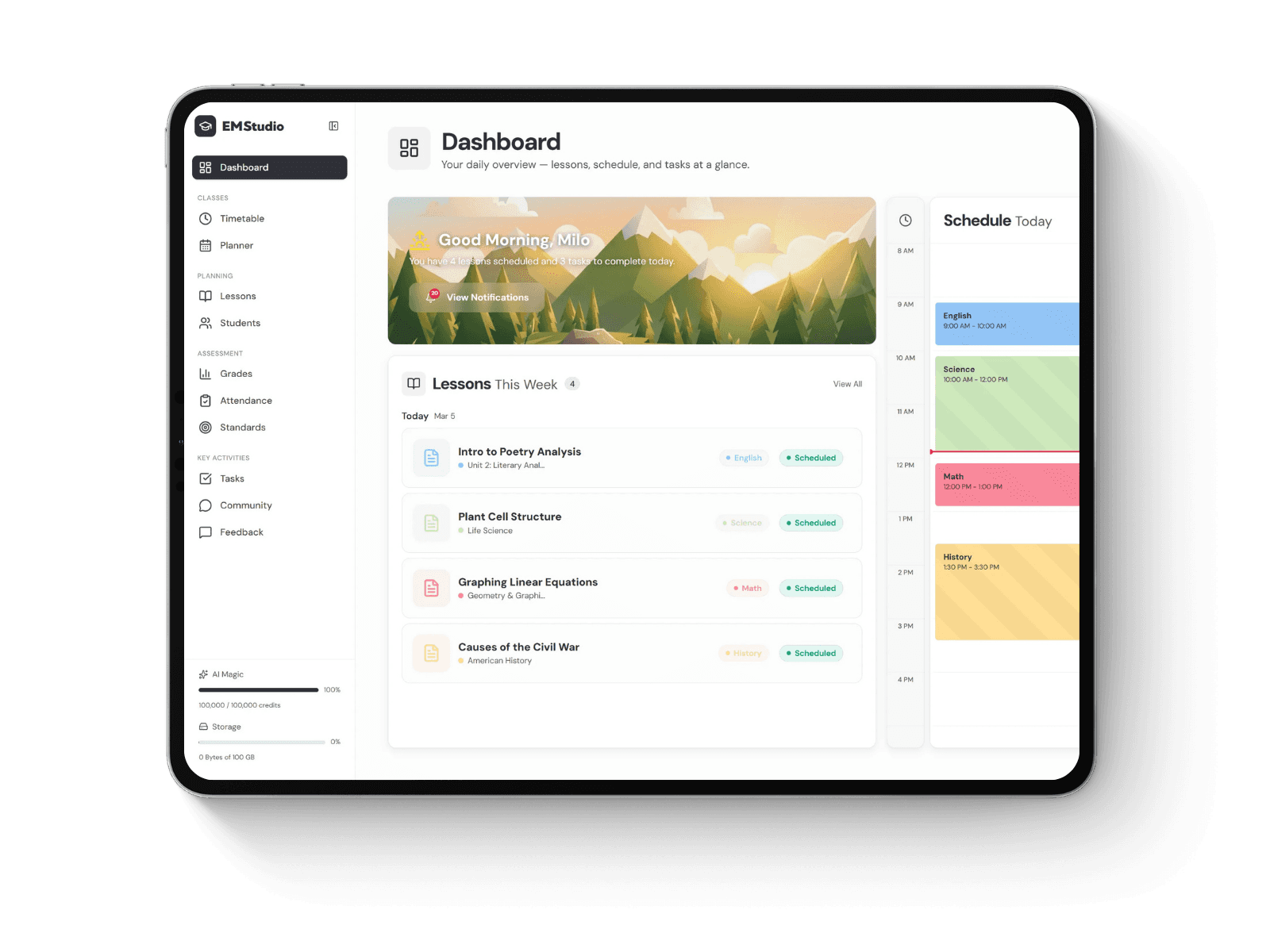
EMStudio is a free teaching management app — manage your classes, students, lessons, and more!
Learn More
Still grading everything by hand?
EMStudio is a free teaching management app — manage your classes, students, lessons, and more!
Learn More
Table of Contents
Set the target before the first paper
Do not begin with a general instruction to “correct the grammar.” Decide what the assignment measures.
A history essay may prioritise argument, evidence, paragraph logic, and formal tone. A science report may require accurate terminology and consistent tense. In a language class, sentence structure and grammatical accuracy may carry more weight.
Write down three to five priorities before opening the first submission:
Complete sentences
Consistent tense
Subject–verb agreement
Sentence-boundary punctuation
Accurate use of key terms
This short list prevents “correction drift,” where one paper receives detailed punctuation notes while another receives mostly comments on vocabulary.
A compact checklist can sit beside the grading rubric:
Review area | Quick question | Code |
Sentence structure | Is each sentence complete and clear? | SS |
Verb control | Are tense and agreement consistent? | V |
Punctuation | Are sentence boundaries correct? | P |
Word choice | Does the word fit the intended meaning? | WC |
Paragraph flow | Does each paragraph develop one point? | PF |
Four or five codes are easier to apply consistently than a full page of symbols.
Use two passes
Many teachers try to assess ideas, evidence, organisation, spelling, punctuation, and grammar at the same time. That approach creates constant mental switches.
During the first pass, read for meaning. Ask whether the student answered the question, supported the main claim, and organised the response logically. During the second pass, scan for the grammar targets on the checklist.
This division protects both speed and accuracy. A polished paragraph should not receive a high content score when it lacks evidence. Conversely, a valuable idea should not disappear under dozens of surface corrections.
Notion4Teachers’ student assessment analysis guide presents assessment as information that helps educators identify what students understand and where they need support. Grammar marks become more useful when they contribute to that wider diagnosis rather than act as isolated corrections.
Let a digital tool complete the first scan
A grammar tool can highlight possible problems before the teacher starts the final review. It is most useful for common spelling errors, punctuation, agreement, awkward wording, and sentences that deserve closer attention.
Teachers can use an online tool to check grammar before completing a final manual review. The scan can shorten the search for repeated surface errors, especially in typed assignments. It also helps the teacher decide which paragraphs need careful inspection and which require only quick confirmation.
GetSolved states that its grammar checker reviews grammar, spelling, punctuation, wording, and sentence clarity. Its guidance advises users to double-check complex sentences and recommends manual review for specialised or highly structured text. That limitation matters in education. A tool may flag a technical term, quotation, dialect feature, character voice, or discipline-specific phrase even when the student used it correctly.
Research supports a cautious approach. A 2024 systematic review of automated written feedback examined 83 published studies. The researchers found positive, negative, neutral, and mixed results across different systems and educational settings. Automation can support the review process, but it should not decide the grade.
Mark patterns, not every instance
If a student shifts tense eight times, eight separate comments rarely provide eight times the value. Mark the first two examples, identify the pattern, and ask the student to locate the rest.
A concise note could say:
V: This paragraph moves between past and present tense. I marked the first two changes. Revise the remaining verbs so the timeline stays clear.
The comment explains the issue, demonstrates it, and gives the student a clear task. It also avoids rewriting the paragraph for them.
Teachers should distinguish a careless slip from a genuine misunderstanding. The EEF’s review of marking evidence notes that simple mistakes and deeper misconceptions may require different responses. A minor error may only need a mark, while a misunderstanding may need a hint or question that directs the student back to the relevant principle.
This approach also makes revision more active. Students must recognise the pattern and apply the rule independently instead of copying a corrected version supplied by the teacher.
Build a small comment bank
Teachers often write the same explanation dozens of times. Save clear versions of frequent comments in the learning platform, a document, or a text-expansion tool.
Sentence boundary: “Two complete thoughts have been joined without suitable punctuation. Mark where the first thought ends, then revise the sentence.”
Unclear reference: “The pronoun does not point to a clear noun. Replace it with the exact person, object, or idea.”
Evidence link: “The example is relevant, but the next sentence must explain how it supports your claim.”
Word choice: “This term is too broad for the point. Replace it with a word that identifies the exact action or quality.”
Templates should provide a starting point rather than replace individual feedback. Add one personal sentence when necessary. For example, “Your evidence in paragraph three is the best place to make this change” turns a reusable template into a targeted comment.
The UK Department for Education’s workload guidance on marking recommends standardised codes, diagnostic grids, model answers, self- or peer-marked tasks, and whole-class feedback as possible ways to reduce repetitive written comments.
Review assignments in batches
Instead of completing one paper from first sentence to final score, review the same feature across a small group.
Read five introductions first. Next, check the evidence paragraphs. Then review conclusions or the selected grammar target. Keeping one criterion active reduces mental resets and makes it easier to apply the same standard across the class.
Record any rubric decision that changes during the process. Otherwise, the first paper may receive a different interpretation from the final one.
For language classes, connect the patterns you find to the next lesson. Notion4Teachers’ overview of methods of teaching English discusses the need to adapt instruction according to learning objectives and assessment information. If most students misuse sentence boundaries, one focused class lesson may help more than twenty-five versions of the same margin comment.
Use whole-class feedback
After reviewing several papers, create a short class feedback sheet:
Class pattern | Anonymous example | Revision task |
Comma splice | Two complete sentences joined by a comma | Add a full stop, semicolon, or conjunction |
Unclear pronoun | “This shows it was unfair” | Replace vague words with precise nouns |
Weak evidence link | A quotation followed by a new point | Explain how the quotation supports the claim |
Tense shift | Past and present verbs in one account | Select one suitable tense and revise |
Discuss the sheet in class and let students correct the anonymous examples before revising their own work. This addresses shared misconceptions once, while private comments remain available for individual needs.
Whole-class feedback does not mean that every student receives identical advice. It separates class-wide problems from issues that require a personal explanation. The Department for Education workload resource specifically identifies whole-class feedback as an alternative to detailed written comments for every student.
Give students a pre-submission check
A one-minute checklist can remove avoidable errors before work reaches the teacher:
I answered each part of the task.
Every sentence has a clear subject and main verb.
My verb tense remains consistent.
I checked sentence-ending punctuation.
I reviewed names and subject-specific terms.
I read the final paragraph aloud.
Peer review can also help when the task is narrow. “Check every verb for tense” gives students a clear objective. “Fix your partner’s grammar” is too broad and may lead to unreliable corrections.
Students practise independent review habits, while the teacher retains responsibility for the assessment. Over time, the same checklist can reduce the number of obvious errors that reach the marking stage.
Keep the final decision human
Grammar software can detect patterns quickly, but it does not fully understand the assignment, the student’s intention, or the terminology taught in class.
A 2024 study comparing teacher and GPT-assisted corrective feedback found that automated feedback could vary even when the system received the same prompt and student text. It also produced some corrections that were grammatically accurate but unnecessary.
Pause whenever a suggested change could alter meaning. Read the full paragraph, check the rubric, and ask a question when the intended message remains uncertain. Replacing the sentence with the teacher’s own version may improve its surface accuracy while changing what the student wanted to say.
The fastest reliable workflow is not “let software grade the paper.” It is to define the target, scan efficiently, identify patterns, reuse strong comments, address shared errors once, and apply teacher judgement at the end.
That system reduces repetitive work without lowering the quality of feedback. More importantly, it keeps the teacher’s attention on what matters most: the student’s meaning, progress, and next step.
[a]https://www.pexels.com/photo/person-checking-test-papers-6684372
Set the target before the first paper
Do not begin with a general instruction to “correct the grammar.” Decide what the assignment measures.
A history essay may prioritise argument, evidence, paragraph logic, and formal tone. A science report may require accurate terminology and consistent tense. In a language class, sentence structure and grammatical accuracy may carry more weight.
Write down three to five priorities before opening the first submission:
Complete sentences
Consistent tense
Subject–verb agreement
Sentence-boundary punctuation
Accurate use of key terms
This short list prevents “correction drift,” where one paper receives detailed punctuation notes while another receives mostly comments on vocabulary.
A compact checklist can sit beside the grading rubric:
Review area | Quick question | Code |
Sentence structure | Is each sentence complete and clear? | SS |
Verb control | Are tense and agreement consistent? | V |
Punctuation | Are sentence boundaries correct? | P |
Word choice | Does the word fit the intended meaning? | WC |
Paragraph flow | Does each paragraph develop one point? | PF |
Four or five codes are easier to apply consistently than a full page of symbols.
Use two passes
Many teachers try to assess ideas, evidence, organisation, spelling, punctuation, and grammar at the same time. That approach creates constant mental switches.
During the first pass, read for meaning. Ask whether the student answered the question, supported the main claim, and organised the response logically. During the second pass, scan for the grammar targets on the checklist.
This division protects both speed and accuracy. A polished paragraph should not receive a high content score when it lacks evidence. Conversely, a valuable idea should not disappear under dozens of surface corrections.
Notion4Teachers’ student assessment analysis guide presents assessment as information that helps educators identify what students understand and where they need support. Grammar marks become more useful when they contribute to that wider diagnosis rather than act as isolated corrections.
Let a digital tool complete the first scan
A grammar tool can highlight possible problems before the teacher starts the final review. It is most useful for common spelling errors, punctuation, agreement, awkward wording, and sentences that deserve closer attention.
Teachers can use an online tool to check grammar before completing a final manual review. The scan can shorten the search for repeated surface errors, especially in typed assignments. It also helps the teacher decide which paragraphs need careful inspection and which require only quick confirmation.
GetSolved states that its grammar checker reviews grammar, spelling, punctuation, wording, and sentence clarity. Its guidance advises users to double-check complex sentences and recommends manual review for specialised or highly structured text. That limitation matters in education. A tool may flag a technical term, quotation, dialect feature, character voice, or discipline-specific phrase even when the student used it correctly.
Research supports a cautious approach. A 2024 systematic review of automated written feedback examined 83 published studies. The researchers found positive, negative, neutral, and mixed results across different systems and educational settings. Automation can support the review process, but it should not decide the grade.
Mark patterns, not every instance
If a student shifts tense eight times, eight separate comments rarely provide eight times the value. Mark the first two examples, identify the pattern, and ask the student to locate the rest.
A concise note could say:
V: This paragraph moves between past and present tense. I marked the first two changes. Revise the remaining verbs so the timeline stays clear.
The comment explains the issue, demonstrates it, and gives the student a clear task. It also avoids rewriting the paragraph for them.
Teachers should distinguish a careless slip from a genuine misunderstanding. The EEF’s review of marking evidence notes that simple mistakes and deeper misconceptions may require different responses. A minor error may only need a mark, while a misunderstanding may need a hint or question that directs the student back to the relevant principle.
This approach also makes revision more active. Students must recognise the pattern and apply the rule independently instead of copying a corrected version supplied by the teacher.
Build a small comment bank
Teachers often write the same explanation dozens of times. Save clear versions of frequent comments in the learning platform, a document, or a text-expansion tool.
Sentence boundary: “Two complete thoughts have been joined without suitable punctuation. Mark where the first thought ends, then revise the sentence.”
Unclear reference: “The pronoun does not point to a clear noun. Replace it with the exact person, object, or idea.”
Evidence link: “The example is relevant, but the next sentence must explain how it supports your claim.”
Word choice: “This term is too broad for the point. Replace it with a word that identifies the exact action or quality.”
Templates should provide a starting point rather than replace individual feedback. Add one personal sentence when necessary. For example, “Your evidence in paragraph three is the best place to make this change” turns a reusable template into a targeted comment.
The UK Department for Education’s workload guidance on marking recommends standardised codes, diagnostic grids, model answers, self- or peer-marked tasks, and whole-class feedback as possible ways to reduce repetitive written comments.
Review assignments in batches
Instead of completing one paper from first sentence to final score, review the same feature across a small group.
Read five introductions first. Next, check the evidence paragraphs. Then review conclusions or the selected grammar target. Keeping one criterion active reduces mental resets and makes it easier to apply the same standard across the class.
Record any rubric decision that changes during the process. Otherwise, the first paper may receive a different interpretation from the final one.
For language classes, connect the patterns you find to the next lesson. Notion4Teachers’ overview of methods of teaching English discusses the need to adapt instruction according to learning objectives and assessment information. If most students misuse sentence boundaries, one focused class lesson may help more than twenty-five versions of the same margin comment.
Use whole-class feedback
After reviewing several papers, create a short class feedback sheet:
Class pattern | Anonymous example | Revision task |
Comma splice | Two complete sentences joined by a comma | Add a full stop, semicolon, or conjunction |
Unclear pronoun | “This shows it was unfair” | Replace vague words with precise nouns |
Weak evidence link | A quotation followed by a new point | Explain how the quotation supports the claim |
Tense shift | Past and present verbs in one account | Select one suitable tense and revise |
Discuss the sheet in class and let students correct the anonymous examples before revising their own work. This addresses shared misconceptions once, while private comments remain available for individual needs.
Whole-class feedback does not mean that every student receives identical advice. It separates class-wide problems from issues that require a personal explanation. The Department for Education workload resource specifically identifies whole-class feedback as an alternative to detailed written comments for every student.
Give students a pre-submission check
A one-minute checklist can remove avoidable errors before work reaches the teacher:
I answered each part of the task.
Every sentence has a clear subject and main verb.
My verb tense remains consistent.
I checked sentence-ending punctuation.
I reviewed names and subject-specific terms.
I read the final paragraph aloud.
Peer review can also help when the task is narrow. “Check every verb for tense” gives students a clear objective. “Fix your partner’s grammar” is too broad and may lead to unreliable corrections.
Students practise independent review habits, while the teacher retains responsibility for the assessment. Over time, the same checklist can reduce the number of obvious errors that reach the marking stage.
Keep the final decision human
Grammar software can detect patterns quickly, but it does not fully understand the assignment, the student’s intention, or the terminology taught in class.
A 2024 study comparing teacher and GPT-assisted corrective feedback found that automated feedback could vary even when the system received the same prompt and student text. It also produced some corrections that were grammatically accurate but unnecessary.
Pause whenever a suggested change could alter meaning. Read the full paragraph, check the rubric, and ask a question when the intended message remains uncertain. Replacing the sentence with the teacher’s own version may improve its surface accuracy while changing what the student wanted to say.
The fastest reliable workflow is not “let software grade the paper.” It is to define the target, scan efficiently, identify patterns, reuse strong comments, address shared errors once, and apply teacher judgement at the end.
That system reduces repetitive work without lowering the quality of feedback. More importantly, it keeps the teacher’s attention on what matters most: the student’s meaning, progress, and next step.
[a]https://www.pexels.com/photo/person-checking-test-papers-6684372
Still grading everything by hand?
EMStudio is a free teaching management app — manage your classes, students, lessons, and more!
Learn More
Still grading everything by hand?
EMStudio is a free teaching management app — manage your classes, students, lessons, and more!
Learn More



Notion4Teachers
Notion templates to simplify administrative tasks and enhance your teaching experience.



2026 Notion4Teachers. All Rights Reserved.
Notion4Teachers
Notion templates to simplify administrative tasks and enhance your teaching experience.
2026 Notion4Teachers. All Rights Reserved.
Notion4Teachers
Notion templates to simplify administrative tasks and enhance your teaching experience.
2026 Notion4Teachers. All Rights Reserved.