
Teacher Pay Teachers Lesson Plans Template
Teacher Pay Teachers Lesson Plans Template

Article by
Milo
ESL Content Coordinator & Educator
ESL Content Coordinator & Educator
All Posts
Your TpT purchases are worthless if you can't find them during your prep period. I've watched teachers dump thousands into the educational marketplace only to lose the perfect poetry unit inside a downloads folder graveyard. We treat Teacher Pay Teachers lesson plans like digital hoarding, not actual curriculum assets we can deploy when we need them.
Last October, I watched a 4th grade colleague spend her entire forty-minute prep hunting for a fractions activity she'd bought the previous spring. She scrolled through three email inboxes and two Google Drives. Never found it. Bought something new instead. This is the standard workflow—buy, download, forget, repeat—and it's bleeding both time and money from classrooms already short on both.
I built a Notion database for teachers that treats TpT resources like curriculum, not clutter. This curriculum organization system creates a searchable library where every purchase lives with its standards, grade level, and the exact unit where you'll actually use it. No more orphaned PDFs floating on your desktop or mystery files named "final_final_activity_v2."
This post walks through the four core components of your TpT library system. It shows you how to import years of purchases without drowning in the backlog. You'll set up custom categories that match your actual schedule. Whether you're juggling six periods of middle school science or a self-contained elementary day, this lesson plan taxonomy turns your digital resource management into something usable. You can teach from it tomorrow morning.
Still grading everything by hand?
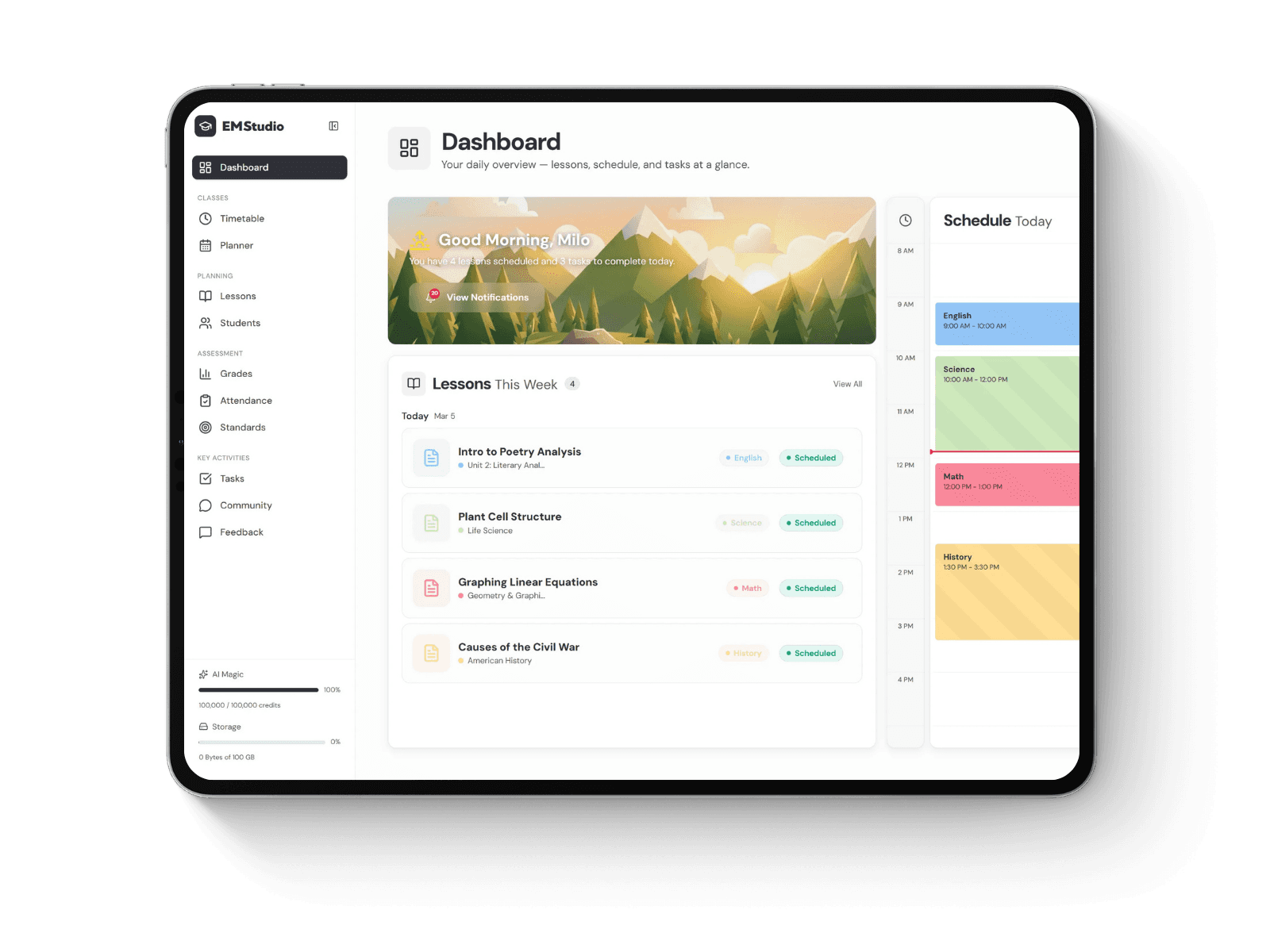
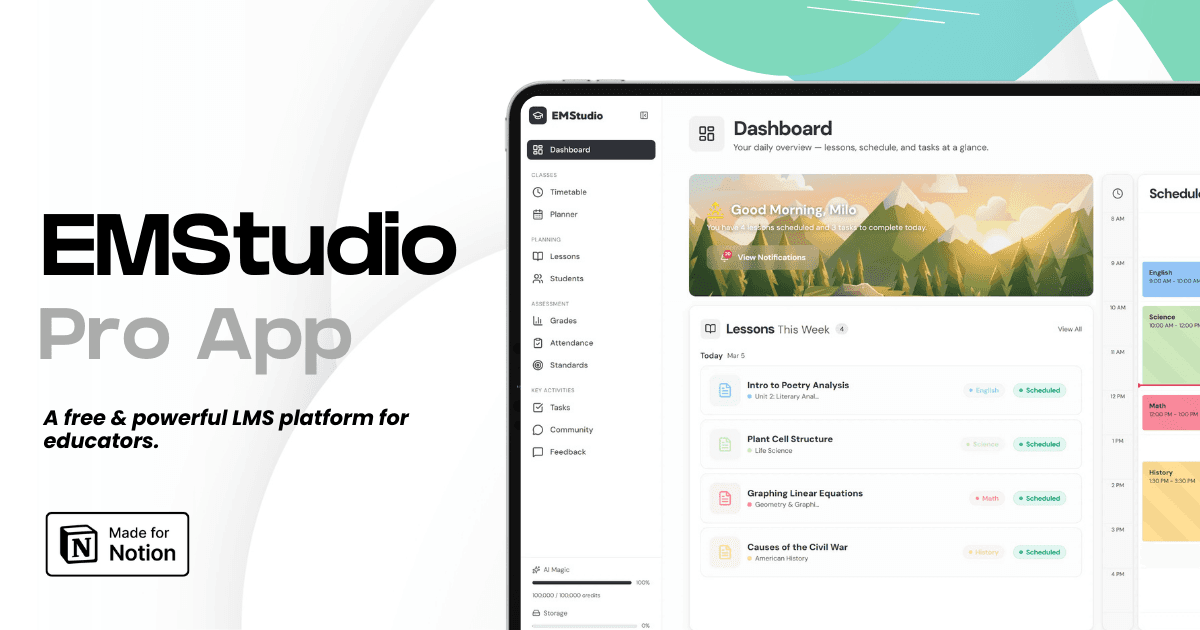
EMStudio is a free teaching management app — manage your classes, students, lessons, and more!
Learn More
Still grading everything by hand?
EMStudio is a free teaching management app — manage your classes, students, lessons, and more!
Learn More
Table of Contents
What This Template Covers
This curriculum organization system runs entirely in Notion. The free tier handles everything you need initially. The template connects four Notion databases for teachers: Resource Inventory, Standards Alignment Matrix, Seasonal Calendar, and Quality Tracker. They talk to each other, so updating a standard in one place updates it everywhere.
Here's why that matters. Teachers shopping any teacher pay website typically download 200+ files yearly. If you use teacher pay teachers lesson plans, research suggests 30-40% sit unused—not because they're bad, but because retrieval fails without a digital resource management system. Last October, I watched my own 4th-grade ELA folder swell to 300+ PDFs named "final_final_v2," only to rediscover a perfect poetry unit three months after the unit ended.
The template links to whatever storage you already use: Google Drive, Dropbox, OneDrive, or local hard drives via URL properties. No migrating files required. Your existing folder structure stays exactly where it is.
Plan 45 minutes for the initial instructional materials audit and setup. After that, 10 minutes weekly maintains complete visibility across your entire library. The educational marketplace workflow works on free Notion accounts indefinitely. You'll only need the paid Power-Up if your lesson plan taxonomy exceeds 1,000 entries—and honestly, if you hit that number, the $8 monthly pays for itself in time saved from searching.

The Four Core Components of Your TpT Library System
This curriculum organization system replaces static folders. Your teacher pay teachers lesson plans appear in multiple filtered views simultaneously. One resource can live in your 7th-grade queue, standards matrix, and fall calendar without duplication.
This digital resource management setup includes four parts. The Resource Database tracks inventory, the Standards Matrix maps alignment, the Seasonal Calendar prevents scrambling, and the Rating Tracker protects your wallet. Together they save roughly two hours weekly.
The Resource Database with Preview Links
Build with Title, Seller (relation), Price Paid (currency), Preview Link (URL), and File Location (URL). Add Grade Level (multi-select), Subject (relation), and Usage Status (select).
Create a formula dividing Price by Times Used for Cost-Per-Use. I learned my $12.50 6th-grade unit used once was pricier than a $4.50 packet used daily. Embed TpT preview images.
The Standards Alignment Matrix
Create a relation between Resource and Standards databases using CCSS, NGSS, TEKS, or district dropdowns. Link that $4.50 Photosynthesis Lab to NGSS MS-LS1-6 with evidence notes describing which components satisfy the standard.
Add a rollup counting resources per standard to expose gaps. This approach lets you align standards with a curriculum tool instead of using spreadsheets.
The Seasonal Planning Calendar
Configure calendar views by season: Back-to-School (Aug-Sep), Halloween/Fall (Oct), Winter (Dec), Test Prep (Mar-Apr), End-of-Year (May-Jun). Set automated reminders 14 days before content is needed based on Intended Use Date.
Create a board view grouped by month showing printing deadlines. This prevents October 30th panic when perfect Halloween activities hide in downloads.
The Quality Rating and Review Tracker
Rate resources 1-5 stars: 1 (Delete), 2 (Major mods), 3 (Usable), 4 (Ready), 5 (Rebuy). Add checkboxes for Answer Key, Editable Format, Low Ink, and Differentiated.
Flag items under 3 stars costing over $5.00 for refunds. This digital resource library for your classroom exposes which teachers for teachers lesson plans are worth repurchasing.

Step-by-Step Setup: From Template Download to First Entry
Don't import your entire teacher pay teachers lesson plans history on day one. I watched a 7th grade colleague dump three years of purchases into her Notion database for teachers without testing the structure first. She abandoned the curriculum organization system by Thursday.
Run this instructional materials audit on five current resources first:
Duplicate template (2 min)
Rename workspace (1 min)
Connect cloud storage bookmarks (5 min)
Import first 5 resources (20 min)
Configure mobile app (5 min)
Test search function (3 min)
Duplicating and Renaming Your Notion Workspace
Click Duplicate in the top-right corner. Rename to "[Last Name] TpT Library 2024-2025" and set a book emoji icon for quick mobile spotting.
Keep permissions Private for individual digital resource management, or Share with Grade Level Team for collaboration. The free plan allows up to 10 guests. See our step-by-step guide to Notion lesson planning for workflows.
Download the mobile app and add the widget to your home screen. One tap opens "Add Resource" while browsing teachers pay com.
Linking Directly to Your Teachers Pay Teachers Account
Go to teacherspayteachers.com/My-Purchases, copy the URL, and paste into a Quick Links property. This streamlines your educational marketplace workflow.
Create a browser bookmarklet with JavaScript to capture TpT product title, seller, and price to your clipboard. Pseudo-code: grab H1 class "product-title", copy.
Enable two-factor authentication on your teacher's pay account before bulk importing. Rapid entry triggers security lockouts.
Configuring Subject and Grade-Level Properties
Customize Grade Level to match your assignment. Use "9th Regular" and "11th AP." Avoid generic ranges to preserve your lesson plan taxonomy.
Add a Period/Block property: Period 1-8 with A/B indicators, or "Rotation 1-4" for specialists.
Configure Subject as a relation database for multiple preps. Separating Biology, Chemistry, and Physics prevents tag proliferation in your digital resource management system by October.

How Do You Import Years of TpT Purchases Without the Overwhelm?
Import your TpT purchases in batches of 50 using CSV exports from your purchase history, starting with resources for the current semester only. Tag each entry by urgency—'Use This Week,' 'This Month,' or 'Archive'—and dedicate 20 minutes twice weekly until active teaching resources are catalogued. Skip outdated materials to prevent initial overwhelm.
Your future self doesn't need every teacher pay teachers lesson plans from 2019. Start with what you're teaching next Tuesday. This isn't an instructional materials audit; it's triage.
I learned this the hard way with my 7th grade ELA curriculum. I spent three weekends cataloging Halloween activities while my Monday grammar lessons sat in an unmarked Downloads folder. The Backwards Import method fixes this. You import only what you need for the current month. Everything else waits.
Limit each session to 50 resources. Notion times out on larger CSV imports, and your brain checks out after 20 minutes. Schedule two sessions weekly until your active materials are sorted. This prevents the system from becoming another abandoned digital resource management project.
The biggest mistake? Organizing "someday" files before securing daily materials. Do not touch those holiday activities or future units yet. When teachers fail at curriculum organization system setup, this is why. They build beautiful archives while today's lesson plans remain scattered.
Bulk Import Strategies Using CSV Exports
Export your purchase history by opening Chrome Developer Tools and clicking the Network tab. Select XHR while loading 'My Purchases,' then copy the response data. Convert this JSON to CSV using any free online converter.
Your CSV needs these columns: Date, Product Name, Seller, Order ID, Price, and License Type. Import via Notion's 'Merge with CSV' function. Map the Order ID to a unique ID field. This prevents duplicates when you import again later.
Backward Planning Your Resource Archive
Create an 'Import Priority' formula in your Notion database for teachers. If the purchase date is within 90 days, mark it 'High.' If 91-365 days, mark 'Medium.' Anything older gets 'Archive Unless Currently Using.'
Filter your database to show only 'High' priority items during your first two weeks. Set a calendar reminder for 15 minutes every Friday to process ten 'Medium' priority items. This keeps your educational marketplace workflow manageable without drowning in backlog.
Priority Tagging for Immediate Use vs. Storage
Establish a triage tagging system for your payforteachers collection. Red tags mean 'Immediate Use'—teaching within two weeks. Yellow means 'Unit Planning' for the next unit. Green covers 'Reference/Storage' like holiday activities. Black means 'Evaluate for Deletion.'
Create a filtered view showing only Red tags for daily lesson planning. This hides unused resources. If a Green-tagged resource sits untouched for 12 months, move it to an Archive database. This lesson plan taxonomy keeps your active workspace clean. For more strategies on managing educational data without the overwhelm, review our complete guide.

Customizing Categories for Elementary, Middle, or High School Schedules
If you teach self-contained elementary, prioritize Rotation/Center tags in your lesson plan taxonomy. If you're departmentalized middle school, use Period blocks. High school teachers need Unit collections with standards. Elementary teachers juggle 8-10 subject areas daily. Middle school teachers average 6 periods. High school teachers handle 4 preps but complex unit sequences. Stop using grade-level tags like "7th grade." You will reuse 6th grade resources for remediation or 8th grade for acceleration. Track skill level instead.
Elementary Rotation and Center-Based Organization
Configure your Notion database for teachers for Daily 5 or Workshop models. Create properties for Center Type (Word Work, Listen to Reading), Prep Level (Print-and-Go vs. Laminate-and-Cut), and Group Size (Independent, Pair, Small Group).
I watched a Kindergarten teacher organize 200+ teacher pay teachers lesson plans and other teacher pay for teachers downloads from the educational marketplace workflow.
She arranged them for her 90-minute literacy block using Week 1-4 rotation cycles. Add a Seasonal checkbox to filter holiday-themed resources that disrupt regular schedules.
Middle School Period and Subject Blocks
Structure your digital resource management for A/B block scheduling. Create properties for A Day/B Day, Period Number, and Class Duration (45 min vs. 90 min). Time slots determine which activities fit.
A 7th-grade science teacher with 55-minute periods Monday-Wednesday and 90-minute labs Thursday-Friday needs different resource types for each slot.
Include a Lab vs. Lecture tag to distinguish consumable materials from presentation slides in your curriculum organization system.
High School Unit and Semester Collections
Organize by semester-long arcs. Create high school unit and semester collections like "Quarter 1: Foundations" and "Quarter 2: Analysis" with relations to final exam units.
An 11th-grade AP Language teacher might separate rhetorical analysis resources from synthesis essay units, using crossover tags for shared skills.
Add a Difficulty Level property (Standard, Honors, AP, Remediation). High school teachers frequently differentiate within the same course during their instructional materials audit.

How Do You Spot High-Quality Resources Before You Buy?
Analyze thumbnails for readability and verify previews show at least 3 sample pages including answer keys and table of contents. Check seller credibility through response times to questions, update history within the last 2 years, and follower count. Read 3-4 star reviews specifically for mentions of prep time and actual grade-level accuracy, ignoring generic 5-star ratings without detail.
Preview Analysis Checklist for Thumbnails and Descriptions
I learned this the hard way with a 7th-grade unit on figurative language. The preview looked crisp, but printed as pixelated mush. Now I use a Pre-Purchase Verification List.
Thumbnail text readable at 200% zoom.
Preview shows student-facing pages, answer keys, and table of contents.
Description lists total page count and standards alignment.
Student content exceeds 60% of total pages.
Price-per-page under $0.50 for elementary or $0.25 for secondary.
Seller responds to pre-sale questions within 24 hours.
File format allows editing; skip PDF-only when customization is needed.
Resources exceeding these price benchmarks need exceptional differentiation or digital interactives to justify the cost.
Seller Credibility Markers and Store Reviews
Badges help, but dig deeper. A Top Rated Seller badge requires 4.0+ stars over 50+ ratings. Check the Recent Feedback tab for consistency over time.
Click the store name and scan Recent Uploads. Active sellers update within 6 months; dormant stores may not respond to technical issues. Test responsiveness: ask about Canadian spellings. Quality sellers reply within 24 hours.
Avoid accounts newer than 6 months with fewer than 4 ratings. You are not their beta tester.
Reading Between the Lines of Customer Feedback
Five-star generic praise tells you nothing. Filter for 3-4 star reviews first—they contain specific usability critiques about prep time and actual grade-level accuracy.
Scan for keywords: prep time under 15 minutes, blackline ink options, and honest grade-level assessments. Watch for too easy for listed grade or incomplete answer keys. Check if sellers reply to negative feedback with corrections or refunds.
Skip teacher pay teachers lesson plans with no preview. Protect your essential teachers pay resources budget by ignoring generic 5-star ratings without detail.

Weekly Workflow: From TpT Cart to Classroom Delivery
My Friday-to-Friday educational marketplace workflow keeps me sane. Friday I buy teacher pay teachers lesson plans. Sunday I download and sort for thirty minutes max. Monday I implement with my 7th graders. Next Friday I evaluate and record in my tracker. Always save original ZIP files to an external drive before extracting. Sellers close accounts without warning.
The Sunday Sorting and File Download Routine
I download purchases to Downloads/TpT/Unsorted without extracting. I rename files immediately using my lesson plan taxonomy: Subject_Grade_ResourceName_Seller. Sci7_Cells_MitosisLab_SmithScience tells me exactly what I have. This takes thirty minutes maximum for two resources.
Then I extract and check for corruption or "sample" watermarks.
Integrating New Lessons into Your Weekly Spread
In my Notion database for teachers, I filter a "This Week" view showing resources tagged with the current week number. I drag items from "Ready to Prep" to specific days during my planning block.
After teaching, I log "Actual Prep Time" to build accurate estimates for my time management strategies for teachers.
Digital File Organization and Backup Protocols
I follow the 3-2-1 backup rule for digital resource management: three copies across local, cloud, and external drives. Monthly, I run dupeGuru to catch duplicates that clutter my curriculum organization system.
At semester end, unused items move to Archive. If untouched after one year, I delete local files but keep the Notion entry for my instructional materials audit.

Maintaining Your System: Quarterly Reviews and Archive Updates
I treat my instructional materials audit like painless software and system updates: I schedule it quarterly. August, November, February, and May. I set a timer for 45 minutes and review 50 to 75 resources.
Skip this, and your curriculum organization system bloats—suddenly 80% of entries are irrelevant and search breaks. I enforce one rule: archive one old resource for every new teacher pay teachers lesson plans purchase.
Archiving Outdated or Unused Resources
I archive when standards shift, or when a resource rated below three stars after one use. Duplicates and Flash-based interactives go too.
I change the Status to Archived in my Notion database for teachers, move it to the Archive view, and wait 30 days before deleting local files.
I keep the entry with a note: "Archived [Date] - [Reason]" to maintain my lesson plan taxonomy and avoid repurchasing duds.
Refreshing Standards Alignments for New Curricula
When my district switched to NGSS, I created a "Needs Realignment" view in my educational marketplace workflow. I filtered for resources tagged with the old standards.
I updated each relation to the new codes or marked them Obsolete. I tagged "Bridge Resources" that aligned to both sets—those saved me during the transition year.
Seasonal Content Rotation and Re-tagging
Two weeks before each quarter, I filter by the upcoming season—like "Winter Holidays"—and move those resources to my Active Planning view.
I click five random TpT links monthly to catch dead links. If the product is gone, I update the entry to "Link Dead - Use Local File Only."
I update the Current Price field during sales to calculate my Money Saved rollup, keeping my digital resource management honest.
The Bigger Picture on Teacher Pay Teachers Lesson Plans
You have probably spent hundreds on teacher pay teachers lesson plans that sit untouched in your Downloads folder. I have been there. A solid curriculum organization system does not just store files; it surfaces the right activity when you need it, whether that is Tuesday morning or next October.
Think of your Notion database for teachers as the bridge between the educational marketplace workflow and your actual classroom. You are not hoarding resources anymore. You are curating a library that grows smarter every quarter, with dead links cleared out and favorite sellers tagged for quick finds.
Start small. Import ten purchases this week. Tag them. Use one next Monday. That momentum beats any perfect digital resource management setup. Your future self—the one prepping at 6 AM without panic—will thank you.

What This Template Covers
This curriculum organization system runs entirely in Notion. The free tier handles everything you need initially. The template connects four Notion databases for teachers: Resource Inventory, Standards Alignment Matrix, Seasonal Calendar, and Quality Tracker. They talk to each other, so updating a standard in one place updates it everywhere.
Here's why that matters. Teachers shopping any teacher pay website typically download 200+ files yearly. If you use teacher pay teachers lesson plans, research suggests 30-40% sit unused—not because they're bad, but because retrieval fails without a digital resource management system. Last October, I watched my own 4th-grade ELA folder swell to 300+ PDFs named "final_final_v2," only to rediscover a perfect poetry unit three months after the unit ended.
The template links to whatever storage you already use: Google Drive, Dropbox, OneDrive, or local hard drives via URL properties. No migrating files required. Your existing folder structure stays exactly where it is.
Plan 45 minutes for the initial instructional materials audit and setup. After that, 10 minutes weekly maintains complete visibility across your entire library. The educational marketplace workflow works on free Notion accounts indefinitely. You'll only need the paid Power-Up if your lesson plan taxonomy exceeds 1,000 entries—and honestly, if you hit that number, the $8 monthly pays for itself in time saved from searching.
The Four Core Components of Your TpT Library System
This curriculum organization system replaces static folders. Your teacher pay teachers lesson plans appear in multiple filtered views simultaneously. One resource can live in your 7th-grade queue, standards matrix, and fall calendar without duplication.
This digital resource management setup includes four parts. The Resource Database tracks inventory, the Standards Matrix maps alignment, the Seasonal Calendar prevents scrambling, and the Rating Tracker protects your wallet. Together they save roughly two hours weekly.
The Resource Database with Preview Links
Build with Title, Seller (relation), Price Paid (currency), Preview Link (URL), and File Location (URL). Add Grade Level (multi-select), Subject (relation), and Usage Status (select).
Create a formula dividing Price by Times Used for Cost-Per-Use. I learned my $12.50 6th-grade unit used once was pricier than a $4.50 packet used daily. Embed TpT preview images.
The Standards Alignment Matrix
Create a relation between Resource and Standards databases using CCSS, NGSS, TEKS, or district dropdowns. Link that $4.50 Photosynthesis Lab to NGSS MS-LS1-6 with evidence notes describing which components satisfy the standard.
Add a rollup counting resources per standard to expose gaps. This approach lets you align standards with a curriculum tool instead of using spreadsheets.
The Seasonal Planning Calendar
Configure calendar views by season: Back-to-School (Aug-Sep), Halloween/Fall (Oct), Winter (Dec), Test Prep (Mar-Apr), End-of-Year (May-Jun). Set automated reminders 14 days before content is needed based on Intended Use Date.
Create a board view grouped by month showing printing deadlines. This prevents October 30th panic when perfect Halloween activities hide in downloads.
The Quality Rating and Review Tracker
Rate resources 1-5 stars: 1 (Delete), 2 (Major mods), 3 (Usable), 4 (Ready), 5 (Rebuy). Add checkboxes for Answer Key, Editable Format, Low Ink, and Differentiated.
Flag items under 3 stars costing over $5.00 for refunds. This digital resource library for your classroom exposes which teachers for teachers lesson plans are worth repurchasing.
Step-by-Step Setup: From Template Download to First Entry
Don't import your entire teacher pay teachers lesson plans history on day one. I watched a 7th grade colleague dump three years of purchases into her Notion database for teachers without testing the structure first. She abandoned the curriculum organization system by Thursday.
Run this instructional materials audit on five current resources first:
Duplicate template (2 min)
Rename workspace (1 min)
Connect cloud storage bookmarks (5 min)
Import first 5 resources (20 min)
Configure mobile app (5 min)
Test search function (3 min)
Duplicating and Renaming Your Notion Workspace
Click Duplicate in the top-right corner. Rename to "[Last Name] TpT Library 2024-2025" and set a book emoji icon for quick mobile spotting.
Keep permissions Private for individual digital resource management, or Share with Grade Level Team for collaboration. The free plan allows up to 10 guests. See our step-by-step guide to Notion lesson planning for workflows.
Download the mobile app and add the widget to your home screen. One tap opens "Add Resource" while browsing teachers pay com.
Linking Directly to Your Teachers Pay Teachers Account
Go to teacherspayteachers.com/My-Purchases, copy the URL, and paste into a Quick Links property. This streamlines your educational marketplace workflow.
Create a browser bookmarklet with JavaScript to capture TpT product title, seller, and price to your clipboard. Pseudo-code: grab H1 class "product-title", copy.
Enable two-factor authentication on your teacher's pay account before bulk importing. Rapid entry triggers security lockouts.
Configuring Subject and Grade-Level Properties
Customize Grade Level to match your assignment. Use "9th Regular" and "11th AP." Avoid generic ranges to preserve your lesson plan taxonomy.
Add a Period/Block property: Period 1-8 with A/B indicators, or "Rotation 1-4" for specialists.
Configure Subject as a relation database for multiple preps. Separating Biology, Chemistry, and Physics prevents tag proliferation in your digital resource management system by October.
How Do You Import Years of TpT Purchases Without the Overwhelm?
Import your TpT purchases in batches of 50 using CSV exports from your purchase history, starting with resources for the current semester only. Tag each entry by urgency—'Use This Week,' 'This Month,' or 'Archive'—and dedicate 20 minutes twice weekly until active teaching resources are catalogued. Skip outdated materials to prevent initial overwhelm.
Your future self doesn't need every teacher pay teachers lesson plans from 2019. Start with what you're teaching next Tuesday. This isn't an instructional materials audit; it's triage.
I learned this the hard way with my 7th grade ELA curriculum. I spent three weekends cataloging Halloween activities while my Monday grammar lessons sat in an unmarked Downloads folder. The Backwards Import method fixes this. You import only what you need for the current month. Everything else waits.
Limit each session to 50 resources. Notion times out on larger CSV imports, and your brain checks out after 20 minutes. Schedule two sessions weekly until your active materials are sorted. This prevents the system from becoming another abandoned digital resource management project.
The biggest mistake? Organizing "someday" files before securing daily materials. Do not touch those holiday activities or future units yet. When teachers fail at curriculum organization system setup, this is why. They build beautiful archives while today's lesson plans remain scattered.
Bulk Import Strategies Using CSV Exports
Export your purchase history by opening Chrome Developer Tools and clicking the Network tab. Select XHR while loading 'My Purchases,' then copy the response data. Convert this JSON to CSV using any free online converter.
Your CSV needs these columns: Date, Product Name, Seller, Order ID, Price, and License Type. Import via Notion's 'Merge with CSV' function. Map the Order ID to a unique ID field. This prevents duplicates when you import again later.
Backward Planning Your Resource Archive
Create an 'Import Priority' formula in your Notion database for teachers. If the purchase date is within 90 days, mark it 'High.' If 91-365 days, mark 'Medium.' Anything older gets 'Archive Unless Currently Using.'
Filter your database to show only 'High' priority items during your first two weeks. Set a calendar reminder for 15 minutes every Friday to process ten 'Medium' priority items. This keeps your educational marketplace workflow manageable without drowning in backlog.
Priority Tagging for Immediate Use vs. Storage
Establish a triage tagging system for your payforteachers collection. Red tags mean 'Immediate Use'—teaching within two weeks. Yellow means 'Unit Planning' for the next unit. Green covers 'Reference/Storage' like holiday activities. Black means 'Evaluate for Deletion.'
Create a filtered view showing only Red tags for daily lesson planning. This hides unused resources. If a Green-tagged resource sits untouched for 12 months, move it to an Archive database. This lesson plan taxonomy keeps your active workspace clean. For more strategies on managing educational data without the overwhelm, review our complete guide.
Customizing Categories for Elementary, Middle, or High School Schedules
If you teach self-contained elementary, prioritize Rotation/Center tags in your lesson plan taxonomy. If you're departmentalized middle school, use Period blocks. High school teachers need Unit collections with standards. Elementary teachers juggle 8-10 subject areas daily. Middle school teachers average 6 periods. High school teachers handle 4 preps but complex unit sequences. Stop using grade-level tags like "7th grade." You will reuse 6th grade resources for remediation or 8th grade for acceleration. Track skill level instead.
Elementary Rotation and Center-Based Organization
Configure your Notion database for teachers for Daily 5 or Workshop models. Create properties for Center Type (Word Work, Listen to Reading), Prep Level (Print-and-Go vs. Laminate-and-Cut), and Group Size (Independent, Pair, Small Group).
I watched a Kindergarten teacher organize 200+ teacher pay teachers lesson plans and other teacher pay for teachers downloads from the educational marketplace workflow.
She arranged them for her 90-minute literacy block using Week 1-4 rotation cycles. Add a Seasonal checkbox to filter holiday-themed resources that disrupt regular schedules.
Middle School Period and Subject Blocks
Structure your digital resource management for A/B block scheduling. Create properties for A Day/B Day, Period Number, and Class Duration (45 min vs. 90 min). Time slots determine which activities fit.
A 7th-grade science teacher with 55-minute periods Monday-Wednesday and 90-minute labs Thursday-Friday needs different resource types for each slot.
Include a Lab vs. Lecture tag to distinguish consumable materials from presentation slides in your curriculum organization system.
High School Unit and Semester Collections
Organize by semester-long arcs. Create high school unit and semester collections like "Quarter 1: Foundations" and "Quarter 2: Analysis" with relations to final exam units.
An 11th-grade AP Language teacher might separate rhetorical analysis resources from synthesis essay units, using crossover tags for shared skills.
Add a Difficulty Level property (Standard, Honors, AP, Remediation). High school teachers frequently differentiate within the same course during their instructional materials audit.
How Do You Spot High-Quality Resources Before You Buy?
Analyze thumbnails for readability and verify previews show at least 3 sample pages including answer keys and table of contents. Check seller credibility through response times to questions, update history within the last 2 years, and follower count. Read 3-4 star reviews specifically for mentions of prep time and actual grade-level accuracy, ignoring generic 5-star ratings without detail.
Preview Analysis Checklist for Thumbnails and Descriptions
I learned this the hard way with a 7th-grade unit on figurative language. The preview looked crisp, but printed as pixelated mush. Now I use a Pre-Purchase Verification List.
Thumbnail text readable at 200% zoom.
Preview shows student-facing pages, answer keys, and table of contents.
Description lists total page count and standards alignment.
Student content exceeds 60% of total pages.
Price-per-page under $0.50 for elementary or $0.25 for secondary.
Seller responds to pre-sale questions within 24 hours.
File format allows editing; skip PDF-only when customization is needed.
Resources exceeding these price benchmarks need exceptional differentiation or digital interactives to justify the cost.
Seller Credibility Markers and Store Reviews
Badges help, but dig deeper. A Top Rated Seller badge requires 4.0+ stars over 50+ ratings. Check the Recent Feedback tab for consistency over time.
Click the store name and scan Recent Uploads. Active sellers update within 6 months; dormant stores may not respond to technical issues. Test responsiveness: ask about Canadian spellings. Quality sellers reply within 24 hours.
Avoid accounts newer than 6 months with fewer than 4 ratings. You are not their beta tester.
Reading Between the Lines of Customer Feedback
Five-star generic praise tells you nothing. Filter for 3-4 star reviews first—they contain specific usability critiques about prep time and actual grade-level accuracy.
Scan for keywords: prep time under 15 minutes, blackline ink options, and honest grade-level assessments. Watch for too easy for listed grade or incomplete answer keys. Check if sellers reply to negative feedback with corrections or refunds.
Skip teacher pay teachers lesson plans with no preview. Protect your essential teachers pay resources budget by ignoring generic 5-star ratings without detail.
Weekly Workflow: From TpT Cart to Classroom Delivery
My Friday-to-Friday educational marketplace workflow keeps me sane. Friday I buy teacher pay teachers lesson plans. Sunday I download and sort for thirty minutes max. Monday I implement with my 7th graders. Next Friday I evaluate and record in my tracker. Always save original ZIP files to an external drive before extracting. Sellers close accounts without warning.
The Sunday Sorting and File Download Routine
I download purchases to Downloads/TpT/Unsorted without extracting. I rename files immediately using my lesson plan taxonomy: Subject_Grade_ResourceName_Seller. Sci7_Cells_MitosisLab_SmithScience tells me exactly what I have. This takes thirty minutes maximum for two resources.
Then I extract and check for corruption or "sample" watermarks.
Integrating New Lessons into Your Weekly Spread
In my Notion database for teachers, I filter a "This Week" view showing resources tagged with the current week number. I drag items from "Ready to Prep" to specific days during my planning block.
After teaching, I log "Actual Prep Time" to build accurate estimates for my time management strategies for teachers.
Digital File Organization and Backup Protocols
I follow the 3-2-1 backup rule for digital resource management: three copies across local, cloud, and external drives. Monthly, I run dupeGuru to catch duplicates that clutter my curriculum organization system.
At semester end, unused items move to Archive. If untouched after one year, I delete local files but keep the Notion entry for my instructional materials audit.
Maintaining Your System: Quarterly Reviews and Archive Updates
I treat my instructional materials audit like painless software and system updates: I schedule it quarterly. August, November, February, and May. I set a timer for 45 minutes and review 50 to 75 resources.
Skip this, and your curriculum organization system bloats—suddenly 80% of entries are irrelevant and search breaks. I enforce one rule: archive one old resource for every new teacher pay teachers lesson plans purchase.
Archiving Outdated or Unused Resources
I archive when standards shift, or when a resource rated below three stars after one use. Duplicates and Flash-based interactives go too.
I change the Status to Archived in my Notion database for teachers, move it to the Archive view, and wait 30 days before deleting local files.
I keep the entry with a note: "Archived [Date] - [Reason]" to maintain my lesson plan taxonomy and avoid repurchasing duds.
Refreshing Standards Alignments for New Curricula
When my district switched to NGSS, I created a "Needs Realignment" view in my educational marketplace workflow. I filtered for resources tagged with the old standards.
I updated each relation to the new codes or marked them Obsolete. I tagged "Bridge Resources" that aligned to both sets—those saved me during the transition year.
Seasonal Content Rotation and Re-tagging
Two weeks before each quarter, I filter by the upcoming season—like "Winter Holidays"—and move those resources to my Active Planning view.
I click five random TpT links monthly to catch dead links. If the product is gone, I update the entry to "Link Dead - Use Local File Only."
I update the Current Price field during sales to calculate my Money Saved rollup, keeping my digital resource management honest.
The Bigger Picture on Teacher Pay Teachers Lesson Plans
You have probably spent hundreds on teacher pay teachers lesson plans that sit untouched in your Downloads folder. I have been there. A solid curriculum organization system does not just store files; it surfaces the right activity when you need it, whether that is Tuesday morning or next October.
Think of your Notion database for teachers as the bridge between the educational marketplace workflow and your actual classroom. You are not hoarding resources anymore. You are curating a library that grows smarter every quarter, with dead links cleared out and favorite sellers tagged for quick finds.
Start small. Import ten purchases this week. Tag them. Use one next Monday. That momentum beats any perfect digital resource management setup. Your future self—the one prepping at 6 AM without panic—will thank you.
Still grading everything by hand?
EMStudio is a free teaching management app — manage your classes, students, lessons, and more!
Learn More
Still grading everything by hand?
EMStudio is a free teaching management app — manage your classes, students, lessons, and more!
Learn More



Notion4Teachers
Notion templates to simplify administrative tasks and enhance your teaching experience.



2026 Notion4Teachers. All Rights Reserved.
Notion4Teachers
Notion templates to simplify administrative tasks and enhance your teaching experience.
2026 Notion4Teachers. All Rights Reserved.
Notion4Teachers
Notion templates to simplify administrative tasks and enhance your teaching experience.
2026 Notion4Teachers. All Rights Reserved.