
Teacher and Teaching Methods: A Complete Guide for K-12
Teacher and Teaching Methods: A Complete Guide for K-12

Article by
Milo
ESL Content Coordinator & Educator
ESL Content Coordinator & Educator
All Posts
You’ve sat through PD sessions on the latest "revolutionary" framework. You’ve got binders full of pedagogical strategies. But when you close your classroom door on Monday morning, you’re still guessing which teacher and teaching methods actually fit your 7th graders who read at a 4th-grade level, or your AP seniors who checked out in April. The theory sounds great. Your reality is messier.
This guide cuts through the noise. We’ll look at specific instructional designs that work in real K-12 rooms—not just research labs. You’ll get clear criteria for matching methods to your learning objectives, student engagement patterns, and the formative assessment data you’re already collecting. No more guessing.
Still grading everything by hand?
EMStudio is a free teaching management app — manage your classes, students, lessons, and more!
Learn More
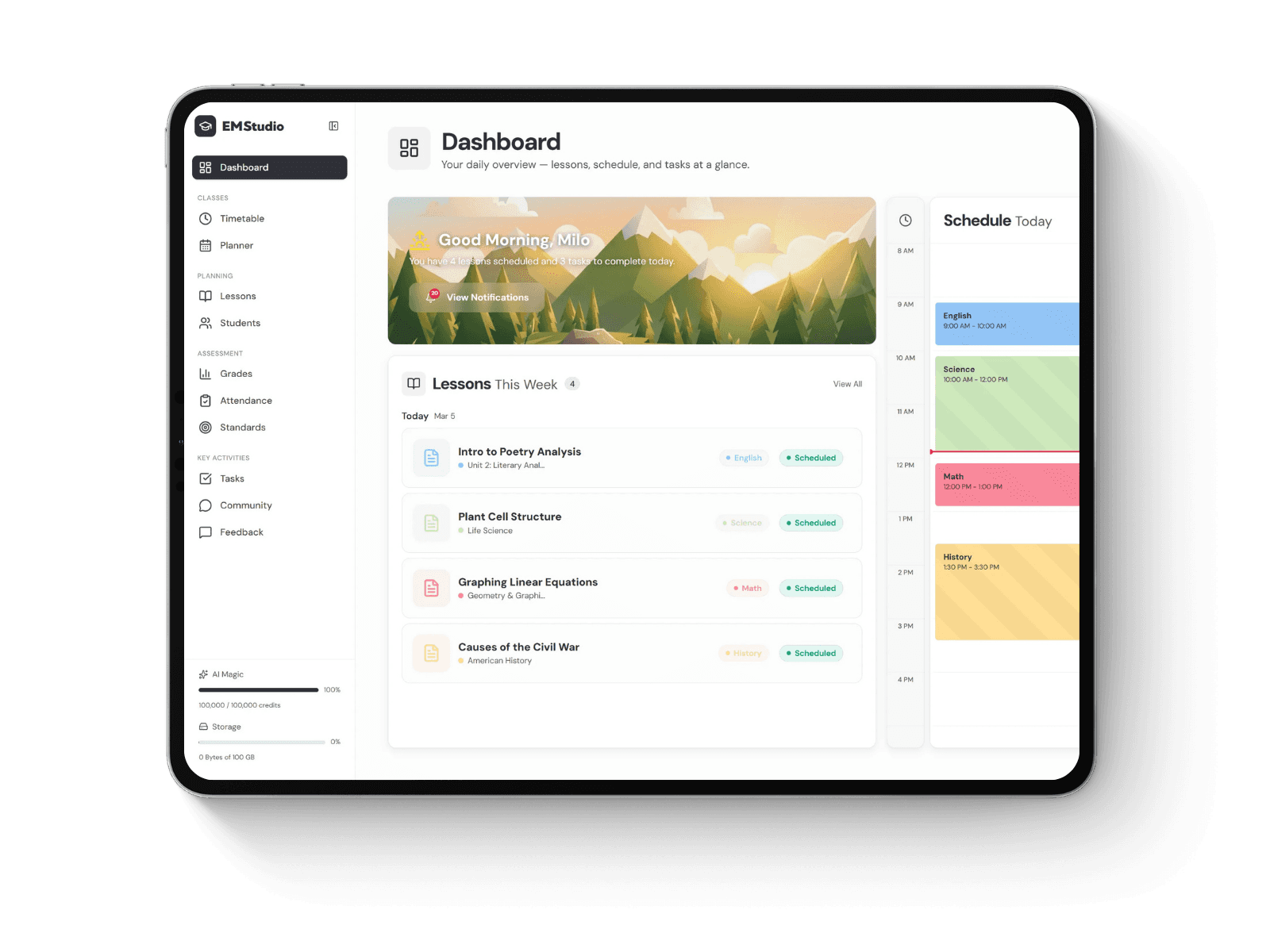
Still grading everything by hand?
EMStudio is a free teaching management app — manage your classes, students, lessons, and more!
Learn More
Table of Contents
What Are Teacher and Teaching Methods?
Teaching methods are the structured strategies educators use to deliver content and facilitate learning, encompassing systematic approaches from direct instruction to inquiry-based models. These methods include specific techniques for engagement, assessment, and differentiation that operationalize educational theories into classroom practice. When we talk about teacher and teaching methods, we're looking at the deliberate choices you make to move students from confusion to understanding.
John Hattie's Visible Learning meta-analysis makes one thing clear: the teacher matters more than the structure. Teacher expertise shows an effect size of 0.49, nearly double the impact of class size reduction at 0.21. This isn't about whether you have 25 or 15 students; it's about what you actually do with them.
Let's clear up some terminology. Teaching methods are the systematic instructional strategies you employ—what you do to deliver content. Teaching styles are your personal delivery characteristics, like your tone or pacing. The Danielson Framework for Teaching organizes effective instructional delivery across four domains, helping you evaluate the method, not the personality.
Instructional planning operates on three levels:
Macro-level philosophies: Broad theories like constructivism (students build knowledge) versus behaviorism (learning through reinforcement).
Meso-level methods: Named approaches like Project-Based Learning or Direct Instruction that operationalize those philosophies.
Micro-level strategies: Specific moves like Think-Pair-Share or exit tickets that you deploy within any method.
The Role of the Teacher in Instructional Delivery
The Danielson Framework breaks your job into four functional roles. As a diagnostician, you assess prior knowledge using pre-tests or quick writes before launching new content. As a designer, you plan aligned instruction backward from the assessment. As a facilitator, you manage classroom discourse using protocols like fishbowl discussions or Socratic seminars. As an assessor, you use formative data to adjust tomorrow's lesson based on today's results.
Here's what this looks like in practice. A 9th-grade English teacher shifting from lecture to literature circles might spend Day 1 diagnosing comprehension with a short quiz and designing differentiated role sheets (discussion director, vocabulary enricher, connector), Day 2 facilitating the first circle while observing protocols, and Day 3 assessing participation before reshuffling groups for the next text.
Teacher clarity drives results. Hattie found it has an effect size of 0.75—one of the highest impacts on student achievement. This means posting learning objectives using Bloom's Taxonomy verbs (analyze, synthesize, evaluate), providing worked examples before independent practice, and establishing success criteria checklists so students know when they've hit the target.
Core Components of Teaching Methodologies
Every effective teaching method, regardless of philosophy, contains four non-negotiable elements. Check your lesson plans against this list:
Clear learning objectives using specific action verbs students can observe and measure.
Active engagement strategies requiring student response every 3-5 minutes—not passive listening.
Formative assessment checkpoints to catch misconceptions before they fossilize.
Metacognitive reflection opportunities where students articulate what they learned and how they learned it.
Watch these core components of teaching methodologies in action during a 45-minute 5th-grade science lesson on ecosystems using the 5E model. Engage (5 minutes): Show a decomposing log photo and ask "What do you think happens next?" Explore (12 minutes): Students use magnifying glasses and field journals to examine soil samples. Explain (10 minutes): Direct instruction connecting observations to vocabulary (decomposer, nutrient cycle). Elaborate (10 minutes): Predict what happens to a forest without fungi. Evaluate (8 minutes): Exit ticket drawing the nutrient flow plus one-sentence reflection on what surprised them.
Notice the rhythm. Students touch materials, talk to partners, write predictions, and reflect. No component stands alone—they interlock to create the instructional design that actually sticks.
Why Do Teacher and Teaching Methods Matter for Student Outcomes?
Teaching methods matter because research consistently shows that instructional choices impact student outcomes more significantly than class size or technology access. Effective methods increase engagement, combat the natural forgetting curve—which causes 70% information loss within 24 hours—and provide necessary differentiation for diverse learners. John Hattie's meta-analyses confirm this: while shrinking class sizes shows a modest 0.21 effect size, teacher-level interventions like response to intervention (1.29), classroom discussion (0.82), and teacher credibility (0.90) dramatically outperform structural changes. Your choice of pedagogical strategies is the lever that actually moves achievement.
Impact on Engagement and Knowledge Retention
The NTL Institute's research on the Learning Pyramid exposes the brutal math of passive learning. Without active processing, students lose half of new information within one hour. After 24 hours, retention from a standard lecture flatlines at 5-10%. Compare that to "practice by doing" at 75% or "teaching others" at 90%, and the case for active instructional design becomes obvious. You cannot lecture your way to mastery when the human brain is designed to forget.
Here is how retention breaks down by method:
Lecture: 5-10% retention after 24 hours
Reading: 10%
Audio-visual: 20%
Demonstration: 30%
Discussion Group: 50%
Practice by Doing: 75%
Teach Others/Immediate Use: 90%
Real student engagement shows up in observable metrics, not gut feelings. Aim for 85%+ time-on-task during independent work. Use whiteboards or Pear Deck to achieve 100% student response rates instead of hearing from the same three volunteers. Push cognitive demand to Webb's Depth of Knowledge levels 2-3 or Bloom's taxonomy application levels, where students manipulate concepts rather than recall isolated facts. Layer in formative assessment checkpoints every 10-15 minutes to catch the 50% decay before it happens. These metrics confirm your teacher and teaching methods are working, or signal you need to pivot before the forgetting curve wins.
Connection to Learning Styles and Differentiation
We need to kill the "learning styles" myth first. The VARK model (visual, auditory, read/write, kinesthetic) lacks empirical support—cognitive scientists have debunked it for years. Matching instruction to a student's preferred style doesn't improve outcomes. However, this doesn't mean one-size-fits-all. You still need differentiation based on readiness, interest, and learning profile, as Carol Ann Tomlinson's model suggests. This is where connection to learning styles and differentiation gets practical: you're not accommodating fictional learning styles, but addressing real variance in prior knowledge and skill. Consider a 7th-grade math class tackling 2-step variable equations. Some students need algebra tiles (concrete), others prefer representational drawings, while advanced learners jump straight to abstract equations. Same learning objectives, different entry points based on readiness. This aligns with the expertise reversal effect from cognitive load theory: novices require explicit instruction and worked examples to avoid overwhelming working memory, while experts actually perform worse with too much guidance. Your effective teaching methodology must shift based on where students sit on that expertise continuum, not on whether they claim to be "visual learners." Typical K-12 classrooms span 4-5 grade levels in reading alone; ignoring that range by using a single method guarantees you miss someone.

How Do Teacher and Teaching Methods Work in Practice?
Teaching methods function through structured instructional cycles that move from objective-setting to assessment, using either teacher-directed delivery for foundational skills or student-centered exploration for conceptual understanding. Continuous formative assessment drives real-time adjustments, with feedback loops closing within 24 hours for optimal retention.
The Instructional Cycle and Lesson Design
The 5E Instructional Model serves as the engine behind most effective teaching learning methods. Consider a high school biology lesson on protein synthesis with these specific phases:
Engage (5 minutes): Project a photo of a lactose-intolerant student reacting to milk and ask, "Why can some people digest this while others can't?" This hook targets prior knowledge without revealing answers.
Explore (12 minutes): Students use colored amino acid manipulatives to build polypeptide chains from mRNA sequences printed on strip templates. They mess up codon reading. They rebuild while you circulate with a clipboard, noting who confuses uracil with thymine.
Explain (10 minutes): You deliver direct instruction with diagrams, correcting the specific errors observed during exploration rather than lecturing blind.
Elaborate (10 minutes): Students apply this to genetic disorders like sickle cell anemia, forcing transfer of the concept to new contexts.
Evaluate (8 minutes): A three-tiered exit ticket—basic translation, application to a new mutation, and a "create your own" extension targeting Bloom's taxonomy levels.
Here's the pivot point: if fewer than 70% of students succeed in the Explore phase, you insert a 5-minute micro-lecture before Elaborate. You don't proceed to application when the foundation is cracked. This decision point separates rigid lesson plans from responsive instructional design.
Teacher-Led vs. Student-Centered Approaches
Teacher and teaching methods differ primarily in who holds the cognitive load. In explicit instruction, you control pacing and schema-building. In student-centered approaches, students construct meaning through discovery. Both work, but for different learning objectives.
Dimension | Teacher-Led (Calculus) | Student-Centered (Environmental Science) |
|---|---|---|
Cognitive Demand | Lower initially; algorithmic fluency | Higher; analysis of ecosystem interactions |
Teacher Role | Expert model; explicit demonstration | Facilitator; question-poser |
Student Autonomy | Guided practice with high structure | Open inquiry; self-directed research |
Pacing Control | Teacher determines speed based on mastery checks | Flexible; varies by group |
Assessment Type | Closed-response; computation accuracy | Open-ended; argumentation quality |
Use this decision matrix when selecting your pedagogical strategies:
Foundational skill building (K-12 math facts): Direct Instruction. Prep time: 1 hour.
Conceptual understanding (6-12 science): Guided Discovery.
Social development (all ages): Cooperative Learning.
Creative synthesis (9-12 humanities): Project-Based Learning. Prep time: 10+ hours.
Avoid the pendulum swing. Never use pure discovery with novice learners who lack the schema to interpret what they're seeing. A 7th grader won't efficiently "discover" the quadratic formula. Conversely, never lecture for 45 minutes when teaching psychomotor skills like lab safety or when attention spans flatline after 15 minutes.
Assessment Integration and Feedback Loops
Formative assessment isn't grading. It's the GPS system for your instruction. Build assessment-capable learners who can answer three questions: Where am I going? How am I going? Where to next?
Match your techniques to your methods of teaching:
Direct Instruction: Choral response ("What comes next?") and individual whiteboards for real-time checks of student engagement.
Project-Based Learning: Rubrics co-created with students and gallery walks for peer critique.
Inquiry Science: Science notebooks with argumentation protocols ("Claim, Evidence, Reasoning").
Timing matters neurochemically. Give immediate feedback for procedural errors—stop a student mid-calculation when they distribute the negative incorrectly in algebra. Wait exactly 24 hours before returning conceptual writing; same-day feedback on essays creates emotional noise that blocks retention, while delays beyond 48 hours lose the context window. For creative projects, use structured peer protocols like "Two Stars and a Wish" rather than vague compliments. When Google Forms show less than 70% mastery on a checkpoint, don't advance to the next topic. Re-teach using a different modality—switch from visual to kinesthetic—the next day. That's the feedback loop that actually moves learning forward.

What Are the Most Effective Teaching Methodologies Used Today?
The most effective teaching methodologies today include Direct Instruction for foundational skills (effect size 0.59) and Project-Based Learning for authentic application. Differentiated Instruction serves diverse needs, while Cooperative Learning builds social skills. Inquiry-Based Learning develops critical thinking. The relationship between teacher and teaching methods determines whether your instructional design succeeds.
Before you switch methods, expect the implementation dip. When you adopt any new pedagogical strategy, student achievement typically drops 10-15% during the first two to three weeks. This isn't failure. Students and teachers are adjusting to new routines and expectations. Push through week three before you assess whether the method works.
Project-Based Learning and Real-World Application
Project-Based Learning and real-world application follow the PBLWorks Gold Standard: a challenging problem or question, sustained inquiry lasting three to six weeks, authenticity, student voice and choice, reflection, critique and revision, and a public product. I ran this with 10th graders designing sustainable urban gardens for an actual city council presentation. They hit biology standards (photosynthesis), math (budgeting at $15 per student for materials), and civics (local government structures) simultaneously. These teaching methodology examples show how student engagement increases when work matters beyond the gradebook.
Prep runs high—expect to spend $50 to $200 per project and commit three or more weeks. PBL fails when driving questions are too broad, scaffolding is insufficient for novice learners, or assessment lacks rubrics with specific quality indicators. If groups finish in three days instead of three weeks, your challenge was insufficient. Success requires heavy upfront instructional design but yields deep student engagement and opportunities for formative assessment throughout the process.
Differentiated Instruction for Diverse Learners
Differentiated instruction for diverse learners uses Carol Ann Tomlinson's framework: differentiate Content (what students learn), Process (how they learn it), and Product (how they show learning). In my 6th-grade social studies class studying Ancient Egypt, I offered three text complexity levels on pyramid construction for Content. For Process, students chose video, jigsaw reading, or podcast. For Product, they selected an essay, 3D model, or dramatic presentation—all scored on the same rubric criteria. This approach helps students climb Bloom's taxonomy from remembering to creating based on their readiness.
This method carries medium ongoing cost. Initial planning requires two to three times your normal prep time. It becomes sustainable only through tiered template creation and learning stations that rotate over three to four class periods. Don't attempt to differentiate every lesson; focus on core concepts where student readiness varies most.
Collaborative and Cooperative Learning Models
There's a difference between ineffective "group work" and structured Cooperative Learning. The Johnson & Johnson model requires five essential elements:
Positive interdependence: Group members depend on each other to succeed.
Individual accountability: Each student is responsible for their own learning.
Promotive interaction: Students encourage each other's efforts.
Social skills: Explicit teaching of communication and leadership.
Group processing: Reflection on how well the group functioned.
I use Jigsaw for expert groups diving deep into content, and Think-Pair-Share for two-minute quick processing checks. Group size matters. Use pairs for complex discussions, triads for projects, and never exceed four for true collaborative learning. Assign specific roles: Facilitator, Recorder, Materials Manager, and Reporter. To prevent "hogs and logs" (where one student does everything while others coast), use individual accountability measures like random calling or individual quizzes on the group content.
Direct Instruction and Explicit Teaching Techniques
Direct instruction and explicit teaching techniques follow Rosenshine's 10 Principles of Instruction. The structure is tight: I Do (worked examples with think-aloud for five to seven minutes), We Do (guided practice with prompts), then You Do (independent practice with monitoring). I rely on this for math procedures, phonics, grammar rules, and laboratory safety protocols. Follow the 80% success rule: students must hit 80% accuracy during guided practice before you release them to independent work.
This is low cost with immediate results, but overuse kills student engagement. Limit direct instruction segments to 15 or 20 minutes, then follow with active processing. It is not recommended for teaching creativity, personal expression, or complex problem-solving in heterogeneous groups. Use it to build schema before inquiry.
Inquiry-Based and Discovery Learning Approaches
Inquiry-Based Learning follows the 5E model (Engage, Explore, Explain, Elaborate, Evaluate) or the IDEAL model (Identify, Define, Explore, Act, Look back). It works best for science investigations, historical document analysis, and mathematical problem-solving. My 8th graders spent two weeks investigating local water quality using the scientific method, collecting actual samples from three neighborhood sites and presenting findings to the local watershed association. These types of teaching methodologies push students to the top of Bloom's taxonomy—creating and evaluating—rather than just remembering facts.
Here is the critical warning: the expertise reversal effect means inquiry methods actually harm learning when students lack sufficient prior knowledge. Novice learners require direct instruction first to build schema, then inquiry for application. Avoid pure discovery with ELL beginners or students reading two or more grade levels below content. These students need explicit teaching before they can discover effectively.
How to Select Teaching Methods That Match Your Educational Context?
Select teaching methods by first analyzing student demographics and prior knowledge (using diagnostic data), then matching instructional approaches to specific learning objectives and standards (using Bloom's Taxonomy or DOK levels), while honestly evaluating available time, materials, budget ($0-$200 per unit), and technology resources to ensure sustainable implementation.
Follow this decision tree. First, classify your learning objective type. Declarative knowledge (facts, vocabulary) differs from procedural knowledge (algorithms, lab techniques) or conditional knowledge (when to apply a strategy). Next, analyze constraints: class length, device availability, and your own energy levels. Finally, align method complexity to content complexity. Don't launch a three-week PBL unit for a simple memorization standard.
Be real about money and infrastructure. Direct Instruction costs $0-5 per student—copy paper and maybe markers. Project-Based Learning runs $50-200 per unit when you buy materials for 30 kids. Technology matters too. 1:1 devices enable flipped models; without them, you're printing packets. Space is another constraint. Cooperative Learning requires movable furniture. If you're teaching 38 kids in a room with fixed rows and no floor space, rethink group work.
Watch for demographic red flags. Avoid unscripted inquiry with ELL beginners or classes where over 50% have IEPs and lack background knowledge. They need explicit structure first. Skip pure lecture with ADHD-heavy classes or when you know student engagement drops after 12 minutes. Don't force collaborative projects if you lack the physical room to separate groups.
Analyzing Student Demographics and Prior Knowledge
Run diagnostics before committing. Use formative assessment tools like pre-tests, exit tickets, or KWL charts to map prior knowledge. Decision rule: If over half the class scores below 60% on the diagnostic, use Direct Instruction to build foundations before inquiry. If reading levels span more than two grade bands—say you have 4th graders reading at 2nd and 6th grade levels—avoid whole-group lecture. Use Differentiated Instruction or station rotation instead.
Specific demographics demand specific adaptations. ELL populations need visual scaffolds, word banks, and structured output opportunities like sentence frames. High-poverty populations often require additional background knowledge building before complex teaching methods and strategies like PBL become accessible. Gifted clusters need compacting and acceleration options, not repetition of mastered content.
Aligning Methods with Learning Objectives and Standards
Use Backward Design (Wiggins & McTighe) as your instructional design framework. Identify desired results first, determine acceptable evidence, then plan learning experiences. Match cognitive complexity using Bloom's Taxonomy or DOK levels. Remember and Understand (DOK 1-2) suit Direct Instruction. Apply and Analyze (DOK 3) work with Cooperative Learning. Create and Evaluate (DOK 4) require Inquiry-Based Learning or PBL.
Standards-specific alignment is non-negotiable. NGSS Science and Engineering Practices mandate inquiry methods for SEPs and argumentation for Crosscutting Concepts. Common Core ELA emphasizes close reading strategies (Direct Instruction territory) and collaborative discussions (Cooperative Learning). Always check your aligning methods with learning objectives and standards before finalizing unit plans.
Evaluating Resource Availability and Time Constraints
Create a resource evaluation matrix comparing teacher and teaching methods across these factors:
Prep Time: Hours per week required to maintain quality
Materials Cost: Per-student dollar investment
Space Requirements: Traditional seating vs. flexible furniture
Technology: Apps, devices, or internet bandwidth needed
Substitute-ability: Can a non-specialist continue instruction?
Apply the sustainability test. Ask: Will this method survive a teacher absence, a week of technology failures, or a $0 copying budget for the month? If your pedagogical strategies require ideal conditions—perfect tech, tiny class sizes, unlimited prep time—they will fail by October. Choose methods that function within your actual constraints, not ones that demand miracles.

Implementing New Teaching Methods in Your Classroom
Step 1 — Audit Your Current Instructional Practices
You can't fix what you can't see. Before adding any new teaching methods, audit your current practice using the Stop-Start-Continue protocol or analyze Danielson Framework Domains 1 and 3. Then run an Instructional Methods Inventory for one week. Carry a legal pad and log every activity by Webb's DOK level—are they recalling facts or designing solutions?—and mark whether students are active or passive.
Calculate your talk time. I thought I was student-centered until I timed myself: 65% teacher talk. The target is under 30%. For a 50-minute period, you get 15 minutes max. The rest belongs to them.
While auditing, identify zombie practices—activities shambling forward on habit alone. Eliminate these immediately:
Round-robin reading: High anxiety for struggling readers, zero engagement for others.
Undifferentiated worksheets: Busywork with no cognitive lift.
Lectures exceeding 15 minutes without processing breaks.
Popcorn reading: Random selection that keeps kids scanning ahead in terror rather than listening.
Kill these first. They consume the oxygen you need for better pedagogical strategies.
Step 2 — Select and Pilot Test One New Method
Pick one thing. Not five. The biggest mistake when adopting innovative teaching methods is attempting a full curriculum overhaul across every period. Instead, select based on your biggest student need—engagement vs. achievement gap—and lowest resource barrier. Isolate the pilot: one subject area, one 2-week unit, one class section.
Use the replacement strategy. Don't add; swap. Exchange individual silent reading for Literature Circles in 7th-grade ELA. Introduce the fishbowl technique first—half the class discusses while the other half observes with rubrics, then switch. This models the protocol without the chaos of 32 kids practicing simultaneously.
Mitigate risk. Tell students: "This is a teaching experiment. It might flop, and that's data." Prepare an escape hatch—a backup traditional lesson in a folder labeled "Emergency Exit." Start with your highest-achieving, most flexible class to test mechanics. If the method can't survive there, it won't survive 5th period. This separates effective teaching and learning methods from edu-fads that collapse under real conditions.
Step 3 — Develop Materials and Establish Success Metrics
Build the plane while flying it. You need materials that won't leave you improvising when Tuesday morning hits. Use Canva for visuals and Google Classroom for distribution so you're not photocopying at 6 AM. Your development checklist:
Anticipatory set (hook activity)
Guided practice protocols with sentence frames
Independent practice tasks with clear learning objectives
Assessment rubrics with exemplars
Early finisher extensions
Budget time honestly. The first iteration requires three hours of prep for every one hour of instruction. That's instructional design reality. By the third iteration, you'll hit a 1:1 ratio as templates emerge.
To establish success metrics, blend quantitative and qualitative data. Track assignment completion rates—aim for above 90%—and exit ticket scores. Measure student engagement through time-on-task observations and a weekly 3-question survey: "I understood the purpose," "I was actively involved," and "I can teach this to someone else." That last question hits Bloom's taxonomy at the evaluation level.
Step 4 — Gather Feedback and Iterate Before Scaling
Don't scale until the method survives contact with reality. Run weekly formative assessment loops. Deploy an anonymous Google Form with three Likert-scale questions: What helped? What confused you? What should I change? Bring in peer observation using method-specific "look-fors"—if testing Cooperative Learning, your colleague watches for positive interdependence and individual accountability checks, not generic classroom management.
Iterate surgically. Change only one variable at a time—group size, material clarity, or time allocation. Adjust everything at once and you'll have no idea what failed. Scale only after three successful iterations across 80% of classes showing positive metrics.
Know your abort triggers. Revert immediately if you see:
Behavior incidents spike 50%
Parent complaints exceed three
Summative assessment scores drop more than 15% below baseline
Pull the plug, troubleshoot, and document the failure. That data is as valuable as the wins when matching other teaching methods to your context. Not every approach works for every teacher and teaching methods combination, and that's normal.

What Teacher And Teaching Methods Really Comes Down To
You don't need a perfect instructional design on day one. The teachers who see real growth pick one new approach, run it for two weeks, and watch what happens. They don't overhaul their entire system every Sunday night. They test, adjust, and repeat. That consistency beats chasing every new trend that rolls through the faculty lounge. Small shifts stick; grand revolutions usually collapse by Wednesday.
Today, pick the lesson you'll teach tomorrow. Swap one element—maybe add a quick formative assessment five minutes in instead of waiting until the bell rings. See who gets stuck while they're still sitting in front of you, not after they've gone home. That's it. One change, one period, one look at the results. Your pedagogical strategies should fit your actual room, not the other way around. Notice what shifts in student engagement, jot it on a sticky note, and build from there next week.

What Are Teacher and Teaching Methods?
Teaching methods are the structured strategies educators use to deliver content and facilitate learning, encompassing systematic approaches from direct instruction to inquiry-based models. These methods include specific techniques for engagement, assessment, and differentiation that operationalize educational theories into classroom practice. When we talk about teacher and teaching methods, we're looking at the deliberate choices you make to move students from confusion to understanding.
John Hattie's Visible Learning meta-analysis makes one thing clear: the teacher matters more than the structure. Teacher expertise shows an effect size of 0.49, nearly double the impact of class size reduction at 0.21. This isn't about whether you have 25 or 15 students; it's about what you actually do with them.
Let's clear up some terminology. Teaching methods are the systematic instructional strategies you employ—what you do to deliver content. Teaching styles are your personal delivery characteristics, like your tone or pacing. The Danielson Framework for Teaching organizes effective instructional delivery across four domains, helping you evaluate the method, not the personality.
Instructional planning operates on three levels:
Macro-level philosophies: Broad theories like constructivism (students build knowledge) versus behaviorism (learning through reinforcement).
Meso-level methods: Named approaches like Project-Based Learning or Direct Instruction that operationalize those philosophies.
Micro-level strategies: Specific moves like Think-Pair-Share or exit tickets that you deploy within any method.
The Role of the Teacher in Instructional Delivery
The Danielson Framework breaks your job into four functional roles. As a diagnostician, you assess prior knowledge using pre-tests or quick writes before launching new content. As a designer, you plan aligned instruction backward from the assessment. As a facilitator, you manage classroom discourse using protocols like fishbowl discussions or Socratic seminars. As an assessor, you use formative data to adjust tomorrow's lesson based on today's results.
Here's what this looks like in practice. A 9th-grade English teacher shifting from lecture to literature circles might spend Day 1 diagnosing comprehension with a short quiz and designing differentiated role sheets (discussion director, vocabulary enricher, connector), Day 2 facilitating the first circle while observing protocols, and Day 3 assessing participation before reshuffling groups for the next text.
Teacher clarity drives results. Hattie found it has an effect size of 0.75—one of the highest impacts on student achievement. This means posting learning objectives using Bloom's Taxonomy verbs (analyze, synthesize, evaluate), providing worked examples before independent practice, and establishing success criteria checklists so students know when they've hit the target.
Core Components of Teaching Methodologies
Every effective teaching method, regardless of philosophy, contains four non-negotiable elements. Check your lesson plans against this list:
Clear learning objectives using specific action verbs students can observe and measure.
Active engagement strategies requiring student response every 3-5 minutes—not passive listening.
Formative assessment checkpoints to catch misconceptions before they fossilize.
Metacognitive reflection opportunities where students articulate what they learned and how they learned it.
Watch these core components of teaching methodologies in action during a 45-minute 5th-grade science lesson on ecosystems using the 5E model. Engage (5 minutes): Show a decomposing log photo and ask "What do you think happens next?" Explore (12 minutes): Students use magnifying glasses and field journals to examine soil samples. Explain (10 minutes): Direct instruction connecting observations to vocabulary (decomposer, nutrient cycle). Elaborate (10 minutes): Predict what happens to a forest without fungi. Evaluate (8 minutes): Exit ticket drawing the nutrient flow plus one-sentence reflection on what surprised them.
Notice the rhythm. Students touch materials, talk to partners, write predictions, and reflect. No component stands alone—they interlock to create the instructional design that actually sticks.
Why Do Teacher and Teaching Methods Matter for Student Outcomes?
Teaching methods matter because research consistently shows that instructional choices impact student outcomes more significantly than class size or technology access. Effective methods increase engagement, combat the natural forgetting curve—which causes 70% information loss within 24 hours—and provide necessary differentiation for diverse learners. John Hattie's meta-analyses confirm this: while shrinking class sizes shows a modest 0.21 effect size, teacher-level interventions like response to intervention (1.29), classroom discussion (0.82), and teacher credibility (0.90) dramatically outperform structural changes. Your choice of pedagogical strategies is the lever that actually moves achievement.
Impact on Engagement and Knowledge Retention
The NTL Institute's research on the Learning Pyramid exposes the brutal math of passive learning. Without active processing, students lose half of new information within one hour. After 24 hours, retention from a standard lecture flatlines at 5-10%. Compare that to "practice by doing" at 75% or "teaching others" at 90%, and the case for active instructional design becomes obvious. You cannot lecture your way to mastery when the human brain is designed to forget.
Here is how retention breaks down by method:
Lecture: 5-10% retention after 24 hours
Reading: 10%
Audio-visual: 20%
Demonstration: 30%
Discussion Group: 50%
Practice by Doing: 75%
Teach Others/Immediate Use: 90%
Real student engagement shows up in observable metrics, not gut feelings. Aim for 85%+ time-on-task during independent work. Use whiteboards or Pear Deck to achieve 100% student response rates instead of hearing from the same three volunteers. Push cognitive demand to Webb's Depth of Knowledge levels 2-3 or Bloom's taxonomy application levels, where students manipulate concepts rather than recall isolated facts. Layer in formative assessment checkpoints every 10-15 minutes to catch the 50% decay before it happens. These metrics confirm your teacher and teaching methods are working, or signal you need to pivot before the forgetting curve wins.
Connection to Learning Styles and Differentiation
We need to kill the "learning styles" myth first. The VARK model (visual, auditory, read/write, kinesthetic) lacks empirical support—cognitive scientists have debunked it for years. Matching instruction to a student's preferred style doesn't improve outcomes. However, this doesn't mean one-size-fits-all. You still need differentiation based on readiness, interest, and learning profile, as Carol Ann Tomlinson's model suggests. This is where connection to learning styles and differentiation gets practical: you're not accommodating fictional learning styles, but addressing real variance in prior knowledge and skill. Consider a 7th-grade math class tackling 2-step variable equations. Some students need algebra tiles (concrete), others prefer representational drawings, while advanced learners jump straight to abstract equations. Same learning objectives, different entry points based on readiness. This aligns with the expertise reversal effect from cognitive load theory: novices require explicit instruction and worked examples to avoid overwhelming working memory, while experts actually perform worse with too much guidance. Your effective teaching methodology must shift based on where students sit on that expertise continuum, not on whether they claim to be "visual learners." Typical K-12 classrooms span 4-5 grade levels in reading alone; ignoring that range by using a single method guarantees you miss someone.
How Do Teacher and Teaching Methods Work in Practice?
Teaching methods function through structured instructional cycles that move from objective-setting to assessment, using either teacher-directed delivery for foundational skills or student-centered exploration for conceptual understanding. Continuous formative assessment drives real-time adjustments, with feedback loops closing within 24 hours for optimal retention.
The Instructional Cycle and Lesson Design
The 5E Instructional Model serves as the engine behind most effective teaching learning methods. Consider a high school biology lesson on protein synthesis with these specific phases:
Engage (5 minutes): Project a photo of a lactose-intolerant student reacting to milk and ask, "Why can some people digest this while others can't?" This hook targets prior knowledge without revealing answers.
Explore (12 minutes): Students use colored amino acid manipulatives to build polypeptide chains from mRNA sequences printed on strip templates. They mess up codon reading. They rebuild while you circulate with a clipboard, noting who confuses uracil with thymine.
Explain (10 minutes): You deliver direct instruction with diagrams, correcting the specific errors observed during exploration rather than lecturing blind.
Elaborate (10 minutes): Students apply this to genetic disorders like sickle cell anemia, forcing transfer of the concept to new contexts.
Evaluate (8 minutes): A three-tiered exit ticket—basic translation, application to a new mutation, and a "create your own" extension targeting Bloom's taxonomy levels.
Here's the pivot point: if fewer than 70% of students succeed in the Explore phase, you insert a 5-minute micro-lecture before Elaborate. You don't proceed to application when the foundation is cracked. This decision point separates rigid lesson plans from responsive instructional design.
Teacher-Led vs. Student-Centered Approaches
Teacher and teaching methods differ primarily in who holds the cognitive load. In explicit instruction, you control pacing and schema-building. In student-centered approaches, students construct meaning through discovery. Both work, but for different learning objectives.
Dimension | Teacher-Led (Calculus) | Student-Centered (Environmental Science) |
|---|---|---|
Cognitive Demand | Lower initially; algorithmic fluency | Higher; analysis of ecosystem interactions |
Teacher Role | Expert model; explicit demonstration | Facilitator; question-poser |
Student Autonomy | Guided practice with high structure | Open inquiry; self-directed research |
Pacing Control | Teacher determines speed based on mastery checks | Flexible; varies by group |
Assessment Type | Closed-response; computation accuracy | Open-ended; argumentation quality |
Use this decision matrix when selecting your pedagogical strategies:
Foundational skill building (K-12 math facts): Direct Instruction. Prep time: 1 hour.
Conceptual understanding (6-12 science): Guided Discovery.
Social development (all ages): Cooperative Learning.
Creative synthesis (9-12 humanities): Project-Based Learning. Prep time: 10+ hours.
Avoid the pendulum swing. Never use pure discovery with novice learners who lack the schema to interpret what they're seeing. A 7th grader won't efficiently "discover" the quadratic formula. Conversely, never lecture for 45 minutes when teaching psychomotor skills like lab safety or when attention spans flatline after 15 minutes.
Assessment Integration and Feedback Loops
Formative assessment isn't grading. It's the GPS system for your instruction. Build assessment-capable learners who can answer three questions: Where am I going? How am I going? Where to next?
Match your techniques to your methods of teaching:
Direct Instruction: Choral response ("What comes next?") and individual whiteboards for real-time checks of student engagement.
Project-Based Learning: Rubrics co-created with students and gallery walks for peer critique.
Inquiry Science: Science notebooks with argumentation protocols ("Claim, Evidence, Reasoning").
Timing matters neurochemically. Give immediate feedback for procedural errors—stop a student mid-calculation when they distribute the negative incorrectly in algebra. Wait exactly 24 hours before returning conceptual writing; same-day feedback on essays creates emotional noise that blocks retention, while delays beyond 48 hours lose the context window. For creative projects, use structured peer protocols like "Two Stars and a Wish" rather than vague compliments. When Google Forms show less than 70% mastery on a checkpoint, don't advance to the next topic. Re-teach using a different modality—switch from visual to kinesthetic—the next day. That's the feedback loop that actually moves learning forward.
What Are the Most Effective Teaching Methodologies Used Today?
The most effective teaching methodologies today include Direct Instruction for foundational skills (effect size 0.59) and Project-Based Learning for authentic application. Differentiated Instruction serves diverse needs, while Cooperative Learning builds social skills. Inquiry-Based Learning develops critical thinking. The relationship between teacher and teaching methods determines whether your instructional design succeeds.
Before you switch methods, expect the implementation dip. When you adopt any new pedagogical strategy, student achievement typically drops 10-15% during the first two to three weeks. This isn't failure. Students and teachers are adjusting to new routines and expectations. Push through week three before you assess whether the method works.
Project-Based Learning and Real-World Application
Project-Based Learning and real-world application follow the PBLWorks Gold Standard: a challenging problem or question, sustained inquiry lasting three to six weeks, authenticity, student voice and choice, reflection, critique and revision, and a public product. I ran this with 10th graders designing sustainable urban gardens for an actual city council presentation. They hit biology standards (photosynthesis), math (budgeting at $15 per student for materials), and civics (local government structures) simultaneously. These teaching methodology examples show how student engagement increases when work matters beyond the gradebook.
Prep runs high—expect to spend $50 to $200 per project and commit three or more weeks. PBL fails when driving questions are too broad, scaffolding is insufficient for novice learners, or assessment lacks rubrics with specific quality indicators. If groups finish in three days instead of three weeks, your challenge was insufficient. Success requires heavy upfront instructional design but yields deep student engagement and opportunities for formative assessment throughout the process.
Differentiated Instruction for Diverse Learners
Differentiated instruction for diverse learners uses Carol Ann Tomlinson's framework: differentiate Content (what students learn), Process (how they learn it), and Product (how they show learning). In my 6th-grade social studies class studying Ancient Egypt, I offered three text complexity levels on pyramid construction for Content. For Process, students chose video, jigsaw reading, or podcast. For Product, they selected an essay, 3D model, or dramatic presentation—all scored on the same rubric criteria. This approach helps students climb Bloom's taxonomy from remembering to creating based on their readiness.
This method carries medium ongoing cost. Initial planning requires two to three times your normal prep time. It becomes sustainable only through tiered template creation and learning stations that rotate over three to four class periods. Don't attempt to differentiate every lesson; focus on core concepts where student readiness varies most.
Collaborative and Cooperative Learning Models
There's a difference between ineffective "group work" and structured Cooperative Learning. The Johnson & Johnson model requires five essential elements:
Positive interdependence: Group members depend on each other to succeed.
Individual accountability: Each student is responsible for their own learning.
Promotive interaction: Students encourage each other's efforts.
Social skills: Explicit teaching of communication and leadership.
Group processing: Reflection on how well the group functioned.
I use Jigsaw for expert groups diving deep into content, and Think-Pair-Share for two-minute quick processing checks. Group size matters. Use pairs for complex discussions, triads for projects, and never exceed four for true collaborative learning. Assign specific roles: Facilitator, Recorder, Materials Manager, and Reporter. To prevent "hogs and logs" (where one student does everything while others coast), use individual accountability measures like random calling or individual quizzes on the group content.
Direct Instruction and Explicit Teaching Techniques
Direct instruction and explicit teaching techniques follow Rosenshine's 10 Principles of Instruction. The structure is tight: I Do (worked examples with think-aloud for five to seven minutes), We Do (guided practice with prompts), then You Do (independent practice with monitoring). I rely on this for math procedures, phonics, grammar rules, and laboratory safety protocols. Follow the 80% success rule: students must hit 80% accuracy during guided practice before you release them to independent work.
This is low cost with immediate results, but overuse kills student engagement. Limit direct instruction segments to 15 or 20 minutes, then follow with active processing. It is not recommended for teaching creativity, personal expression, or complex problem-solving in heterogeneous groups. Use it to build schema before inquiry.
Inquiry-Based and Discovery Learning Approaches
Inquiry-Based Learning follows the 5E model (Engage, Explore, Explain, Elaborate, Evaluate) or the IDEAL model (Identify, Define, Explore, Act, Look back). It works best for science investigations, historical document analysis, and mathematical problem-solving. My 8th graders spent two weeks investigating local water quality using the scientific method, collecting actual samples from three neighborhood sites and presenting findings to the local watershed association. These types of teaching methodologies push students to the top of Bloom's taxonomy—creating and evaluating—rather than just remembering facts.
Here is the critical warning: the expertise reversal effect means inquiry methods actually harm learning when students lack sufficient prior knowledge. Novice learners require direct instruction first to build schema, then inquiry for application. Avoid pure discovery with ELL beginners or students reading two or more grade levels below content. These students need explicit teaching before they can discover effectively.
How to Select Teaching Methods That Match Your Educational Context?
Select teaching methods by first analyzing student demographics and prior knowledge (using diagnostic data), then matching instructional approaches to specific learning objectives and standards (using Bloom's Taxonomy or DOK levels), while honestly evaluating available time, materials, budget ($0-$200 per unit), and technology resources to ensure sustainable implementation.
Follow this decision tree. First, classify your learning objective type. Declarative knowledge (facts, vocabulary) differs from procedural knowledge (algorithms, lab techniques) or conditional knowledge (when to apply a strategy). Next, analyze constraints: class length, device availability, and your own energy levels. Finally, align method complexity to content complexity. Don't launch a three-week PBL unit for a simple memorization standard.
Be real about money and infrastructure. Direct Instruction costs $0-5 per student—copy paper and maybe markers. Project-Based Learning runs $50-200 per unit when you buy materials for 30 kids. Technology matters too. 1:1 devices enable flipped models; without them, you're printing packets. Space is another constraint. Cooperative Learning requires movable furniture. If you're teaching 38 kids in a room with fixed rows and no floor space, rethink group work.
Watch for demographic red flags. Avoid unscripted inquiry with ELL beginners or classes where over 50% have IEPs and lack background knowledge. They need explicit structure first. Skip pure lecture with ADHD-heavy classes or when you know student engagement drops after 12 minutes. Don't force collaborative projects if you lack the physical room to separate groups.
Analyzing Student Demographics and Prior Knowledge
Run diagnostics before committing. Use formative assessment tools like pre-tests, exit tickets, or KWL charts to map prior knowledge. Decision rule: If over half the class scores below 60% on the diagnostic, use Direct Instruction to build foundations before inquiry. If reading levels span more than two grade bands—say you have 4th graders reading at 2nd and 6th grade levels—avoid whole-group lecture. Use Differentiated Instruction or station rotation instead.
Specific demographics demand specific adaptations. ELL populations need visual scaffolds, word banks, and structured output opportunities like sentence frames. High-poverty populations often require additional background knowledge building before complex teaching methods and strategies like PBL become accessible. Gifted clusters need compacting and acceleration options, not repetition of mastered content.
Aligning Methods with Learning Objectives and Standards
Use Backward Design (Wiggins & McTighe) as your instructional design framework. Identify desired results first, determine acceptable evidence, then plan learning experiences. Match cognitive complexity using Bloom's Taxonomy or DOK levels. Remember and Understand (DOK 1-2) suit Direct Instruction. Apply and Analyze (DOK 3) work with Cooperative Learning. Create and Evaluate (DOK 4) require Inquiry-Based Learning or PBL.
Standards-specific alignment is non-negotiable. NGSS Science and Engineering Practices mandate inquiry methods for SEPs and argumentation for Crosscutting Concepts. Common Core ELA emphasizes close reading strategies (Direct Instruction territory) and collaborative discussions (Cooperative Learning). Always check your aligning methods with learning objectives and standards before finalizing unit plans.
Evaluating Resource Availability and Time Constraints
Create a resource evaluation matrix comparing teacher and teaching methods across these factors:
Prep Time: Hours per week required to maintain quality
Materials Cost: Per-student dollar investment
Space Requirements: Traditional seating vs. flexible furniture
Technology: Apps, devices, or internet bandwidth needed
Substitute-ability: Can a non-specialist continue instruction?
Apply the sustainability test. Ask: Will this method survive a teacher absence, a week of technology failures, or a $0 copying budget for the month? If your pedagogical strategies require ideal conditions—perfect tech, tiny class sizes, unlimited prep time—they will fail by October. Choose methods that function within your actual constraints, not ones that demand miracles.
Implementing New Teaching Methods in Your Classroom
Step 1 — Audit Your Current Instructional Practices
You can't fix what you can't see. Before adding any new teaching methods, audit your current practice using the Stop-Start-Continue protocol or analyze Danielson Framework Domains 1 and 3. Then run an Instructional Methods Inventory for one week. Carry a legal pad and log every activity by Webb's DOK level—are they recalling facts or designing solutions?—and mark whether students are active or passive.
Calculate your talk time. I thought I was student-centered until I timed myself: 65% teacher talk. The target is under 30%. For a 50-minute period, you get 15 minutes max. The rest belongs to them.
While auditing, identify zombie practices—activities shambling forward on habit alone. Eliminate these immediately:
Round-robin reading: High anxiety for struggling readers, zero engagement for others.
Undifferentiated worksheets: Busywork with no cognitive lift.
Lectures exceeding 15 minutes without processing breaks.
Popcorn reading: Random selection that keeps kids scanning ahead in terror rather than listening.
Kill these first. They consume the oxygen you need for better pedagogical strategies.
Step 2 — Select and Pilot Test One New Method
Pick one thing. Not five. The biggest mistake when adopting innovative teaching methods is attempting a full curriculum overhaul across every period. Instead, select based on your biggest student need—engagement vs. achievement gap—and lowest resource barrier. Isolate the pilot: one subject area, one 2-week unit, one class section.
Use the replacement strategy. Don't add; swap. Exchange individual silent reading for Literature Circles in 7th-grade ELA. Introduce the fishbowl technique first—half the class discusses while the other half observes with rubrics, then switch. This models the protocol without the chaos of 32 kids practicing simultaneously.
Mitigate risk. Tell students: "This is a teaching experiment. It might flop, and that's data." Prepare an escape hatch—a backup traditional lesson in a folder labeled "Emergency Exit." Start with your highest-achieving, most flexible class to test mechanics. If the method can't survive there, it won't survive 5th period. This separates effective teaching and learning methods from edu-fads that collapse under real conditions.
Step 3 — Develop Materials and Establish Success Metrics
Build the plane while flying it. You need materials that won't leave you improvising when Tuesday morning hits. Use Canva for visuals and Google Classroom for distribution so you're not photocopying at 6 AM. Your development checklist:
Anticipatory set (hook activity)
Guided practice protocols with sentence frames
Independent practice tasks with clear learning objectives
Assessment rubrics with exemplars
Early finisher extensions
Budget time honestly. The first iteration requires three hours of prep for every one hour of instruction. That's instructional design reality. By the third iteration, you'll hit a 1:1 ratio as templates emerge.
To establish success metrics, blend quantitative and qualitative data. Track assignment completion rates—aim for above 90%—and exit ticket scores. Measure student engagement through time-on-task observations and a weekly 3-question survey: "I understood the purpose," "I was actively involved," and "I can teach this to someone else." That last question hits Bloom's taxonomy at the evaluation level.
Step 4 — Gather Feedback and Iterate Before Scaling
Don't scale until the method survives contact with reality. Run weekly formative assessment loops. Deploy an anonymous Google Form with three Likert-scale questions: What helped? What confused you? What should I change? Bring in peer observation using method-specific "look-fors"—if testing Cooperative Learning, your colleague watches for positive interdependence and individual accountability checks, not generic classroom management.
Iterate surgically. Change only one variable at a time—group size, material clarity, or time allocation. Adjust everything at once and you'll have no idea what failed. Scale only after three successful iterations across 80% of classes showing positive metrics.
Know your abort triggers. Revert immediately if you see:
Behavior incidents spike 50%
Parent complaints exceed three
Summative assessment scores drop more than 15% below baseline
Pull the plug, troubleshoot, and document the failure. That data is as valuable as the wins when matching other teaching methods to your context. Not every approach works for every teacher and teaching methods combination, and that's normal.
What Teacher And Teaching Methods Really Comes Down To
You don't need a perfect instructional design on day one. The teachers who see real growth pick one new approach, run it for two weeks, and watch what happens. They don't overhaul their entire system every Sunday night. They test, adjust, and repeat. That consistency beats chasing every new trend that rolls through the faculty lounge. Small shifts stick; grand revolutions usually collapse by Wednesday.
Today, pick the lesson you'll teach tomorrow. Swap one element—maybe add a quick formative assessment five minutes in instead of waiting until the bell rings. See who gets stuck while they're still sitting in front of you, not after they've gone home. That's it. One change, one period, one look at the results. Your pedagogical strategies should fit your actual room, not the other way around. Notice what shifts in student engagement, jot it on a sticky note, and build from there next week.
Still grading everything by hand?
EMStudio is a free teaching management app — manage your classes, students, lessons, and more!
Learn More
Still grading everything by hand?
EMStudio is a free teaching management app — manage your classes, students, lessons, and more!
Learn More



Notion4Teachers
Notion templates to simplify administrative tasks and enhance your teaching experience.



2026 Notion4Teachers. All Rights Reserved.
Notion4Teachers
Notion templates to simplify administrative tasks and enhance your teaching experience.
2026 Notion4Teachers. All Rights Reserved.
Notion4Teachers
Notion templates to simplify administrative tasks and enhance your teaching experience.
2026 Notion4Teachers. All Rights Reserved.