
Standards Based Grading: 7 Steps to Implementation
Standards Based Grading: 7 Steps to Implementation

Article by
Milo
ESL Content Coordinator & Educator
ESL Content Coordinator & Educator
All Posts
Your gradebook is lying to you. That 78% in the gradebook doesn't tell you whether a student can solve linear equations or just turned in their homework on time. Traditional averaging mixes behavior with learning until neither one is visible. Standards based grading strips away the extra credit and participation points to show you exactly what kids actually know.
I switched three years ago after a straight-A student failed my final. She'd collected every homework point but couldn't write a paragraph. I spent weekends unpacking standards into learning targets. Now when a parent asks why their child got a 2 on a proficiency scale, I show them the exact skill gap.
This post walks through the seven steps I used to rebuild my gradebook. We'll start by auditing what you're currently averaging, then build proficiency scales that measure mastery, not compliance.
Still grading everything by hand?
EMStudio is a free teaching management app — manage your classes, students, lessons, and more!
Learn More
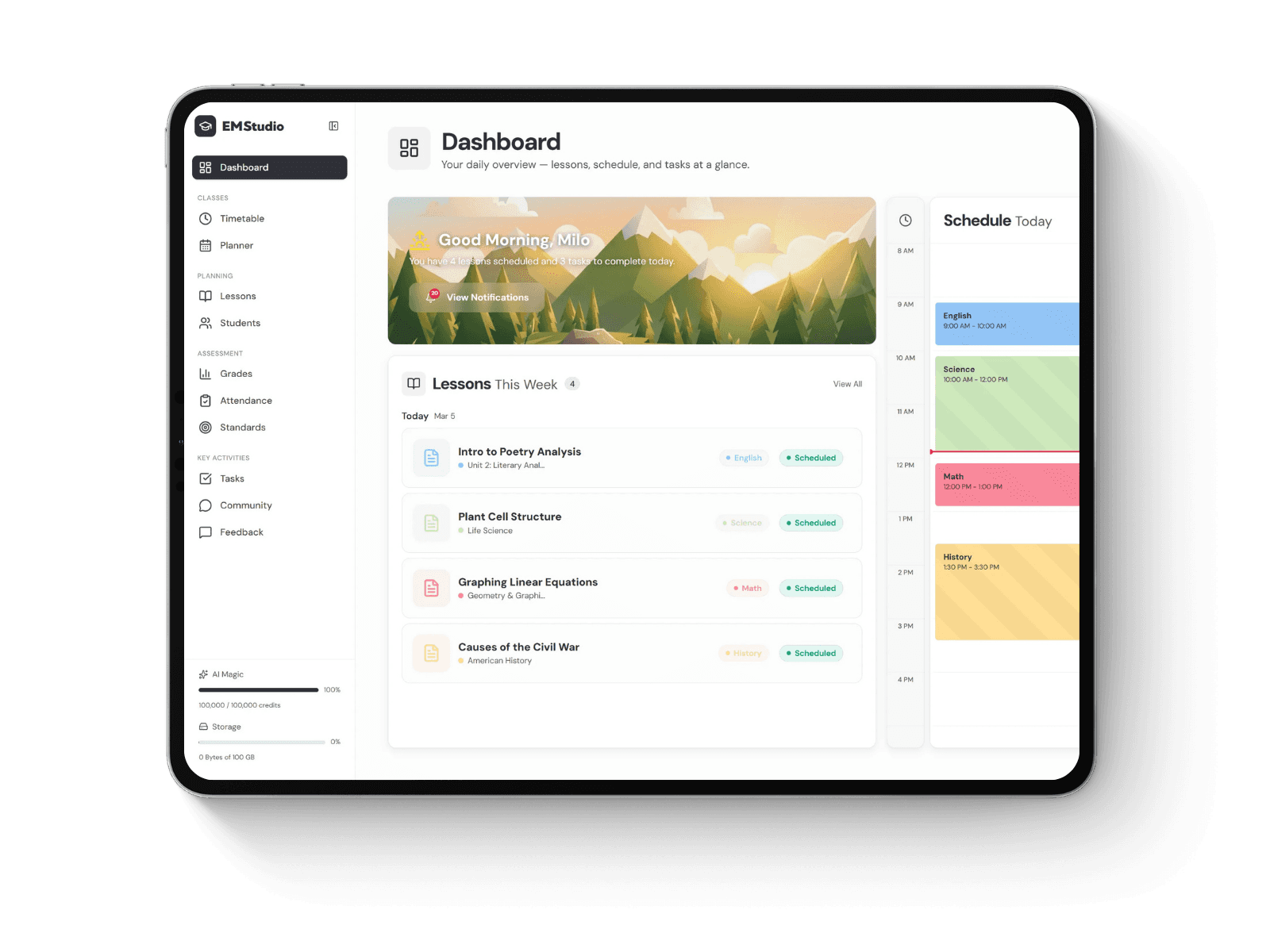
Still grading everything by hand?
EMStudio is a free teaching management app — manage your classes, students, lessons, and more!
Learn More
Table of Contents
Before You Start: Auditing Your Current Grading Methods
Last October, I watched a 7th grader calculate his path to passing. He needed 47% on the final despite knowing nothing about proportional relationships. His gradebook showed 70% homework completion, 100% for bringing tissues, and three zeros on summative assessments. This is the audit moment. Look for the zero effect dragging averages into mathematical nonsense, extra credit masking actual learning gaps, and participation points rewarding compliance over chemistry understanding. Check if your 100-point scale treats missing work as a 50-point penalty versus an evidence gap. Flag attendance bonuses, supply bribery, and completion grades that measure hand-raising, not proficiency scales mastery.
Run a calibration protocol with three sample portfolios. Calculate one using traditional averaging across gradebook categories like homework and quizzes. Then reassess using mastery-based assessment criteria that weight recent evidence. Watch how the student with two zeros but recent retakes suddenly appears proficient while the homework grinder drops. This reveals grade distortion.
Evaluating Points-Based Practices
Five red flags dominate most gradebooks. Mathematical averaging of zeros destroys accuracy. Homework graded for completion rather than understanding tells you who has wifi, not who grasps learning targets. Extra credit for tissues or supplies conflates charity with achievement. Attendance-based participation points punish illness. One hundred-point percentage scales pretend precision where none exists.
These practices mix behavior with achievement. Late penalty deductions measure responsibility; they do not measure whether a student can solve equations. When we redefine success metrics beyond the bell curve, we stop grading parenting and start grading knowledge.
Understanding Ungrading Pedagogy Connections
The road to standards based grading runs through a spectrum. Pure ungrading pedagogy relies on conference-based evaluation with no points. Labor-based grading contracts measure time-on-task. Specifications grading uses pass-fail bundles with tokens for reassessment policy extensions. District implementation research shows most need 12 to 18 months to move from traditional to full adoption.
For K-12, specifications grading and portfolio-based SBG serve as the only viable bridges into full ungrading pedagogy. They keep learning targets visible while ditching the percentage fog. Neither requires immediate summative vs formative purity, but both demand you stop averaging behavior into academic grades.
Step 1 — Unpack Your Standards Into Measurable Competencies
I learned this with my 7th graders last fall. I assumed "recognize proportional relationships" meant they could spot straight lines on graphs. They were just guessing. Real standards based grading requires concrete actions. Take CCSS 7.RP.A.2: I split it into four skills. Calculate unit rates in like and different units. Determine if quantities are proportional. Identify the constant of proportionality. Represent relationships with equations. This noun-plus-verb method beats aligning standards with a digital curriculum tool that skips the unpacking step.
Look at the vertical progression. Sixth graders use ratio reasoning with simple fractions. Seventh graders analyze proportional relationships and calculate unit rates in multistep problems. Eighth graders connect these concepts to linear equations and functions. Your workflow is simple. Select one standard. Identify its Bloom's Taxonomy demand. Draft a four-level progression from recall to analysis. Validate with anchor papers from your files.
Converting Blooms Taxonomy to Progressions
I map Bloom's six levels onto a four-point scale. Levels one and two, Remember and Understand, become Beginning. Level three, Apply, equals Developing. Level four, Analyze, marks Proficient. Levels five and six, Evaluate and Create, equal Advanced. Consider MS-PS1-2. At level one, students identify properties from data. At level three, they analyze patterns to classify matter. At level four, they synthesize conclusions about chemical reactions. The verbs show the climb.
Writing Observable Performance Descriptors
Cut internal-state language. Replace "understands linear equations" with "graphs linear equations with integer coefficients and identifies slope from y equals mx plus b." Swap "knows photosynthesis" with "traces energy flow from sunlight to ATP production." Change "comprehends point of view" to "distinguishes first-person from third-person narration." If someone outside education can picture the action without asking what it looks like, you have it right. Measure visible work, not feelings.

Step 2 — Design Proficiency Scales and Rubric Templates
The 4-Point Mastery Scale Framework
Last year my 7th graders showed me why the zero effect destroys motivation. My four-point proficiency scales fix this math. Level 1.0 covers 0-59 percent for blank work or misconceptions. Level 2.0 hits 60-74 percent for partial understanding with algorithmic errors. Level 3.0 captures 75-89 percent for consistent correct application. Level 4.0 reaches 90-100 percent only for transfer to novel contexts. This standards based grading approach balances the 60-point failing range against the 40-point passing range.
Rubric Wording Examples for Novice to Expert
Stop writing "good organization" on rubrics. I rewrite them as "uses transition words between three or more paragraphs." For argumentative writing, Level 2 requires a claim statement. Level 3 adds supporting evidence. Level 4 needs nuanced reasoning that addresses counter-evidence. I keep three rubric design templates ready. Analytical grids map four criteria by four levels. Holistic descriptors allow single-score efficiency. Single-point rubrics center on mastery-based assessment with margins for feedback.
Competency Based Pedagogy Alignment
Your scales must align with competency based pedagogy. Verify using the Competency Based Education Network framework. Check four pillars. Learner agency comes through self-assessment. Flexibility requires a reassessment policy. Relevance needs authentic gradebook categories. Transparency means posting learning targets before assessment. Within our performance assessment framework, ensure rubrics emphasize application over recall. Distinguish summative vs formative uses clearly, and allow multiple pathways to demonstrate proficiency.
Step 3 — Align Assessments to Specific Standards
Backward Mapping From Summatives
I start every unit by staring at the summative assessment I want to give in four weeks. That is the Wiggins and McTighe approach: identify enduring understandings first, then determine what counts as acceptable evidence. I select one priority standard and map the prerequisite skills students need before they can attempt the final performance task. This backward mapping keeps the learning targets visible from day one and connects summative vs formative work clearly.
Next, I draft formative hinge questions for three checkpoints during the unit. These align with my proficiency scales to catch gaps before they fossilize. I also build remediation resources for students who stumble. The entire process takes forty-five minutes per unit upfront. That investment saves three to four hours of reteaching later when half your class still cannot explain the underlying concept.
Question-Level Standard Tagging
Last October my seventh graders took a ten-item rational numbers test. Items one through three targeted 7.NS.A.1 for adding and subtracting rationals at DOK 1. Items four through six hit 7.NS.A.2 for multiplication and division at DOK 2. I mark these codes directly in the margin of my master copy. This granularity shows me whether a student missed the computation or the conceptual application, which shapes my reassessment policy and supports mastery-based assessment.
MasteryConnect automates this tagging if your district pays for item banks. Canvas Outcomes works for alignment but feels clunky during quiz creation. For budget-conscious implementations, I use a Google Sheets blueprint with a simple formula. Enter =IF(COUNTIF(B2:B11,"7.NS.A.1")>=2,"Mastered","Developing") to auto-calculate mastery levels as you input standard tags. See our full standards-based curriculum implementation guide for the template. This precision transforms vague grading methods for teachers into transparent standards based grading systems where every question points to a specific learning target. Your gradebook categories finally reflect true mastery.

Step 4 — How Do You Structure a Standards Based Gradebook?
Structure your standards-based gradebook by creating assignment groups for each reporting standard, not by task type. Enter assessments as single standards entries using a 4-point scale, enable multiple attempts for reassessment tracking, and use the LMS gradebook's learning mastery view or equivalent to display trend data, not averages.
I learned this the hard way with my 7th graders last spring. When I organized by homework and quizzes, the gradebook became meaningless math soup. Switching to skill-based categories revealed exactly who needed help with proportional reasoning.
Setting Up Categories by Skill
In Canvas, build Outcome Groups for each reporting cluster like "Ratios and Proportional Relationships," then disable the default assignments view. PowerTeacher Pro offers a Standards View toggle that hides traditional points entirely; enable this and import your district's learning targets. Google Classroom lacks native standards tracking, so use Topic tags for each standard and export to Google Sheets for calculation, which feels clunky but works until your district upgrades.
Weight your categories 80 percent summative standards evidence and 20 percent formative work if your district requires both. Never mix behavior with academics. Move late penalties and participation marks to a separate citizenship column so parents see the distinction during conferences.
Managing Reassessment Entries
Allow reassessment within a two-week window to keep pacing moving. Enter each attempt as a new assignment tagged to the same standard so the LMS tracks the progression. Set the display to show the trend—most recent evidence—or the highest score per your district's reassessment policy. Never average; replacement grades reflect current understanding.
Prevent infinite loops by requiring a recovery request form. Students must analyze their errors and complete corrective practice before retaking. This cuts grading load by half while keeping the focus on mastery-based assessment. The form lives in the LMS and takes two minutes to complete.
Conversion to Letter Grades When Required
If your district mandates letter grades, use equal interval conversion. Map 4 to 100 percent, 3 to 85 percent, 2 to 70 percent, 1 to 55 percent, and 0 to 50 percent. This maintains the integrity of proficiency scales while satisfying the registrar. For full standards based grading reporting, skip conversion and export the 4-point trend data directly.
Use this Excel formula for bulk conversion: =IF(scale=4,100,IF(scale=3,85,IF(scale=2,70,IF(scale=1,55,50)))). Paste this in a helper column next to your export. Moving to this system cuts report card time significantly. Consider setting up a digital gradebook in Notion if your LMS lacks flexibility for these grading methods for teachers.

Step 5 — Communicate Progress Without Traditional Percentages
Student-Friendly Progress Reports
I stopped printing percentages for my 7th graders last year. They stared at the red and green bars anyway, ignoring the numbers. Now I hand them single-page checklists with the standard code on the left, the "I can" statement in the middle, and a thick colored bar on the right. Green means meeting the learning target, yellow means approaching, red means starting, plus a small arrow showing if they are climbing, holding steady, or sliding.
Each row lists the current level from 1 to 4 and one concrete next step to reach the next proficiency tier. Each descriptor links directly to mastery-based assessment criteria we reviewed in class. When parents hold this next to a traditional report, the contrast is immediate. One sheet shows "Math 85%" while the other shows "Level 3 Proficient in analyzing proportional relationships" with a green bar and an upward trend arrow. This visual clarity makes competency based pedagogy tangible. Percentages bury that clarity.
Parent Communication Scripts
For the initial phone call, I open with translation. "Jordan isn't an 85 percent. Jordan is proficient in analyzing themes and developing in citing textual evidence. Here is what that means for his reading tonight." This frames parent communication strategies for modern teachers around evidence, not mystery.
When the question shifts to "what is the grade," I anchor the number to meaning. "The 3 on our proficiency scales is solid grade-level understanding. In traditional terms that translates to a B, but more importantly, it means she can independently solve two-step equations with variables on both sides." The reassessment policy allows that 3 to become a 4 with targeted practice before the summative deadline. For transcript worries, I explain that we convert levels to GPA using the same 4.0 scale colleges use, and admissions officers confirm that standards based grading transcripts provide clearer skill evidence than percentage averages.
Avoiding Common Pitfalls When Switching Systems
The Grade Inflation Trap
We have all seen it happen. One teacher is a student proficient for writing a five-sentence paragraph, while another needs eight sentences with transition words. Without rigorous definitions tied to learning targets, a 3 becomes an A in one room and a B in another.
This drift kills the system. Students learn that proficiency scales mean whatever the teacher wants them to mean. Parents get confused when the same child earns top marks from Ms. Johnson and mediocre ones from Mr. Lee for identical work.
Fix it with monthly calibration. Gather anonymized student samples and score them together. When three teachers look at the same argumentative essay and all rate it a 2, you know your standards based grading definitions hold weight.
Maintaining Manageable Workloads
Stop building massive tests. I switched to five-question targeted quizzes per standard, not fifty-question monsters that cover everything. You can pull these from item banks like Illustrative Mathematics or Achieve the Core rather than writing them from scratch.
Batch your grading by standard, not by class period. When you look at twenty responses to the same learning target, you spot patterns faster. This method pairs well with analyzing student assessment data to find gaps quickly.
Use auto-scoring tools. GradeCam bubblesheets grade themselves; Formative shows you real-time responses as students work. Both cut hours from your week. These time-saving hacks to manage teacher workload prevent burnout during the transition.
Quick Wins to Build Momentum
Do not flip your entire gradebook at once. Pick one high-leverage skill, like citing text evidence, and run pure standards based grading on just that target for nine weeks. Let everything else stay traditional while you learn the ropes.
Retrofit what you already use. Take your existing four-point rubric and rewrite the descriptors using mastery-based assessment language. You keep the same assignments; you just change what the numbers mean.
Hand students graph paper. Have them track their own progression on three priority standards across the quarter. When seventh graders watch their line climb from 1 to 3, they invest before you ever touch the report card.

What's Next for Standards Based Grading
You have the roadmap now. The first year switching to standards based grading feels like rebuilding the plane while flying it. I spent October knee-deep in spreadsheets trying to align old quizzes to new proficiency scales, wondering if I'd made a terrible mistake. By April, watching students actually read my feedback instead of hunting for point values, I knew we'd gotten it right.
The field is shifting fast. Districts are dropping percentage-based report cards for mastery-based assessment models. States are rewriting policies to separate behavior from academic grades. If you start now, you're ahead of the curve. If you wait, you'll be playing catch-up when your district mandates the change.
Stay current by refining your learning targets every summer based on what actually measured growth. Join the Facebook groups where teachers share rubric templates. Most importantly, keep that distinction between summative vs formative crystal clear for students. The teachers who thrive won't be the ones with the fanciest gradebook setup. They'll be the ones who stuck with it long enough to see kids stop asking "how many points is this?" and start asking "what do I need to learn?"
Before You Start: Auditing Your Current Grading Methods
Last October, I watched a 7th grader calculate his path to passing. He needed 47% on the final despite knowing nothing about proportional relationships. His gradebook showed 70% homework completion, 100% for bringing tissues, and three zeros on summative assessments. This is the audit moment. Look for the zero effect dragging averages into mathematical nonsense, extra credit masking actual learning gaps, and participation points rewarding compliance over chemistry understanding. Check if your 100-point scale treats missing work as a 50-point penalty versus an evidence gap. Flag attendance bonuses, supply bribery, and completion grades that measure hand-raising, not proficiency scales mastery.
Run a calibration protocol with three sample portfolios. Calculate one using traditional averaging across gradebook categories like homework and quizzes. Then reassess using mastery-based assessment criteria that weight recent evidence. Watch how the student with two zeros but recent retakes suddenly appears proficient while the homework grinder drops. This reveals grade distortion.
Evaluating Points-Based Practices
Five red flags dominate most gradebooks. Mathematical averaging of zeros destroys accuracy. Homework graded for completion rather than understanding tells you who has wifi, not who grasps learning targets. Extra credit for tissues or supplies conflates charity with achievement. Attendance-based participation points punish illness. One hundred-point percentage scales pretend precision where none exists.
These practices mix behavior with achievement. Late penalty deductions measure responsibility; they do not measure whether a student can solve equations. When we redefine success metrics beyond the bell curve, we stop grading parenting and start grading knowledge.
Understanding Ungrading Pedagogy Connections
The road to standards based grading runs through a spectrum. Pure ungrading pedagogy relies on conference-based evaluation with no points. Labor-based grading contracts measure time-on-task. Specifications grading uses pass-fail bundles with tokens for reassessment policy extensions. District implementation research shows most need 12 to 18 months to move from traditional to full adoption.
For K-12, specifications grading and portfolio-based SBG serve as the only viable bridges into full ungrading pedagogy. They keep learning targets visible while ditching the percentage fog. Neither requires immediate summative vs formative purity, but both demand you stop averaging behavior into academic grades.
Step 1 — Unpack Your Standards Into Measurable Competencies
I learned this with my 7th graders last fall. I assumed "recognize proportional relationships" meant they could spot straight lines on graphs. They were just guessing. Real standards based grading requires concrete actions. Take CCSS 7.RP.A.2: I split it into four skills. Calculate unit rates in like and different units. Determine if quantities are proportional. Identify the constant of proportionality. Represent relationships with equations. This noun-plus-verb method beats aligning standards with a digital curriculum tool that skips the unpacking step.
Look at the vertical progression. Sixth graders use ratio reasoning with simple fractions. Seventh graders analyze proportional relationships and calculate unit rates in multistep problems. Eighth graders connect these concepts to linear equations and functions. Your workflow is simple. Select one standard. Identify its Bloom's Taxonomy demand. Draft a four-level progression from recall to analysis. Validate with anchor papers from your files.
Converting Blooms Taxonomy to Progressions
I map Bloom's six levels onto a four-point scale. Levels one and two, Remember and Understand, become Beginning. Level three, Apply, equals Developing. Level four, Analyze, marks Proficient. Levels five and six, Evaluate and Create, equal Advanced. Consider MS-PS1-2. At level one, students identify properties from data. At level three, they analyze patterns to classify matter. At level four, they synthesize conclusions about chemical reactions. The verbs show the climb.
Writing Observable Performance Descriptors
Cut internal-state language. Replace "understands linear equations" with "graphs linear equations with integer coefficients and identifies slope from y equals mx plus b." Swap "knows photosynthesis" with "traces energy flow from sunlight to ATP production." Change "comprehends point of view" to "distinguishes first-person from third-person narration." If someone outside education can picture the action without asking what it looks like, you have it right. Measure visible work, not feelings.
Step 2 — Design Proficiency Scales and Rubric Templates
The 4-Point Mastery Scale Framework
Last year my 7th graders showed me why the zero effect destroys motivation. My four-point proficiency scales fix this math. Level 1.0 covers 0-59 percent for blank work or misconceptions. Level 2.0 hits 60-74 percent for partial understanding with algorithmic errors. Level 3.0 captures 75-89 percent for consistent correct application. Level 4.0 reaches 90-100 percent only for transfer to novel contexts. This standards based grading approach balances the 60-point failing range against the 40-point passing range.
Rubric Wording Examples for Novice to Expert
Stop writing "good organization" on rubrics. I rewrite them as "uses transition words between three or more paragraphs." For argumentative writing, Level 2 requires a claim statement. Level 3 adds supporting evidence. Level 4 needs nuanced reasoning that addresses counter-evidence. I keep three rubric design templates ready. Analytical grids map four criteria by four levels. Holistic descriptors allow single-score efficiency. Single-point rubrics center on mastery-based assessment with margins for feedback.
Competency Based Pedagogy Alignment
Your scales must align with competency based pedagogy. Verify using the Competency Based Education Network framework. Check four pillars. Learner agency comes through self-assessment. Flexibility requires a reassessment policy. Relevance needs authentic gradebook categories. Transparency means posting learning targets before assessment. Within our performance assessment framework, ensure rubrics emphasize application over recall. Distinguish summative vs formative uses clearly, and allow multiple pathways to demonstrate proficiency.
Step 3 — Align Assessments to Specific Standards
Backward Mapping From Summatives
I start every unit by staring at the summative assessment I want to give in four weeks. That is the Wiggins and McTighe approach: identify enduring understandings first, then determine what counts as acceptable evidence. I select one priority standard and map the prerequisite skills students need before they can attempt the final performance task. This backward mapping keeps the learning targets visible from day one and connects summative vs formative work clearly.
Next, I draft formative hinge questions for three checkpoints during the unit. These align with my proficiency scales to catch gaps before they fossilize. I also build remediation resources for students who stumble. The entire process takes forty-five minutes per unit upfront. That investment saves three to four hours of reteaching later when half your class still cannot explain the underlying concept.
Question-Level Standard Tagging
Last October my seventh graders took a ten-item rational numbers test. Items one through three targeted 7.NS.A.1 for adding and subtracting rationals at DOK 1. Items four through six hit 7.NS.A.2 for multiplication and division at DOK 2. I mark these codes directly in the margin of my master copy. This granularity shows me whether a student missed the computation or the conceptual application, which shapes my reassessment policy and supports mastery-based assessment.
MasteryConnect automates this tagging if your district pays for item banks. Canvas Outcomes works for alignment but feels clunky during quiz creation. For budget-conscious implementations, I use a Google Sheets blueprint with a simple formula. Enter =IF(COUNTIF(B2:B11,"7.NS.A.1")>=2,"Mastered","Developing") to auto-calculate mastery levels as you input standard tags. See our full standards-based curriculum implementation guide for the template. This precision transforms vague grading methods for teachers into transparent standards based grading systems where every question points to a specific learning target. Your gradebook categories finally reflect true mastery.
Step 4 — How Do You Structure a Standards Based Gradebook?
Structure your standards-based gradebook by creating assignment groups for each reporting standard, not by task type. Enter assessments as single standards entries using a 4-point scale, enable multiple attempts for reassessment tracking, and use the LMS gradebook's learning mastery view or equivalent to display trend data, not averages.
I learned this the hard way with my 7th graders last spring. When I organized by homework and quizzes, the gradebook became meaningless math soup. Switching to skill-based categories revealed exactly who needed help with proportional reasoning.
Setting Up Categories by Skill
In Canvas, build Outcome Groups for each reporting cluster like "Ratios and Proportional Relationships," then disable the default assignments view. PowerTeacher Pro offers a Standards View toggle that hides traditional points entirely; enable this and import your district's learning targets. Google Classroom lacks native standards tracking, so use Topic tags for each standard and export to Google Sheets for calculation, which feels clunky but works until your district upgrades.
Weight your categories 80 percent summative standards evidence and 20 percent formative work if your district requires both. Never mix behavior with academics. Move late penalties and participation marks to a separate citizenship column so parents see the distinction during conferences.
Managing Reassessment Entries
Allow reassessment within a two-week window to keep pacing moving. Enter each attempt as a new assignment tagged to the same standard so the LMS tracks the progression. Set the display to show the trend—most recent evidence—or the highest score per your district's reassessment policy. Never average; replacement grades reflect current understanding.
Prevent infinite loops by requiring a recovery request form. Students must analyze their errors and complete corrective practice before retaking. This cuts grading load by half while keeping the focus on mastery-based assessment. The form lives in the LMS and takes two minutes to complete.
Conversion to Letter Grades When Required
If your district mandates letter grades, use equal interval conversion. Map 4 to 100 percent, 3 to 85 percent, 2 to 70 percent, 1 to 55 percent, and 0 to 50 percent. This maintains the integrity of proficiency scales while satisfying the registrar. For full standards based grading reporting, skip conversion and export the 4-point trend data directly.
Use this Excel formula for bulk conversion: =IF(scale=4,100,IF(scale=3,85,IF(scale=2,70,IF(scale=1,55,50)))). Paste this in a helper column next to your export. Moving to this system cuts report card time significantly. Consider setting up a digital gradebook in Notion if your LMS lacks flexibility for these grading methods for teachers.
Step 5 — Communicate Progress Without Traditional Percentages
Student-Friendly Progress Reports
I stopped printing percentages for my 7th graders last year. They stared at the red and green bars anyway, ignoring the numbers. Now I hand them single-page checklists with the standard code on the left, the "I can" statement in the middle, and a thick colored bar on the right. Green means meeting the learning target, yellow means approaching, red means starting, plus a small arrow showing if they are climbing, holding steady, or sliding.
Each row lists the current level from 1 to 4 and one concrete next step to reach the next proficiency tier. Each descriptor links directly to mastery-based assessment criteria we reviewed in class. When parents hold this next to a traditional report, the contrast is immediate. One sheet shows "Math 85%" while the other shows "Level 3 Proficient in analyzing proportional relationships" with a green bar and an upward trend arrow. This visual clarity makes competency based pedagogy tangible. Percentages bury that clarity.
Parent Communication Scripts
For the initial phone call, I open with translation. "Jordan isn't an 85 percent. Jordan is proficient in analyzing themes and developing in citing textual evidence. Here is what that means for his reading tonight." This frames parent communication strategies for modern teachers around evidence, not mystery.
When the question shifts to "what is the grade," I anchor the number to meaning. "The 3 on our proficiency scales is solid grade-level understanding. In traditional terms that translates to a B, but more importantly, it means she can independently solve two-step equations with variables on both sides." The reassessment policy allows that 3 to become a 4 with targeted practice before the summative deadline. For transcript worries, I explain that we convert levels to GPA using the same 4.0 scale colleges use, and admissions officers confirm that standards based grading transcripts provide clearer skill evidence than percentage averages.
Avoiding Common Pitfalls When Switching Systems
The Grade Inflation Trap
We have all seen it happen. One teacher is a student proficient for writing a five-sentence paragraph, while another needs eight sentences with transition words. Without rigorous definitions tied to learning targets, a 3 becomes an A in one room and a B in another.
This drift kills the system. Students learn that proficiency scales mean whatever the teacher wants them to mean. Parents get confused when the same child earns top marks from Ms. Johnson and mediocre ones from Mr. Lee for identical work.
Fix it with monthly calibration. Gather anonymized student samples and score them together. When three teachers look at the same argumentative essay and all rate it a 2, you know your standards based grading definitions hold weight.
Maintaining Manageable Workloads
Stop building massive tests. I switched to five-question targeted quizzes per standard, not fifty-question monsters that cover everything. You can pull these from item banks like Illustrative Mathematics or Achieve the Core rather than writing them from scratch.
Batch your grading by standard, not by class period. When you look at twenty responses to the same learning target, you spot patterns faster. This method pairs well with analyzing student assessment data to find gaps quickly.
Use auto-scoring tools. GradeCam bubblesheets grade themselves; Formative shows you real-time responses as students work. Both cut hours from your week. These time-saving hacks to manage teacher workload prevent burnout during the transition.
Quick Wins to Build Momentum
Do not flip your entire gradebook at once. Pick one high-leverage skill, like citing text evidence, and run pure standards based grading on just that target for nine weeks. Let everything else stay traditional while you learn the ropes.
Retrofit what you already use. Take your existing four-point rubric and rewrite the descriptors using mastery-based assessment language. You keep the same assignments; you just change what the numbers mean.
Hand students graph paper. Have them track their own progression on three priority standards across the quarter. When seventh graders watch their line climb from 1 to 3, they invest before you ever touch the report card.
What's Next for Standards Based Grading
You have the roadmap now. The first year switching to standards based grading feels like rebuilding the plane while flying it. I spent October knee-deep in spreadsheets trying to align old quizzes to new proficiency scales, wondering if I'd made a terrible mistake. By April, watching students actually read my feedback instead of hunting for point values, I knew we'd gotten it right.
The field is shifting fast. Districts are dropping percentage-based report cards for mastery-based assessment models. States are rewriting policies to separate behavior from academic grades. If you start now, you're ahead of the curve. If you wait, you'll be playing catch-up when your district mandates the change.
Stay current by refining your learning targets every summer based on what actually measured growth. Join the Facebook groups where teachers share rubric templates. Most importantly, keep that distinction between summative vs formative crystal clear for students. The teachers who thrive won't be the ones with the fanciest gradebook setup. They'll be the ones who stuck with it long enough to see kids stop asking "how many points is this?" and start asking "what do I need to learn?"
Still grading everything by hand?
EMStudio is a free teaching management app — manage your classes, students, lessons, and more!
Learn More
Still grading everything by hand?
EMStudio is a free teaching management app — manage your classes, students, lessons, and more!
Learn More
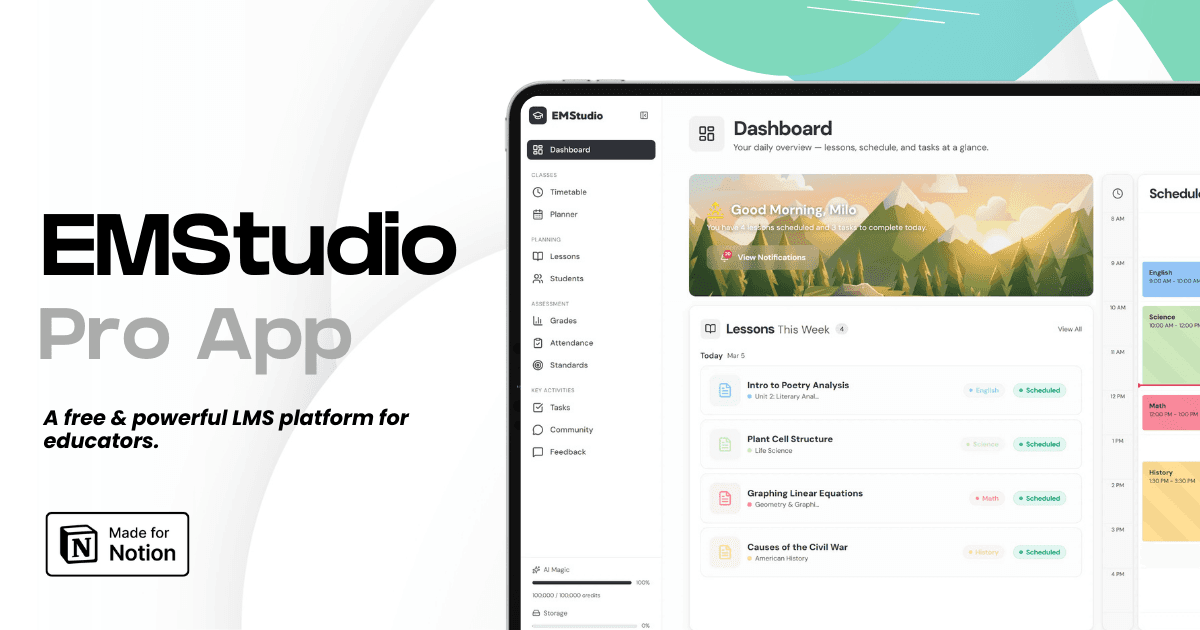





Notion4Teachers
Notion templates to simplify administrative tasks and enhance your teaching experience.



2026 Notion4Teachers. All Rights Reserved.
Notion4Teachers
Notion templates to simplify administrative tasks and enhance your teaching experience.
2026 Notion4Teachers. All Rights Reserved.
Notion4Teachers
Notion templates to simplify administrative tasks and enhance your teaching experience.
2026 Notion4Teachers. All Rights Reserved.