A spring plant unit that starts with coloring pages and lives in Notion

Every spring the same request lands on a lot of elementary teachers' desks: "Can we do flowers?"
Yes. Here's how I'd set it up.
A plant unit is one of the easiest science topics to make hands-on. Seeds, roots, a bean in a wet paper towel on the windowsill. But before the beans sprout there's a week where students need the vocabulary, petal, stem, leaf, root and seed, and that's where a good coloring page earns its place.
Some teachers write coloring off as busywork. It stops being busywork once students have a job to do with the page.
Still grading everything by hand?
EMStudio is a free teaching management app — manage your classes, students, lessons, and more!
Why coloring belongs in a science lesson
Coloring makes students look closely. A child who has to decide where the petals end and the stem begins is observing structure, even if they think they're just picking a crayon.
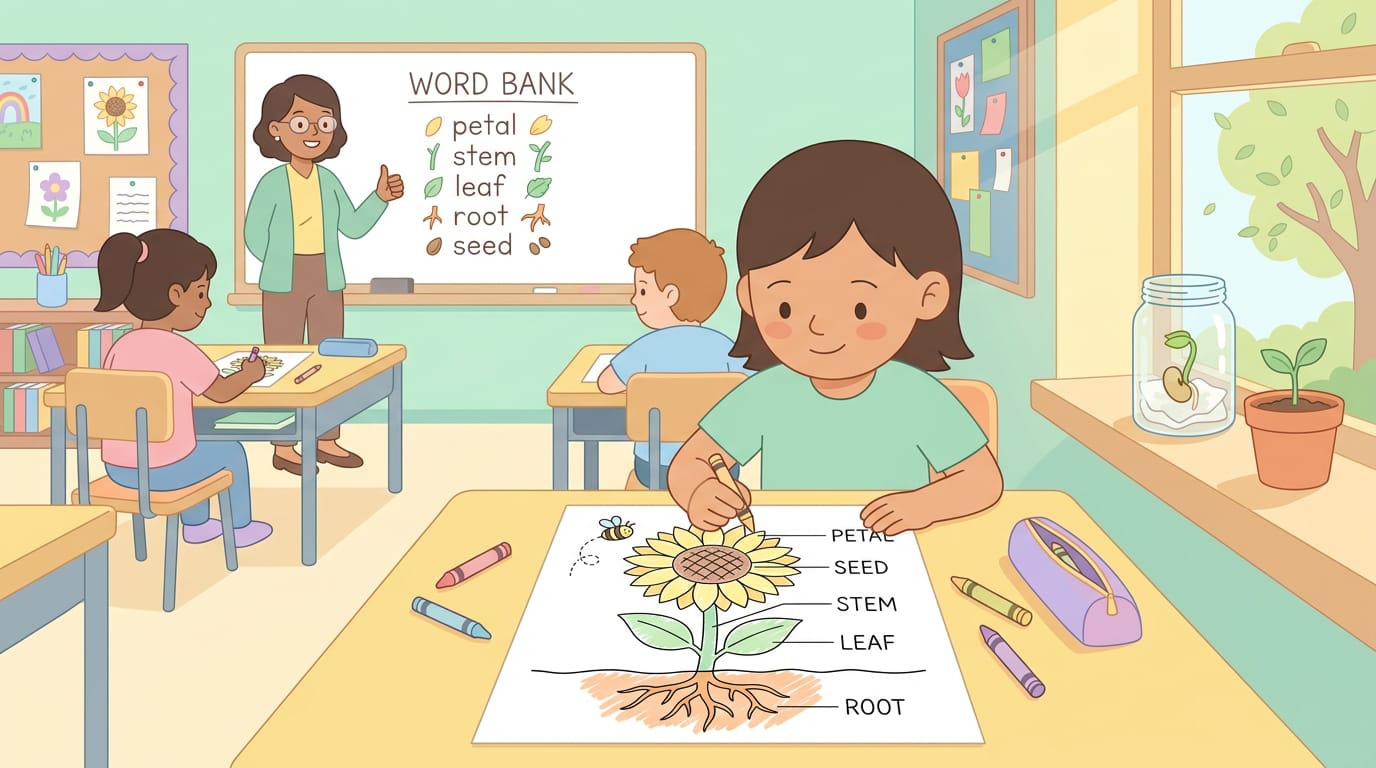
It also gives you a low-pressure way to teach labeling. Hand out a sunflower, put the word bank on the board, and ask students to color each part a different shade and label it. Early finishers can add the roots underground or draw a bee. Older or faster students can add pistil and sepal as bonus words. Students who need more time still finish with something they're proud of.
Fifteen quiet minutes after recess help, too.
What to look for in classroom printables
Not every free coloring page survives the copy room. Before you print thirty of anything, check these points.
Black line art only. Gray shading turns into mud on most school copiers.
US Letter sizing, so the edges don't get cut off.
A license that allows classroom copies. Plenty of free sites limit their pages to personal use, and it's usually buried in the terms.
Variety. A sunflower, a tulip and a cactus show very different plant structures, which helps when you compare them.
No account wall at 7:40 a.m.
Five sources, scored out of 10
I scored each source on those five points for a second or third grade plant unit. The scores measure fit for this one job, not overall quality. Twinkl and Teachers Pay Teachers, for example, do things the top pick never tries.
1. PrintableColoringPages.ai: 9.5
It comes first because every page on it passes the copy-room test. The library has a section of flower coloring pages to print, 23 designs right now, covering a rose, sunflower, tulip, daisy, lotus, poppy, daffodil, lavender, a succulent, a cactus, a flower pot and a whole flower garden.
Each page is a vector PDF at 300 DPI, as separate US Letter and A4 files, in pure black and white. It copies cleanly even on a tired machine. There's no signup, and the pages are released into the public domain, so you can print class sets without reading a license twice.
You can also describe a page and have the site draw it, free. A sunflower with big, separate petals is easier for younger students to label than a busy bouquet, and asking for exactly that saves a round of searching.
2. Twinkl: 8
Twinkl has a huge range of curriculum-linked resources, including labeling worksheets for plant parts and life cycle sequencing cards. A free account gets you a limited number of downloads, but most of the library needs a paid membership. If your school already subscribes, it's an easy place to build out the rest of the unit.
3. Teachers Pay Teachers: 7.5
TpT is where you'll find complete plant units made by other teachers, from life cycle booklets to flower dissection labs. Some resources are free, many are paid, and you need an account to download. Read the reviews before you buy a set.
4. Super Coloring: 7
Super Coloring has a large library, including some fairly realistic flower drawings that older students like. Pages come with ads. Check the terms before making class copies, since many free coloring sites are for personal use only.
5. Crayola: 6.5
Kids know the brand, so the pages feel familiar, and the simple outlines suit kindergarten and first grade. For a parts-of-a-flower lesson the drawings are often too stylized, but for a spring bulletin board they work well.
The comparison
Source | Score | Account needed | Best for |
|---|---|---|---|
PrintableColoringPages.ai | 9.5 | No | Clean class sets, custom pages |
Twinkl | 8 | Yes, mostly paid | Full curriculum resources |
Teachers Pay Teachers | 7.5 | Yes | Complete units by other teachers |
Super Coloring | 7 | No | Realistic drawings for older kids |
Crayola | 6.5 | No | Simple pages for K and 1 |
Keeping it all in Notion
Finding the files again next year is where most teachers lose time. A simple Notion database fixes that. Create one called Printables, with properties for Subject, Grade and Unit (Unit works best as a Select), File (a URL or Files & media property) and Date used. Every time you print something, add a row and drop the PDF in.
Next spring, filter where Unit is Plants and sort by Date used, and the whole set is there in the order you taught it. Add a Copied checkbox property, then filter for Copied is unchecked to see what still needs to go to the copy room.
If you plan week by week, a button block that creates a new lesson page with a linked view of the Printables database already on it saves you rebuilding the same layout every Sunday night.
Three ways to use the pages
Label and color: one color per part, with the word bank on the board.
Compare and contrast: hand out a sunflower and a cactus. Ask students what each plant has that the other one doesn't, and why the cactus might need it. Let them argue about it for five minutes before you answer.
Garden wall: every student colors a different flower, and together they build a classroom garden on the bulletin board. Families tend to stop at that wall during spring open house.
Still grading everything by hand?
EMStudio is a free teaching management app — manage your classes, students, lessons, and more!