Kindergarten Class: How to Set Up, Plan, and Thrive
Kindergarten Class: How to Set Up, Plan, and Thrive

Article by
Milo
ESL Content Coordinator & Educator
ESL Content Coordinator & Educator
All Posts
Kindergarten is the hardest grade to teach. Not because the content is difficult—it is the management. You are teaching twenty-five five-year-olds how to exist in a school building for the first time while trying to squeeze in phonics instruction and early literacy. Everything takes three times longer than you planned. A simple line to the cafeteria becomes a twenty-minute negotiation about personal space. If your kindergarten class runs smoothly, you are performing magic. If it does not, you are drowning by 9:15 AM.
I learned this the hard way during my first year. I spent August laminating beautiful centers and printing color-coded worksheets. I had a Pinterest-worthy room. By October, I was spending every Sunday night rewriting lesson plans because my transition routines took twelve minutes instead of two. The kids could not find the pencils. They did not know what came next. I was exhausted from making thousands of micro-decisions every hour while trying to teach early literacy to children who were still learning to tie their shoes.
This post shows you how to build a kindergarten class that actually functions without burning out. You will learn to design a layout that prevents traffic jams, weave English critical thinking into daily lessons without adding prep time, and create sustainable routines that run themselves. These are the systems I developed over fifteen years and wish someone had handed me before that first bell rang. Start with the room. Everything else flows from there.
Still grading everything by hand?
EMStudio is a free teaching management app — manage your classes, students, lessons, and more!
Learn More
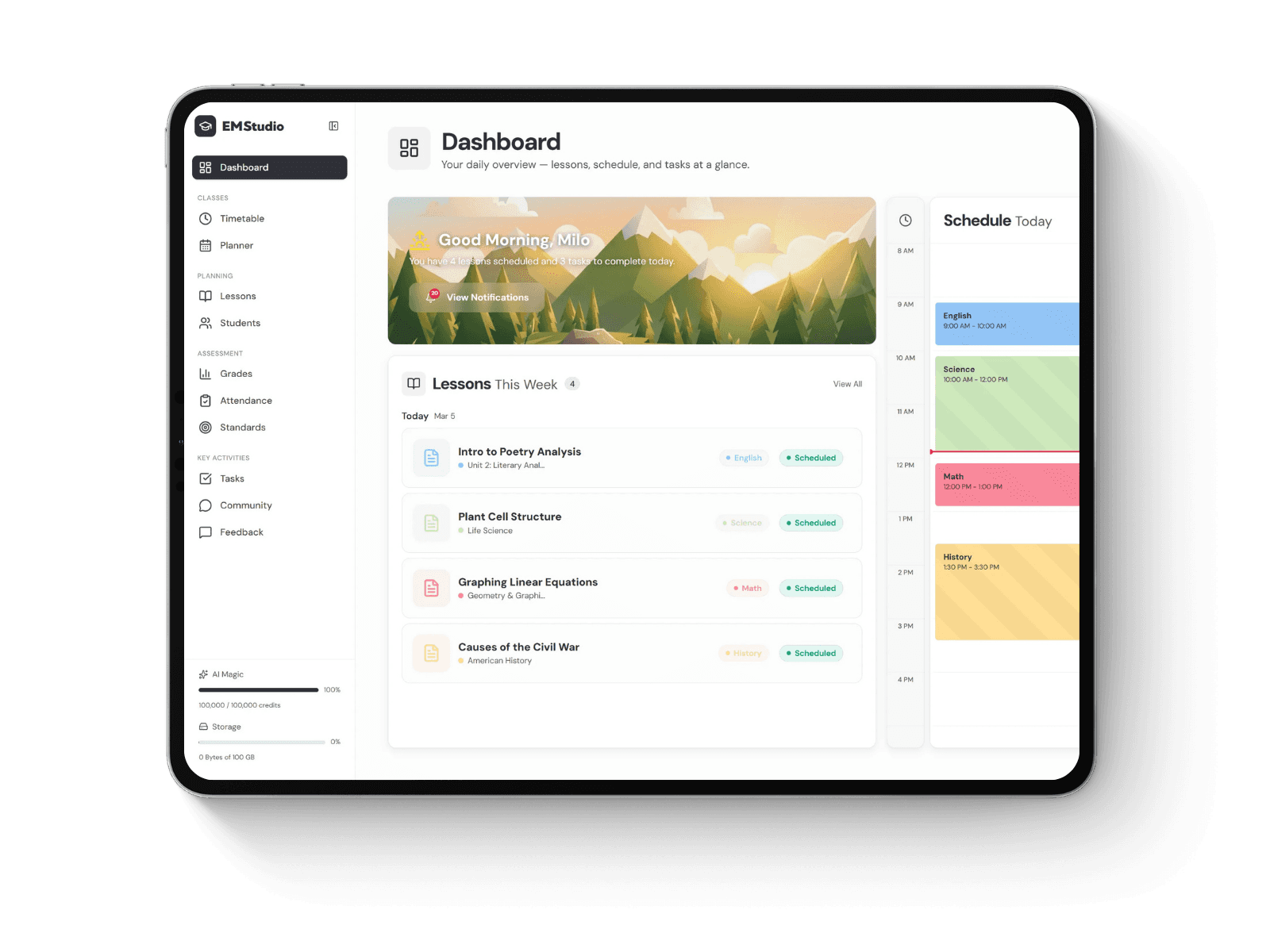
Still grading everything by hand?
EMStudio is a free teaching management app — manage your classes, students, lessons, and more!
Learn More
Table of Contents
What Do You Need to Prepare Before Teaching Your First Kindergarten Class?
Before teaching your first kindergarten class, gather magnetic letters, visual timers, and personal laminators; map your first month focusing on alphabet recognition and number sense 0-10; establish safety protocols including allergy tracking and emergency drills; set up ClassDojo for parents; and plan 15-minute attention blocks for opening day.
You cannot wing it with five-year-olds. Teaching kindergarten requires concrete materials, visual schedules, and backup plans for backup plans. The first weeks determine your entire year.
Start with the essentials. I learned this the hard way during my first year when I ran out of laminating pouches three days before open house. You need tools that survive daily use by twenty-five five-year-olds.
Two sets of magnetic letters (uppercase and lowercase) for phonics instruction on your whiteboard.
Individual pencil boxes to eliminate the "I can't find my crayon" meltdowns.
Time Timer 8-inch visual timer so students see time disappearing during centers.
Wireless doorbell for attention signals—one chime beats shouting over 25 voices.
Personal laminator (Scotch TL901) for durability; the faculty room machine always breaks.
Velcro dots for flexible seating arrangements that change with each activity.
Sensory fidget tools for students who need tactile input during early literacy lessons.
Family photo display board to ease separation anxiety during those first mornings.
Labeled cubbies with picture/name combos so pre-readers can find their belongings.
Sanitation station with pump bottles for handwashing protocol enforcement.
Map your first four weeks using backward design. Week one and two focus on name recognition and introducing letters A and B. Weeks three and four build number sense 0-10 and rhyming foundations. Structure your day around 15-minute whole-group blocks for early literacy and math—anything longer and you lose them. Rotate through 20-minute learning centers with clear transition routines signaled by that wireless doorbell. Solid classroom management starts with these predictable structures. Write emergency sub plans now; you will need them by week three.
Safety comes before phonics instruction. Generate allergy alert cards using the FARE template for your 3-ring binder and wall display. Schedule two emergency exit drills during week one—five-year-olds need muscle memory for fire alarms. Establish a 20-second handwashing protocol using your visual timer. Create a sign-in/sign-out station with timestamp logs; administrators check these during inspections. Label your epinephrine storage clearly.
Configure ClassDojo or Remind before doors open. Aim for 90% parent enrollment by day three. Prepare welcome packets with transportation tags—laminated, of course, using your comprehensive teacher supply checklist. Set up a comfort item shelf with family photos and small stuffed animals for separation anxiety support. Send your first message introducing yourself before meet-the-teacher night.
Work backward from opening day. Four weeks out: Order supplies and configure your parent communication system. Send welcome emails with supply lists attached. Two weeks out: Laminate center materials and post visual schedules at student eye level. One week out: Run emergency drills yourself to check exit routes. Label every cubby with picture/name combos. One day out: Fill pump bottles, test your wireless doorbell, and print allergy cards. Charge your doorbell remote.
Teaching kindergarten means preparing for everything while knowing plans will change. These essential survival strategies for your first year keep you grounded when the glue sticks run dry and the laminator jams. You have got this.

Step 1 — How Do You Design a Kindergarten Class Layout That Prevents Chaos?
Design your kindergarten layout with 36-inch traffic pathways between centers to prevent collisions. Create distinct zones: Quiet (library), Active (dramatic play), Messy (art), and Teacher (small group). Use colored tape for boundaries and ensure sight lines to all areas. Avoid placing high-interest items near exits or creating hidden 'cave zones' where students are unsupervised. Good design prevents most behavior problems before they start.
Chaos starts with the floor plan. When teaching kindergarten, every inch matters because these students are still learning to navigate shared space. Your layout either prevents problems or creates them.
Poor layouts create daily power struggles. Smart layouts create independence.
You need 36-inch walkways between every piece of furniture. Measure with a yardstick. Do not guess. Anything narrower creates traffic jams and bumped heads. Arrange shelves and tables to form circular traffic patterns that flow naturally.
Dead-ends trap students and create bottlenecks during transition routines. I learned this the hard way in my first year when two students collided at a sharp corner near the block center. One ended up with a bloody lip. Fire code typically requires 36 inches anyway, but even if your district ignores that standard, follow it for your sanity and your students' safety.
Build four distinct zones that match energy levels using effective classroom design using learning zones.
Quiet Zone: Library corner with 6x6 carpet remnant and pillows for early literacy work.
Active Zone: Dramatic play with sound-muffling panels to contain noise.
Messy Zone: Art station with vinyl flooring protection and accessible sink.
Teacher Zone: Kidney table with 360-degree sight lines to monitor learning centers during phonics instruction.
Your teacher zone anchors the entire room. From that kidney table, you should see every learning center without turning your head more than ninety degrees. This positioning is non-negotiable for classroom management. If you must stand up and walk to check the block area, move your table.
Position your teacher zone so no student sits more than 12 feet away or behind a visual barrier. Scanning your kindergarten class should take seconds, not minutes. Eliminate cave zones under tables or behind tall shelves where supervision is impossible.
If you cannot see a space while seated at your small group table, students cannot use that space. This rule transforms classroom management from reactive to preventive. You catch problems before they start. No more breaking up conflicts after they explode.
Never place high-interest items like blocks or play kitchens near exit doors. Students elope toward interesting objects, and you cannot block the fire exit. Keep carpet areas at least four feet from shelving to prevent climbing hazards. Five-year-olds see shelves as ladders.
Avoid rows of desks facing forward for twenty or more students. This restricts movement and increases behavior issues in teaching kindergarten. Students need to move, and you need to reach them quickly without navigating a maze of chair legs. Open floor plans save your sanity.
Install colored duct tape boundaries on floors to delineate center borders. Students need visual cues to understand where one zone ends and another begins.
Use a wireless doorbell for transition signals. Auditory cues reduce transition time by approximately thirty percent because students learn to associate the chime with specific actions. The predictable sound eliminates the need to raise your voice.
Post visual schedules at five-year-old eye level, thirty-six inches from the floor. When students can see what comes next, they transition independently. These research-based organization strategies turn your room into a teaching tool.

Step 2 — How Do You Build English Critical Thinking Into Daily Kindergarten Lessons?
Build English critical thinking by using revised Bloom's taxonomy adapted for 5-year-olds. Target the analysis and evaluation levels daily. Implement Mystery Bag inquiries where students ask yes/no questions, and facilitate Philosophy for Children circles using a talking piece.
Stop asking what color the cat is. Start asking why he kept walking. Your kindergarten english lessons need fewer recall questions and more puzzles that make five-year-olds argue with evidence.
You already know Bloom's taxonomy. For kindergarten class settings, simplify it to six verbs: Remember, Understand, Apply, Analyze, Evaluate, Create. Most early literacy programs stall at Remember and Understand. They ask kids to recite the alphabet or sort letters. That's phonics instruction, not thinking.
Push into Analyze and Evaluate daily. Ask students to compare two characters. Ask them to choose the better solution and defend it. When I taught kindergarten, I watched a five-year-old explain why the wolf in The Three Little Pigs might just be hungry. That's analysis. You want that.
Replace your recall questions with analytical stems.
Don't ask "What color is Pete's shoe?" Ask "Why did Pete keep walking in his white shoes?"
Don't ask "What sound does C make?" Ask "How would you feel if you woke up with no shoes?"
Use repetitive anchor texts like Pete the Cat. Kids memorize the pattern quickly. Then you can manipulate the questions to target higher levels. The text becomes familiar ground for complex thinking.
Run a daily Mystery Bag protocol during your morning meeting or at learning centers.
Place three clues about a vocabulary word inside a drawstring bag.
Students ask yes/no questions for ten minutes to deduce the content.
They practice deductive reasoning while building oral language skills.
One day I hid the word "hibernate." The clues were "animals do this," "in winter," and "they sleep." It took my class eight minutes to narrow it down. They asked "Is it eating?" No. "Is it moving?" No. Then Marcus guessed it. He explained his reasoning by connecting the sleep clue to his cat at home. The bag builds stamina for inquiry.
Conduct weekly Socratic circles with eight to twelve students. Use a talking piece. The child holding it speaks; others listen. Try questions like "Is it okay to take something that isn't yours if you're hungry?" Ask this after reading The Giving Tree. Sit in a circle on the carpet so everyone sees each other.
These circles develop developing adaptive thinking skills in young learners better than any worksheet. You can find step-by-step critical thinking strategies that map specific questions to picture books. Keep circles short. Ten minutes is plenty for five-year-olds.
Traditional Kindergarten Questions | Critical Thinking Questions |
What did Goldilocks break? | Why was entering the house a poor choice? |
What color was her hair? | How would you feel if someone sat in your chair? |
Who came home first? | What evidence shows the bears were angry? |
Where did she sleep? | Is it ever okay to use someone's things without asking? |
What did Baby Bear say? | How could Goldilocks have solved her problem differently? |
This shift transforms early literacy from memorization into reasoning. You are not abandoning phonics instruction. You are layering thinking on top of it. When students analyze why Pete the Cat didn't cry, they practice the same sequential logic they will use for decoding words later.
English critical thinking starts with these small shifts. You don't need separate blocks of time. You embed the questions into your existing read-alouds and transition routines. The magic happens when you wait three extra seconds for an answer. Don't jump in to save the silence.

Step 3 — How Do You Create Sustainable Routines That Run Your Kindergarten Class Automatically?
Create sustainable routines using visual schedules with Boardmaker icons, color-coded 45-minute blocks, and automated transitions triggered by specific 2-minute clean-up songs. Train students over 6 weeks: entering procedures first, then centers rotation, then independent stamina. Research shows strong classroom management has an effect size of 0.52 on student achievement.
You cannot teach kindergarten english lessons while managing chaos. Your kindergarten class needs systems that run without your voice. Build the machine first, then fill it with content.
Hang a linear visual schedule at student eye level using Boardmaker icons or free printable picture cards. Divide the day into 45-minute blocks. Color-code each segment so five-year-olds can predict what comes next without asking you. Red means math manipulatives. Blue signals kindergarten english lessons or guided reading groups. Green covers science exploration. Yellow warns of transitions. Move a clothespin or highlight the current block so students track time independently. Visual schedules eliminate the constant interruptions that derail early literacy blocks.
Automate shifts between learning centers so you are not the traffic cop. Play the Harry Kindergarten Clean Up Song, specifically the two-minute version, and train students to finish toy collection before the music stops. Use the Turtle Technique for hallway lines: slow walking with hands clasped behind backs. Station two hall passes maximum at the bathroom door. No pass, no exit. These transition routines become muscle memory by October. The goal is zero teacher talk during shifts between phonics instruction and math exploration.
John Hattie's meta-analysis places classroom management strategies at an effect size of 0.52 on student achievement. That beats many curriculum interventions. Spending six weeks on explicit routine training is not lost instructional time for early literacy. It is a high-leverage investment that compounds daily for the remaining thirty weeks. Think of it as front-loading the hard work so April runs smoother than September. Your data tracking will show the difference in usable instructional minutes.
I learned this sequencing the hard way with a particularly energetic morning group. They could not handle centers until they mastered entering the room silently. I tried rotating groups in week two and spent twenty minutes managing disputes over blocks. Never again. Follow this progression exactly:
Weeks 1-2: entering the room, backpack hooks, lunch choice, and morning tubs without talking.
Weeks 3-4: centers rotation and the zero-to-five voice level scale, where zero means silent and five is playground volume.
Weeks 5-6: independent stamina building toward fifteen minutes of sustained focus without teacher direction.
Do not rush the voice level scale. Post it with photographs of students modeling each number. Practice daily. By week six, students should sustain silent reading or writing workshop for fifteen minutes while you conduct reading assessments across the room.
Even perfect systems break. Prepare sponge activities for routine breakdowns. Keep Magic Playdough, homemade with hidden food coloring that reveals as they knead, for emergency calming. Use Silent Ball, a gross motor control game where students toss without speaking, to reset group energy. Laminate emergency visual cue cards for substitute teachers who do not know your verbal procedures that eliminate daily chaos. These backups save your sanity during fire drills or unexpected assemblies when normal routines suspend.
These structures free you to actually teach instead of directing traffic. Start building a productive daily routine on day one. Your future self will thank you when March arrives and the kindergarten class runs itself while you pull small groups for targeted phonics instruction or writing conferences. The automation buys you time to differentiate.

Getting Started with Kindergarten Class
You have the map now. You know where the blocks go, how to pivot from "what" to "why," and which transition routines save your voice before 10 AM. None of this works Monday if you try it all Monday. Pick one system. Run it for a week. Watch where it breaks.
Your kindergarten class will not look like the Pinterest boards. It will look like twenty small humans learning to share glue sticks while you decipher their cues. That is exactly right. Trust the layout. Trust the phonics instruction blocks you carved out. Trust that early literacy grows in the mess of centers, not despite it.
Classroom management is not a personality trait. It is a series of small decisions about where the line is and how you hold it. Start there. The rest builds.
Sketch your layout tonight. Move one shelf before you leave.
Write one "why" question for tomorrow's read-aloud.
Teach one transition routine. Practice it until they roll their eyes.
Block your phonics instruction time. Guard it from the intercom.

What Do You Need to Prepare Before Teaching Your First Kindergarten Class?
Before teaching your first kindergarten class, gather magnetic letters, visual timers, and personal laminators; map your first month focusing on alphabet recognition and number sense 0-10; establish safety protocols including allergy tracking and emergency drills; set up ClassDojo for parents; and plan 15-minute attention blocks for opening day.
You cannot wing it with five-year-olds. Teaching kindergarten requires concrete materials, visual schedules, and backup plans for backup plans. The first weeks determine your entire year.
Start with the essentials. I learned this the hard way during my first year when I ran out of laminating pouches three days before open house. You need tools that survive daily use by twenty-five five-year-olds.
Two sets of magnetic letters (uppercase and lowercase) for phonics instruction on your whiteboard.
Individual pencil boxes to eliminate the "I can't find my crayon" meltdowns.
Time Timer 8-inch visual timer so students see time disappearing during centers.
Wireless doorbell for attention signals—one chime beats shouting over 25 voices.
Personal laminator (Scotch TL901) for durability; the faculty room machine always breaks.
Velcro dots for flexible seating arrangements that change with each activity.
Sensory fidget tools for students who need tactile input during early literacy lessons.
Family photo display board to ease separation anxiety during those first mornings.
Labeled cubbies with picture/name combos so pre-readers can find their belongings.
Sanitation station with pump bottles for handwashing protocol enforcement.
Map your first four weeks using backward design. Week one and two focus on name recognition and introducing letters A and B. Weeks three and four build number sense 0-10 and rhyming foundations. Structure your day around 15-minute whole-group blocks for early literacy and math—anything longer and you lose them. Rotate through 20-minute learning centers with clear transition routines signaled by that wireless doorbell. Solid classroom management starts with these predictable structures. Write emergency sub plans now; you will need them by week three.
Safety comes before phonics instruction. Generate allergy alert cards using the FARE template for your 3-ring binder and wall display. Schedule two emergency exit drills during week one—five-year-olds need muscle memory for fire alarms. Establish a 20-second handwashing protocol using your visual timer. Create a sign-in/sign-out station with timestamp logs; administrators check these during inspections. Label your epinephrine storage clearly.
Configure ClassDojo or Remind before doors open. Aim for 90% parent enrollment by day three. Prepare welcome packets with transportation tags—laminated, of course, using your comprehensive teacher supply checklist. Set up a comfort item shelf with family photos and small stuffed animals for separation anxiety support. Send your first message introducing yourself before meet-the-teacher night.
Work backward from opening day. Four weeks out: Order supplies and configure your parent communication system. Send welcome emails with supply lists attached. Two weeks out: Laminate center materials and post visual schedules at student eye level. One week out: Run emergency drills yourself to check exit routes. Label every cubby with picture/name combos. One day out: Fill pump bottles, test your wireless doorbell, and print allergy cards. Charge your doorbell remote.
Teaching kindergarten means preparing for everything while knowing plans will change. These essential survival strategies for your first year keep you grounded when the glue sticks run dry and the laminator jams. You have got this.
Step 1 — How Do You Design a Kindergarten Class Layout That Prevents Chaos?
Design your kindergarten layout with 36-inch traffic pathways between centers to prevent collisions. Create distinct zones: Quiet (library), Active (dramatic play), Messy (art), and Teacher (small group). Use colored tape for boundaries and ensure sight lines to all areas. Avoid placing high-interest items near exits or creating hidden 'cave zones' where students are unsupervised. Good design prevents most behavior problems before they start.
Chaos starts with the floor plan. When teaching kindergarten, every inch matters because these students are still learning to navigate shared space. Your layout either prevents problems or creates them.
Poor layouts create daily power struggles. Smart layouts create independence.
You need 36-inch walkways between every piece of furniture. Measure with a yardstick. Do not guess. Anything narrower creates traffic jams and bumped heads. Arrange shelves and tables to form circular traffic patterns that flow naturally.
Dead-ends trap students and create bottlenecks during transition routines. I learned this the hard way in my first year when two students collided at a sharp corner near the block center. One ended up with a bloody lip. Fire code typically requires 36 inches anyway, but even if your district ignores that standard, follow it for your sanity and your students' safety.
Build four distinct zones that match energy levels using effective classroom design using learning zones.
Quiet Zone: Library corner with 6x6 carpet remnant and pillows for early literacy work.
Active Zone: Dramatic play with sound-muffling panels to contain noise.
Messy Zone: Art station with vinyl flooring protection and accessible sink.
Teacher Zone: Kidney table with 360-degree sight lines to monitor learning centers during phonics instruction.
Your teacher zone anchors the entire room. From that kidney table, you should see every learning center without turning your head more than ninety degrees. This positioning is non-negotiable for classroom management. If you must stand up and walk to check the block area, move your table.
Position your teacher zone so no student sits more than 12 feet away or behind a visual barrier. Scanning your kindergarten class should take seconds, not minutes. Eliminate cave zones under tables or behind tall shelves where supervision is impossible.
If you cannot see a space while seated at your small group table, students cannot use that space. This rule transforms classroom management from reactive to preventive. You catch problems before they start. No more breaking up conflicts after they explode.
Never place high-interest items like blocks or play kitchens near exit doors. Students elope toward interesting objects, and you cannot block the fire exit. Keep carpet areas at least four feet from shelving to prevent climbing hazards. Five-year-olds see shelves as ladders.
Avoid rows of desks facing forward for twenty or more students. This restricts movement and increases behavior issues in teaching kindergarten. Students need to move, and you need to reach them quickly without navigating a maze of chair legs. Open floor plans save your sanity.
Install colored duct tape boundaries on floors to delineate center borders. Students need visual cues to understand where one zone ends and another begins.
Use a wireless doorbell for transition signals. Auditory cues reduce transition time by approximately thirty percent because students learn to associate the chime with specific actions. The predictable sound eliminates the need to raise your voice.
Post visual schedules at five-year-old eye level, thirty-six inches from the floor. When students can see what comes next, they transition independently. These research-based organization strategies turn your room into a teaching tool.
Step 2 — How Do You Build English Critical Thinking Into Daily Kindergarten Lessons?
Build English critical thinking by using revised Bloom's taxonomy adapted for 5-year-olds. Target the analysis and evaluation levels daily. Implement Mystery Bag inquiries where students ask yes/no questions, and facilitate Philosophy for Children circles using a talking piece.
Stop asking what color the cat is. Start asking why he kept walking. Your kindergarten english lessons need fewer recall questions and more puzzles that make five-year-olds argue with evidence.
You already know Bloom's taxonomy. For kindergarten class settings, simplify it to six verbs: Remember, Understand, Apply, Analyze, Evaluate, Create. Most early literacy programs stall at Remember and Understand. They ask kids to recite the alphabet or sort letters. That's phonics instruction, not thinking.
Push into Analyze and Evaluate daily. Ask students to compare two characters. Ask them to choose the better solution and defend it. When I taught kindergarten, I watched a five-year-old explain why the wolf in The Three Little Pigs might just be hungry. That's analysis. You want that.
Replace your recall questions with analytical stems.
Don't ask "What color is Pete's shoe?" Ask "Why did Pete keep walking in his white shoes?"
Don't ask "What sound does C make?" Ask "How would you feel if you woke up with no shoes?"
Use repetitive anchor texts like Pete the Cat. Kids memorize the pattern quickly. Then you can manipulate the questions to target higher levels. The text becomes familiar ground for complex thinking.
Run a daily Mystery Bag protocol during your morning meeting or at learning centers.
Place three clues about a vocabulary word inside a drawstring bag.
Students ask yes/no questions for ten minutes to deduce the content.
They practice deductive reasoning while building oral language skills.
One day I hid the word "hibernate." The clues were "animals do this," "in winter," and "they sleep." It took my class eight minutes to narrow it down. They asked "Is it eating?" No. "Is it moving?" No. Then Marcus guessed it. He explained his reasoning by connecting the sleep clue to his cat at home. The bag builds stamina for inquiry.
Conduct weekly Socratic circles with eight to twelve students. Use a talking piece. The child holding it speaks; others listen. Try questions like "Is it okay to take something that isn't yours if you're hungry?" Ask this after reading The Giving Tree. Sit in a circle on the carpet so everyone sees each other.
These circles develop developing adaptive thinking skills in young learners better than any worksheet. You can find step-by-step critical thinking strategies that map specific questions to picture books. Keep circles short. Ten minutes is plenty for five-year-olds.
Traditional Kindergarten Questions | Critical Thinking Questions |
What did Goldilocks break? | Why was entering the house a poor choice? |
What color was her hair? | How would you feel if someone sat in your chair? |
Who came home first? | What evidence shows the bears were angry? |
Where did she sleep? | Is it ever okay to use someone's things without asking? |
What did Baby Bear say? | How could Goldilocks have solved her problem differently? |
This shift transforms early literacy from memorization into reasoning. You are not abandoning phonics instruction. You are layering thinking on top of it. When students analyze why Pete the Cat didn't cry, they practice the same sequential logic they will use for decoding words later.
English critical thinking starts with these small shifts. You don't need separate blocks of time. You embed the questions into your existing read-alouds and transition routines. The magic happens when you wait three extra seconds for an answer. Don't jump in to save the silence.
Step 3 — How Do You Create Sustainable Routines That Run Your Kindergarten Class Automatically?
Create sustainable routines using visual schedules with Boardmaker icons, color-coded 45-minute blocks, and automated transitions triggered by specific 2-minute clean-up songs. Train students over 6 weeks: entering procedures first, then centers rotation, then independent stamina. Research shows strong classroom management has an effect size of 0.52 on student achievement.
You cannot teach kindergarten english lessons while managing chaos. Your kindergarten class needs systems that run without your voice. Build the machine first, then fill it with content.
Hang a linear visual schedule at student eye level using Boardmaker icons or free printable picture cards. Divide the day into 45-minute blocks. Color-code each segment so five-year-olds can predict what comes next without asking you. Red means math manipulatives. Blue signals kindergarten english lessons or guided reading groups. Green covers science exploration. Yellow warns of transitions. Move a clothespin or highlight the current block so students track time independently. Visual schedules eliminate the constant interruptions that derail early literacy blocks.
Automate shifts between learning centers so you are not the traffic cop. Play the Harry Kindergarten Clean Up Song, specifically the two-minute version, and train students to finish toy collection before the music stops. Use the Turtle Technique for hallway lines: slow walking with hands clasped behind backs. Station two hall passes maximum at the bathroom door. No pass, no exit. These transition routines become muscle memory by October. The goal is zero teacher talk during shifts between phonics instruction and math exploration.
John Hattie's meta-analysis places classroom management strategies at an effect size of 0.52 on student achievement. That beats many curriculum interventions. Spending six weeks on explicit routine training is not lost instructional time for early literacy. It is a high-leverage investment that compounds daily for the remaining thirty weeks. Think of it as front-loading the hard work so April runs smoother than September. Your data tracking will show the difference in usable instructional minutes.
I learned this sequencing the hard way with a particularly energetic morning group. They could not handle centers until they mastered entering the room silently. I tried rotating groups in week two and spent twenty minutes managing disputes over blocks. Never again. Follow this progression exactly:
Weeks 1-2: entering the room, backpack hooks, lunch choice, and morning tubs without talking.
Weeks 3-4: centers rotation and the zero-to-five voice level scale, where zero means silent and five is playground volume.
Weeks 5-6: independent stamina building toward fifteen minutes of sustained focus without teacher direction.
Do not rush the voice level scale. Post it with photographs of students modeling each number. Practice daily. By week six, students should sustain silent reading or writing workshop for fifteen minutes while you conduct reading assessments across the room.
Even perfect systems break. Prepare sponge activities for routine breakdowns. Keep Magic Playdough, homemade with hidden food coloring that reveals as they knead, for emergency calming. Use Silent Ball, a gross motor control game where students toss without speaking, to reset group energy. Laminate emergency visual cue cards for substitute teachers who do not know your verbal procedures that eliminate daily chaos. These backups save your sanity during fire drills or unexpected assemblies when normal routines suspend.
These structures free you to actually teach instead of directing traffic. Start building a productive daily routine on day one. Your future self will thank you when March arrives and the kindergarten class runs itself while you pull small groups for targeted phonics instruction or writing conferences. The automation buys you time to differentiate.
Getting Started with Kindergarten Class
You have the map now. You know where the blocks go, how to pivot from "what" to "why," and which transition routines save your voice before 10 AM. None of this works Monday if you try it all Monday. Pick one system. Run it for a week. Watch where it breaks.
Your kindergarten class will not look like the Pinterest boards. It will look like twenty small humans learning to share glue sticks while you decipher their cues. That is exactly right. Trust the layout. Trust the phonics instruction blocks you carved out. Trust that early literacy grows in the mess of centers, not despite it.
Classroom management is not a personality trait. It is a series of small decisions about where the line is and how you hold it. Start there. The rest builds.
Sketch your layout tonight. Move one shelf before you leave.
Write one "why" question for tomorrow's read-aloud.
Teach one transition routine. Practice it until they roll their eyes.
Block your phonics instruction time. Guard it from the intercom.
Still grading everything by hand?
EMStudio is a free teaching management app — manage your classes, students, lessons, and more!
Learn More
Still grading everything by hand?
EMStudio is a free teaching management app — manage your classes, students, lessons, and more!
Learn More



Notion4Teachers
Notion templates to simplify administrative tasks and enhance your teaching experience.



2026 Notion4Teachers. All Rights Reserved.
Notion4Teachers
Notion templates to simplify administrative tasks and enhance your teaching experience.
2026 Notion4Teachers. All Rights Reserved.
Notion4Teachers
Notion templates to simplify administrative tasks and enhance your teaching experience.
2026 Notion4Teachers. All Rights Reserved.