
How to Introduce a New Indoor Play Setup Without Overwhelming a Toddler
How to Introduce a New Indoor Play Setup Without Overwhelming a Toddler

Article by
Milo
ESL Content Coordinator & Educator
ESL Content Coordinator & Educator
All Posts

You clear a corner of the living room. Arrange a soft ramp. A few climbing blocks and a mat. Then, expect your toddler to dive straight in. Instead, they stand at the edge. Cling to your leg. Or move the pieces around without using the setup the way you imagined.
That reaction does not mean the play area is a bad fit. For a toddler, several new shapes, textures, heights, and movement choices have arrived all at once. The better approach is to make the space feel familiar. Then, make it challenging.
The goal is to give them enough time and control to explore without turning a new play setup into another source of pressure.
Still grading everything by hand?
EMStudio is a free teaching management app — manage your classes, students, lessons, and more!
Learn More
Still grading everything by hand?
EMStudio is a free teaching management app — manage your classes, students, lessons, and more!
Learn More
Table of Contents
Start With Less Than the Full Setup
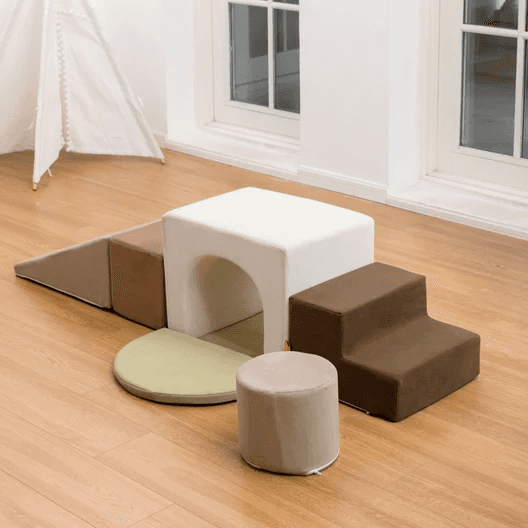
A large indoor play arrangement may look exciting to an adult, but toddlers often respond better when they can understand one or two pieces first.
Begin with the simplest combination. A low foam block beside a mat, for example, gives a child several clear options. Crawl over it. Sit on it. Push against it. Or walk around it. Once that feels ordinary. Then, another piece can be added.
Let Familiarity Come Before Difficulty
Keep the first setup in the same place for several play sessions. Constantly changing the layout may make the area feel new again before the child has had a chance to understand it.
Repeating the same short route gives toddlers opportunities to judge height, distance, softness, and balance without solving a completely different movement problem each time.
Build Around Movements Your Toddler Already Knows
If your toddler crawls well, create a short route across a mat and over a low cushion. If they enjoy pulling to stand, use a stable, appropriate-height surface under close supervision. A child who already steps over objects can try a simple low obstacle before facing a ramp or stacked configuration.
This keeps the challenge just ahead of the child's current ability rather than several steps beyond it.
Products from Banasuper include modular soft-play pieces that can be arranged in different configurations, making gradual introductions practical. Instead of presenting every possible activity at once, parents can create a small layout. And adjust it as the child becomes more comfortable. The brand's current play-set range includes modular equipment intended for crawling, climbing, building, and other forms of indoor movement.
Watch What the Child Repeats
Repetition is useful information. If a toddler climbs the same low block ten times but ignores the tunnel. Then, there is no need to redirect them simply because the tunnel is part of the set.
That repetition may be where the child is practicing balance, motor planning, or confidence. What looks repetitive to an adult can still present useful challenges to a child who is learning how to position their hands, shift their weight, and judge a surface.
Keep Sensory Load Under Control
A new play area is not only a movement experience. It can also bring unfamiliar colours, fabric textures, visual clutter, and the feeling of a different surface under the hands and feet.
For the first few sessions, keep the surrounding area relatively calm. There is little benefit in adding loud music, flashing toys, balls, books, and several extra activities at the same time.
Let the play equipment provide the main sensory experience. A toddler can feel the softness of foam, notice a slope under the feet, press against a block, crawl through an opening, or change body position while climbing. Those simple experiences already give the child plenty to process.
This also gives parents a clearer view. A view of what the toddler enjoys. And what seems uncomfortable. If the child repeatedly avoids a particular texture. Or shape. Then, there is no need to force it into every play session.
Stay Close Without Turning Play Into a Lesson
Parents often want to demonstrate every possible use of a new toy. A quick demonstration can help, but constant instruction can make play feel like a task.
Sit nearby and allow the toddler to lead. If help is needed, offer the smallest amount necessary. That might mean holding a hand during one step, placing a favourite toy beyond a low block, or showing how to crawl through an opening once.
Avoid repeatedly lifting a hesitant child onto equipment. A movement is more useful when the child is ready to attempt it and can participate actively.
Increase the Challenge One Change at a Time
Once the first arrangement feels familiar, add only one new variable. Raise one section slightly, introduce a tunnel, add a second block, or change the route.
Changing one element makes it easier to judge the child's response. If the new version leads to confident exploration. Then, the difficulty is probably manageable. If the toddler avoids the area. Or becomes frustrated. Or repeatedly asks for help. Then, simplify it again.
Progress does not always mean making everything taller. A new challenge can involve crawling around a block instead of over it, carrying a lightweight object across the mat, or choosing between two routes.
Final Thoughts
A successful indoor play setup is not the one that looks most impressive on the first day. It is the one a toddler can understand, explore, and gradually make their own. Start with a small arrangement, connect it to movements the child already knows, keep the sensory environment calm, and change only one thing at a time. When curiosity sets the pace, new equipment becomes less of a sudden event and more of a space the child can grow into.
Start With Less Than the Full Setup
A large indoor play arrangement may look exciting to an adult, but toddlers often respond better when they can understand one or two pieces first.
Begin with the simplest combination. A low foam block beside a mat, for example, gives a child several clear options. Crawl over it. Sit on it. Push against it. Or walk around it. Once that feels ordinary. Then, another piece can be added.
Let Familiarity Come Before Difficulty
Keep the first setup in the same place for several play sessions. Constantly changing the layout may make the area feel new again before the child has had a chance to understand it.
Repeating the same short route gives toddlers opportunities to judge height, distance, softness, and balance without solving a completely different movement problem each time.
Build Around Movements Your Toddler Already Knows
If your toddler crawls well, create a short route across a mat and over a low cushion. If they enjoy pulling to stand, use a stable, appropriate-height surface under close supervision. A child who already steps over objects can try a simple low obstacle before facing a ramp or stacked configuration.
This keeps the challenge just ahead of the child's current ability rather than several steps beyond it.
Products from Banasuper include modular soft-play pieces that can be arranged in different configurations, making gradual introductions practical. Instead of presenting every possible activity at once, parents can create a small layout. And adjust it as the child becomes more comfortable. The brand's current play-set range includes modular equipment intended for crawling, climbing, building, and other forms of indoor movement.
Watch What the Child Repeats
Repetition is useful information. If a toddler climbs the same low block ten times but ignores the tunnel. Then, there is no need to redirect them simply because the tunnel is part of the set.
That repetition may be where the child is practicing balance, motor planning, or confidence. What looks repetitive to an adult can still present useful challenges to a child who is learning how to position their hands, shift their weight, and judge a surface.
Keep Sensory Load Under Control
A new play area is not only a movement experience. It can also bring unfamiliar colours, fabric textures, visual clutter, and the feeling of a different surface under the hands and feet.
For the first few sessions, keep the surrounding area relatively calm. There is little benefit in adding loud music, flashing toys, balls, books, and several extra activities at the same time.
Let the play equipment provide the main sensory experience. A toddler can feel the softness of foam, notice a slope under the feet, press against a block, crawl through an opening, or change body position while climbing. Those simple experiences already give the child plenty to process.
This also gives parents a clearer view. A view of what the toddler enjoys. And what seems uncomfortable. If the child repeatedly avoids a particular texture. Or shape. Then, there is no need to force it into every play session.
Stay Close Without Turning Play Into a Lesson
Parents often want to demonstrate every possible use of a new toy. A quick demonstration can help, but constant instruction can make play feel like a task.
Sit nearby and allow the toddler to lead. If help is needed, offer the smallest amount necessary. That might mean holding a hand during one step, placing a favourite toy beyond a low block, or showing how to crawl through an opening once.
Avoid repeatedly lifting a hesitant child onto equipment. A movement is more useful when the child is ready to attempt it and can participate actively.
Increase the Challenge One Change at a Time
Once the first arrangement feels familiar, add only one new variable. Raise one section slightly, introduce a tunnel, add a second block, or change the route.
Changing one element makes it easier to judge the child's response. If the new version leads to confident exploration. Then, the difficulty is probably manageable. If the toddler avoids the area. Or becomes frustrated. Or repeatedly asks for help. Then, simplify it again.
Progress does not always mean making everything taller. A new challenge can involve crawling around a block instead of over it, carrying a lightweight object across the mat, or choosing between two routes.
Final Thoughts
A successful indoor play setup is not the one that looks most impressive on the first day. It is the one a toddler can understand, explore, and gradually make their own. Start with a small arrangement, connect it to movements the child already knows, keep the sensory environment calm, and change only one thing at a time. When curiosity sets the pace, new equipment becomes less of a sudden event and more of a space the child can grow into.
Still grading everything by hand?
EMStudio is a free teaching management app — manage your classes, students, lessons, and more!
Learn More
Still grading everything by hand?
EMStudio is a free teaching management app — manage your classes, students, lessons, and more!
Learn More



Notion4Teachers
Notion templates to simplify administrative tasks and enhance your teaching experience.



2026 Notion4Teachers. All Rights Reserved.
Notion4Teachers
Notion templates to simplify administrative tasks and enhance your teaching experience.
2026 Notion4Teachers. All Rights Reserved.
Notion4Teachers
Notion templates to simplify administrative tasks and enhance your teaching experience.
2026 Notion4Teachers. All Rights Reserved.