
6 Best "What Should I Do With My Life" Quizzes for Students
6 Best "What Should I Do With My Life" Quizzes for Students

Article by
Milo
ESL Content Coordinator & Educator
ESL Content Coordinator & Educator
All Posts
A student can picture themselves in nursing, graphic design or running a business, and still have no idea what to do next week. "What should I do with my life?" is a big question, and a well-chosen quiz can shrink it into something an educator and student can actually discuss.
This guide is for educators advising students aged 16 and older. The six quizzes below answer different versions of the question: where my current path leads, which careers match my interests, what I'm naturally good at, and which education route gets me there. Their results can guide exploration, but none of them should make a student's decision.
Still grading everything by hand?
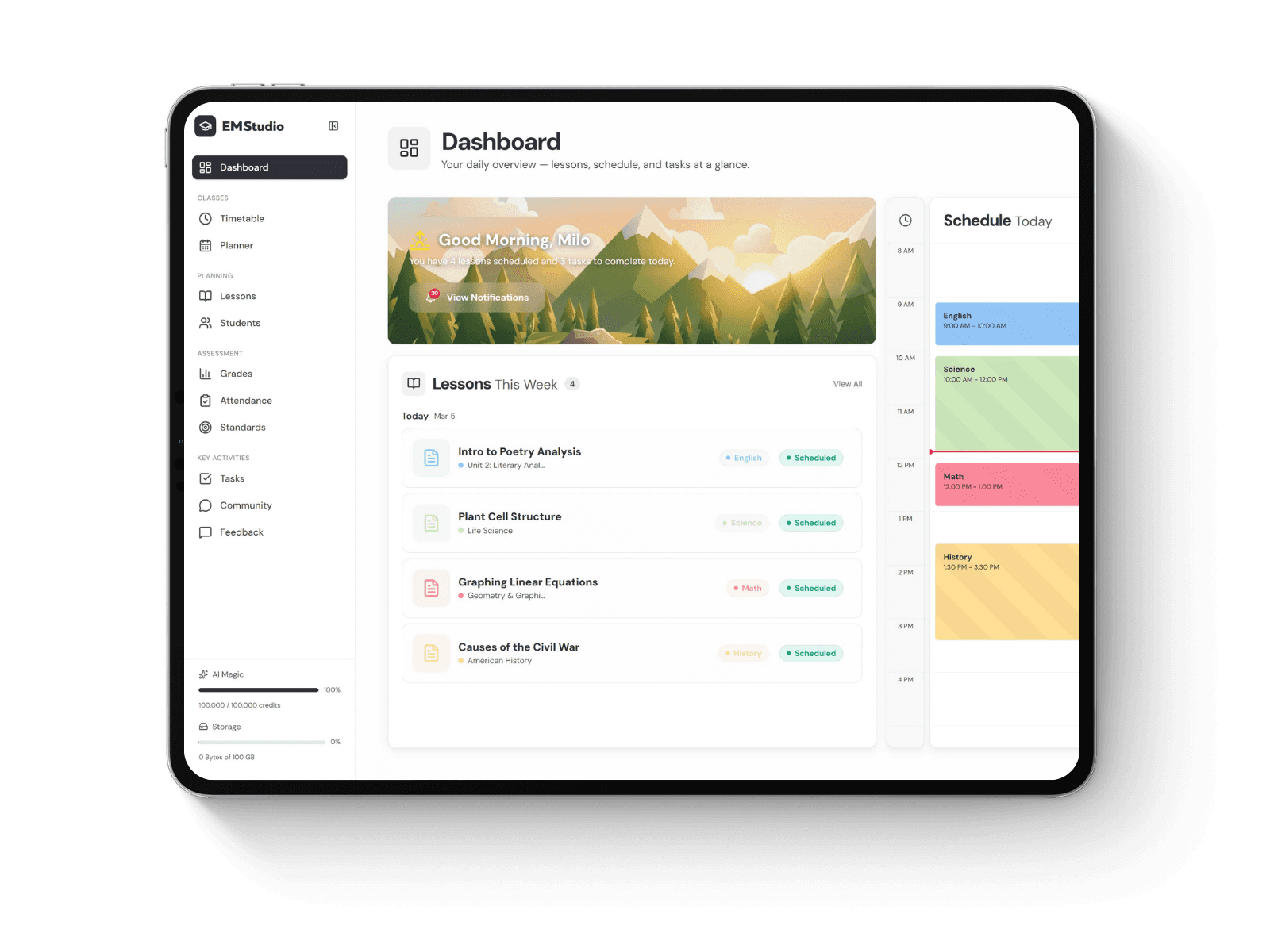
EMStudio is a free teaching management app — manage your classes, students, lessons, and more!
Learn More
Still grading everything by hand?
EMStudio is a free teaching management app — manage your classes, students, lessons, and more!
Learn More
Table of Contents
Key Takeaways
Start with a five-year reflection quiz when a student is unsure about life direction, not just job titles.
Use detailed matching tools once the question narrows to specific careers or degrees.
Pair self-reported interests with performance-based aptitude evidence where you can.
Treat every result as a discussion prompt, and let students keep their personal answers private.
How We Picked
This comparison draws on each provider's public product pages and documentation, checked on November 2, 2026. We grouped tools by the question they answer, recorded published completion estimates, and separated self-reported interests from performance-based aptitude measures. Usage counts and ratings show reach, not accuracy, so we didn't rank on them.
Quiz | Best for | Assessment type | Time | Discussion prompt |
MyPassion.AI | Life direction at a crossroads | AI-scored branching quiz | Under 10 minutes | Where could your current path lead? |
CareerExplorer | Career and degree matching | Machine-learning matching on self-reported information | About 30 minutes | Which matches surprised you? |
YouScience Brightpath | Aptitude exploration | Performance-based tasks plus interests | 60 to 90 minutes, multiple sittings | Which aptitude deserves exploring? |
O*NET Interest Profiler | Occupational interests | RIASEC interest inventory | Varies | Which occupations would you research? |
BigFuture Career Quiz | Career-to-education research | Interest survey | About 15 minutes | What education does each career need? |
Truity Career Personality Profiler | Work-environment reflection | Holland Code plus Big Five | About 10 to 15 minutes | Which work preference could you test? |
1. MyPassion.AI
Best for: Students at a crossroads who need direction before narrowing down job titles.
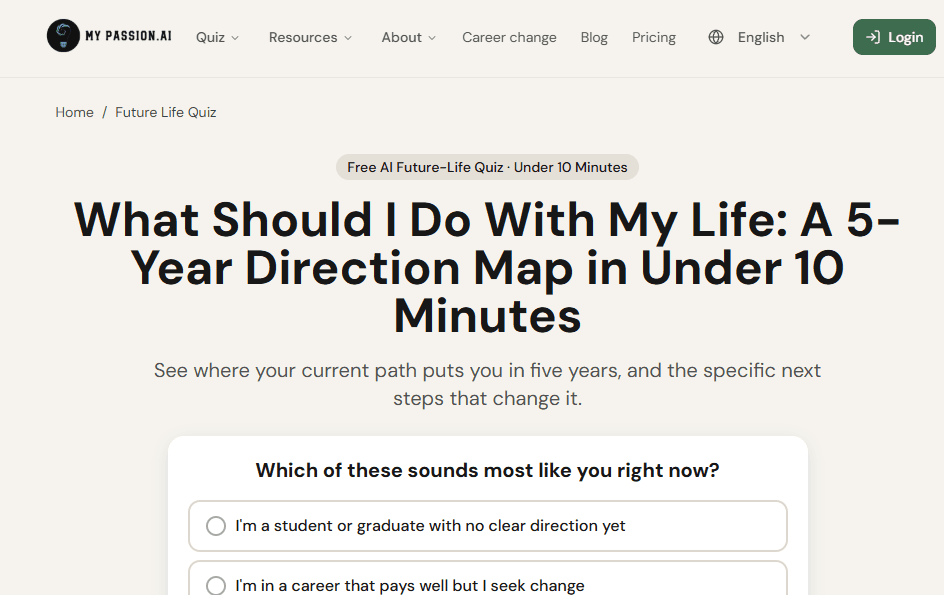
What it measures: MyPassion.AI's future life quiz is a free AI quiz that projects a student's current path into a five-year outcome and gives concrete next steps. Its 26 branching questions are built for people at a crossroads, not as a personality type test.
Time: Under 10 minutes.
Pros:
AI-scored rather than template-matched
Short enough for a single advising session
Concrete next steps give the debrief a practical endpoint
Cons:
The five-year scenario is a reflection prompt, not a validated forecast
Results still need an educator conversation to turn next steps into action
Suggested follow-up: Have students pick one direction and a low-risk task, such as talking with someone in that field.
2. CareerExplorer
Best for: Students ready to research specific careers and degrees in detail.
What it measures: CareerExplorer matches students to careers and degrees using their interests, goals, history, workplace preferences and personality. The provider describes machine-learning matching across more than 1,500 career and degree profiles.
Time: About 30 minutes, with pause-and-resume support.
Pros:
Covers degrees as well as careers
Pause-and-resume support fits shorter advising blocks
Broad profile library supports follow-up research
Cons:
Needs more scheduled time than a short reflection quiz
The breadth of results still requires students to shortlist
Suggested follow-up: Ask students to shortlist three profiles and compare their preparation requirements.

3. YouScience Brightpath
Best for: Schools that want aptitude evidence alongside interests.
What it measures: The Aptitude & Career Discovery assessment within Brightpath uses performance-based exercises to measure core career aptitudes, adding interest information for context. Results connect to course planning and postsecondary exploration on the school platform.
Time: Typically 60 to 90 minutes, which can be split across sittings.
Pros:
Performance-based tasks add evidence beyond what students say they enjoy
Connects results with course and postsecondary planning
Gaps between aptitudes and interests spark useful conversations
Cons:
Requires a longer time commitment
Adopting the broader platform takes more planning than assigning a single quiz
Suggested follow-up: Pick an aptitude that differs from the student's current interests and explore where it might be used.

4. O*NET Interest Profiler
Best for: A conventional, non-AI baseline for occupational interests.
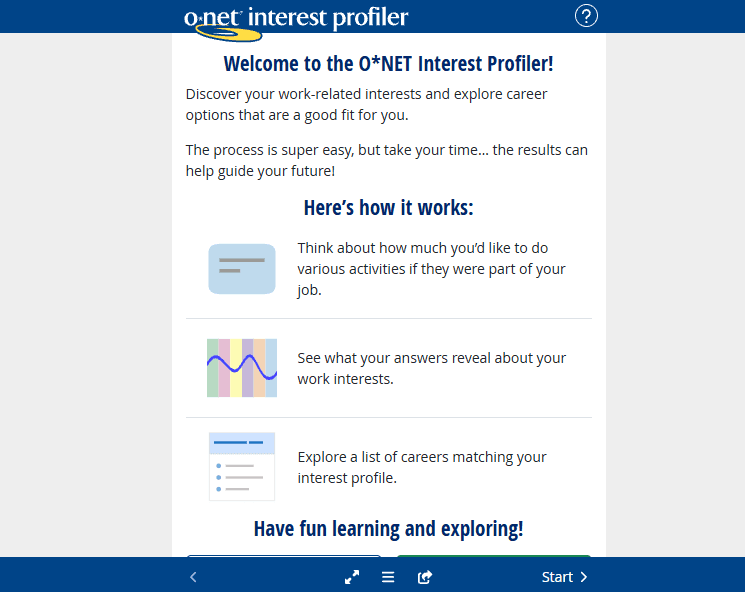
What it measures: The Interest Profiler measures six RIASEC interest areas. The web-based Mini-IP has 30 questions, is available in English and Spanish, and links results to more than 900 occupations.
Time: Varies by student; allow flexible scheduling.
Pros:
Gives students vocabulary for what attracts them to work
English and Spanish web versions
Links directly to occupational research
Cons:
Reported interests don't demonstrate ability
Doesn't address broader life priorities
Suggested follow-up: Compare occupations tied to different interest combinations and ask which activities the student wants to try.
5. BigFuture Career Quiz
Best for: Connecting career ideas with education paths.
What it measures: College Board's quiz uses an O*NET-provided interest survey of 60 questions about likes and dislikes, then recommends 30 careers. Its library of more than 1,000 career profiles shows income, job growth and common education level.
Time: About 15 minutes.
Pros:
Pairs career suggestions with education-path information
Profiles include state and national labor data
Useful as conversations move toward postsecondary options
Cons:
Interest-based, so it doesn't measure demonstrated aptitude
Doesn't resolve whole-life priorities
Suggested follow-up: Compare education routes for two recommended careers and note what needs further research.

6. Truity Career Personality Profiler
Best for: Reflecting on preferred work environments.
What it measures: Truity's profiler combines Holland Code interests with Big Five personality traits across 94 questions.
Time: About 10 to 15 minutes.
Pros:
Combines interests and personality in one questionnaire
Opens conversations about work environments, not just job titles
Short enough for a single advising session
Cons:
Self-reported traits don't demonstrate job skills
Risk of students treating results as a fixed label
Suggested follow-up: Ask students to pick one work-environment preference and test it through research or a conversation with someone in the field.

How to Use Quiz Results With Students
A quiz is most useful when it leads to a small, concrete action. After any of these tools, ask students what surprised them, what they disagree with, and which possibility deserves a closer look. Then agree on one low-risk next step and a date to check in.
Keep the follow-through visible. Students can log their chosen next steps, deadlines and reflections in a simple tracker, and many educators adapt goal tracker templates for this so progress stays easy to review between sessions.
Protect student privacy throughout. Let students keep personal answers and scores to themselves, and focus advising conversations on what they choose to share.
Conclusion
The best "what should I do with my life" quiz depends on the question a student is really asking. Start with five-year reflection when direction itself is unclear, then move to career matching, aptitude evidence, interest inventories or education-path research as the question narrows. Whichever tool you use, treat results as prompts, agree on one practical next step, and check in on what the student learns.
FAQ
Can a quiz tell a student what to do with their life?
No. A good quiz narrows the question and suggests directions to explore, but the decision comes from the student's own experiments, conversations and reflection.
Which quiz should a student take first?
If they're unsure about overall direction, start with a five-year reflection quiz. If they already have a field in mind, a career-matching or education-path tool is more useful.
What's the difference between interest and aptitude assessments?
Interest assessments record what students say they enjoy. Aptitude assessments use performance-based tasks to measure what they're naturally good at.
How should educators handle quiz results?
Let students keep their answers private, discuss only what they choose to share, and turn each result into one concrete next step with a follow-up date.
Key Takeaways
Start with a five-year reflection quiz when a student is unsure about life direction, not just job titles.
Use detailed matching tools once the question narrows to specific careers or degrees.
Pair self-reported interests with performance-based aptitude evidence where you can.
Treat every result as a discussion prompt, and let students keep their personal answers private.
How We Picked
This comparison draws on each provider's public product pages and documentation, checked on November 2, 2026. We grouped tools by the question they answer, recorded published completion estimates, and separated self-reported interests from performance-based aptitude measures. Usage counts and ratings show reach, not accuracy, so we didn't rank on them.
Quiz | Best for | Assessment type | Time | Discussion prompt |
MyPassion.AI | Life direction at a crossroads | AI-scored branching quiz | Under 10 minutes | Where could your current path lead? |
CareerExplorer | Career and degree matching | Machine-learning matching on self-reported information | About 30 minutes | Which matches surprised you? |
YouScience Brightpath | Aptitude exploration | Performance-based tasks plus interests | 60 to 90 minutes, multiple sittings | Which aptitude deserves exploring? |
O*NET Interest Profiler | Occupational interests | RIASEC interest inventory | Varies | Which occupations would you research? |
BigFuture Career Quiz | Career-to-education research | Interest survey | About 15 minutes | What education does each career need? |
Truity Career Personality Profiler | Work-environment reflection | Holland Code plus Big Five | About 10 to 15 minutes | Which work preference could you test? |
1. MyPassion.AI
Best for: Students at a crossroads who need direction before narrowing down job titles.
What it measures: MyPassion.AI's future life quiz is a free AI quiz that projects a student's current path into a five-year outcome and gives concrete next steps. Its 26 branching questions are built for people at a crossroads, not as a personality type test.
Time: Under 10 minutes.
Pros:
AI-scored rather than template-matched
Short enough for a single advising session
Concrete next steps give the debrief a practical endpoint
Cons:
The five-year scenario is a reflection prompt, not a validated forecast
Results still need an educator conversation to turn next steps into action
Suggested follow-up: Have students pick one direction and a low-risk task, such as talking with someone in that field.
2. CareerExplorer
Best for: Students ready to research specific careers and degrees in detail.
What it measures: CareerExplorer matches students to careers and degrees using their interests, goals, history, workplace preferences and personality. The provider describes machine-learning matching across more than 1,500 career and degree profiles.
Time: About 30 minutes, with pause-and-resume support.
Pros:
Covers degrees as well as careers
Pause-and-resume support fits shorter advising blocks
Broad profile library supports follow-up research
Cons:
Needs more scheduled time than a short reflection quiz
The breadth of results still requires students to shortlist
Suggested follow-up: Ask students to shortlist three profiles and compare their preparation requirements.
3. YouScience Brightpath
Best for: Schools that want aptitude evidence alongside interests.
What it measures: The Aptitude & Career Discovery assessment within Brightpath uses performance-based exercises to measure core career aptitudes, adding interest information for context. Results connect to course planning and postsecondary exploration on the school platform.
Time: Typically 60 to 90 minutes, which can be split across sittings.
Pros:
Performance-based tasks add evidence beyond what students say they enjoy
Connects results with course and postsecondary planning
Gaps between aptitudes and interests spark useful conversations
Cons:
Requires a longer time commitment
Adopting the broader platform takes more planning than assigning a single quiz
Suggested follow-up: Pick an aptitude that differs from the student's current interests and explore where it might be used.
4. O*NET Interest Profiler
Best for: A conventional, non-AI baseline for occupational interests.
What it measures: The Interest Profiler measures six RIASEC interest areas. The web-based Mini-IP has 30 questions, is available in English and Spanish, and links results to more than 900 occupations.
Time: Varies by student; allow flexible scheduling.
Pros:
Gives students vocabulary for what attracts them to work
English and Spanish web versions
Links directly to occupational research
Cons:
Reported interests don't demonstrate ability
Doesn't address broader life priorities
Suggested follow-up: Compare occupations tied to different interest combinations and ask which activities the student wants to try.
5. BigFuture Career Quiz
Best for: Connecting career ideas with education paths.
What it measures: College Board's quiz uses an O*NET-provided interest survey of 60 questions about likes and dislikes, then recommends 30 careers. Its library of more than 1,000 career profiles shows income, job growth and common education level.
Time: About 15 minutes.
Pros:
Pairs career suggestions with education-path information
Profiles include state and national labor data
Useful as conversations move toward postsecondary options
Cons:
Interest-based, so it doesn't measure demonstrated aptitude
Doesn't resolve whole-life priorities
Suggested follow-up: Compare education routes for two recommended careers and note what needs further research.
6. Truity Career Personality Profiler
Best for: Reflecting on preferred work environments.
What it measures: Truity's profiler combines Holland Code interests with Big Five personality traits across 94 questions.
Time: About 10 to 15 minutes.
Pros:
Combines interests and personality in one questionnaire
Opens conversations about work environments, not just job titles
Short enough for a single advising session
Cons:
Self-reported traits don't demonstrate job skills
Risk of students treating results as a fixed label
Suggested follow-up: Ask students to pick one work-environment preference and test it through research or a conversation with someone in the field.
How to Use Quiz Results With Students
A quiz is most useful when it leads to a small, concrete action. After any of these tools, ask students what surprised them, what they disagree with, and which possibility deserves a closer look. Then agree on one low-risk next step and a date to check in.
Keep the follow-through visible. Students can log their chosen next steps, deadlines and reflections in a simple tracker, and many educators adapt goal tracker templates for this so progress stays easy to review between sessions.
Protect student privacy throughout. Let students keep personal answers and scores to themselves, and focus advising conversations on what they choose to share.
Conclusion
The best "what should I do with my life" quiz depends on the question a student is really asking. Start with five-year reflection when direction itself is unclear, then move to career matching, aptitude evidence, interest inventories or education-path research as the question narrows. Whichever tool you use, treat results as prompts, agree on one practical next step, and check in on what the student learns.
FAQ
Can a quiz tell a student what to do with their life?
No. A good quiz narrows the question and suggests directions to explore, but the decision comes from the student's own experiments, conversations and reflection.
Which quiz should a student take first?
If they're unsure about overall direction, start with a five-year reflection quiz. If they already have a field in mind, a career-matching or education-path tool is more useful.
What's the difference between interest and aptitude assessments?
Interest assessments record what students say they enjoy. Aptitude assessments use performance-based tasks to measure what they're naturally good at.
How should educators handle quiz results?
Let students keep their answers private, discuss only what they choose to share, and turn each result into one concrete next step with a follow-up date.
Still grading everything by hand?
EMStudio is a free teaching management app — manage your classes, students, lessons, and more!
Learn More
Still grading everything by hand?
EMStudio is a free teaching management app — manage your classes, students, lessons, and more!
Learn More


Notion4Teachers
Notion templates to simplify administrative tasks and enhance your teaching experience.



2026 Notion4Teachers. All Rights Reserved.
Notion4Teachers
Notion templates to simplify administrative tasks and enhance your teaching experience.
2026 Notion4Teachers. All Rights Reserved.
Notion4Teachers
Notion templates to simplify administrative tasks and enhance your teaching experience.
2026 Notion4Teachers. All Rights Reserved.