Why students forget (and how to actually fix it)
Why students forget (and how to actually fix it)

Article by
Milo
ESL Content Coordinator & Educator
ESL Content Coordinator & Educator
All Posts
We’ve all been there. You see a student sitting at a desk at 11 PM with a stack of notes and a half-empty energy drink. They’re staring at the same page for twenty minutes, trying to force it into their brain. They might pass the test tomorrow. Probably will. But ask them about it in a week? Nothing. It’s like the information never existed.
And that’s the problem with cramming. It’s a temporary fix that leaves everyone feeling burnt out. I think we’ve just accepted it as "the way school works," but honestly, it’s a waste of everyone’s time.
If we want students to actually keep what they learn, we have to look at spaced repetition. It sounds technical, I know. But it’s really just about timing. It’s about working with how our brains naturally store things for the long haul.
Still grading everything by hand?
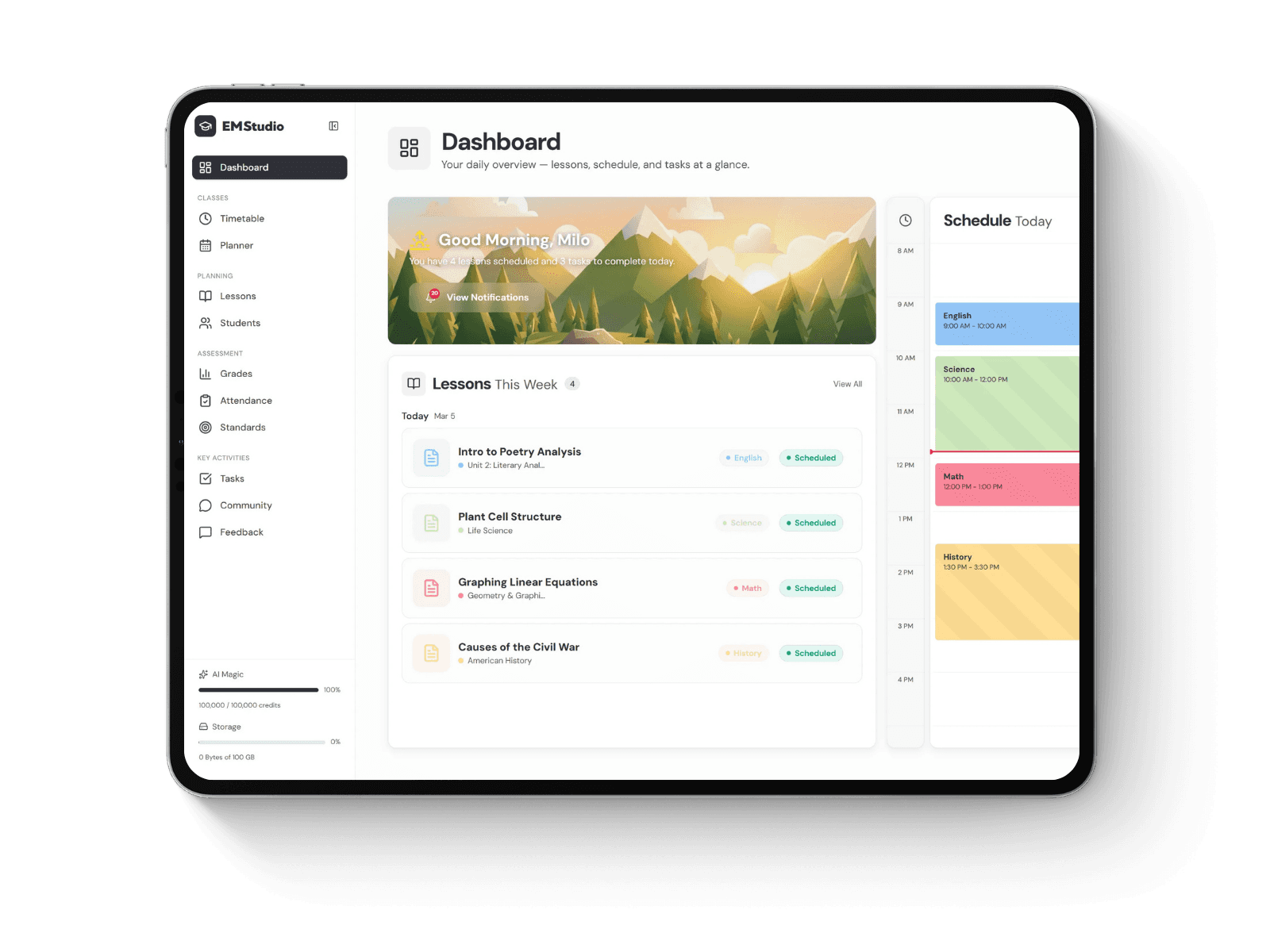
EMStudio is a free teaching management app — manage your classes, students, lessons, and more!
Learn More
Still grading everything by hand?
EMStudio is a free teaching management app — manage your classes, students, lessons, and more!
Learn More
Table of Contents
The forgetting curve is real
There is this thing called the forgetting curve. Basically, as soon as you learn something, your brain starts trying to throw it away. Within 48 hours, most of it is gone. It’s a bit of a ruthless system, but that’s how we’re wired.
But you can stop it.
Spaced repetition works by hitting the "save" button right before you’re about to forget. Instead of looking at the same notes for five hours in one night, you look at them for ten minutes today. Then ten minutes tomorrow. Then maybe next week. You’re telling your brain, "Hey, this actually matters. Keep it."
Small pieces are better
I think one of the biggest mistakes students make is trying to swallow a whole chapter at once. It’s overwhelming. You can’t eat a whole steak in one go, you have to cut it up.
Learning is the same.
If a student is tackling biology, they shouldn't try to memorize the whole book. They should focus on one small thing. One "atom" of info. Like how the mitochondria works. When the info is small, the brain doesn't panic. It’s easier to manage, and it makes the review sessions way less scary.
It’s all in the timing
The "magic" isn't in how hard you study. It’s when you do it.
You don’t want to review the same thing every single day. That’s just a recipe for boredom. Instead, you stretch out the gaps. If you learn it today, check it tomorrow. If you still know it? Great. Wait three days. Then a week. This way, you’re spending your energy on the stuff you’re actually struggling with, not the stuff you already know by heart.
Stop just "reading" notes
Most students think they’re studying when they use a highlighter. They’re not. They’re just making the page look pretty. That’s "passive" learning. It feels like you’re doing something, but your brain is basically asleep.
For this to work, you need active recall.
You have to force your brain to dig for the answer. Close the book and ask, "What did I just read?" That struggle, that moment where you’re trying to remember, is where the learning actually happens. If it’s too easy, you aren't learning. If you want to make this easier to stick with, effective study tools are built around this idea, helping you organize notes, create flashcards, and revisit information at the right time, so you don’t have to track everything manually.
How to actually use this
You don’t need a total curriculum overhaul. You just need a few shifts in the routine.
The 5-minute recap: Start every class by asking what happened yesterday.
The Friday review: Take twenty minutes at the end of the week to touch on the big ideas.
Self-testing: Teach kids to hide their notes. If they can’t say it without looking, they don’t know it yet.
Changing the goal
The hardest part isn’t the logic. It’s the habit. It takes discipline to plan ahead instead of relying on that last-minute adrenaline rush. But when a student realizes they actually remember something from three months ago? Their confidence just changes.
The forgetting curve is real
There is this thing called the forgetting curve. Basically, as soon as you learn something, your brain starts trying to throw it away. Within 48 hours, most of it is gone. It’s a bit of a ruthless system, but that’s how we’re wired.
But you can stop it.
Spaced repetition works by hitting the "save" button right before you’re about to forget. Instead of looking at the same notes for five hours in one night, you look at them for ten minutes today. Then ten minutes tomorrow. Then maybe next week. You’re telling your brain, "Hey, this actually matters. Keep it."
Small pieces are better
I think one of the biggest mistakes students make is trying to swallow a whole chapter at once. It’s overwhelming. You can’t eat a whole steak in one go, you have to cut it up.
Learning is the same.
If a student is tackling biology, they shouldn't try to memorize the whole book. They should focus on one small thing. One "atom" of info. Like how the mitochondria works. When the info is small, the brain doesn't panic. It’s easier to manage, and it makes the review sessions way less scary.
It’s all in the timing
The "magic" isn't in how hard you study. It’s when you do it.
You don’t want to review the same thing every single day. That’s just a recipe for boredom. Instead, you stretch out the gaps. If you learn it today, check it tomorrow. If you still know it? Great. Wait three days. Then a week. This way, you’re spending your energy on the stuff you’re actually struggling with, not the stuff you already know by heart.
Stop just "reading" notes
Most students think they’re studying when they use a highlighter. They’re not. They’re just making the page look pretty. That’s "passive" learning. It feels like you’re doing something, but your brain is basically asleep.
For this to work, you need active recall.
You have to force your brain to dig for the answer. Close the book and ask, "What did I just read?" That struggle, that moment where you’re trying to remember, is where the learning actually happens. If it’s too easy, you aren't learning. If you want to make this easier to stick with, effective study tools are built around this idea, helping you organize notes, create flashcards, and revisit information at the right time, so you don’t have to track everything manually.
How to actually use this
You don’t need a total curriculum overhaul. You just need a few shifts in the routine.
The 5-minute recap: Start every class by asking what happened yesterday.
The Friday review: Take twenty minutes at the end of the week to touch on the big ideas.
Self-testing: Teach kids to hide their notes. If they can’t say it without looking, they don’t know it yet.
Changing the goal
The hardest part isn’t the logic. It’s the habit. It takes discipline to plan ahead instead of relying on that last-minute adrenaline rush. But when a student realizes they actually remember something from three months ago? Their confidence just changes.
Still grading everything by hand?
EMStudio is a free teaching management app — manage your classes, students, lessons, and more!
Learn More
Still grading everything by hand?
EMStudio is a free teaching management app — manage your classes, students, lessons, and more!
Learn More


Notion4Teachers
Notion templates to simplify administrative tasks and enhance your teaching experience.



2026 Notion4Teachers. All Rights Reserved.
Notion4Teachers
Notion templates to simplify administrative tasks and enhance your teaching experience.
2026 Notion4Teachers. All Rights Reserved.
Notion4Teachers
Notion templates to simplify administrative tasks and enhance your teaching experience.
2026 Notion4Teachers. All Rights Reserved.