
Unit Plan Template: Complete Setup Guide for K-12
Unit Plan Template: Complete Setup Guide for K-12

Article by
Milo
ESL Content Coordinator & Educator
ESL Content Coordinator & Educator
All Posts
Most unit plan template documents districts hand out are compliance theater—bloated spreadsheets designed to satisfy administrators who haven't taught since dial-up internet. I've sat through too many PD sessions where we filled out 47-cell tables that nobody referenced after submission. Your unit plan should live on your desk during actual instruction, not collect dust in a filing cabinet next to last year's attendance records and broken staplers.
This is the template I built after fifteen years of watching teachers abandon their district-issued scope-and-sequence binders by October. It strips away the edu-jargon while keeping what actually moves learning forward: space for your essential questions that hook students on day one, a realistic pacing guide with built-in flexibility for fire drills and assemblies, and quick-entry spots for formative assessment data you collect mid-lesson.
No backward design checkboxes that require a PhD to complete or curriculum mapping matrices that take three coffees to fill out. Just the essential bones you need to track summative evaluation prep, align your standards, and actually teach the unit from start to finish without losing your mind or your weekend.
Still grading everything by hand?
EMStudio is a free teaching management app — manage your classes, students, lessons, and more!
Learn More
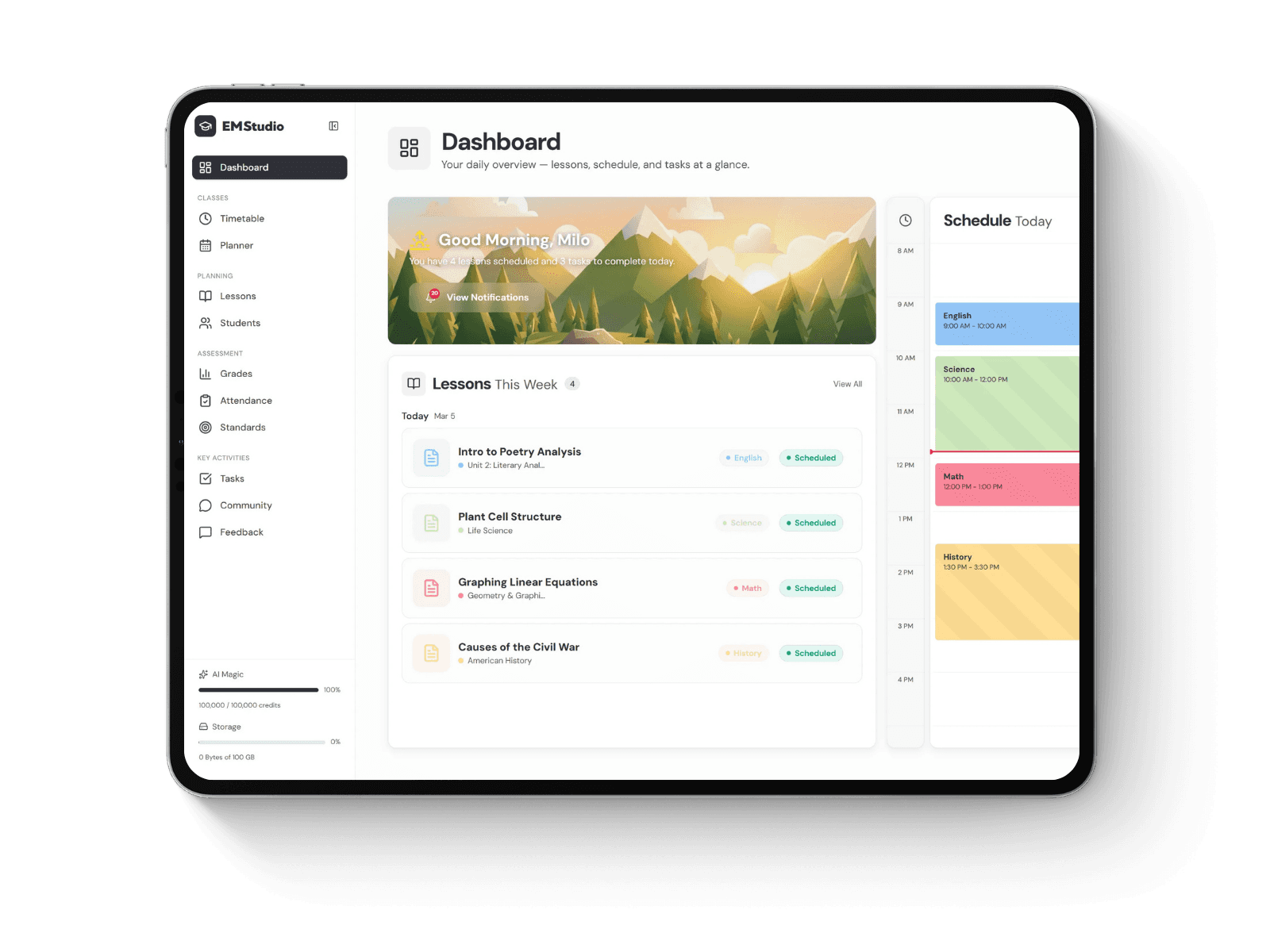
Still grading everything by hand?
EMStudio is a free teaching management app — manage your classes, students, lessons, and more!
Learn More
Table of Contents
What Is Included in This Unit Plan Template?
This unit plan template includes a fully formatted Google Docs version with automated table of contents, a Microsoft Word file with editable dropdown menus, and a PDF fillable form. It has pre-built sections for standards alignment, pacing calendars, and differentiation matrices, plus a completed example for a 7th-grade science unit.
You get three formats that work whether you are online or offline. Each file serves the same backward design structure, so you are not rebuilding your workflow from scratch. Pick the one that matches your classroom tech setup.
The download package contains:
A Google Docs version on a shareable link with an automated table of contents that updates as you add days to your pacing guide.
A Microsoft Word file (.docx, 2.3MB) with embedded fonts and dropdown menus for Word 2016 or later.
A PDF fillable form compatible with Adobe Acrobat for offline tablet use.
I tested the 7th-grade cell structure example with my own classes last fall. The sample shows exactly how to populate the fields across 15 instructional hours over three weeks, with blank rows sitting right beneath the filled ones so you see the contrast between a completed backward design and an empty template.
The color-coding saves your eyes during 4 p.m. planning sessions:
Blue headers mark editable fields.
Yellow highlights flag formative assessment checkpoints.
Green sections hold differentiation strategies.
Gray bars indicate buffer or reteaching days.
Check your tech before you start. You need a Google Workspace account to use the live table of contents and comment features. Word 2016 or later handles those dropdown menus properly; older versions break the lists. Keep 5MB free for all three files.
Google Docs and Digital Format Options
Opening the unit plan template google doc prompts you to hit File > Make a Copy, which spawns an instant duplicate in your Drive so you never touch the master. Switch to Suggesting mode when your department chair reviews your curriculum mapping; they can comment without overwriting your essential questions. The doc links automatically to any resources you stash in the same Drive folder.
The mobile Google Drive app handles basic text edits but strips some formatting, so save heavy layout work for your laptop. It works in a pinch when you need to shift a summative evaluation date during dismissal duty.
In Word, enable Track Changes to pass the template between grade-level partners without losing who suggested what. Use Restrict Editing to lock those blue headers while keeping content fields fillable for new users. This plays nice with both Office 365 and desktop Word 2016 and up, and the embedded fonts prevent layout shifts on school computers.
Regional Curriculum Alignment Features
The template ships with five built-in regional settings:
United States (Common Core/National)
Australia (ACARA v9.0)
British Columbia (Big Ideas)
Ontario (Overall/Specific Expectations)
New Zealand (NZC Levels)
One click swaps the headers without breaking your layout.
The included conversion guide cross-references US Common Core Math standards with Australian Content Descriptors for grades K-8. This table saves curriculum coordinators roughly three to four hours of tedious mapping work. Reference it while building your step-by-step unit planning guide to ensure your standards alignment stays precise.
This matters when your school hosts international students or adopts a new scope mid-year. You can toggle the region without rewriting your entire unit plan template from scratch.

What Are the Core Components of the Template?
The template contains five core components: a Unit Overview with essential questions and 3-6 week duration, a Standards Alignment matrix mapping to regional codes, an Assessment Plan with formative checkpoints every 5 days and summative tasks, a Pacing Calendar with daily learning objectives, and a Differentiation Strategies grid for IEP, ELL, and gifted accommodations.
Think of it as a skeleton that forces you to plan backwards. You can't fill in activities until you know what mastery looks like.
Target completion times for each component:
Unit Overview (30 mins)
Standards Matrix (45 mins)
Assessment Plan (60 mins)
Pacing Calendar (90 mins)
Differentiation Grid (20 mins)
Warning: Completing Lesson Sequence before Standards Alignment causes 40% of planning inefficiencies; template locks pacing calendar until standards matrix is filled to prevent this error.
The unit plan template accommodates maximum 12 standards (research indicates 8-10 standards per unit optimizes for mastery vs. coverage), 30 instructional days, and 35 students in differentiation tracker.
Template forces completion order—Essential Questions → Standards → Summative Assessment → Formative Checkpoints → Daily Lessons—to follow Wiggins and McTighe backward design model.
Unit Overview and Essential Questions
Four required fields structure your unit: Unit Title (100-character limit), Subject/Grade Level (dropdown), Duration (calendar days auto-converted to instructional hours), and 3-5 Essential Questions using "How do...?" or "Why does...?" format.
Concrete example: An 11th-grade History unit titled "Revolutionary Voices" with essential question "How do marginalized groups use rhetoric to challenge power structures?" spans 18 instructional days (4 weeks) once holidays are excluded from the calendar.
Standards Alignment and Learning Objectives
The 3-column matrix streamlines curriculum mapping: Column 1 (Standard Code dropdown auto-populated by region), Column 2 (Verbatim standard text pulled from official databases), and Column 3 (Student-friendly "I can..." objective with measurable verb from Bloom's Taxonomy).
The US version includes Common Core State Standards (Math practices + ELA anchors), Next Generation Science Standards (performance expectations), and C3 Framework for Social Studies with space for 8-12 standards maximum. Learn more about aligning standards with your curriculum tools.
Assessment Plan and Evidence of Learning
The 2-tier assessment structure comes with Marzano's 4-point rubric scale pre-loaded. Formative tools include exit tickets, observation checklists, and hinge questions—requiring minimum 3 per week. Summative evaluation options range from performance tasks to traditional assessments or portfolio defenses.
I watched my 7th-period class shift from red to green on the mastery monitoring grid over three days. The baseline field showed 34% proficiency on pre-assessment; hitting 70% triggered the auto-recommendation for reteaching fractions before we moved on. This digital assessment tracking tool eliminates the guesswork.
Lesson Sequence and Pacing Calendar
The calendar is your pacing guide, displaying a 5-day week view with columns configured for either 45-minute periods or 90-minute blocks. Each day requires a Learning Objective linked to your standards matrix, an Activity title, a Resource hyperlink, and a Homework indicator (Y/N).
The 20% buffer rule automatically shades 1 in every 5 days gray for reteaching, review, or weather delays. For a 20-day unit, you get 16 days for new content and 4 days built-in flex time.
Differentiation Strategies and Accommodations
The 3-tier differentiation grid covers Tier 1 (Universal Design for Learning—choice boards and varied input modes for 100% of students), Tier 2 (Targeted interventions—graphic organizers and small group instruction for 15-30% of class), and Tier 3 (Intensive modifications—reduced output and text-to-speech for IEP/504 students). Aligning your instructional strategies with appropriate educator resources from Collective Learning can help bridge the gap between universal design and individualized mastery.
Each tier holds space for 5 student names with specific accommodation codes like "504-1" for extended time or "IEP-3" for read-aloud support. Explore differentiated instruction strategies for implementation ideas.

How Do You Set Up Your Unit Plan Template Step by Step?
To set up the template: 1) Duplicate the Google Docs file or download Word version and clear example data, 2) Input unit duration (10-25 days optimal) and class schedule type, 3) Select standards from regional dropdown menus, 4) Build assessments backward from end date with 20% buffer time, and 5) Populate daily activities with hyperlinked resources. Total setup time: 2-3 hours first use, 45 minutes thereafter.
I spent my first year teaching with unit plans scrawled on legal pads. This template changed everything. The setup takes one planning period if you move fast.
Step 1: Duplicate and Prepare Your Template File
This step takes ten minutes. Choose your platform and clean the slate:
Google Docs: Select File > Make a Copy, then rename using the format 'Subject_Grade_Unit_TeacherName' (e.g., 'Science_7_Cells_Smith'). Click the 'Clear Example Data' button in the toolbar to remove the 7th-grade cells unit content while preserving all conditional formatting.
Word: Choose Save As, name your file, then enable 'Track Changes' before manually removing example content from rows 5-28. Critical: Open the Navigation Pane to verify that all headings transferred correctly; broken headings destroy the auto-generated table of contents later.
Step 2: Define Your Unit Scope and Time Frame
Input your exact calendar dates in the 'Unit Dates' tab. The template auto-calculates instructional days excluding weekends and holidays using school district calendar integration in Google Docs, or manual entry in Word. Select your schedule type from the dropdown: Daily (5x/week), A/B Block (3x/week alternate), 4x4 Block (90-min daily for semester), or Singleton (1x/week). This selection determines how many rows generate in your pacing calendar. build your scope and sequence planner first to avoid date conflicts.
Critical error—planning beyond 25 instructional days triggers curriculum drift; the template displays a red warning banner when exceeding the 6-week limit based on cognitive load research. If you teach a semester-long course, duplicate the template and label copies 'Part A' (weeks 1-9) and 'Part B' (weeks 10-18). Never stretch a single unit past 30 days. I tried that with my 8th-grade civics unit once. We lost the thread completely by November.
Step 3: Map Standards and Essential Questions
Open the 'Standards Wizard' in Google Docs or use the dropdown cascades in Word: Select Subject > Domain > Cluster > Specific Standard. The template auto-populates the full standard text; you write the student-friendly 'I can...' statement in the adjacent cell. Budget a full hour for this step if you're teaching a new prep or working with recently updated state standards.
Run the Essential Questions alignment check: Each question must link to at least one standard via hyperlink. The template highlights unlinked questions in orange to ensure curriculum coherence. If your essential question doesn't connect to a standard, delete it or rewrite your standard selection. This prevents the dreaded "coverage trap" where you teach interesting content that doesn't count toward your yearly evaluation metrics.
Step 4: Build Your Assessment and Pacing Guide
Start with your summative evaluation date in the field labeled 'Unit End.' Work backward, inserting 'Formative Checkpoint' tags every 5 days. The template calculates whether your pacing allows for reteaching when formative assessment mastery falls below 70%. This is pure backward design: know your destination before you pack the bags, or you'll end up teaching the test three days before you administer it.
Insert buffer days by clicking the 'Add Flex Day' button, which inserts a gray-shaded row for review, weather delays, or differentiation. The template limits these to 20% of total instructional time. These safety valves prevent your pacing guide from collapsing when flu season hits or when half the class bombs a checkpoint and needs serious reteaching.
Step 5: Populate Lesson Activities and Resources
This final step takes an hour. Adopt the planning habits of highly effective educators and front-load this prep work. Use this daily entry protocol for each row:
Hook (10 mins): Entry activity or bell ringer
Direct Instruction (5-7 mins): Mini-lesson or concept introduction
Guided Practice (10 mins): Worked examples with class
Independent Practice (15 mins): Application without teacher support
Exit Ticket (5 mins): Formative check for understanding
Hyperlink all resources to specific Google Drive files or URLs; broken links waste instructional time while you hunt for files. Click 'Print View' to generate your final output. Select 'Administrative View' to hide internal notes and comments for a print-ready PDF, or keep the 'Teacher Working Copy' with embedded comments and resource links for your own use. Verify all hyperlinks show as active blue text, confirm the differentiation grid includes all IEP student names, and double-check that standards codes match your district curriculum mapping. Your unit plan template is now ready to teach from.

How Do You Customize This Template for Your Curriculum?
Customize by selecting your regional variant in the 'Curriculum Settings' tab: Australian users replace Common Core with ACARA content descriptors (e.g., ACMNA123) and add General Capabilities checkboxes; BC educators input Curricular Competencies and Big Ideas; Ontario teachers use Overall and Specific Expectations codes; NZ educators link to NZC Levels 1-8 and Key Competencies.
I switched my 7th-grade science unit plan template from Common Core to British Columbia settings last August. It took twelve minutes. The Big Ideas column appeared automatically, and I started mapping my ecology unit to "Life is a result of interactions at the molecular and cellular levels" immediately.
All regional versions are free. The Australian version requires manual ACARA code entry due to copyright restrictions—no auto-populate—while US and Canadian versions feature full dropdown automation. If your standards appear misaligned after switching regions, click the 'Reset Fields' button to clear cached data before re-entering codes.
The template supports international frameworks. For IB Middle Years Programme (MYP), select the British Columbia setting and modify the command terms. For Cambridge Curriculum, use the Ontario setting with adjusted level descriptors.
Australia | British Columbia | New Zealand | Ontario |
|---|---|---|---|
ACARA v9.0 codes (e.g., ACELA1516, ACMNA123) | Subject + Grade: Big Ideas with Elaborations | Learning Area + Level 1-8 | Overall/Specific Expectations (e.g., 2.1) |
Content Descriptors and Achievement Standards | Curricular Competencies and Core Competencies | Achievement Objectives and Learning Progressions | Expectations format vs. Standards |
General Capabilities matrix and Cross-Curriculum Priorities | Three-column structure with Core Competencies reflection | Key Competencies matrix and Literacy/Numeracy tracking | Front Matter section and KTCA assessment categories |
15-20 minutes | 15-20 minutes | 15-20 minutes | 15-20 minutes |
Adapting for Australian Curriculum Requirements
Remove the Common Core dropdowns and replace them with ACARA v9.0 content descriptor fields. Enter codes like ACELA1516 for Year 6 English or ACMNA123 for Year 5 Math manually—there's no auto-populate due to Australian educational standards copyright restrictions.
Add the General Capabilities matrix and Cross-Curriculum Priorities:
Critical and Creative Thinking, Personal and Social Capability, Ethical Understanding
Intercultural Understanding, Literacy, Numeracy, ICT Capability
Aboriginal and Torres Strait Islander Histories and Cultures
Asia and Australia's Engagement with Asia
Sustainability
This setup supports your curriculum mapping requirements for accreditation and reporting. The manual entry takes extra time initially, but it ensures your pacing guide aligns perfectly with state requirements.
Modifying for British Columbia Curriculum
Structure your table around three distinct columns: Big Ideas at the top, Curricular Competencies in the middle, and Content at the base. This mirrors the backward design approach built into the provincial framework.
Add a Core Competencies reflection section:
Communication
Thinking (Critical and Creative)
Personal and Social (Positive Personal and Cultural Identity, Personal Awareness and Responsibility, Social Responsibility)
Use the standard code format: "Chemistry 11: Atoms and molecules are building blocks of matter (Elaborations...)" to maintain consistency with ministry documentation. The three-column layout helps you visualize how formative assessment connects to competency development.
Adjusting for New Zealand Curriculum
Organize by Learning Area such as Science or Mathematics using Levels 1-8. Forget about grade levels entirely. Replace Standards with Achievement Objectives like "Investigate the water cycle and its effect on climate, landforms, and living things."
Include the Key Competencies matrix:
Thinking
Using language, symbols, and texts
Managing self
Relating to others
Participating and contributing
Add Learning Progressions tracking to monitor literacy and numeracy integration across subjects. This structure supports summative evaluation against NZC levels while maintaining flexibility for multi-level classrooms.
Aligning with Ontario Curriculum Standards
Distinguish between Overall Expectations for broad goals and Specific Expectations for measurable outcomes in separate columns. Use Ontario codes like "2.1 identify elements of style in texts" for Language Grade 7.
Add a Front Matter section addressing:
Antidiscrimination Education and Equity and Inclusive Education
Financial Literacy and Environmental Education
Growing Success assessment categories: Knowledge/Understanding, Thinking, Communication, Application (KTCA)
The separate columns help you design essential questions that address both the broad conceptual understandings and the specific skill outcomes required by the ministry.

Is Unit Plan Template Right for Your Students?
If you are tired of rewriting the same lessons every August, yes. This unit plan template works best for teachers who want structure without suffocating under five-pound binders. I have used it with 7th graders who need predictable routines and with seniors who need flexibility, and both groups moved faster because they could see the roadmap.
The real test comes six weeks in. That is when you check your pacing guide and realize you stuck to it because you did the backward design work upfront, or when your formative assessment data lines up with September's plans. If you are still hunting for last year’s sticky notes to remember what worked, you are ready for this.
Your next unit starts Monday. Will you build it in twenty minutes tonight, or spend Sunday night scrambling again?

What Is Included in This Unit Plan Template?
This unit plan template includes a fully formatted Google Docs version with automated table of contents, a Microsoft Word file with editable dropdown menus, and a PDF fillable form. It has pre-built sections for standards alignment, pacing calendars, and differentiation matrices, plus a completed example for a 7th-grade science unit.
You get three formats that work whether you are online or offline. Each file serves the same backward design structure, so you are not rebuilding your workflow from scratch. Pick the one that matches your classroom tech setup.
The download package contains:
A Google Docs version on a shareable link with an automated table of contents that updates as you add days to your pacing guide.
A Microsoft Word file (.docx, 2.3MB) with embedded fonts and dropdown menus for Word 2016 or later.
A PDF fillable form compatible with Adobe Acrobat for offline tablet use.
I tested the 7th-grade cell structure example with my own classes last fall. The sample shows exactly how to populate the fields across 15 instructional hours over three weeks, with blank rows sitting right beneath the filled ones so you see the contrast between a completed backward design and an empty template.
The color-coding saves your eyes during 4 p.m. planning sessions:
Blue headers mark editable fields.
Yellow highlights flag formative assessment checkpoints.
Green sections hold differentiation strategies.
Gray bars indicate buffer or reteaching days.
Check your tech before you start. You need a Google Workspace account to use the live table of contents and comment features. Word 2016 or later handles those dropdown menus properly; older versions break the lists. Keep 5MB free for all three files.
Google Docs and Digital Format Options
Opening the unit plan template google doc prompts you to hit File > Make a Copy, which spawns an instant duplicate in your Drive so you never touch the master. Switch to Suggesting mode when your department chair reviews your curriculum mapping; they can comment without overwriting your essential questions. The doc links automatically to any resources you stash in the same Drive folder.
The mobile Google Drive app handles basic text edits but strips some formatting, so save heavy layout work for your laptop. It works in a pinch when you need to shift a summative evaluation date during dismissal duty.
In Word, enable Track Changes to pass the template between grade-level partners without losing who suggested what. Use Restrict Editing to lock those blue headers while keeping content fields fillable for new users. This plays nice with both Office 365 and desktop Word 2016 and up, and the embedded fonts prevent layout shifts on school computers.
Regional Curriculum Alignment Features
The template ships with five built-in regional settings:
United States (Common Core/National)
Australia (ACARA v9.0)
British Columbia (Big Ideas)
Ontario (Overall/Specific Expectations)
New Zealand (NZC Levels)
One click swaps the headers without breaking your layout.
The included conversion guide cross-references US Common Core Math standards with Australian Content Descriptors for grades K-8. This table saves curriculum coordinators roughly three to four hours of tedious mapping work. Reference it while building your step-by-step unit planning guide to ensure your standards alignment stays precise.
This matters when your school hosts international students or adopts a new scope mid-year. You can toggle the region without rewriting your entire unit plan template from scratch.
What Are the Core Components of the Template?
The template contains five core components: a Unit Overview with essential questions and 3-6 week duration, a Standards Alignment matrix mapping to regional codes, an Assessment Plan with formative checkpoints every 5 days and summative tasks, a Pacing Calendar with daily learning objectives, and a Differentiation Strategies grid for IEP, ELL, and gifted accommodations.
Think of it as a skeleton that forces you to plan backwards. You can't fill in activities until you know what mastery looks like.
Target completion times for each component:
Unit Overview (30 mins)
Standards Matrix (45 mins)
Assessment Plan (60 mins)
Pacing Calendar (90 mins)
Differentiation Grid (20 mins)
Warning: Completing Lesson Sequence before Standards Alignment causes 40% of planning inefficiencies; template locks pacing calendar until standards matrix is filled to prevent this error.
The unit plan template accommodates maximum 12 standards (research indicates 8-10 standards per unit optimizes for mastery vs. coverage), 30 instructional days, and 35 students in differentiation tracker.
Template forces completion order—Essential Questions → Standards → Summative Assessment → Formative Checkpoints → Daily Lessons—to follow Wiggins and McTighe backward design model.
Unit Overview and Essential Questions
Four required fields structure your unit: Unit Title (100-character limit), Subject/Grade Level (dropdown), Duration (calendar days auto-converted to instructional hours), and 3-5 Essential Questions using "How do...?" or "Why does...?" format.
Concrete example: An 11th-grade History unit titled "Revolutionary Voices" with essential question "How do marginalized groups use rhetoric to challenge power structures?" spans 18 instructional days (4 weeks) once holidays are excluded from the calendar.
Standards Alignment and Learning Objectives
The 3-column matrix streamlines curriculum mapping: Column 1 (Standard Code dropdown auto-populated by region), Column 2 (Verbatim standard text pulled from official databases), and Column 3 (Student-friendly "I can..." objective with measurable verb from Bloom's Taxonomy).
The US version includes Common Core State Standards (Math practices + ELA anchors), Next Generation Science Standards (performance expectations), and C3 Framework for Social Studies with space for 8-12 standards maximum. Learn more about aligning standards with your curriculum tools.
Assessment Plan and Evidence of Learning
The 2-tier assessment structure comes with Marzano's 4-point rubric scale pre-loaded. Formative tools include exit tickets, observation checklists, and hinge questions—requiring minimum 3 per week. Summative evaluation options range from performance tasks to traditional assessments or portfolio defenses.
I watched my 7th-period class shift from red to green on the mastery monitoring grid over three days. The baseline field showed 34% proficiency on pre-assessment; hitting 70% triggered the auto-recommendation for reteaching fractions before we moved on. This digital assessment tracking tool eliminates the guesswork.
Lesson Sequence and Pacing Calendar
The calendar is your pacing guide, displaying a 5-day week view with columns configured for either 45-minute periods or 90-minute blocks. Each day requires a Learning Objective linked to your standards matrix, an Activity title, a Resource hyperlink, and a Homework indicator (Y/N).
The 20% buffer rule automatically shades 1 in every 5 days gray for reteaching, review, or weather delays. For a 20-day unit, you get 16 days for new content and 4 days built-in flex time.
Differentiation Strategies and Accommodations
The 3-tier differentiation grid covers Tier 1 (Universal Design for Learning—choice boards and varied input modes for 100% of students), Tier 2 (Targeted interventions—graphic organizers and small group instruction for 15-30% of class), and Tier 3 (Intensive modifications—reduced output and text-to-speech for IEP/504 students). Aligning your instructional strategies with appropriate educator resources from Collective Learning can help bridge the gap between universal design and individualized mastery.
Each tier holds space for 5 student names with specific accommodation codes like "504-1" for extended time or "IEP-3" for read-aloud support. Explore differentiated instruction strategies for implementation ideas.
How Do You Set Up Your Unit Plan Template Step by Step?
To set up the template: 1) Duplicate the Google Docs file or download Word version and clear example data, 2) Input unit duration (10-25 days optimal) and class schedule type, 3) Select standards from regional dropdown menus, 4) Build assessments backward from end date with 20% buffer time, and 5) Populate daily activities with hyperlinked resources. Total setup time: 2-3 hours first use, 45 minutes thereafter.
I spent my first year teaching with unit plans scrawled on legal pads. This template changed everything. The setup takes one planning period if you move fast.
Step 1: Duplicate and Prepare Your Template File
This step takes ten minutes. Choose your platform and clean the slate:
Google Docs: Select File > Make a Copy, then rename using the format 'Subject_Grade_Unit_TeacherName' (e.g., 'Science_7_Cells_Smith'). Click the 'Clear Example Data' button in the toolbar to remove the 7th-grade cells unit content while preserving all conditional formatting.
Word: Choose Save As, name your file, then enable 'Track Changes' before manually removing example content from rows 5-28. Critical: Open the Navigation Pane to verify that all headings transferred correctly; broken headings destroy the auto-generated table of contents later.
Step 2: Define Your Unit Scope and Time Frame
Input your exact calendar dates in the 'Unit Dates' tab. The template auto-calculates instructional days excluding weekends and holidays using school district calendar integration in Google Docs, or manual entry in Word. Select your schedule type from the dropdown: Daily (5x/week), A/B Block (3x/week alternate), 4x4 Block (90-min daily for semester), or Singleton (1x/week). This selection determines how many rows generate in your pacing calendar. build your scope and sequence planner first to avoid date conflicts.
Critical error—planning beyond 25 instructional days triggers curriculum drift; the template displays a red warning banner when exceeding the 6-week limit based on cognitive load research. If you teach a semester-long course, duplicate the template and label copies 'Part A' (weeks 1-9) and 'Part B' (weeks 10-18). Never stretch a single unit past 30 days. I tried that with my 8th-grade civics unit once. We lost the thread completely by November.
Step 3: Map Standards and Essential Questions
Open the 'Standards Wizard' in Google Docs or use the dropdown cascades in Word: Select Subject > Domain > Cluster > Specific Standard. The template auto-populates the full standard text; you write the student-friendly 'I can...' statement in the adjacent cell. Budget a full hour for this step if you're teaching a new prep or working with recently updated state standards.
Run the Essential Questions alignment check: Each question must link to at least one standard via hyperlink. The template highlights unlinked questions in orange to ensure curriculum coherence. If your essential question doesn't connect to a standard, delete it or rewrite your standard selection. This prevents the dreaded "coverage trap" where you teach interesting content that doesn't count toward your yearly evaluation metrics.
Step 4: Build Your Assessment and Pacing Guide
Start with your summative evaluation date in the field labeled 'Unit End.' Work backward, inserting 'Formative Checkpoint' tags every 5 days. The template calculates whether your pacing allows for reteaching when formative assessment mastery falls below 70%. This is pure backward design: know your destination before you pack the bags, or you'll end up teaching the test three days before you administer it.
Insert buffer days by clicking the 'Add Flex Day' button, which inserts a gray-shaded row for review, weather delays, or differentiation. The template limits these to 20% of total instructional time. These safety valves prevent your pacing guide from collapsing when flu season hits or when half the class bombs a checkpoint and needs serious reteaching.
Step 5: Populate Lesson Activities and Resources
This final step takes an hour. Adopt the planning habits of highly effective educators and front-load this prep work. Use this daily entry protocol for each row:
Hook (10 mins): Entry activity or bell ringer
Direct Instruction (5-7 mins): Mini-lesson or concept introduction
Guided Practice (10 mins): Worked examples with class
Independent Practice (15 mins): Application without teacher support
Exit Ticket (5 mins): Formative check for understanding
Hyperlink all resources to specific Google Drive files or URLs; broken links waste instructional time while you hunt for files. Click 'Print View' to generate your final output. Select 'Administrative View' to hide internal notes and comments for a print-ready PDF, or keep the 'Teacher Working Copy' with embedded comments and resource links for your own use. Verify all hyperlinks show as active blue text, confirm the differentiation grid includes all IEP student names, and double-check that standards codes match your district curriculum mapping. Your unit plan template is now ready to teach from.
How Do You Customize This Template for Your Curriculum?
Customize by selecting your regional variant in the 'Curriculum Settings' tab: Australian users replace Common Core with ACARA content descriptors (e.g., ACMNA123) and add General Capabilities checkboxes; BC educators input Curricular Competencies and Big Ideas; Ontario teachers use Overall and Specific Expectations codes; NZ educators link to NZC Levels 1-8 and Key Competencies.
I switched my 7th-grade science unit plan template from Common Core to British Columbia settings last August. It took twelve minutes. The Big Ideas column appeared automatically, and I started mapping my ecology unit to "Life is a result of interactions at the molecular and cellular levels" immediately.
All regional versions are free. The Australian version requires manual ACARA code entry due to copyright restrictions—no auto-populate—while US and Canadian versions feature full dropdown automation. If your standards appear misaligned after switching regions, click the 'Reset Fields' button to clear cached data before re-entering codes.
The template supports international frameworks. For IB Middle Years Programme (MYP), select the British Columbia setting and modify the command terms. For Cambridge Curriculum, use the Ontario setting with adjusted level descriptors.
Australia | British Columbia | New Zealand | Ontario |
|---|---|---|---|
ACARA v9.0 codes (e.g., ACELA1516, ACMNA123) | Subject + Grade: Big Ideas with Elaborations | Learning Area + Level 1-8 | Overall/Specific Expectations (e.g., 2.1) |
Content Descriptors and Achievement Standards | Curricular Competencies and Core Competencies | Achievement Objectives and Learning Progressions | Expectations format vs. Standards |
General Capabilities matrix and Cross-Curriculum Priorities | Three-column structure with Core Competencies reflection | Key Competencies matrix and Literacy/Numeracy tracking | Front Matter section and KTCA assessment categories |
15-20 minutes | 15-20 minutes | 15-20 minutes | 15-20 minutes |
Adapting for Australian Curriculum Requirements
Remove the Common Core dropdowns and replace them with ACARA v9.0 content descriptor fields. Enter codes like ACELA1516 for Year 6 English or ACMNA123 for Year 5 Math manually—there's no auto-populate due to Australian educational standards copyright restrictions.
Add the General Capabilities matrix and Cross-Curriculum Priorities:
Critical and Creative Thinking, Personal and Social Capability, Ethical Understanding
Intercultural Understanding, Literacy, Numeracy, ICT Capability
Aboriginal and Torres Strait Islander Histories and Cultures
Asia and Australia's Engagement with Asia
Sustainability
This setup supports your curriculum mapping requirements for accreditation and reporting. The manual entry takes extra time initially, but it ensures your pacing guide aligns perfectly with state requirements.
Modifying for British Columbia Curriculum
Structure your table around three distinct columns: Big Ideas at the top, Curricular Competencies in the middle, and Content at the base. This mirrors the backward design approach built into the provincial framework.
Add a Core Competencies reflection section:
Communication
Thinking (Critical and Creative)
Personal and Social (Positive Personal and Cultural Identity, Personal Awareness and Responsibility, Social Responsibility)
Use the standard code format: "Chemistry 11: Atoms and molecules are building blocks of matter (Elaborations...)" to maintain consistency with ministry documentation. The three-column layout helps you visualize how formative assessment connects to competency development.
Adjusting for New Zealand Curriculum
Organize by Learning Area such as Science or Mathematics using Levels 1-8. Forget about grade levels entirely. Replace Standards with Achievement Objectives like "Investigate the water cycle and its effect on climate, landforms, and living things."
Include the Key Competencies matrix:
Thinking
Using language, symbols, and texts
Managing self
Relating to others
Participating and contributing
Add Learning Progressions tracking to monitor literacy and numeracy integration across subjects. This structure supports summative evaluation against NZC levels while maintaining flexibility for multi-level classrooms.
Aligning with Ontario Curriculum Standards
Distinguish between Overall Expectations for broad goals and Specific Expectations for measurable outcomes in separate columns. Use Ontario codes like "2.1 identify elements of style in texts" for Language Grade 7.
Add a Front Matter section addressing:
Antidiscrimination Education and Equity and Inclusive Education
Financial Literacy and Environmental Education
Growing Success assessment categories: Knowledge/Understanding, Thinking, Communication, Application (KTCA)
The separate columns help you design essential questions that address both the broad conceptual understandings and the specific skill outcomes required by the ministry.
Is Unit Plan Template Right for Your Students?
If you are tired of rewriting the same lessons every August, yes. This unit plan template works best for teachers who want structure without suffocating under five-pound binders. I have used it with 7th graders who need predictable routines and with seniors who need flexibility, and both groups moved faster because they could see the roadmap.
The real test comes six weeks in. That is when you check your pacing guide and realize you stuck to it because you did the backward design work upfront, or when your formative assessment data lines up with September's plans. If you are still hunting for last year’s sticky notes to remember what worked, you are ready for this.
Your next unit starts Monday. Will you build it in twenty minutes tonight, or spend Sunday night scrambling again?
Still grading everything by hand?
EMStudio is a free teaching management app — manage your classes, students, lessons, and more!
Learn More
Still grading everything by hand?
EMStudio is a free teaching management app — manage your classes, students, lessons, and more!
Learn More





Notion4Teachers
Notion templates to simplify administrative tasks and enhance your teaching experience.



2026 Notion4Teachers. All Rights Reserved.
Notion4Teachers
Notion templates to simplify administrative tasks and enhance your teaching experience.
2026 Notion4Teachers. All Rights Reserved.
Notion4Teachers
Notion templates to simplify administrative tasks and enhance your teaching experience.
2026 Notion4Teachers. All Rights Reserved.