
5 Teacher Habits That Build Independent Learners
5 Teacher Habits That Build Independent Learners

Article by
Milo
ESL Content Coordinator & Educator
ESL Content Coordinator & Educator
All Posts
One of the biggest changes I've made in my classroom didn't come from a new curriculum or classroom management program.
It came from changing my own habits.
Like many teachers, I used to answer questions immediately, repeat directions multiple times, and solve problems for my students before they had a chance to think through them themselves. My intentions were good. I wanted to help, but over time I realized I was creating learners who depended on me for every next step.
Still grading everything by hand?
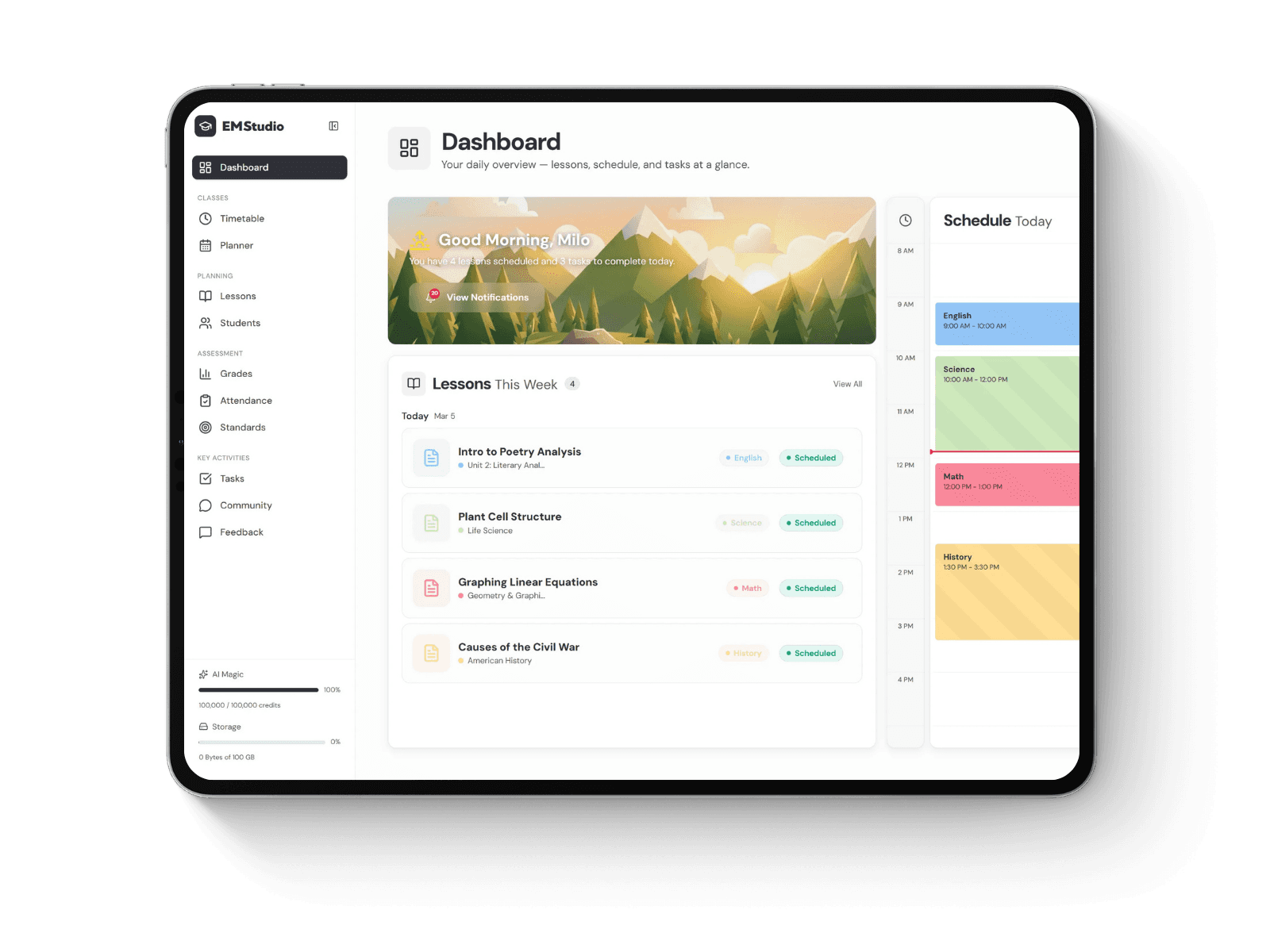
EMStudio is a free teaching management app — manage your classes, students, lessons, and more!
Learn More
Still grading everything by hand?
EMStudio is a free teaching management app — manage your classes, students, lessons, and more!
Learn More
Table of Contents
Small shifts that help students think, problem-solve, and take ownership of their learning.
Building independent learners isn't about expecting students to do everything on their own. It's about intentionally teaching routines, modeling expectations, and creating opportunities for students to think, problem-solve, and take ownership of their learning.
Here are five teacher habits that have transformed my classroom.
1. I Stopped Repeating Directions
This one wasn't easy.
I caught myself repeating directions throughout the day.
"What are we doing?"
"What page are we on?"
"What do I do next?"
The more I repeated myself, the more my students learned they could simply wait for me to say it again.
Now, instead of immediately repeating directions, I ask questions like:
"What did you hear?"
"Where could you find that information?"
"Who can help explain the directions?"
Those small shifts encourage students to become active listeners instead of passive receivers.
I've learned that every time I resist the urge to repeat myself, I'm giving students another opportunity to take responsibility for listening carefully the first time.
In fact, this realization inspired me to reflect on one classroom habit I'm intentionally changing this school year: stop repeating directions. It's a small shift in my teaching, but one that I believe will have a big impact on helping students become more attentive, independent learners.
2. I Teach Students to Use Classroom Resources Before Asking Me
One of my favorite responses is now:
"Show me where you've already looked."
Whether it's an anchor chart, math reference page, classroom library, vocabulary wall, or written directions, I want students to develop the habit of checking available resources before asking me for help.
To reinforce this expectation, I use a Busy Bee visual in my classroom. (Our school mascot is the bee!)
Instead of answering a question immediately, I simply point to the poster.
Where Can I Get Help?
The Four Bs:
Brain – Think first!
Board – Look!
Book – Find the page. Look for text evidence.
Buddy – Ask your side partner.
Over time, students stop looking to me as their first source of help and begin working through those options independently.
This isn't about refusing to help.
It's about teaching students that good learners know how to use the resources around them.
When students discover they can answer many of their own questions, their confidence grows right alongside their independence.
3. I Build Active Listening Into Our Daily Routine
One of the most powerful classroom management strategies I've learned is this:
Never assume students know what your expectations look like.
Whether it's active listening, transitioning between activities, working with a partner, or asking for help appropriately, every routine needs to be explicitly taught, modeled, and practiced.
I want my students to know not only what I'm asking them to do, but also why it matters and how to do it successfully.
At the beginning of the school year, and whenever we introduce a new routine, we take the time to practice together. We model what success looks like, discuss common mistakes, and give students opportunities to reflect and improve.
I often tell teachers that we can't expect students to meet our expectations if we've never explicitly taught them what those expectations look and sound like.
This approach is rooted in many of the same principles emphasized by Responsive Classroom: investing time upfront to intentionally teach routines creates a classroom where students feel confident, capable, and successful.
Teachers sometimes worry that spending time practicing routines takes away from instruction.
In my experience, the opposite is true.
The time invested early in the year pays dividends for months because students know what's expected and can work more independently.
I've found that classrooms where routines are intentionally taught, modeled, and practiced tend to experience fewer behavior challenges and require fewer reminders throughout the year. Investing that time upfront creates a stronger foundation for student independence.
When students understand the what, why, and how behind classroom expectations, they require fewer reminders, make smoother transitions, and become active participants in their own learning.
4. I Encourage Productive Struggle
As teachers, it's natural to want to rescue students the moment they get stuck.
I've learned that some of the best learning happens when I resist the urge to immediately provide the answer.
One simple question has completely changed the way I support students: "How Can I Help?" It's a phrase I've written about extensively because I've seen firsthand how these four words shift ownership back to the learner.
Instead of assuming what a student needs, I'm inviting them to identify it for themselves.
Sometimes they'll tell me they don't understand the directions.
Other times, they'll realize they simply need help getting started, choosing a strategy, or thinking through the first step.
That conversation gives students ownership of the problem while allowing me to provide just enough support to move them forward.
More importantly, it keeps the thinking where it belongs—with the student.
My goal isn't to solve the problem for them.
It's to help them think through the problem until they can solve it themselves.
I've found that when students are given time to struggle productively and talk through their thinking, they become more confident, resilient learners. They begin to realize they already have many of the tools they need—they just need someone to guide their thinking instead of giving them the answer.
5. I Celebrate Independence, Not Just Correct Answers
One of the simplest changes I've made is paying closer attention to what I praise.
Instead of focusing only on correct answers, I intentionally recognize behaviors that build independence.
Things like:
using an anchor chart without being reminded
rereading directions before asking for help
trying multiple strategies
asking a classmate for clarification
persevering through a challenge
These moments may seem small, but they're the habits that create confident learners over time.
When students realize these behaviors are valued just as much as correct answers, they begin taking greater ownership of their learning.
As teachers, we have the opportunity to shape not only what students learn but also how they approach learning itself. Every routine we teach, every question we ask, and every opportunity we give students to think independently helps build the confidence they'll carry long after they leave our classrooms.
Final Thoughts
Building independent learners doesn't happen overnight.
It happens through hundreds of small, intentional decisions we make every day.
When we stop repeating directions, teach students to use available resources, explicitly model expectations, encourage productive struggle, and celebrate independent thinking, we create classrooms where students not only complete assignments but also become confident, independent learners.
And in my experience, that's one of the greatest gifts we can give them.

Christine Weis is an elementary educator with more than 20 years of classroom experience and the creator of For the Love of Teachers, where she shares practical teaching strategies, classroom management ideas, lesson plans, and engaging resources for elementary educators. Passionate about helping teachers create positive, student-centered classrooms, Christine believes that strong relationships, clear routines, and intentional instruction build confident, independent learners. She also creates classroom resources for teachers through her online shop and Teachers Pay Teachers store.
Connect with Christine:
Website: For The Love of Teachers
Teachers Pay Teachers:For The Love of Teachers Shop
Small shifts that help students think, problem-solve, and take ownership of their learning.
Building independent learners isn't about expecting students to do everything on their own. It's about intentionally teaching routines, modeling expectations, and creating opportunities for students to think, problem-solve, and take ownership of their learning.
Here are five teacher habits that have transformed my classroom.
1. I Stopped Repeating Directions
This one wasn't easy.
I caught myself repeating directions throughout the day.
"What are we doing?"
"What page are we on?"
"What do I do next?"
The more I repeated myself, the more my students learned they could simply wait for me to say it again.
Now, instead of immediately repeating directions, I ask questions like:
"What did you hear?"
"Where could you find that information?"
"Who can help explain the directions?"
Those small shifts encourage students to become active listeners instead of passive receivers.
I've learned that every time I resist the urge to repeat myself, I'm giving students another opportunity to take responsibility for listening carefully the first time.
In fact, this realization inspired me to reflect on one classroom habit I'm intentionally changing this school year: stop repeating directions. It's a small shift in my teaching, but one that I believe will have a big impact on helping students become more attentive, independent learners.
2. I Teach Students to Use Classroom Resources Before Asking Me
One of my favorite responses is now:
"Show me where you've already looked."
Whether it's an anchor chart, math reference page, classroom library, vocabulary wall, or written directions, I want students to develop the habit of checking available resources before asking me for help.
To reinforce this expectation, I use a Busy Bee visual in my classroom. (Our school mascot is the bee!)
Instead of answering a question immediately, I simply point to the poster.
Where Can I Get Help?
The Four Bs:
Brain – Think first!
Board – Look!
Book – Find the page. Look for text evidence.
Buddy – Ask your side partner.
Over time, students stop looking to me as their first source of help and begin working through those options independently.
This isn't about refusing to help.
It's about teaching students that good learners know how to use the resources around them.
When students discover they can answer many of their own questions, their confidence grows right alongside their independence.
3. I Build Active Listening Into Our Daily Routine
One of the most powerful classroom management strategies I've learned is this:
Never assume students know what your expectations look like.
Whether it's active listening, transitioning between activities, working with a partner, or asking for help appropriately, every routine needs to be explicitly taught, modeled, and practiced.
I want my students to know not only what I'm asking them to do, but also why it matters and how to do it successfully.
At the beginning of the school year, and whenever we introduce a new routine, we take the time to practice together. We model what success looks like, discuss common mistakes, and give students opportunities to reflect and improve.
I often tell teachers that we can't expect students to meet our expectations if we've never explicitly taught them what those expectations look and sound like.
This approach is rooted in many of the same principles emphasized by Responsive Classroom: investing time upfront to intentionally teach routines creates a classroom where students feel confident, capable, and successful.
Teachers sometimes worry that spending time practicing routines takes away from instruction.
In my experience, the opposite is true.
The time invested early in the year pays dividends for months because students know what's expected and can work more independently.
I've found that classrooms where routines are intentionally taught, modeled, and practiced tend to experience fewer behavior challenges and require fewer reminders throughout the year. Investing that time upfront creates a stronger foundation for student independence.
When students understand the what, why, and how behind classroom expectations, they require fewer reminders, make smoother transitions, and become active participants in their own learning.
4. I Encourage Productive Struggle
As teachers, it's natural to want to rescue students the moment they get stuck.
I've learned that some of the best learning happens when I resist the urge to immediately provide the answer.
One simple question has completely changed the way I support students: "How Can I Help?" It's a phrase I've written about extensively because I've seen firsthand how these four words shift ownership back to the learner.
Instead of assuming what a student needs, I'm inviting them to identify it for themselves.
Sometimes they'll tell me they don't understand the directions.
Other times, they'll realize they simply need help getting started, choosing a strategy, or thinking through the first step.
That conversation gives students ownership of the problem while allowing me to provide just enough support to move them forward.
More importantly, it keeps the thinking where it belongs—with the student.
My goal isn't to solve the problem for them.
It's to help them think through the problem until they can solve it themselves.
I've found that when students are given time to struggle productively and talk through their thinking, they become more confident, resilient learners. They begin to realize they already have many of the tools they need—they just need someone to guide their thinking instead of giving them the answer.
5. I Celebrate Independence, Not Just Correct Answers
One of the simplest changes I've made is paying closer attention to what I praise.
Instead of focusing only on correct answers, I intentionally recognize behaviors that build independence.
Things like:
using an anchor chart without being reminded
rereading directions before asking for help
trying multiple strategies
asking a classmate for clarification
persevering through a challenge
These moments may seem small, but they're the habits that create confident learners over time.
When students realize these behaviors are valued just as much as correct answers, they begin taking greater ownership of their learning.
As teachers, we have the opportunity to shape not only what students learn but also how they approach learning itself. Every routine we teach, every question we ask, and every opportunity we give students to think independently helps build the confidence they'll carry long after they leave our classrooms.
Final Thoughts
Building independent learners doesn't happen overnight.
It happens through hundreds of small, intentional decisions we make every day.
When we stop repeating directions, teach students to use available resources, explicitly model expectations, encourage productive struggle, and celebrate independent thinking, we create classrooms where students not only complete assignments but also become confident, independent learners.
And in my experience, that's one of the greatest gifts we can give them.
Christine Weis is an elementary educator with more than 20 years of classroom experience and the creator of For the Love of Teachers, where she shares practical teaching strategies, classroom management ideas, lesson plans, and engaging resources for elementary educators. Passionate about helping teachers create positive, student-centered classrooms, Christine believes that strong relationships, clear routines, and intentional instruction build confident, independent learners. She also creates classroom resources for teachers through her online shop and Teachers Pay Teachers store.
Connect with Christine:
Website: For The Love of Teachers
Teachers Pay Teachers:For The Love of Teachers Shop
Still grading everything by hand?
EMStudio is a free teaching management app — manage your classes, students, lessons, and more!
Learn More
Still grading everything by hand?
EMStudio is a free teaching management app — manage your classes, students, lessons, and more!
Learn More



Notion4Teachers
Notion templates to simplify administrative tasks and enhance your teaching experience.



2026 Notion4Teachers. All Rights Reserved.
Notion4Teachers
Notion templates to simplify administrative tasks and enhance your teaching experience.
2026 Notion4Teachers. All Rights Reserved.
Notion4Teachers
Notion templates to simplify administrative tasks and enhance your teaching experience.
2026 Notion4Teachers. All Rights Reserved.