
How to Organize a School Volleyball Team's First Season
How to Organize a School Volleyball Team's First Season

Article by
Milo
ESL Content Coordinator & Educator
ESL Content Coordinator & Educator
All Posts
Meta title: How to Organize a School Volleyball Team's First Season
Meta description: Run sign-ups, plan practices, schedule matches, keep parents informed and sort out uniforms so your new school volleyball team is ready for its first match.

Alt text: Teacher-coach handing volleyball sign-up forms to high school students in a school gym
You said yes in a staff meeting, and now you're the volleyball coach. There's a stack of interest forms on your desk, a gym booked for Tuesdays and Thursdays, and a group of students who've mostly played in PE class. The first match is eight weeks away.
Starting a team from scratch is a lot to juggle alongside teaching, but most of the work happens before the first practice. Get the paperwork and schedule sorted early, and the season mostly runs itself. Here's how to set it up.
Still grading everything by hand?
EMStudio is a free teaching management app — manage your classes, students, lessons, and more!
Learn More
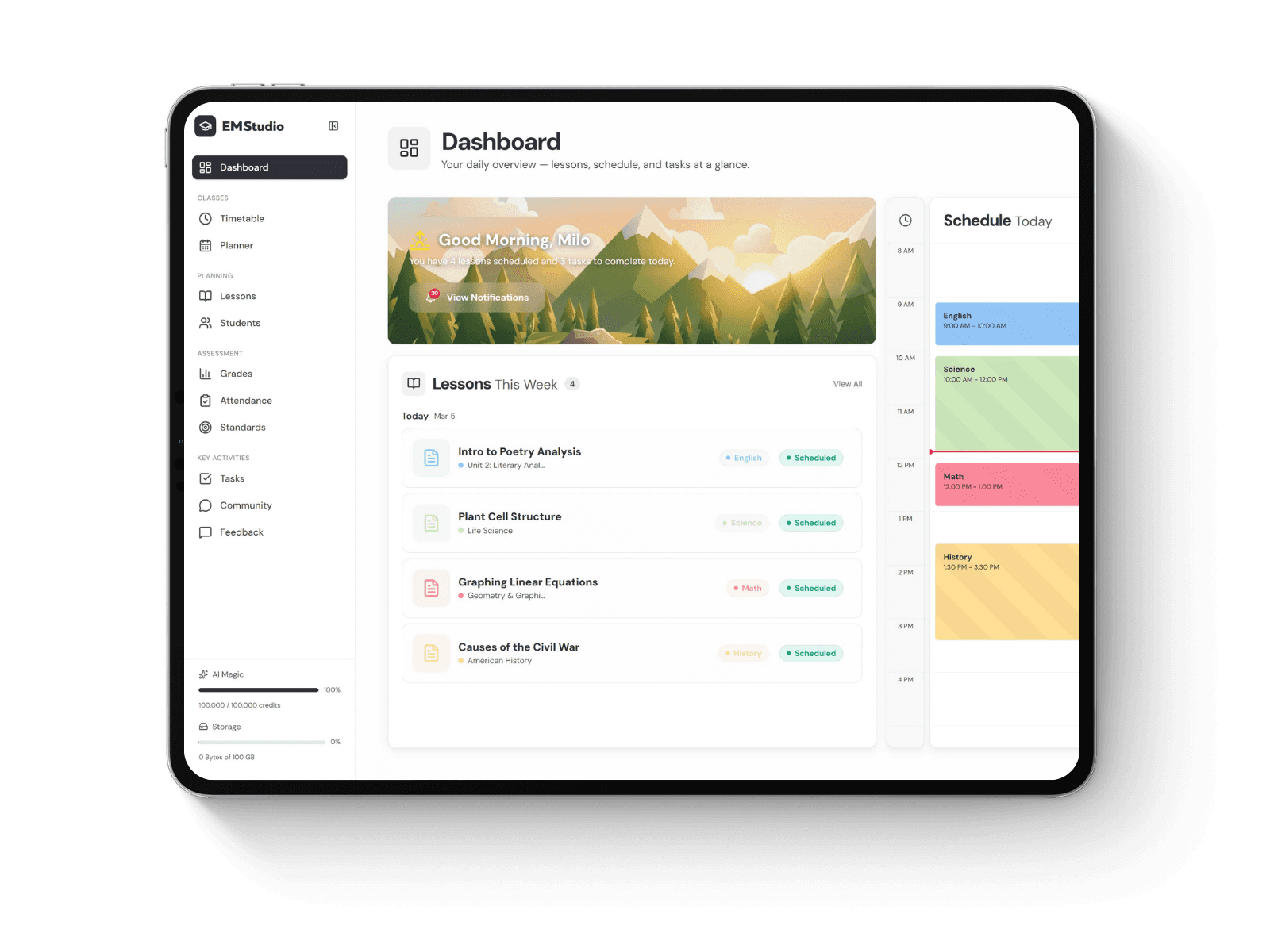
Still grading everything by hand?
EMStudio is a free teaching management app — manage your classes, students, lessons, and more!
Learn More
Table of Contents
Step 1 - Run Sign-Ups and Paperwork Early
Sign-ups and paperwork come first, because no student can practice until their forms are in. Start collecting them at least four weeks before your first session.
Your sign-up packet should include:
A registration form with contact details for the student and a parent
A medical and emergency information form
A signed code of conduct for players
A permission form for travel to away matches
Any participation fee details your school requires
Check whether players need a physical before they can take part. MedlinePlus notes that most states require a sports physical before children and teens can play. Your school's athletic office will know the local rules.
Set a firm deadline for forms and keep a simple spreadsheet showing who's cleared to practice. On the first day, anyone missing a form can watch but not play.
Step 2 - Plan Practice Sessions Around the Basics
Good first-season practices focus on the core skills: passing, setting, serving and moving as a team. Most new players need repetition far more than complicated drills.
Warm-Up
Start every session the same way, with ten minutes of jogging, dynamic stretches and light passing in pairs. A predictable routine gets players moving quickly and gives late arrivals a clear way to join in.
Skill Blocks
Pick one or two skills per session and give each its own block. Short drills with lots of touches work better than long lines where players wait their turn. Rotate partners so stronger players spend time helping newer ones.
Game Play
Finish with small-sided games or a full scrimmage. Players learn rotation, communication and scoring much faster in a game than in an explanation. Write each practice plan before you arrive so you're coaching, not deciding what to do next.
Step 3 - Build Your Match Schedule
Your match schedule shapes the whole season, so lock it in with your athletic director as early as possible. Find out which league or conference you'll play in and whether there's room for a few friendly matches against nearby schools.
When you plan the calendar, confirm:
Home and away dates, with start times
Gym availability for every home match
Transportation for away matches
Who will keep score and run the clock
Any tournament or end-of-season dates
Share the full schedule with players and parents as soon as it's confirmed, even if a few details are still pending. Families plan around it, and late changes are easier to handle when everyone already has the overall picture.

Alt text: Teacher talking with parents on the bleachers at a pre-season volleyball meeting
Step 4 - Keep Parents in the Loop
Clear parent communication heads off most problems before they start. Parents want to know when practices end, how their child is doing and what they need to buy or pay for.
Hold a short parent meeting before the season starts. Cover the schedule, your expectations for attendance, how playing time works and how you'll share updates. Then pick one channel for messages, such as your school's messaging app or a weekly email, and stick to it.
Be clear about what you can and can't discuss. Questions about playing time are best handled in a scheduled conversation, not on the sideline after a loss.
Top Tip: Send one short update every week, on the same day. Include the coming week's practice times, match details, anything players need to bring and one thing the team did well. A predictable message cuts down on individual questions, and parents learn to look for it instead of chasing you for information. |
Step 5 - Prepare for Player Safety
A safety plan protects your players and you, so put one together before the first practice. Know where the first aid kit and the nearest automated external defibrillator are, and keep emergency contact forms with you at every session.
Concussions can happen in volleyball, from collisions, dives or a ball to the head. The CDC's HEADS UP program worked with the National Federation of State High School Associations to offer concussion training for high school coaches, focused on recognizing and managing concussions. Complete it before the season, and check whether your state or district requires it.
Make sure players bring water to every session and take regular breaks, especially in a warm gym. Agree on an emergency plan with your athletic trainer or school nurse, so everyone knows who calls for help and who stays with an injured player.
Step 6 - Plan Equipment and Uniforms
Equipment and uniforms take longer to arrange than most new coaches expect, so start planning in your first week. Check what the school already has before you order anything new.
Before your first practice, make sure you have:
Enough volleyballs for partner drills, ideally one between two players
A net, posts and antennas that meet your league's requirements
Knee pads for every player
A ball cart or bag for storage and transport
Scorebooks and a first aid kit
Uniforms are where planning really pays off. Players need jerseys with numbers that meet your league's rules, plus comfortable shorts that let them dive and jump without riding up. If you're ordering volleyball shorts from Sports Gear Swag, for example, they come in a loose fit and a compression fit, so ask players which they prefer. Collect every player's size on the sign-up form, and place the order early enough to swap any sizes that don't fit before the first match.
Check your league's uniform rules before you order anything, including requirements for number size and placement and matching colors across the team. Order uniforms at least six weeks out so a delay doesn't leave anyone without one on match day.
Open Sign-Ups This Week
Put your sign-up packet together, set a deadline for forms and book a time for your parent meeting. Once those are in place, the rest of the season has a solid start.
Frequently Asked Questions
When should sign-ups open for a new school volleyball team?
Start collecting forms at least four weeks before your first practice. No student should practice until their registration, medical and permission forms are in.
Do school volleyball players need a sports physical?
MedlinePlus notes that most states require a sports physical before children and teens can play. Your school's athletic office will know the local rules.
When should I order volleyball uniforms?
Order uniforms at least six weeks before the first match, so a delay doesn't leave anyone without one. Collect every player's size on the sign-up form first.
Step 1 - Run Sign-Ups and Paperwork Early
Sign-ups and paperwork come first, because no student can practice until their forms are in. Start collecting them at least four weeks before your first session.
Your sign-up packet should include:
A registration form with contact details for the student and a parent
A medical and emergency information form
A signed code of conduct for players
A permission form for travel to away matches
Any participation fee details your school requires
Check whether players need a physical before they can take part. MedlinePlus notes that most states require a sports physical before children and teens can play. Your school's athletic office will know the local rules.
Set a firm deadline for forms and keep a simple spreadsheet showing who's cleared to practice. On the first day, anyone missing a form can watch but not play.
Step 2 - Plan Practice Sessions Around the Basics
Good first-season practices focus on the core skills: passing, setting, serving and moving as a team. Most new players need repetition far more than complicated drills.
Warm-Up
Start every session the same way, with ten minutes of jogging, dynamic stretches and light passing in pairs. A predictable routine gets players moving quickly and gives late arrivals a clear way to join in.
Skill Blocks
Pick one or two skills per session and give each its own block. Short drills with lots of touches work better than long lines where players wait their turn. Rotate partners so stronger players spend time helping newer ones.
Game Play
Finish with small-sided games or a full scrimmage. Players learn rotation, communication and scoring much faster in a game than in an explanation. Write each practice plan before you arrive so you're coaching, not deciding what to do next.
Step 3 - Build Your Match Schedule
Your match schedule shapes the whole season, so lock it in with your athletic director as early as possible. Find out which league or conference you'll play in and whether there's room for a few friendly matches against nearby schools.
When you plan the calendar, confirm:
Home and away dates, with start times
Gym availability for every home match
Transportation for away matches
Who will keep score and run the clock
Any tournament or end-of-season dates
Share the full schedule with players and parents as soon as it's confirmed, even if a few details are still pending. Families plan around it, and late changes are easier to handle when everyone already has the overall picture.
Alt text: Teacher talking with parents on the bleachers at a pre-season volleyball meeting
Step 4 - Keep Parents in the Loop
Clear parent communication heads off most problems before they start. Parents want to know when practices end, how their child is doing and what they need to buy or pay for.
Hold a short parent meeting before the season starts. Cover the schedule, your expectations for attendance, how playing time works and how you'll share updates. Then pick one channel for messages, such as your school's messaging app or a weekly email, and stick to it.
Be clear about what you can and can't discuss. Questions about playing time are best handled in a scheduled conversation, not on the sideline after a loss.
Top Tip: Send one short update every week, on the same day. Include the coming week's practice times, match details, anything players need to bring and one thing the team did well. A predictable message cuts down on individual questions, and parents learn to look for it instead of chasing you for information. |
Step 5 - Prepare for Player Safety
A safety plan protects your players and you, so put one together before the first practice. Know where the first aid kit and the nearest automated external defibrillator are, and keep emergency contact forms with you at every session.
Concussions can happen in volleyball, from collisions, dives or a ball to the head. The CDC's HEADS UP program worked with the National Federation of State High School Associations to offer concussion training for high school coaches, focused on recognizing and managing concussions. Complete it before the season, and check whether your state or district requires it.
Make sure players bring water to every session and take regular breaks, especially in a warm gym. Agree on an emergency plan with your athletic trainer or school nurse, so everyone knows who calls for help and who stays with an injured player.
Step 6 - Plan Equipment and Uniforms
Equipment and uniforms take longer to arrange than most new coaches expect, so start planning in your first week. Check what the school already has before you order anything new.
Before your first practice, make sure you have:
Enough volleyballs for partner drills, ideally one between two players
A net, posts and antennas that meet your league's requirements
Knee pads for every player
A ball cart or bag for storage and transport
Scorebooks and a first aid kit
Uniforms are where planning really pays off. Players need jerseys with numbers that meet your league's rules, plus comfortable shorts that let them dive and jump without riding up. If you're ordering volleyball shorts from Sports Gear Swag, for example, they come in a loose fit and a compression fit, so ask players which they prefer. Collect every player's size on the sign-up form, and place the order early enough to swap any sizes that don't fit before the first match.
Check your league's uniform rules before you order anything, including requirements for number size and placement and matching colors across the team. Order uniforms at least six weeks out so a delay doesn't leave anyone without one on match day.
Open Sign-Ups This Week
Put your sign-up packet together, set a deadline for forms and book a time for your parent meeting. Once those are in place, the rest of the season has a solid start.
Frequently Asked Questions
When should sign-ups open for a new school volleyball team?
Start collecting forms at least four weeks before your first practice. No student should practice until their registration, medical and permission forms are in.
Do school volleyball players need a sports physical?
MedlinePlus notes that most states require a sports physical before children and teens can play. Your school's athletic office will know the local rules.
When should I order volleyball uniforms?
Order uniforms at least six weeks before the first match, so a delay doesn't leave anyone without one. Collect every player's size on the sign-up form first.
Still grading everything by hand?
EMStudio is a free teaching management app — manage your classes, students, lessons, and more!
Learn More
Still grading everything by hand?
EMStudio is a free teaching management app — manage your classes, students, lessons, and more!
Learn More



Notion4Teachers
Notion templates to simplify administrative tasks and enhance your teaching experience.



2026 Notion4Teachers. All Rights Reserved.
Notion4Teachers
Notion templates to simplify administrative tasks and enhance your teaching experience.
2026 Notion4Teachers. All Rights Reserved.
Notion4Teachers
Notion templates to simplify administrative tasks and enhance your teaching experience.
2026 Notion4Teachers. All Rights Reserved.