
The Hidden Tax on Every Music or Tutoring Payment
The Hidden Tax on Every Music or Tutoring Payment

Article by
Milo
ESL Content Coordinator & Educator
ESL Content Coordinator & Educator
All Posts
What Music Schools and Tutoring Centers Get Wrong About Processing Fees
Ask the owner of a music school, voice studio, or tutoring center what their biggest fixed cost is, and you'll hear rent, instructor payroll, maybe insurance.
Ask them how much they paid in credit card processing fees last year, on top of piano lesson tuition, guitar lesson packages, SAT prep sessions, and monthly tutoring plans, and you'll usually get a guess, not a number. That gap isn't a minor accounting detail.
It's one of the largest line items in a lesson-based business, whether you run a private music academy, a multi-instructor tutoring center, or a test prep and academic tutoring franchise, and almost nobody treats it like one. Here's what changes when payment processing finally gets the same scrutiny as rent.
Still grading everything by hand?
EMStudio is a free teaching management app — manage your classes, students, lessons, and more!
Learn More
Still grading everything by hand?
EMStudio is a free teaching management app — manage your classes, students, lessons, and more!
Learn More
Table of Contents
The Fee Nobody Budgets For
Walk into the finance conversation at most music schools, voice and instrument studios, or math and reading tutoring centers, and you'll find real attention paid to instructor pay, marketing spend, and facility costs.
Ask where credit card fees show up in that conversation, whether it's a monthly piano lesson autopay, a semester of SAT and ACT prep, or a package of group guitar classes, and you'll usually get a shrug, or a vague sense that "the processor takes a cut."
Why this fee hides in plain sight
Processing fees never arrive as a single bill. They're deducted before a deposit ever hits the bank account, a few cents off a voice lesson payment here, a percentage point off a tutoring package there, thousands of times a month across a full roster of students.
Rent shows up as one line, once a month.
Instructor and tutor payroll shows up as one line, every pay period.
Processing fees show up as a rounding difference on hundreds of separate tuition and lesson-package transactions.
Because no single charge looks large, owners of music schools and tutoring centers rarely add them up. A $200 monthly tuition payment, whether it's for piano lessons, violin lessons, or one-on-one academic tutoring, loses two or three dollars to fees; multiply that by a full roster of students across private lessons, group classes, and test prep cohorts, and the number gets big fast, but it never announces itself the way a rent increase does.
The math most owners haven't run
A typical card transaction costs a business somewhere around 2.5% to 3.5% once interchange, the card network fee, and the processor's markup are all added together. On a music school or tutoring center billing $30,000 a month across piano, guitar, voice, and test prep tuition, that's $750 to $1,050 disappearing before the money ever reaches instructor pay, tutor pay, or rent, every single month, without a single conversation about it.
Owners who do run this math, whether they run a single-location music studio or a growing tutoring center with multiple locations, are often surprised to find processing fees rival what they spend on marketing, and yet marketing gets a line item in the budget while processing fees get absorbed into "cost of doing business."
Why the Standard Fix Doesn't Fix Much
The default response, when a music school or tutoring center owner does notice the fee, is to call around for a lower rate. That's a reasonable instinct, and it rarely moves the number as much as people hope.
Negotiating a rate has a ceiling
Interchange, the biggest piece of the fee, is set by the card networks, not your processor. A new sales rep can shave the markup on top of interchange, but the floor underneath it doesn't move. Most owners who switch processors save a fraction of a percent and spend a month migrating their tuition billing, autopay, and lesson-package system to get there.
The bigger lever is how families pay, not who processes the card
The transactions costing the most are the ones running on a credit card at all, whether that's a recurring piano lesson payment, a guitar lesson package, or a monthly tutoring plan. A bank-to-bank payment, an ACH transfer straight from a checking account, typically costs a small flat fee instead of a percentage, regardless of the tuition amount. For a family paying $300 a month for private music lessons or academic tutoring, that's the difference between losing eight or nine dollars to a card fee and losing well under a dollar to an ACH transfer.
This is the lever that actually changes the number: not chasing a better rate on the same kind of transaction, but changing what kind of transaction most of your music lesson or tutoring tuition runs through.
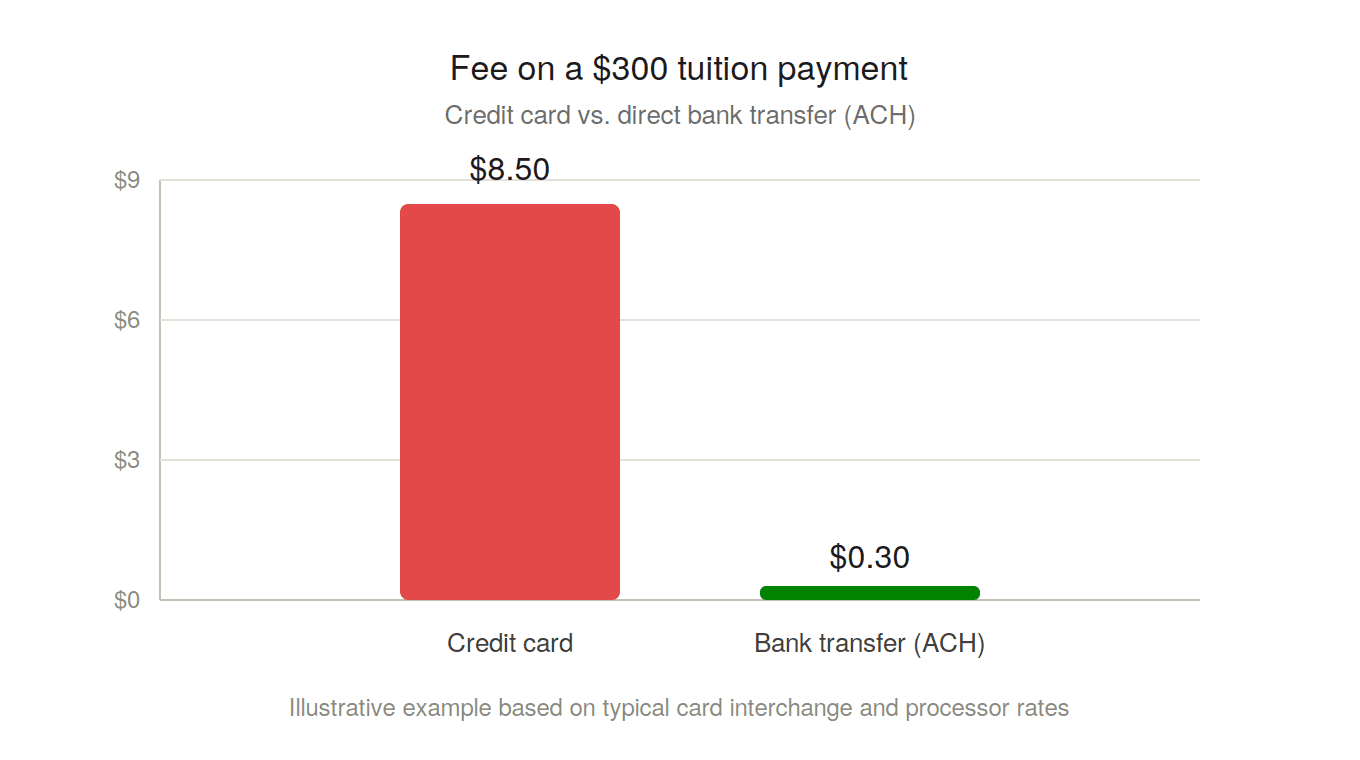
Fee on a $300 tuition payment: credit card versus bank transfer
What It Looks Like to Actually Fix This
Whether a music school, voice studio, or tutoring center is running on Stripe, Square, QuickBooks Payments, or a platform built specifically for lesson-based businesses like Noto, the tool matters less than whether it makes bank payments the easy default instead of a manual workaround.
Make bank payments the path of least resistance
Most families default to a card because it's the first option they see at checkout for piano lessons, guitar lessons, voice lessons, or a tutoring package, not because they prefer it. When bank payment is offered as an equally simple choice, autopay enrollment and saved account details included, a meaningful share of music school and tutoring center families will take it without ever being asked to.
Platforms built for this, like Noto's bank account connection feature, frame it plainly: schools spending thousands of dollars a month on card fees across private lessons, group classes, and tutoring sessions can cut that by up to $5,000 a month by moving recurring tuition onto direct bank payments, without changing a single family's price.
Know the rules before you pass on the cost
Some music school and tutoring center owners try to close the gap by adding a surcharge for card payments or a discount for cash and bank payments. Both are legal in most states, but the rules on disclosure, caps, and which payment types can be surcharged vary by state and by card network, and getting it wrong risks fees and network penalties that outweigh whatever you were trying to save on tuition processing. This is worth getting right with a processor or platform that already handles state-by-state compliance, rather than building the policy yourself from a forum post.
Making the Switch Without Losing Families
The fear that stops most music school and tutoring center owners from touching their payment setup isn't the math, it's the worry that changing how families pay for piano lessons, voice lessons, or tutoring sessions will feel like a hassle and cost them customers.
Start with new enrollments, not existing ones
Rather than migrating every family's payment method at once, set bank payment as the default for new music lesson and tutoring sign-ups, and let existing families move over at their own pace, often at renewal or re-enrollment for the next semester of lessons or tutoring. This spreads the change over a season instead of forcing every family through it in the same week.
Make the switch a five-minute task, not a form to fill out
The families most likely to resist are the ones asked to re-enter account numbers and routing information by hand, whether they're signing up for weekly guitar lessons or a full academic tutoring package. Platforms that let a family connect their bank account the same way they'd link it to a budgeting app remove almost all of the friction that makes owners nervous about asking.
The Same Blind Spot Shows Up Elsewhere in the Business
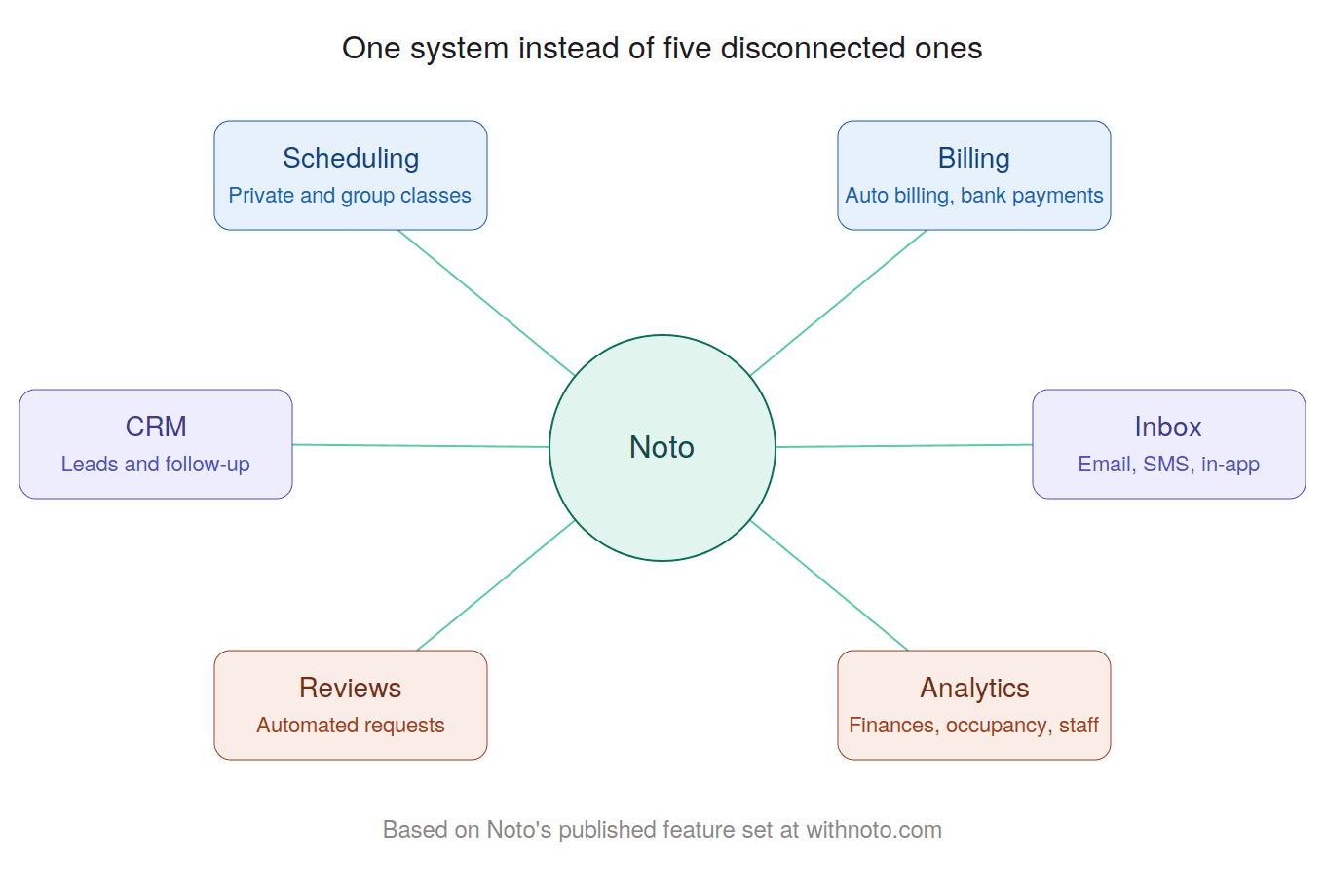
How Noto connects scheduling, billing, CRM, communication, reviews, and analytics
Processing fees are the clearest example because they're a percentage you can calculate, but they're not the only cost that hides in a system stitched together from separate tools. The same pattern, a real cost with no line item, shows up anywhere billing, scheduling, and family communication are handled as three or four disconnected pieces instead of one, whether you're running private music lessons, group music classes, or one-on-one and small-group academic tutoring.
Leads that go cold before anyone follows up
A family that fills out a form on your music school or tutoring center website, inquiring about piano lessons, voice lessons, SAT prep, or after-school tutoring, is a lead with a shelf life.
If that form lives separately from your calendar and your billing system, someone has to manually check it, cross-reference instructor and tutor availability, and respond, and that lag is where interested families quietly disappear.
A form builder that syncs submissions straight into a CRM, the way Noto's does, closes that gap by routing a new music lesson or tutoring inquiry into the same system your staff already use to check openings and follow up.
Availability that only one person can see
In a multi-instructor music school or a multi-tutor, multi-location tutoring center, "who's free Thursday at 4pm for a piano lesson or a math tutoring session" is a question that shouldn't require a phone call to the one person who keeps the master schedule in their head. A sales or admin command center that lets any staff member search availability, matching instructors or tutors, and payment status across locations turns that into something the whole front desk can answer, not just the person who happens to know the calendar best.
Family communication scattered across email, text, and app notifications
Parents and students don't naturally organize their questions about piano lesson scheduling, tutoring session rescheduling, or tuition billing into "the right channel." A unified inbox, handling email, SMS, and in-app messages in one place rather than three, is what keeps a billing question and a lesson or tutoring scheduling question from getting answered by two different people with two different sets of information.
Reviews that never get asked for
Reputation compounds the same way fees do: a little bit, constantly, in the background.
A system that automatically prompts happy music lesson and tutoring families for Google and Facebook reviews after a lesson or session, rather than relying on staff to remember, is the difference between a review page that grows on its own and one that stalls because nobody had time to ask.
Noto's own numbers put the effect of consistent review generation at roughly 40% more leads within the first two months of turning it on, a meaningful boost for any music school or tutoring center competing for local search visibility.
Costs you can't fix if you can't see them
None of this is manageable without a way to actually look at it. Analytics that track finances, room or studio occupancy, and instructor or tutor retention side by side is what turns "I think processing fees are high" or "I think we're losing music lesson and tutoring leads" into a number you can act on, the same way this piece started with the fee nobody had actually added up.
Where to Start This Month
You don't need to renegotiate your entire payment stack to see a difference. You need one number and one change you'll actually make.
Start with the number. Pull last month's processing statement and add up what actually left the business in fees across all your piano, guitar, voice, and tutoring tuition, not the rate on the contract, the real dollar total. Most music school and tutoring center owners have never looked.
Then make bank payment the default for new enrollments only. Don't touch existing autopay yet:
Set it as the pre-selected option at checkout for new music lesson and tutoring sign-ups
Offer it as the option during your next renewal cycle or new semester enrollment
Track how many new families choose it without being pushed
A season is enough time to see whether the shift sticks before deciding whether to revisit existing accounts.
Finally, put processing costs on the same monthly review as instructor payroll, tutor payroll, and marketing spend. You already watch those closely because you know they drift. Processing costs drift too, quietly, tuition increase after tuition increase, and they're just as worth watching for any music school, voice studio, or tutoring center.
Every other major cost in a lesson-based business, from a single-studio music teacher to a multi-location tutoring center, gets a line item and a review. Processing fees usually don't, and that's exactly why they've become one of the largest expenses nobody budgets for.
Fixing it doesn't require a new merchant account or a renegotiated contract: music schools and tutoring centers already have the tools, such as an all-in-one platform built specifically for tuition-based businesses like Noto, which handles the billing alongside scheduling, CRM, and communication for private lessons, group classes, and tutoring sessions alike, so the fee isn't the only blind spot getting fixed. What's been missing is the decision to make bank payment the default instead of the afterthought.
That's not a fee you negotiate away. It's a fee you stop paying in the first place, whether you're running a single piano studio or a growing regional tutoring center.
The Fee Nobody Budgets For
Walk into the finance conversation at most music schools, voice and instrument studios, or math and reading tutoring centers, and you'll find real attention paid to instructor pay, marketing spend, and facility costs.
Ask where credit card fees show up in that conversation, whether it's a monthly piano lesson autopay, a semester of SAT and ACT prep, or a package of group guitar classes, and you'll usually get a shrug, or a vague sense that "the processor takes a cut."
Why this fee hides in plain sight
Processing fees never arrive as a single bill. They're deducted before a deposit ever hits the bank account, a few cents off a voice lesson payment here, a percentage point off a tutoring package there, thousands of times a month across a full roster of students.
Rent shows up as one line, once a month.
Instructor and tutor payroll shows up as one line, every pay period.
Processing fees show up as a rounding difference on hundreds of separate tuition and lesson-package transactions.
Because no single charge looks large, owners of music schools and tutoring centers rarely add them up. A $200 monthly tuition payment, whether it's for piano lessons, violin lessons, or one-on-one academic tutoring, loses two or three dollars to fees; multiply that by a full roster of students across private lessons, group classes, and test prep cohorts, and the number gets big fast, but it never announces itself the way a rent increase does.
The math most owners haven't run
A typical card transaction costs a business somewhere around 2.5% to 3.5% once interchange, the card network fee, and the processor's markup are all added together. On a music school or tutoring center billing $30,000 a month across piano, guitar, voice, and test prep tuition, that's $750 to $1,050 disappearing before the money ever reaches instructor pay, tutor pay, or rent, every single month, without a single conversation about it.
Owners who do run this math, whether they run a single-location music studio or a growing tutoring center with multiple locations, are often surprised to find processing fees rival what they spend on marketing, and yet marketing gets a line item in the budget while processing fees get absorbed into "cost of doing business."
Why the Standard Fix Doesn't Fix Much
The default response, when a music school or tutoring center owner does notice the fee, is to call around for a lower rate. That's a reasonable instinct, and it rarely moves the number as much as people hope.
Negotiating a rate has a ceiling
Interchange, the biggest piece of the fee, is set by the card networks, not your processor. A new sales rep can shave the markup on top of interchange, but the floor underneath it doesn't move. Most owners who switch processors save a fraction of a percent and spend a month migrating their tuition billing, autopay, and lesson-package system to get there.
The bigger lever is how families pay, not who processes the card
The transactions costing the most are the ones running on a credit card at all, whether that's a recurring piano lesson payment, a guitar lesson package, or a monthly tutoring plan. A bank-to-bank payment, an ACH transfer straight from a checking account, typically costs a small flat fee instead of a percentage, regardless of the tuition amount. For a family paying $300 a month for private music lessons or academic tutoring, that's the difference between losing eight or nine dollars to a card fee and losing well under a dollar to an ACH transfer.
This is the lever that actually changes the number: not chasing a better rate on the same kind of transaction, but changing what kind of transaction most of your music lesson or tutoring tuition runs through.
Fee on a $300 tuition payment: credit card versus bank transfer
What It Looks Like to Actually Fix This
Whether a music school, voice studio, or tutoring center is running on Stripe, Square, QuickBooks Payments, or a platform built specifically for lesson-based businesses like Noto, the tool matters less than whether it makes bank payments the easy default instead of a manual workaround.
Make bank payments the path of least resistance
Most families default to a card because it's the first option they see at checkout for piano lessons, guitar lessons, voice lessons, or a tutoring package, not because they prefer it. When bank payment is offered as an equally simple choice, autopay enrollment and saved account details included, a meaningful share of music school and tutoring center families will take it without ever being asked to.
Platforms built for this, like Noto's bank account connection feature, frame it plainly: schools spending thousands of dollars a month on card fees across private lessons, group classes, and tutoring sessions can cut that by up to $5,000 a month by moving recurring tuition onto direct bank payments, without changing a single family's price.
Know the rules before you pass on the cost
Some music school and tutoring center owners try to close the gap by adding a surcharge for card payments or a discount for cash and bank payments. Both are legal in most states, but the rules on disclosure, caps, and which payment types can be surcharged vary by state and by card network, and getting it wrong risks fees and network penalties that outweigh whatever you were trying to save on tuition processing. This is worth getting right with a processor or platform that already handles state-by-state compliance, rather than building the policy yourself from a forum post.
Making the Switch Without Losing Families
The fear that stops most music school and tutoring center owners from touching their payment setup isn't the math, it's the worry that changing how families pay for piano lessons, voice lessons, or tutoring sessions will feel like a hassle and cost them customers.
Start with new enrollments, not existing ones
Rather than migrating every family's payment method at once, set bank payment as the default for new music lesson and tutoring sign-ups, and let existing families move over at their own pace, often at renewal or re-enrollment for the next semester of lessons or tutoring. This spreads the change over a season instead of forcing every family through it in the same week.
Make the switch a five-minute task, not a form to fill out
The families most likely to resist are the ones asked to re-enter account numbers and routing information by hand, whether they're signing up for weekly guitar lessons or a full academic tutoring package. Platforms that let a family connect their bank account the same way they'd link it to a budgeting app remove almost all of the friction that makes owners nervous about asking.
The Same Blind Spot Shows Up Elsewhere in the Business
How Noto connects scheduling, billing, CRM, communication, reviews, and analytics
Processing fees are the clearest example because they're a percentage you can calculate, but they're not the only cost that hides in a system stitched together from separate tools. The same pattern, a real cost with no line item, shows up anywhere billing, scheduling, and family communication are handled as three or four disconnected pieces instead of one, whether you're running private music lessons, group music classes, or one-on-one and small-group academic tutoring.
Leads that go cold before anyone follows up
A family that fills out a form on your music school or tutoring center website, inquiring about piano lessons, voice lessons, SAT prep, or after-school tutoring, is a lead with a shelf life.
If that form lives separately from your calendar and your billing system, someone has to manually check it, cross-reference instructor and tutor availability, and respond, and that lag is where interested families quietly disappear.
A form builder that syncs submissions straight into a CRM, the way Noto's does, closes that gap by routing a new music lesson or tutoring inquiry into the same system your staff already use to check openings and follow up.
Availability that only one person can see
In a multi-instructor music school or a multi-tutor, multi-location tutoring center, "who's free Thursday at 4pm for a piano lesson or a math tutoring session" is a question that shouldn't require a phone call to the one person who keeps the master schedule in their head. A sales or admin command center that lets any staff member search availability, matching instructors or tutors, and payment status across locations turns that into something the whole front desk can answer, not just the person who happens to know the calendar best.
Family communication scattered across email, text, and app notifications
Parents and students don't naturally organize their questions about piano lesson scheduling, tutoring session rescheduling, or tuition billing into "the right channel." A unified inbox, handling email, SMS, and in-app messages in one place rather than three, is what keeps a billing question and a lesson or tutoring scheduling question from getting answered by two different people with two different sets of information.
Reviews that never get asked for
Reputation compounds the same way fees do: a little bit, constantly, in the background.
A system that automatically prompts happy music lesson and tutoring families for Google and Facebook reviews after a lesson or session, rather than relying on staff to remember, is the difference between a review page that grows on its own and one that stalls because nobody had time to ask.
Noto's own numbers put the effect of consistent review generation at roughly 40% more leads within the first two months of turning it on, a meaningful boost for any music school or tutoring center competing for local search visibility.
Costs you can't fix if you can't see them
None of this is manageable without a way to actually look at it. Analytics that track finances, room or studio occupancy, and instructor or tutor retention side by side is what turns "I think processing fees are high" or "I think we're losing music lesson and tutoring leads" into a number you can act on, the same way this piece started with the fee nobody had actually added up.
Where to Start This Month
You don't need to renegotiate your entire payment stack to see a difference. You need one number and one change you'll actually make.
Start with the number. Pull last month's processing statement and add up what actually left the business in fees across all your piano, guitar, voice, and tutoring tuition, not the rate on the contract, the real dollar total. Most music school and tutoring center owners have never looked.
Then make bank payment the default for new enrollments only. Don't touch existing autopay yet:
Set it as the pre-selected option at checkout for new music lesson and tutoring sign-ups
Offer it as the option during your next renewal cycle or new semester enrollment
Track how many new families choose it without being pushed
A season is enough time to see whether the shift sticks before deciding whether to revisit existing accounts.
Finally, put processing costs on the same monthly review as instructor payroll, tutor payroll, and marketing spend. You already watch those closely because you know they drift. Processing costs drift too, quietly, tuition increase after tuition increase, and they're just as worth watching for any music school, voice studio, or tutoring center.
Every other major cost in a lesson-based business, from a single-studio music teacher to a multi-location tutoring center, gets a line item and a review. Processing fees usually don't, and that's exactly why they've become one of the largest expenses nobody budgets for.
Fixing it doesn't require a new merchant account or a renegotiated contract: music schools and tutoring centers already have the tools, such as an all-in-one platform built specifically for tuition-based businesses like Noto, which handles the billing alongside scheduling, CRM, and communication for private lessons, group classes, and tutoring sessions alike, so the fee isn't the only blind spot getting fixed. What's been missing is the decision to make bank payment the default instead of the afterthought.
That's not a fee you negotiate away. It's a fee you stop paying in the first place, whether you're running a single piano studio or a growing regional tutoring center.
Still grading everything by hand?
EMStudio is a free teaching management app — manage your classes, students, lessons, and more!
Learn More
Still grading everything by hand?
EMStudio is a free teaching management app — manage your classes, students, lessons, and more!
Learn More





Notion4Teachers
Notion templates to simplify administrative tasks and enhance your teaching experience.



2026 Notion4Teachers. All Rights Reserved.
Notion4Teachers
Notion templates to simplify administrative tasks and enhance your teaching experience.
2026 Notion4Teachers. All Rights Reserved.
Notion4Teachers
Notion templates to simplify administrative tasks and enhance your teaching experience.
2026 Notion4Teachers. All Rights Reserved.