
Generative AI in Education: What Classrooms Need in 2026
Generative AI in Education: What Classrooms Need in 2026

Article by
Milo
ESL Content Coordinator & Educator
ESL Content Coordinator & Educator
All Posts
Generative AI in education works best when your policy comes before your tool list. You need clear rules for learning goals, disclosure, equity, and assessment, plus an efficient way to check AI generated content when authorship concerns affect grading. The goal is to help students build AI literacy while your course still measures understanding, source judgment, and original work.

Source: https://www.pexels.com/photo/focused-female-teacher-working-in-buenos-aires-classroom-37809800/
Still grading everything by hand?
EMStudio is a free teaching management app — manage your classes, students, lessons, and more!
Learn More
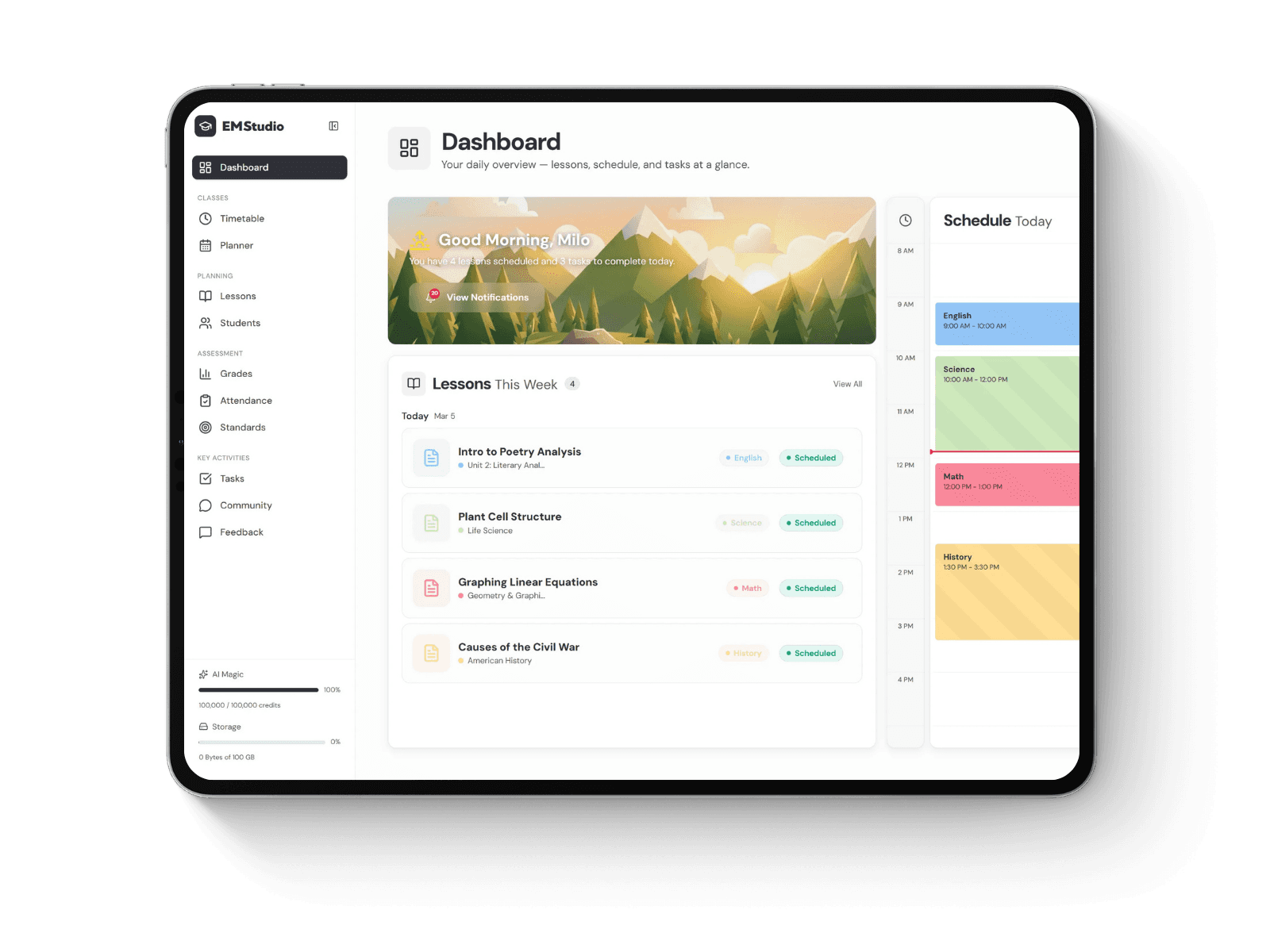
Still grading everything by hand?
EMStudio is a free teaching management app — manage your classes, students, lessons, and more!
Learn More
Table of Contents
Teaching centers and institutions are setting the terms for generative AI in schools
University teaching centers are leading this conversation because they sit close to faculty practice. The Cornell Center for Teaching Innovation frames AI guidance around course design, academic integrity, and student communication. The University of Kansas Center for Teaching Excellence takes a similarly practical approach, helping instructors rethink assignments, assessments, and expectations for AI use.
That matters because generative AI in higher education affects grading, privacy, accessibility, and student support at once. A single department rule cannot solve all of that.
But policy clarity should come before adoption. If your school buys tools before defining acceptable use, students get mixed messages, and teachers carry the risk alone.
Policy readiness score before classroom rollout
Readiness area | 0 = Not ready | 1 = Partial | 2 = Ready |
|---|---|---|---|
Student disclosure rule | No rule | Rule varies by teacher | Shared course language |
Assignment guidance | N/A | Some examples | Allowed and banned uses listed |
Equity plan | No access review | Informal concern | Device, cost, and support plan |
Parent communication | No message | One-time notice | Plain-language FAQ and contact path |
Core principles for using AI in education
Good policy starts with values students can understand. Tell students when AI classroom tools are allowed, why they are allowed, and what they must disclose. A vague “use responsibly” line does not help a student decide whether a grammar suggestion, outline, or full draft crosses the line.
Adoption should match learning goals. If the goal is brainstorming, a model can help students compare ideas. If the goal is an independent argument, the same model may hide weak reasoning.
Equity belongs in the first draft of your policy. Some students have paid tools, quiet workspaces, fast internet, and AI-fluent families. Others do not.
Match AI use to the learning goal
Course goal | Safer allowed use | Higher-risk use | Student evidence to require |
|---|---|---|---|
Build background knowledge | Ask for simple explanations | Submit uncited claims | Notes tied to course materials |
Improve writing | Get feedback on clarity | Generate final paragraphs | Draft history and revision memo |
Practice problem solving | Request hints | Copy full solution steps | Worked process and reflection |
Research sources | Generate search terms | Invent citations | Verified source annotations |
Protect academic integrity without banning every tool
Balanced integrity policies define the task. AI for teachers can support rubric drafting or example prompts, but students need citation expectations for AI-assisted work. Check authorship concerns when the pattern matters: sudden voice changes, missing process work, fake sources, or answers that ignore class readings.
Keep human judgment central
Generative AI should not replace instructor review. Teachers still judge whether work meets the standard, whether feedback fits the student, and whether a grade reflects learning. Ask students to explain what they accepted, rejected, and changed. Automated grading can sort simple practice, but it cannot know your classroom context.
Make access and equity explicit
An AI lesson planner may save staff time, but student access remains uneven. CRPE found a major communication gap around classroom AI: many schools are not clearly explaining their policies to families, making it harder for parents to support responsible use at home. Paid accounts, device limits, language access, and home internet all shape who benefits first.
What generative AI systems create
Generative systems create new text, images, code, summaries, quizzes, lesson materials, and feedback from patterns in training data and user prompts. ChatGPT, made by OpenAI, is the best-known example for many students, but the same style of model now appears inside search, writing, and learning platforms.
Traditional search points users toward existing sources. Artificial generative intelligence produces an answer, which may be useful, incomplete, or wrong. That difference changes classroom practice.
AI teaching tools can draft a reading quiz in seconds, but the teacher still has to check alignment, accuracy, bias, and reading level. ScienceDirect research discussions on higher education learning have also pushed educators to look at both learning gains and risks, not just speed.
Common outputs and classroom checks
Output type | Typical Classroom use | Main risk | Teacher check |
|---|---|---|---|
Text draft | Essay planning | Outsourced argument | Compare to notes and drafts |
Image | Visual explanation | Inaccurate details | Require caption and source basis |
Code | Debugging help | Hidden misunderstanding | Ask for line-by-line explanation |
Quiz items | Practice review | Wrong answer key | Test against course content |
Benefits for students
Students can use these systems for tutoring-style explanations, simpler wording, practice questions, and study guides. That can support student engagement when the task asks them to compare the answer with class notes. The best use is interactive: ask, check, revise, and explain. Passive copying teaches very little.
Risks for students
The use of generative AI can weaken learning when students treat output as truth. Models may produce false facts, fake citations, or polished answers with shallow reasoning. Overreliance also hurts source evaluation. If students skip the struggle, they may submit cleaner work while understanding less.

Source: https://www.pexels.com/photo/a-man-in-blazer-looking-at-the-students-work-9159042/
Classroom responses that fit real courses
Strong classroom responses change the assignment conditions, not just the syllabus warning. Start by naming what is allowed: brainstorming, grammar feedback, practice questions, or no AI support. Then, require an AI-use statement when students use a tool.
A useful statement is short and specific:
Tool used: name the system.
Purpose: explain whether it helped with ideas, feedback, coding, or study.
Student decision: state what changed and what stayed original.
Verification: list how claims, citations, or calculations were checked.
Redesign assignments around the process
Assignments most vulnerable to misuse ask for a generic final product with no checkpoints. Add drafts, reflection notes, annotated sources, and short oral defenses. A student who can explain choices, source quality, and revision decisions is more likely to be learning. Process evidence also makes grading fairer.
Use AI selectively for planning and feedback
Teachers can use planning assistants to create examples, adapt reading levels, draft discussion questions, or find gaps in a rubric. Keep the tool in a support role. You choose the objective, check the output, and decide what students see. Standards drop when the machine sets the target.
Teach students to evaluate AI output
Treat AI output as a text to inspect. Students should fact-check claims, verify citations, compare answers with course materials, and mark uncertain points. This turns tool use into AI literacy. It also helps instructors see whether the tool supports learning or replaces effort.
Set the rules before the tools
Generative AI is not a single classroom problem to ban or a shortcut to adopt without limits. It is a set of tools that can support planning, feedback, tutoring, and creative work when educators connect their use to clear learning goals.
The safest path is transparent policy, redesigned assignments, explicit student guidance, and ongoing attention to equity and access. Schools and universities that treat AI as a literacy issue, not just a discipline issue, will be better prepared to help students use these systems responsibly.
Teaching centers and institutions are setting the terms for generative AI in schools
University teaching centers are leading this conversation because they sit close to faculty practice. The Cornell Center for Teaching Innovation frames AI guidance around course design, academic integrity, and student communication. The University of Kansas Center for Teaching Excellence takes a similarly practical approach, helping instructors rethink assignments, assessments, and expectations for AI use.
That matters because generative AI in higher education affects grading, privacy, accessibility, and student support at once. A single department rule cannot solve all of that.
But policy clarity should come before adoption. If your school buys tools before defining acceptable use, students get mixed messages, and teachers carry the risk alone.
Policy readiness score before classroom rollout
Readiness area | 0 = Not ready | 1 = Partial | 2 = Ready |
|---|---|---|---|
Student disclosure rule | No rule | Rule varies by teacher | Shared course language |
Assignment guidance | N/A | Some examples | Allowed and banned uses listed |
Equity plan | No access review | Informal concern | Device, cost, and support plan |
Parent communication | No message | One-time notice | Plain-language FAQ and contact path |
Core principles for using AI in education
Good policy starts with values students can understand. Tell students when AI classroom tools are allowed, why they are allowed, and what they must disclose. A vague “use responsibly” line does not help a student decide whether a grammar suggestion, outline, or full draft crosses the line.
Adoption should match learning goals. If the goal is brainstorming, a model can help students compare ideas. If the goal is an independent argument, the same model may hide weak reasoning.
Equity belongs in the first draft of your policy. Some students have paid tools, quiet workspaces, fast internet, and AI-fluent families. Others do not.
Match AI use to the learning goal
Course goal | Safer allowed use | Higher-risk use | Student evidence to require |
|---|---|---|---|
Build background knowledge | Ask for simple explanations | Submit uncited claims | Notes tied to course materials |
Improve writing | Get feedback on clarity | Generate final paragraphs | Draft history and revision memo |
Practice problem solving | Request hints | Copy full solution steps | Worked process and reflection |
Research sources | Generate search terms | Invent citations | Verified source annotations |
Protect academic integrity without banning every tool
Balanced integrity policies define the task. AI for teachers can support rubric drafting or example prompts, but students need citation expectations for AI-assisted work. Check authorship concerns when the pattern matters: sudden voice changes, missing process work, fake sources, or answers that ignore class readings.
Keep human judgment central
Generative AI should not replace instructor review. Teachers still judge whether work meets the standard, whether feedback fits the student, and whether a grade reflects learning. Ask students to explain what they accepted, rejected, and changed. Automated grading can sort simple practice, but it cannot know your classroom context.
Make access and equity explicit
An AI lesson planner may save staff time, but student access remains uneven. CRPE found a major communication gap around classroom AI: many schools are not clearly explaining their policies to families, making it harder for parents to support responsible use at home. Paid accounts, device limits, language access, and home internet all shape who benefits first.
What generative AI systems create
Generative systems create new text, images, code, summaries, quizzes, lesson materials, and feedback from patterns in training data and user prompts. ChatGPT, made by OpenAI, is the best-known example for many students, but the same style of model now appears inside search, writing, and learning platforms.
Traditional search points users toward existing sources. Artificial generative intelligence produces an answer, which may be useful, incomplete, or wrong. That difference changes classroom practice.
AI teaching tools can draft a reading quiz in seconds, but the teacher still has to check alignment, accuracy, bias, and reading level. ScienceDirect research discussions on higher education learning have also pushed educators to look at both learning gains and risks, not just speed.
Common outputs and classroom checks
Output type | Typical Classroom use | Main risk | Teacher check |
|---|---|---|---|
Text draft | Essay planning | Outsourced argument | Compare to notes and drafts |
Image | Visual explanation | Inaccurate details | Require caption and source basis |
Code | Debugging help | Hidden misunderstanding | Ask for line-by-line explanation |
Quiz items | Practice review | Wrong answer key | Test against course content |
Benefits for students
Students can use these systems for tutoring-style explanations, simpler wording, practice questions, and study guides. That can support student engagement when the task asks them to compare the answer with class notes. The best use is interactive: ask, check, revise, and explain. Passive copying teaches very little.
Risks for students
The use of generative AI can weaken learning when students treat output as truth. Models may produce false facts, fake citations, or polished answers with shallow reasoning. Overreliance also hurts source evaluation. If students skip the struggle, they may submit cleaner work while understanding less.
Source: https://www.pexels.com/photo/a-man-in-blazer-looking-at-the-students-work-9159042/
Classroom responses that fit real courses
Strong classroom responses change the assignment conditions, not just the syllabus warning. Start by naming what is allowed: brainstorming, grammar feedback, practice questions, or no AI support. Then, require an AI-use statement when students use a tool.
A useful statement is short and specific:
Tool used: name the system.
Purpose: explain whether it helped with ideas, feedback, coding, or study.
Student decision: state what changed and what stayed original.
Verification: list how claims, citations, or calculations were checked.
Redesign assignments around the process
Assignments most vulnerable to misuse ask for a generic final product with no checkpoints. Add drafts, reflection notes, annotated sources, and short oral defenses. A student who can explain choices, source quality, and revision decisions is more likely to be learning. Process evidence also makes grading fairer.
Use AI selectively for planning and feedback
Teachers can use planning assistants to create examples, adapt reading levels, draft discussion questions, or find gaps in a rubric. Keep the tool in a support role. You choose the objective, check the output, and decide what students see. Standards drop when the machine sets the target.
Teach students to evaluate AI output
Treat AI output as a text to inspect. Students should fact-check claims, verify citations, compare answers with course materials, and mark uncertain points. This turns tool use into AI literacy. It also helps instructors see whether the tool supports learning or replaces effort.
Set the rules before the tools
Generative AI is not a single classroom problem to ban or a shortcut to adopt without limits. It is a set of tools that can support planning, feedback, tutoring, and creative work when educators connect their use to clear learning goals.
The safest path is transparent policy, redesigned assignments, explicit student guidance, and ongoing attention to equity and access. Schools and universities that treat AI as a literacy issue, not just a discipline issue, will be better prepared to help students use these systems responsibly.
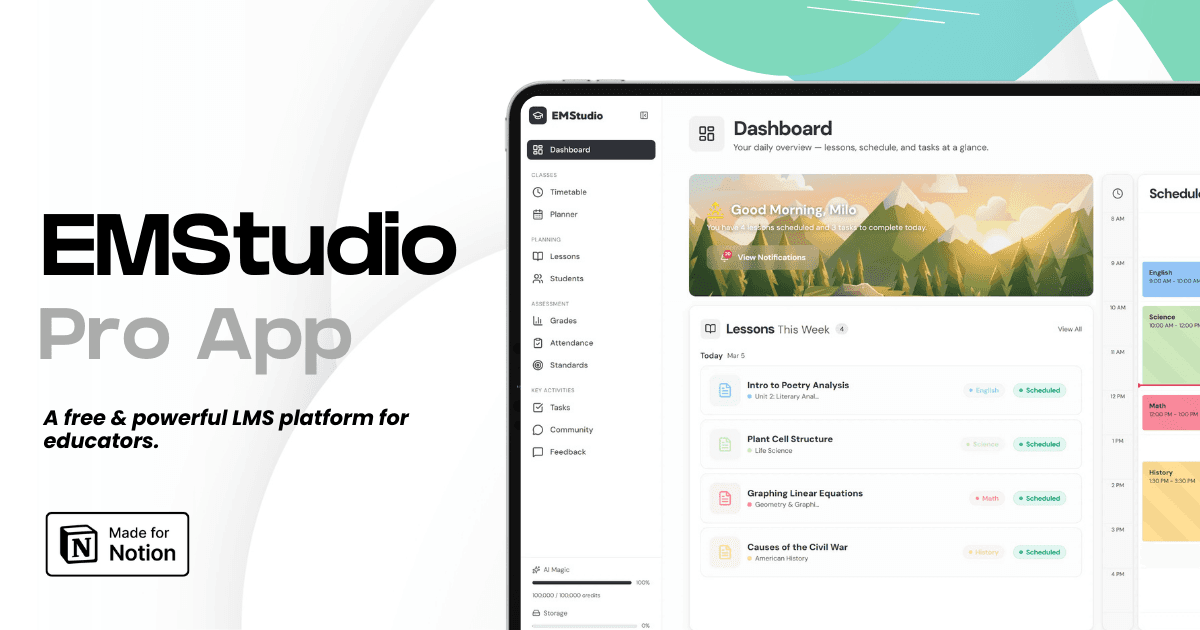
Still grading everything by hand?
EMStudio is a free teaching management app — manage your classes, students, lessons, and more!
Learn More
Still grading everything by hand?
EMStudio is a free teaching management app — manage your classes, students, lessons, and more!
Learn More



Notion4Teachers
Notion templates to simplify administrative tasks and enhance your teaching experience.



2026 Notion4Teachers. All Rights Reserved.
Notion4Teachers
Notion templates to simplify administrative tasks and enhance your teaching experience.
2026 Notion4Teachers. All Rights Reserved.
Notion4Teachers
Notion templates to simplify administrative tasks and enhance your teaching experience.
2026 Notion4Teachers. All Rights Reserved.