
8 Practical Ways to Streamline Lesson Planning and Content Creation in 2026
8 Practical Ways to Streamline Lesson Planning and Content Creation in 2026

Article by
Milo
ESL Content Coordinator & Educator
ESL Content Coordinator & Educator
All Posts
Planning a single week of lessons can feel like juggling ten different apps at once. You are pulling curriculum standards from one document, cobbling together a worksheet in another, answering parent emails on the side, and trying to remember where you saved last year's reading guide. The content itself is rarely the hard part. The hard part is the scatter.
That is why so many educators have moved their planning into Notion. A single workspace can hold lesson plans, unit calendars, resource libraries, and student-facing pages without forcing you to bounce between tabs. But Notion on its own is only half the solution. The other half is pairing it with a small, reliable set of tools and workflows that turn blank pages into finished lessons, faster.
Below are eight practical strategies for cutting planning time, reducing context-switching, and building a system that holds up week after week. Each one is designed to slot directly into an existing Notion setup, with no overhaul required.
Still grading everything by hand?
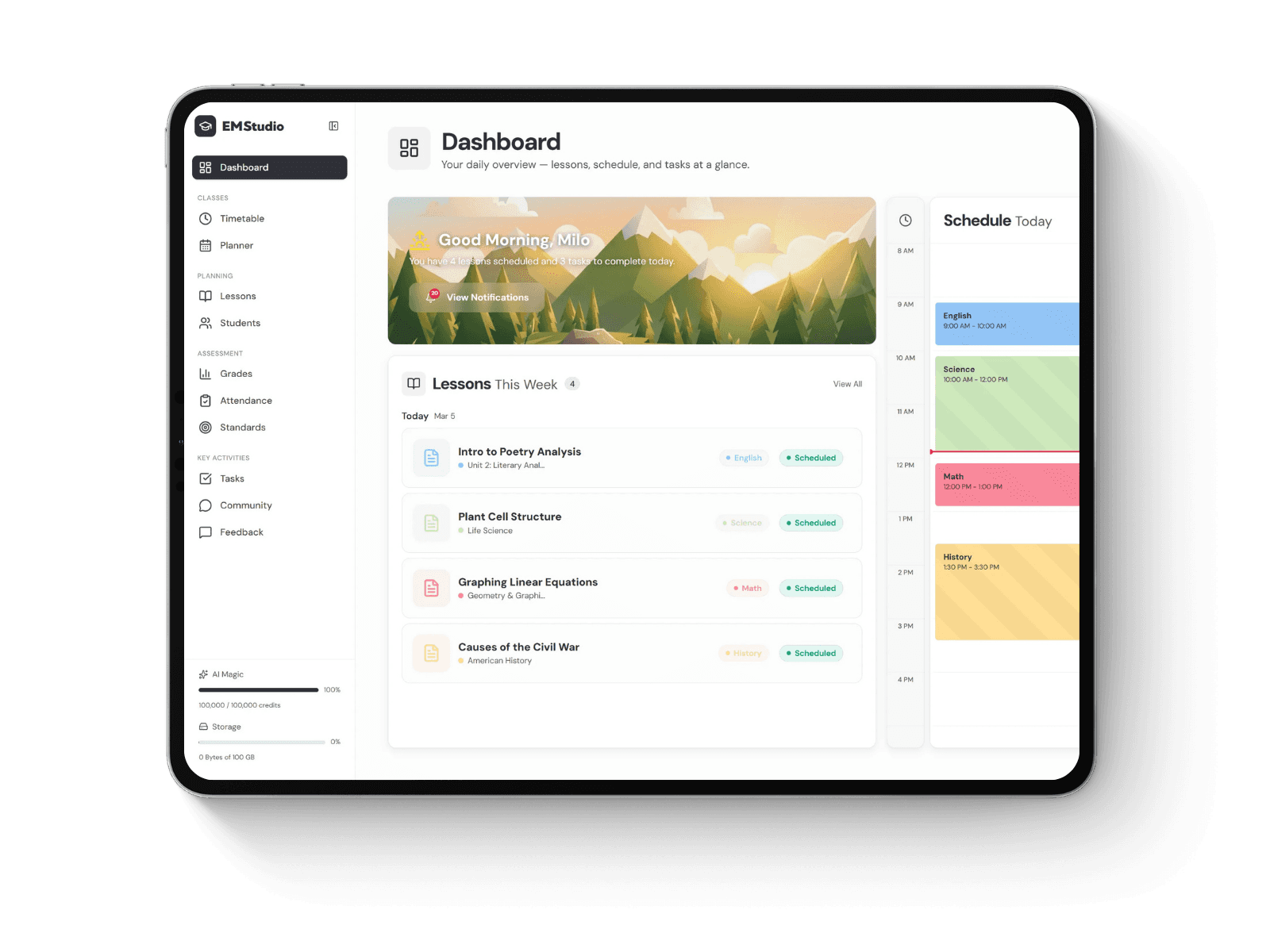
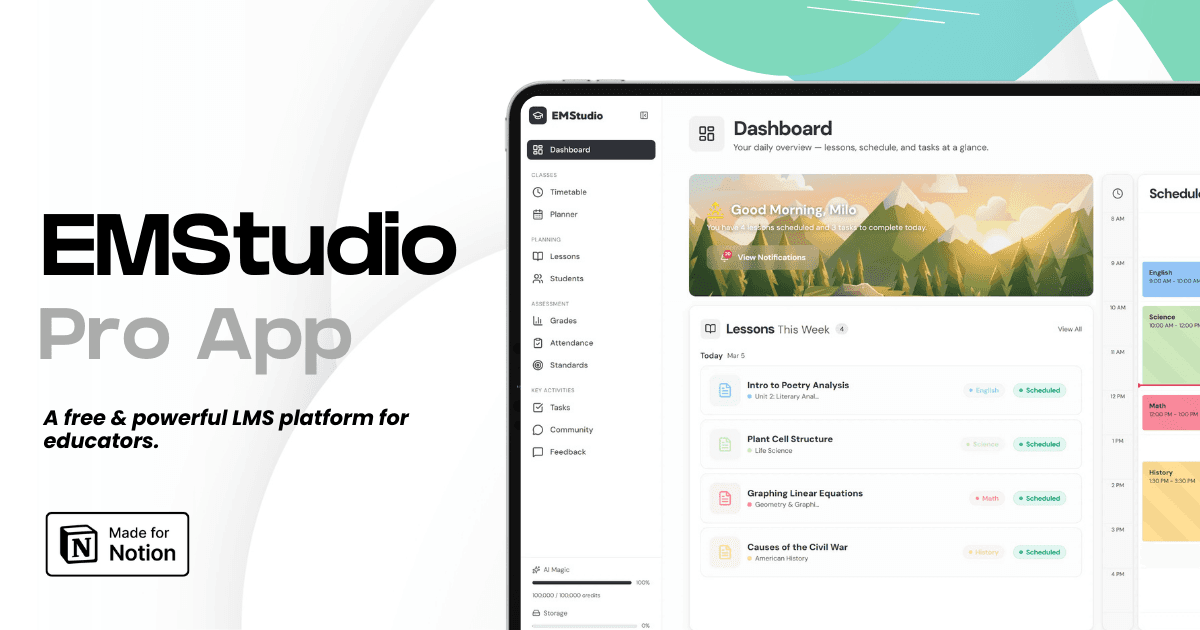
EMStudio is a free teaching management app — manage your classes, students, lessons, and more!
Learn More
Still grading everything by hand?
EMStudio is a free teaching management app — manage your classes, students, lessons, and more!
Learn More
Table of Contents
1. Build a Master Unit Database Instead of Standalone Pages
One of the fastest ways to lose time is recreating the same lesson structure every week. A master unit database in Notion solves this by storing every lesson as a row in one central database, with properties for subject, grade level, standard, duration, and status. From there, you can filter, group, and display the same data in a dozen different views: a weekly calendar, a standards tracker, or a backlog of lessons that still need resources.
Classroom example: a middle school science teacher creates one "Lessons" database and tags each entry with the NGSS standard it covers. When a parent or administrator asks which standards have been taught so far this quarter, a filtered view answers the question in seconds.
If you are still new to databases, the Lesson Planner template on Notion4Teachers is a good starting point, since it already has the structure in place.
2. Use Templates Within Templates for Repeatable Lesson Formats
Notion lets you save a page template inside any database, which means every new lesson can start with your preferred format pre-filled: objectives, warm-up, direct instruction, guided practice, independent practice, exit ticket. Click "New," pick the template, and you skip the cognitive load of starting from a blank page.
Classroom example: an elementary teacher builds two templates in the same lesson database, one for literacy blocks and one for math blocks, each with its own structure. New lessons take two minutes to scaffold instead of fifteen.
3. Generate First-Draft Lesson Content with a Dedicated Writing Tool
Drafting lesson content, worksheets, and summaries from scratch is one of the most time-consuming parts of the week. A dedicated writing tool can take the first pass off your plate, giving you a rough draft that you then refine for your specific students, rather than staring at an empty document.
The free Content Writer developed by Tomedes, a translation company, is one option worth knowing about. It generates written content in response to a prompt, and what makes it notably useful for educators is that it compares outputs from multiple AI models and assembles the final draft from the segments those models agree on. For classroom use, that tends to mean fewer odd factual slips in the first draft, which is the draft you are actually going to review and edit.
Classroom example: a high school humanities teacher uses it to generate a 300-word background summary on the Industrial Revolution, then edits the draft in Notion to match the reading level of her class and adds three comprehension questions. What would have been a thirty-minute task becomes a ten-minute one.
As with any AI-generated content, the final review still belongs to the teacher. The tool is a drafting assistant, not a replacement for professional judgment.
4. Create a Resource Library That Actually Gets Used
Most teachers have a folder somewhere full of PDFs, links, and scanned worksheets that they rarely revisit because finding anything takes too long. A Notion resource library fixes this by turning those assets into searchable database entries tagged by subject, skill, type (worksheet, video, slide deck), and grade level.
Classroom example: a language teacher saves every reading passage as a resource entry with tags for CEFR level, topic, and estimated time. When planning a lesson, she filters for "B1, environment, 15 minutes" and finds three options in under a minute.
Pairing a resource library with a clear lesson plan format makes the whole system click, since you know exactly where each piece of content belongs.
5. Replace Endless Email Threads with a Shared Planning Board
If you co-plan with other teachers, a shared Notion page is almost always faster than a group email chain. A simple Kanban board with columns for "To Plan," "Drafting," "Ready to Teach," and "Taught" gives everyone visibility into who is working on what without anyone having to ask.
Classroom example: three fifth-grade teachers sharing a grade level share one planning board. Unit leads rotate; each teacher can see who owns what and what is due next without opening their inbox. Research on teacher collaboration consistently finds that shared planning systems reduce duplication of effort and improve instructional coherence, something the OECD's TALIS findings have documented across education systems.
6. Build a Differentiation Layer Into Every Lesson
Differentiated instruction often falls apart not because teachers do not believe in it, but because there is nowhere obvious to store the variations. Adding a simple toggle block to each lesson page, labeled something like "Scaffolded version" and "Extension version," gives you a consistent home for the adaptations you are already making.
Classroom example: a special education teacher adds three toggles to every lesson template: one for modified vocabulary, one for visual supports, and one for extension tasks. Over a semester, these toggles become a reusable bank of differentiation moves.
If you want a deeper walkthrough of this approach, using Notion to support differentiated instruction covers it in detail.
7. Automate the Weekly Review with a Recurring Dashboard
A weekly review of five or ten minutes spent looking at what was taught, what is coming up, and what needs adjusting is one of the highest-leverage habits a teacher can build. Notion makes it easy to set up a dashboard that surfaces exactly what you need: lessons taught this week, upcoming assessments, students flagged for follow-up, and a space for reflection notes.
Classroom example: a teacher opens her Notion dashboard every Friday afternoon. A filtered view shows lessons from the past week with a "What worked / what to adjust" field, and another shows next week's plan in a single column. Ten minutes later, planning for Monday is already half done.
Evidence from the Education Endowment Foundation suggests that regular, structured reflection is one of the most cost-effective ways to improve teaching practice, and a dashboard is the simplest way to make it stick.
8. Link Notion to One External Tool You Already Use
The fastest way to make Notion indispensable is to connect it to one tool you already rely on, such as Google Calendar, Google Drive, or an assignment platform. You do not need a complex automation setup. A single embed or synced link pulls information into Notion so you stop toggling.
Classroom example: a teacher embeds her school Google Calendar directly into the top of her Notion weekly planning page. Schedule changes show up automatically, and she never has to check two places to see what is happening tomorrow.
The goal is not to turn Notion into the one true app for everything. It is to make Notion the hub where the signals from your other tools come to rest.
Putting It Into Practice
None of these strategies are about working more. They are about making the same amount of teaching feel less chaotic. If you are starting fresh, pick two: one structural change (like a unit database) and one workflow change (like a weekly review dashboard). Run both for three weeks before adding anything else.
The teachers who get the most out of Notion are not the ones with the most elaborate workspaces. They are the ones who have a small, reliable system that reduces friction on the boring parts of the job, so they can spend the saved time on the parts that actually matter: the students in the room.
1. Build a Master Unit Database Instead of Standalone Pages
One of the fastest ways to lose time is recreating the same lesson structure every week. A master unit database in Notion solves this by storing every lesson as a row in one central database, with properties for subject, grade level, standard, duration, and status. From there, you can filter, group, and display the same data in a dozen different views: a weekly calendar, a standards tracker, or a backlog of lessons that still need resources.
Classroom example: a middle school science teacher creates one "Lessons" database and tags each entry with the NGSS standard it covers. When a parent or administrator asks which standards have been taught so far this quarter, a filtered view answers the question in seconds.
If you are still new to databases, the Lesson Planner template on Notion4Teachers is a good starting point, since it already has the structure in place.
2. Use Templates Within Templates for Repeatable Lesson Formats
Notion lets you save a page template inside any database, which means every new lesson can start with your preferred format pre-filled: objectives, warm-up, direct instruction, guided practice, independent practice, exit ticket. Click "New," pick the template, and you skip the cognitive load of starting from a blank page.
Classroom example: an elementary teacher builds two templates in the same lesson database, one for literacy blocks and one for math blocks, each with its own structure. New lessons take two minutes to scaffold instead of fifteen.
3. Generate First-Draft Lesson Content with a Dedicated Writing Tool
Drafting lesson content, worksheets, and summaries from scratch is one of the most time-consuming parts of the week. A dedicated writing tool can take the first pass off your plate, giving you a rough draft that you then refine for your specific students, rather than staring at an empty document.
The free Content Writer developed by Tomedes, a translation company, is one option worth knowing about. It generates written content in response to a prompt, and what makes it notably useful for educators is that it compares outputs from multiple AI models and assembles the final draft from the segments those models agree on. For classroom use, that tends to mean fewer odd factual slips in the first draft, which is the draft you are actually going to review and edit.
Classroom example: a high school humanities teacher uses it to generate a 300-word background summary on the Industrial Revolution, then edits the draft in Notion to match the reading level of her class and adds three comprehension questions. What would have been a thirty-minute task becomes a ten-minute one.
As with any AI-generated content, the final review still belongs to the teacher. The tool is a drafting assistant, not a replacement for professional judgment.
4. Create a Resource Library That Actually Gets Used
Most teachers have a folder somewhere full of PDFs, links, and scanned worksheets that they rarely revisit because finding anything takes too long. A Notion resource library fixes this by turning those assets into searchable database entries tagged by subject, skill, type (worksheet, video, slide deck), and grade level.
Classroom example: a language teacher saves every reading passage as a resource entry with tags for CEFR level, topic, and estimated time. When planning a lesson, she filters for "B1, environment, 15 minutes" and finds three options in under a minute.
Pairing a resource library with a clear lesson plan format makes the whole system click, since you know exactly where each piece of content belongs.
5. Replace Endless Email Threads with a Shared Planning Board
If you co-plan with other teachers, a shared Notion page is almost always faster than a group email chain. A simple Kanban board with columns for "To Plan," "Drafting," "Ready to Teach," and "Taught" gives everyone visibility into who is working on what without anyone having to ask.
Classroom example: three fifth-grade teachers sharing a grade level share one planning board. Unit leads rotate; each teacher can see who owns what and what is due next without opening their inbox. Research on teacher collaboration consistently finds that shared planning systems reduce duplication of effort and improve instructional coherence, something the OECD's TALIS findings have documented across education systems.
6. Build a Differentiation Layer Into Every Lesson
Differentiated instruction often falls apart not because teachers do not believe in it, but because there is nowhere obvious to store the variations. Adding a simple toggle block to each lesson page, labeled something like "Scaffolded version" and "Extension version," gives you a consistent home for the adaptations you are already making.
Classroom example: a special education teacher adds three toggles to every lesson template: one for modified vocabulary, one for visual supports, and one for extension tasks. Over a semester, these toggles become a reusable bank of differentiation moves.
If you want a deeper walkthrough of this approach, using Notion to support differentiated instruction covers it in detail.
7. Automate the Weekly Review with a Recurring Dashboard
A weekly review of five or ten minutes spent looking at what was taught, what is coming up, and what needs adjusting is one of the highest-leverage habits a teacher can build. Notion makes it easy to set up a dashboard that surfaces exactly what you need: lessons taught this week, upcoming assessments, students flagged for follow-up, and a space for reflection notes.
Classroom example: a teacher opens her Notion dashboard every Friday afternoon. A filtered view shows lessons from the past week with a "What worked / what to adjust" field, and another shows next week's plan in a single column. Ten minutes later, planning for Monday is already half done.
Evidence from the Education Endowment Foundation suggests that regular, structured reflection is one of the most cost-effective ways to improve teaching practice, and a dashboard is the simplest way to make it stick.
8. Link Notion to One External Tool You Already Use
The fastest way to make Notion indispensable is to connect it to one tool you already rely on, such as Google Calendar, Google Drive, or an assignment platform. You do not need a complex automation setup. A single embed or synced link pulls information into Notion so you stop toggling.
Classroom example: a teacher embeds her school Google Calendar directly into the top of her Notion weekly planning page. Schedule changes show up automatically, and she never has to check two places to see what is happening tomorrow.
The goal is not to turn Notion into the one true app for everything. It is to make Notion the hub where the signals from your other tools come to rest.
Putting It Into Practice
None of these strategies are about working more. They are about making the same amount of teaching feel less chaotic. If you are starting fresh, pick two: one structural change (like a unit database) and one workflow change (like a weekly review dashboard). Run both for three weeks before adding anything else.
The teachers who get the most out of Notion are not the ones with the most elaborate workspaces. They are the ones who have a small, reliable system that reduces friction on the boring parts of the job, so they can spend the saved time on the parts that actually matter: the students in the room.
Still grading everything by hand?
EMStudio is a free teaching management app — manage your classes, students, lessons, and more!
Learn More
Still grading everything by hand?
EMStudio is a free teaching management app — manage your classes, students, lessons, and more!
Learn More


Notion4Teachers
Notion templates to simplify administrative tasks and enhance your teaching experience.



2026 Notion4Teachers. All Rights Reserved.
Notion4Teachers
Notion templates to simplify administrative tasks and enhance your teaching experience.
2026 Notion4Teachers. All Rights Reserved.
Notion4Teachers
Notion templates to simplify administrative tasks and enhance your teaching experience.
2026 Notion4Teachers. All Rights Reserved.