
How Teachers Selling Notion Templates Can Get Them Found in Search
How Teachers Selling Notion Templates Can Get Them Found in Search

Article by
Milo
ESL Content Coordinator & Educator
ESL Content Coordinator & Educator
All Posts
Meta Title: How Teachers Selling Notion Templates Get Found in Search (57 characters)
Meta Description: Selling Notion templates you built for your classroom? Here's how teachers can make them easier to find through listings, product pages, content and SEO. (153 characters)
A lot of teacher-made Notion templates start the same way. You build a planner for your own classroom, a colleague asks for a copy, then three more do, and at some point you put a price on it. Selling Notion templates turns into a small side business before you've decided to start one.
Building the template is the part teachers are good at. Getting it in front of the next teacher who needs it is harder, and that's mostly a search problem. This guide covers how to name, list and describe teacher templates so people can find them, plus a simple way to keep track of the work in Notion itself.
Still grading everything by hand?
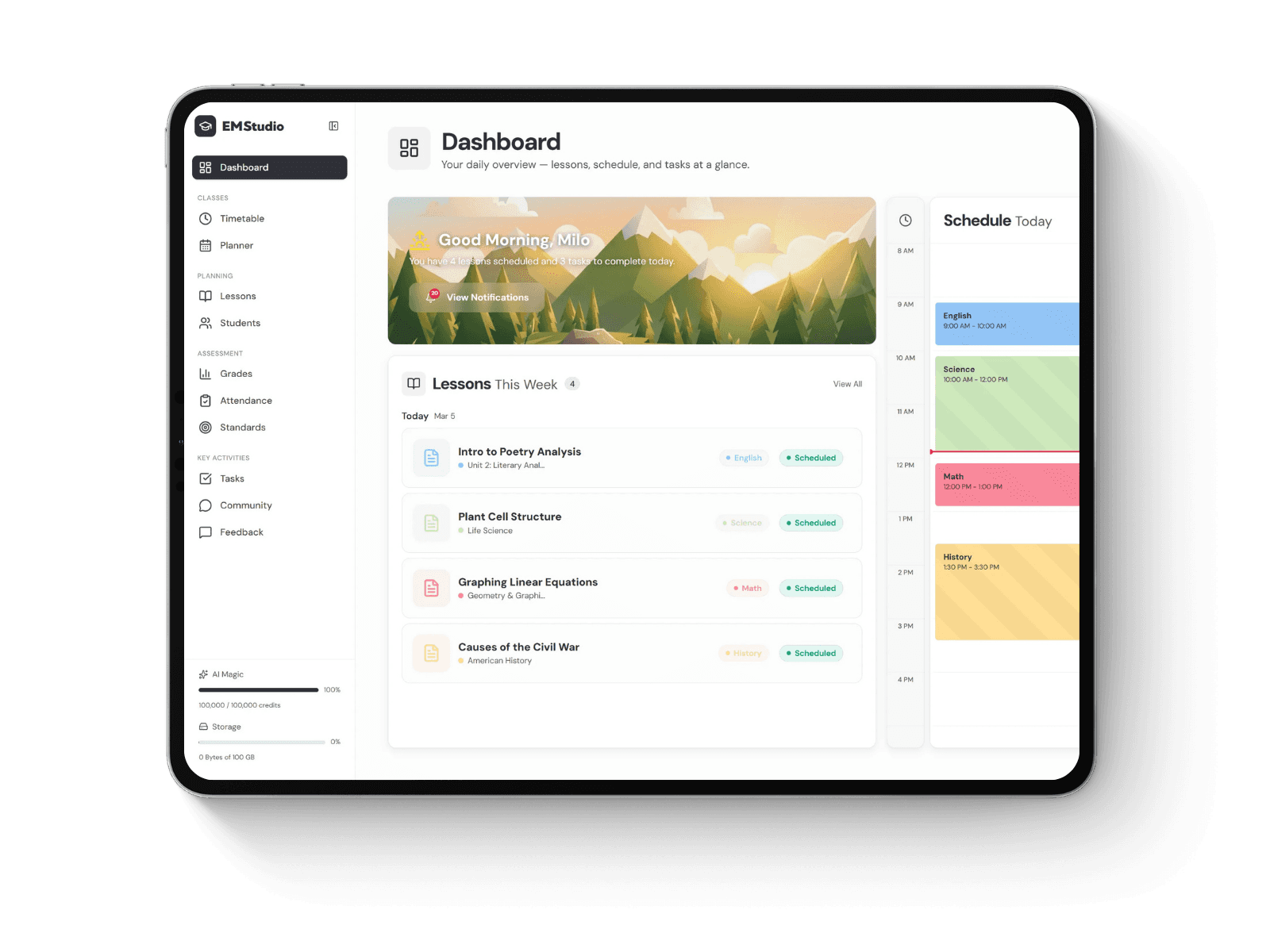
EMStudio is a free teaching management app — manage your classes, students, lessons, and more!
Learn More
Still grading everything by hand?
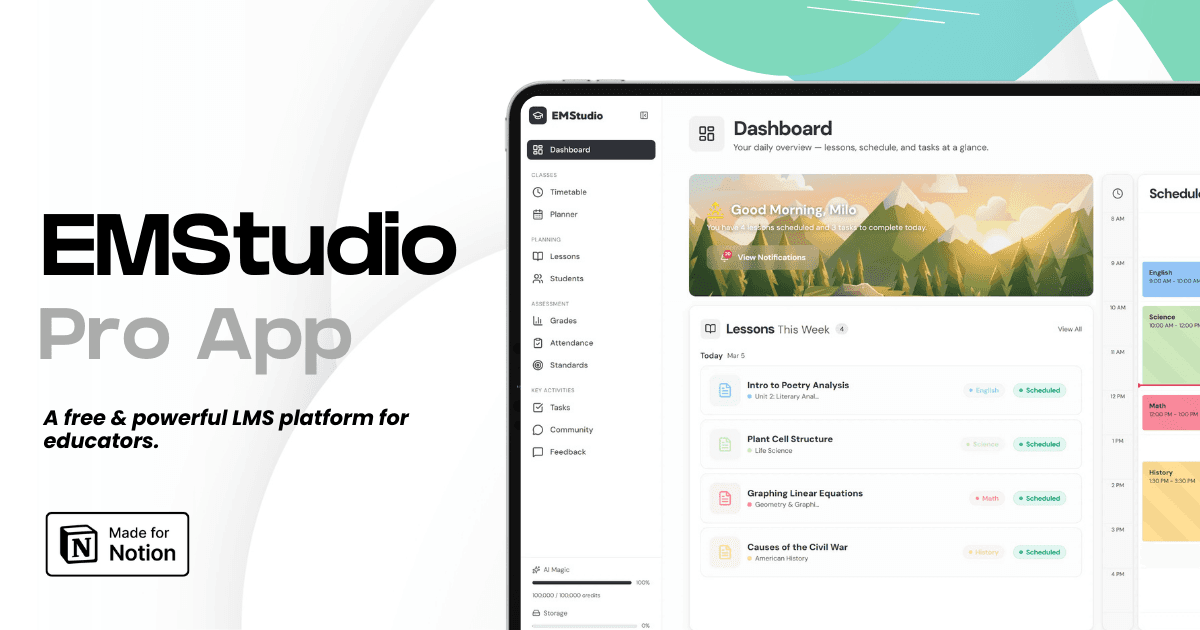
EMStudio is a free teaching management app — manage your classes, students, lessons, and more!
Learn More
Table of Contents
Start With What Teachers Type
Teachers looking for a template rarely search for a product name. They search for the job they're trying to get done: "Notion lesson planner for high school," "gradebook template Notion," "substitute plan template." Some are browsing a marketplace category. Others start on Google and click whatever looks closest.
So before touching a listing, write down five or six phrases a teacher might use to find what you made. Think grade level, subject and the task itself. "Weekly planner" is broad. "Weekly lesson planner for elementary teachers" is closer to how a tired teacher searches on a Sunday night.
Keep that list somewhere handy. It shapes almost everything below.
Name Templates the Way Teachers Search
Creative names are fun, and they can work as a brand. But a name like "The Sunday Reset" tells a buyer nothing on its own. Pairing it with a plain description fixes that: "The Sunday Reset: Weekly Lesson Planner for Middle School Teachers."
The same goes for descriptions. Lead with who the template is for and what it helps with, then list what's inside. Teachers want to know whether it fits their setup: grade level, subjects, whether it handles multiple class periods, whether it works on the free Notion plan. Answer those directly and you save buyers a round of questions.
Listing on the Notion Marketplace
The Notion Marketplace is an obvious place to sell, since the people browsing it already use Notion. Notion's help guide onselling templates on its Marketplace lists what a listing needs, including a name, a category, screenshots or a short video, a brief and a full description, and a custom URL.
Each of those is a chance to use the phrases from your list. Pick the category that matches what a teacher would browse, write the brief description for someone skimming, and use the screenshots to show the template filled in with realistic sample data rather than empty tables.
One practical note: the same help page says submissions are reviewed by the Notion team and approval can take a few months. That's a good reason not to rely on the Marketplace alone.
A Product Page You Control
A page on your own website, even a simple one, gives search engines another page they can crawl and potentially show for relevant searches. It also gives you a place to send people from social media, teacher groups or a newsletter, wherever the template is sold.
Google'sSEO Starter Guide covers the basics that matter most for a small product page. Give each page a unique, clear title that describes what's on it. Use readable words in the URL, write a short description that sums up the page, and add descriptive alt text to your screenshots. The guide also warns against stuffing the same keyword over and over, which reads badly to people too.
Patience helps here. Google's guide notes that you may need to wait a few weeks to see whether changes had any effect in search results, so don't rewrite everything after three days.
Write About the Problem, Not Only the Product
Product pages usually target a narrower set of searches. Short posts that answer real teacher questions tend to reach people earlier, before they've decided they want a template at all.
Think "how to plan a unit in Notion," "setting up a Notion gradebook for multiple class periods" or "what to put in a substitute folder." Each post can teach something useful on its own, then mention your template as one way to do it. If you record a quick walkthrough video for the post, you can reuse it in your Marketplace listing too.
There's a trust benefit, too. A teacher who found your post useful may also have more confidence in the expertise behind your template.
Track the Whole Thing in Notion
It would be odd to run a Notion template business without a Notion system behind it. One database can hold every listing, page and post in one place:
Item (template name, product page, blog post)
Where it lives (Marketplace, your site, another shop)
Target phrase from your list
Status (draft, live, needs update)
Last updated date
Notes on search terms or buyer questions
Add a view sorted by "last updated" so stale listings rise to the top. Notion database templates can repeat, so a monthly review task can create itself. When it comes up, check your site's search data in Google Search Console, note which phrases are bringing visitors in, and add them to the matching row. Over a school year, that column shows which templates teachers are looking for, which is useful when deciding what to build next.
When It Makes Sense to Get Outside Help
For many teacher-sellers, the steps above are plenty. Clear names, honest listings and a handful of helpful posts can keep a small shop steady.
Things change when the shop grows into a real business, with dozens of templates, its own site and other sellers competing for the same searches. The work involved in SEO, content, technical improvements and paid search can take more hours than a working teacher has. At that point, an agency such ashqdm.io can help with SEO and PPC when the work becomes more than a teacher can reasonably manage alone.
Whoever you talk to, ask what will be done each month and how results will be reported. A good answer should be specific enough to drop straight into your tracker.
Mistakes That Can Cost a Template Seller Sales
Screenshots cause more trouble than people expect. Never use a screenshot from your real classroom workspace, even blurred. Use made-up sample data for student names, grades and notes, so nothing identifiable ends up in a listing.
Be careful with promises, too. "Saves you five hours a week" is hard to back up, and buyers can feel misled if it doesn't happen for them. Describing what the template does and showing it in use is more honest, and it gives buyers what they need to decide.
It's also tempting to copy what a best-selling template calls itself. Borrowing another seller's exact title, description or layout can cause problems with the platform and with other teachers, who tend to notice. Your own words, built from your own search phrases, give buyers a clearer reason to pick yours.
And keep listings in sync. If you update a template, update the screenshots and descriptions everywhere it's sold. An outdated listing that doesn't match what the buyer receives is a quick route to a refund request.
A Short Plan for This Month
Pick three things and do them before the next school break:
Write the five or six search phrases a teacher might use for your best-selling template.
Rewrite that template's title and description so the phrase and the audience are clear.
Set up the tracker database and add every place the template is listed.
That's enough to start. Check the tracker at the end of each term, see which phrases and pages are bringing people in, and let those notes decide where your next free weekend goes. If a template keeps getting found but rarely bought, the listing probably needs work. If one barely gets found at all, the name and description are the place to start.
Start With What Teachers Type
Teachers looking for a template rarely search for a product name. They search for the job they're trying to get done: "Notion lesson planner for high school," "gradebook template Notion," "substitute plan template." Some are browsing a marketplace category. Others start on Google and click whatever looks closest.
So before touching a listing, write down five or six phrases a teacher might use to find what you made. Think grade level, subject and the task itself. "Weekly planner" is broad. "Weekly lesson planner for elementary teachers" is closer to how a tired teacher searches on a Sunday night.
Keep that list somewhere handy. It shapes almost everything below.
Name Templates the Way Teachers Search
Creative names are fun, and they can work as a brand. But a name like "The Sunday Reset" tells a buyer nothing on its own. Pairing it with a plain description fixes that: "The Sunday Reset: Weekly Lesson Planner for Middle School Teachers."
The same goes for descriptions. Lead with who the template is for and what it helps with, then list what's inside. Teachers want to know whether it fits their setup: grade level, subjects, whether it handles multiple class periods, whether it works on the free Notion plan. Answer those directly and you save buyers a round of questions.
Listing on the Notion Marketplace
The Notion Marketplace is an obvious place to sell, since the people browsing it already use Notion. Notion's help guide onselling templates on its Marketplace lists what a listing needs, including a name, a category, screenshots or a short video, a brief and a full description, and a custom URL.
Each of those is a chance to use the phrases from your list. Pick the category that matches what a teacher would browse, write the brief description for someone skimming, and use the screenshots to show the template filled in with realistic sample data rather than empty tables.
One practical note: the same help page says submissions are reviewed by the Notion team and approval can take a few months. That's a good reason not to rely on the Marketplace alone.
A Product Page You Control
A page on your own website, even a simple one, gives search engines another page they can crawl and potentially show for relevant searches. It also gives you a place to send people from social media, teacher groups or a newsletter, wherever the template is sold.
Google'sSEO Starter Guide covers the basics that matter most for a small product page. Give each page a unique, clear title that describes what's on it. Use readable words in the URL, write a short description that sums up the page, and add descriptive alt text to your screenshots. The guide also warns against stuffing the same keyword over and over, which reads badly to people too.
Patience helps here. Google's guide notes that you may need to wait a few weeks to see whether changes had any effect in search results, so don't rewrite everything after three days.
Write About the Problem, Not Only the Product
Product pages usually target a narrower set of searches. Short posts that answer real teacher questions tend to reach people earlier, before they've decided they want a template at all.
Think "how to plan a unit in Notion," "setting up a Notion gradebook for multiple class periods" or "what to put in a substitute folder." Each post can teach something useful on its own, then mention your template as one way to do it. If you record a quick walkthrough video for the post, you can reuse it in your Marketplace listing too.
There's a trust benefit, too. A teacher who found your post useful may also have more confidence in the expertise behind your template.
Track the Whole Thing in Notion
It would be odd to run a Notion template business without a Notion system behind it. One database can hold every listing, page and post in one place:
Item (template name, product page, blog post)
Where it lives (Marketplace, your site, another shop)
Target phrase from your list
Status (draft, live, needs update)
Last updated date
Notes on search terms or buyer questions
Add a view sorted by "last updated" so stale listings rise to the top. Notion database templates can repeat, so a monthly review task can create itself. When it comes up, check your site's search data in Google Search Console, note which phrases are bringing visitors in, and add them to the matching row. Over a school year, that column shows which templates teachers are looking for, which is useful when deciding what to build next.
When It Makes Sense to Get Outside Help
For many teacher-sellers, the steps above are plenty. Clear names, honest listings and a handful of helpful posts can keep a small shop steady.
Things change when the shop grows into a real business, with dozens of templates, its own site and other sellers competing for the same searches. The work involved in SEO, content, technical improvements and paid search can take more hours than a working teacher has. At that point, an agency such ashqdm.io can help with SEO and PPC when the work becomes more than a teacher can reasonably manage alone.
Whoever you talk to, ask what will be done each month and how results will be reported. A good answer should be specific enough to drop straight into your tracker.
Mistakes That Can Cost a Template Seller Sales
Screenshots cause more trouble than people expect. Never use a screenshot from your real classroom workspace, even blurred. Use made-up sample data for student names, grades and notes, so nothing identifiable ends up in a listing.
Be careful with promises, too. "Saves you five hours a week" is hard to back up, and buyers can feel misled if it doesn't happen for them. Describing what the template does and showing it in use is more honest, and it gives buyers what they need to decide.
It's also tempting to copy what a best-selling template calls itself. Borrowing another seller's exact title, description or layout can cause problems with the platform and with other teachers, who tend to notice. Your own words, built from your own search phrases, give buyers a clearer reason to pick yours.
And keep listings in sync. If you update a template, update the screenshots and descriptions everywhere it's sold. An outdated listing that doesn't match what the buyer receives is a quick route to a refund request.
A Short Plan for This Month
Pick three things and do them before the next school break:
Write the five or six search phrases a teacher might use for your best-selling template.
Rewrite that template's title and description so the phrase and the audience are clear.
Set up the tracker database and add every place the template is listed.
That's enough to start. Check the tracker at the end of each term, see which phrases and pages are bringing people in, and let those notes decide where your next free weekend goes. If a template keeps getting found but rarely bought, the listing probably needs work. If one barely gets found at all, the name and description are the place to start.
Still grading everything by hand?
EMStudio is a free teaching management app — manage your classes, students, lessons, and more!
Learn More
Still grading everything by hand?
EMStudio is a free teaching management app — manage your classes, students, lessons, and more!
Learn More


Notion4Teachers
Notion templates to simplify administrative tasks and enhance your teaching experience.



2026 Notion4Teachers. All Rights Reserved.
Notion4Teachers
Notion templates to simplify administrative tasks and enhance your teaching experience.
2026 Notion4Teachers. All Rights Reserved.
Notion4Teachers
Notion templates to simplify administrative tasks and enhance your teaching experience.
2026 Notion4Teachers. All Rights Reserved.