
A Ready-Made Chess Unit for Teachers Who Do Not Play
A Ready-Made Chess Unit for Teachers Who Do Not Play

Article by
Milo
ESL Content Coordinator & Educator
ESL Content Coordinator & Educator
All Posts
Images Folder:
https://drive.google.com/drive/folders/1VaMnwZE1W-Lzz-eyzCOzEjM0iZUdp1tS
Friday, 2:15, a fifth-grade class, fifteen roll-up boards, and a teacher who last played chess at a cousin's house in 2004. That is the situation this unit was built for.
No chess club in the school, no parent volunteer who plays, and a six-week slot that needs filling with something the children will not groan at.
Every lesson is 30 to 40 minutes, every lesson needs one board per pair, and the teacher's job is to run the routine and keep score, not to win games.
The moves themselves are taught by a wall chart and a short video on day one, and after that the children teach each other faster than any adult could.

Photo: "Troedyrallt primary school pupils playing chess" by Geoff Charles, National Library of Wales via Wikimedia Commons (CC BY-SA 4.0)
Still grading everything by hand?
EMStudio is a free teaching management app — manage your classes, students, lessons, and more!
Learn More

Still grading everything by hand?
EMStudio is a free teaching management app — manage your classes, students, lessons, and more!
Learn More
Table of Contents
What the unit needs
Item | How many | Notes |
Vinyl roll-up boards with plastic pieces | One per pair, so 15 for a class of 30 | Tournament size, 5 cm squares, about $12 each in a class pack |
Wall chart of piece moves | One, A2 or larger | Stays up for the whole unit |
Move-notation cards | One per pair | A small card showing files a to h and ranks 1 to 8 |
A ten-minute video on how the pieces move | One, shown once | Any of the free ones on the major chess sites |
A class scoreboard | One | A sheet on the wall: wins, draws, games played |
A digital board for the projector | Optional | Useful for the two puzzle lessons |
Total cost for a class of 30 is under $250 the first year and close to nothing after that, since the boards last a decade. Nothing on the list requires the teacher to know an opening.
Six weeks, one lesson a week
Week | Lesson | What the children do | What the teacher does |
1 | How the pieces move | Ten minutes of video, then the pawn game for the rest of the lesson, rules in the box below | Runs the pawn game, checks moves against the wall chart |
2 | Check, checkmate, stalemate | Play full games from the start position, stop at the first check and name it aloud | Walks the room, asks each pair to show a check |
3 | Value of the pieces | Games where every capture scores points, from 1 for a pawn up to 9 for the queen | Keeps the scoreboard, announces the highest capture score |
4 | Puzzles: mate in one | Ten positions on the projector, pairs race to find the mate | Clicks through the positions, reveals the answer after 60 seconds |
5 | The three opening rules | Play games where each side must follow the rules: centre pawn first, knights before bishops, castle by move ten | Checks that games follow the rules, no other coaching |
6 | Class tournament | Four rounds of ten-minute games, pairings by the scoreboard | Runs the pairings and the clock |
Most teachers skip the pawn game. Do not. It is four minutes long and it carries the whole unit.
Pawn game | Detail |
Setup | Sixteen pawns on their home squares, every other piece back in the bag |
Moves | Pawns move as usual: one square forward, two on the first go, and they take diagonally |
Winner | First player to get any pawn to the far rank |
Length | About four minutes a game |
What it teaches without a word being said | Captures, blocked pawns, and why a pawn with nothing in front of it is dangerous |
The three opening rules in week five are the entire strategy content of the unit, and they are enough to stop nine-year-olds from moving the same rook back and forth. The rules are not the teacher's opinion, they are the standard beginner guidance that every coach uses, and a teacher who has never played can enforce them because each one is a yes-or-no check.
Where the teacher gets answers
The moment the unit runs into trouble is week two, when a child asks whether a particular move was legal, or week five, when a pair disagrees about whether a position is a stalemate. The teacher needs a referee that does not require chess knowledge. Two options work. The first is a second copy of the wall chart on each desk. The second is a phone with a free analysis tool, where a photo or a quick entry of the position settles the question in seconds.
The same phone solves the marking problem. ChessHelper.ai takes a finished game and writes out, in plain words, which move went wrong and what the player should have looked at instead. That is the feedback a coach gives, and here it arrives without the teacher reading a single variation. A child who finishes early runs the game through it, reads the note on the worst move, and writes one sentence in a chess notebook. The sentence is the mark for the week.
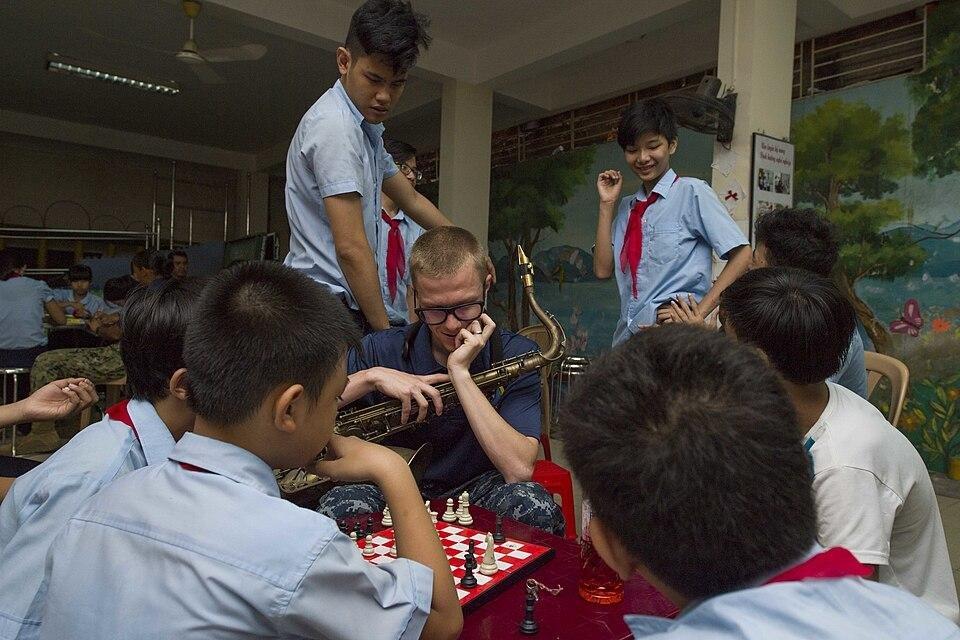
Photo: U.S. Navy photo by Petty Officer 2nd Class Chelsea Milburn, via Wikimedia Commons (public domain)
Assessment that does not require the teacher to judge chess
What is assessed | How | Evidence |
Knows the moves | Week 1 pawn game and week 2 check exercise | Teacher tick sheet |
Can read a position | Week 4 puzzle scores | Number of mates found out of ten |
Follows a plan | Week 5 opening rules | Games checked against the three rules |
Reflects on play | One sentence after each game from week 3 on | Chess notebook, one line per game |
Sportsmanship | Every week | Handshake before and after, result recorded honestly |
None of these need the teacher to know whether a move was good. They need the teacher to see whether a rule was followed, a puzzle was solved, or a sentence was written, which is ordinary classroom marking.
What the unit is actually for
Chess in a classroom is not there to produce tournament players. It gives children a weekly hour where a decision has a visible consequence two moves later, where losing is survivable and immediate, and where the quiet child who never speaks in maths turns out to see forks before anyone else. Teachers who have run a unit like this report that the scoreboard becomes the most-read thing on the wall. The unit works because it asks nothing of the teacher except structure, and structure is what teachers are good at.
What the unit needs
Item | How many | Notes |
Vinyl roll-up boards with plastic pieces | One per pair, so 15 for a class of 30 | Tournament size, 5 cm squares, about $12 each in a class pack |
Wall chart of piece moves | One, A2 or larger | Stays up for the whole unit |
Move-notation cards | One per pair | A small card showing files a to h and ranks 1 to 8 |
A ten-minute video on how the pieces move | One, shown once | Any of the free ones on the major chess sites |
A class scoreboard | One | A sheet on the wall: wins, draws, games played |
A digital board for the projector | Optional | Useful for the two puzzle lessons |
Total cost for a class of 30 is under $250 the first year and close to nothing after that, since the boards last a decade. Nothing on the list requires the teacher to know an opening.
Six weeks, one lesson a week
Week | Lesson | What the children do | What the teacher does |
1 | How the pieces move | Ten minutes of video, then the pawn game for the rest of the lesson, rules in the box below | Runs the pawn game, checks moves against the wall chart |
2 | Check, checkmate, stalemate | Play full games from the start position, stop at the first check and name it aloud | Walks the room, asks each pair to show a check |
3 | Value of the pieces | Games where every capture scores points, from 1 for a pawn up to 9 for the queen | Keeps the scoreboard, announces the highest capture score |
4 | Puzzles: mate in one | Ten positions on the projector, pairs race to find the mate | Clicks through the positions, reveals the answer after 60 seconds |
5 | The three opening rules | Play games where each side must follow the rules: centre pawn first, knights before bishops, castle by move ten | Checks that games follow the rules, no other coaching |
6 | Class tournament | Four rounds of ten-minute games, pairings by the scoreboard | Runs the pairings and the clock |
Most teachers skip the pawn game. Do not. It is four minutes long and it carries the whole unit.
Pawn game | Detail |
Setup | Sixteen pawns on their home squares, every other piece back in the bag |
Moves | Pawns move as usual: one square forward, two on the first go, and they take diagonally |
Winner | First player to get any pawn to the far rank |
Length | About four minutes a game |
What it teaches without a word being said | Captures, blocked pawns, and why a pawn with nothing in front of it is dangerous |
The three opening rules in week five are the entire strategy content of the unit, and they are enough to stop nine-year-olds from moving the same rook back and forth. The rules are not the teacher's opinion, they are the standard beginner guidance that every coach uses, and a teacher who has never played can enforce them because each one is a yes-or-no check.
Where the teacher gets answers
The moment the unit runs into trouble is week two, when a child asks whether a particular move was legal, or week five, when a pair disagrees about whether a position is a stalemate. The teacher needs a referee that does not require chess knowledge. Two options work. The first is a second copy of the wall chart on each desk. The second is a phone with a free analysis tool, where a photo or a quick entry of the position settles the question in seconds.
The same phone solves the marking problem. ChessHelper.ai takes a finished game and writes out, in plain words, which move went wrong and what the player should have looked at instead. That is the feedback a coach gives, and here it arrives without the teacher reading a single variation. A child who finishes early runs the game through it, reads the note on the worst move, and writes one sentence in a chess notebook. The sentence is the mark for the week.
Photo: U.S. Navy photo by Petty Officer 2nd Class Chelsea Milburn, via Wikimedia Commons (public domain)
Assessment that does not require the teacher to judge chess
What is assessed | How | Evidence |
Knows the moves | Week 1 pawn game and week 2 check exercise | Teacher tick sheet |
Can read a position | Week 4 puzzle scores | Number of mates found out of ten |
Follows a plan | Week 5 opening rules | Games checked against the three rules |
Reflects on play | One sentence after each game from week 3 on | Chess notebook, one line per game |
Sportsmanship | Every week | Handshake before and after, result recorded honestly |
None of these need the teacher to know whether a move was good. They need the teacher to see whether a rule was followed, a puzzle was solved, or a sentence was written, which is ordinary classroom marking.
What the unit is actually for
Chess in a classroom is not there to produce tournament players. It gives children a weekly hour where a decision has a visible consequence two moves later, where losing is survivable and immediate, and where the quiet child who never speaks in maths turns out to see forks before anyone else. Teachers who have run a unit like this report that the scoreboard becomes the most-read thing on the wall. The unit works because it asks nothing of the teacher except structure, and structure is what teachers are good at.
Still grading everything by hand?
EMStudio is a free teaching management app — manage your classes, students, lessons, and more!
Learn More
Still grading everything by hand?
EMStudio is a free teaching management app — manage your classes, students, lessons, and more!
Learn More





Notion4Teachers
Notion templates to simplify administrative tasks and enhance your teaching experience.



2026 Notion4Teachers. All Rights Reserved.
Notion4Teachers
Notion templates to simplify administrative tasks and enhance your teaching experience.
2026 Notion4Teachers. All Rights Reserved.
Notion4Teachers
Notion templates to simplify administrative tasks and enhance your teaching experience.
2026 Notion4Teachers. All Rights Reserved.